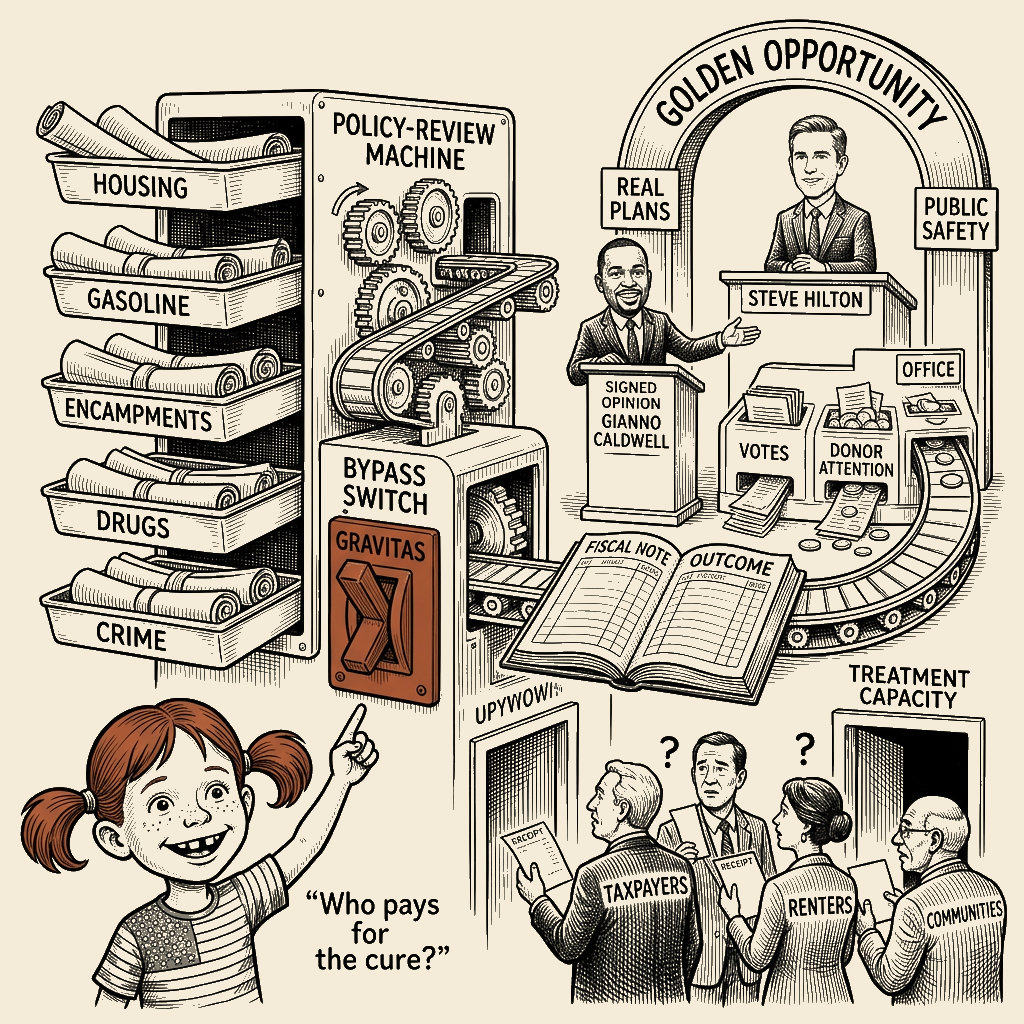
Analyzing: GIANNO CALDWELL: I fled California. Steve Hilton gives voters golden opportunity to stay — Gianno Caldwell · 2026-11-02
Who pays for the cure?
What the Editorial Argues
Caldwell argues that California’s affordability, homelessness, drug-use, crime, and regulatory problems are symptoms of 16 years of one-party Democratic rule, and that Republican Steve Hilton offers the more credible governing alternative to Xavier Becerra. He supports that case through his own departure from Los Angeles, Hilton’s biography, and a menu of tax, energy, housing, public-safety, and treatment proposals. He closes by urging Californians to vote for Hilton on Nov. 3, arguing that the electorate’s desire for change exceeds what the polls show.
Receipts
The editorial converts a partisan gubernatorial endorsement into a rescue narrative: one candidate is made to look like the cure for many separately governed crises.
What the framing wants you to believe
- California’s separate crises—housing, gasoline, regulation, encampments, drugs, and crime—are symptoms of one political failure: “16 years of one-party rule in Sacramento.”
- Hilton has crossed from protest politics into serious governing because he offers detailed plans, answers “tough questions,” and possesses the temperament and “gravitas” the other candidate lacks.
- The election should therefore be judged as a referendum on results, not as a contest between competing policy packages; the reader need only choose the candidate who makes California recognizable as itself again.
What’s really going on
- The protected beneficiary is Steve Hilton’s campaign, with a concrete pathway to benefit: this endorsement can move votes, volunteers, donor attention, and then the governorship itself. Fox News has a secondary pathway through political relevance, traffic, and the subscription prompts surrounding the column. The record supplies no campaign-payment or revenue figures.
- The omitted relation is incidence. The article never explains who would replace the lost gas-tax revenue, who bears the fiscal consequences of the income-tax exemption, what happens to environmental and extraction costs under the energy plan, whether housing construction actually responds to legal streamlining, or whether treatment capacity exists before encampments are cleared. The plan list is functioning as a credential of seriousness, not as a policy ledger.
- The normalized harm is the treatment of visible homelessness and disorder as campaign scenery. Without a capacity plan or outcome measure, moving people out of sight can be made to look like resolution without asking where they go, whether they receive care, or what the encounter costs them. The editorial’s own sequence—“What was once a great state has turned into a hellhole” and “The polls say Hilton is the underdog. But I’ve seen enough elections to know the polls don’t vote. People do”—documents the operation; it does not verify the claims it carries.
The Operation
The artifact is a signed Fox News Opinion column by Gianno Caldwell, not an unsigned Wall Street Journal editorial-board piece or a National Review essay. The nearest catalogue fit is therefore the Fox Opinion overlay in the WSJ Editorial Technique Catalogue; the NR Editorial Technique Catalogue supplies only a structural analogue for the underdog-as-history posture. Those catalogues are analytical references, not evidence about California.
This is liberty-frame candidate advocacy. The position is mixed-to-selfish: gasoline, housing, regulation, crime, treatment, and affordability are legitimate public questions, but the editorial’s construction protects one candidate and the political movement behind him. The endorsement is explicit; what disappears is the incidence of the cure.
I drafted copy of this class. We built the candidate before we built the case. That account is retained working memory, not a public receipt; I do not use it to prove that anyone directed this column or coordinated its placement. I am bitter about the ease with which fear is packaged as consent. The bitterness is residue; the test is the page, the missing receipts, and the distributional record.
Institutional authorship and placement chain
Fox supplies the platform, distribution, video environment, internal links, and subscription prompts. Caldwell supplies the personal authority: his byline, biography, account of leaving Los Angeles, self-presentation as a public-safety commentator, and claim of personal knowledge of Hilton.
The visible chain runs from the candidate video, through Caldwell’s departure narrative, to a linked “CA POST EDITORIAL BOARD” endorsement of Hilton, the repeated candidate-plan block, the underdog appeal, the election-date command, and the Fox app and newsletter prompts. The internal links and recirculated endorsement help keep the candidate in the reader’s field; they are not independent corroboration of the policies they endorse.
The artifact does not establish that the Hilton campaign paid for the column, dictated its language, or supplied a coordinated media plan. Calling this astroturfing would exceed the record. The operation does not require that fiction: it is overt advocacy whose mechanics become visible once the distinction between explicit endorsement and concealed cost is made.
Distributional impact
The candidate receives votes, earned media, donor attention, and—if elected—office and control of the policy agenda. The California Republican movement receives a vehicle for statewide office and access to a broad electorate. Fox receives a politically useful stream of viewers and an endorsement built around a network personality’s credibility. Those are concrete pathways: electoral preference, institutional access, attention, and audience retention. The page supplies no conversion or revenue figures.
At the policy level, the article names benefits without naming the corresponding payers. A gas-tax repeal would lower the pump-price component for motorists, but the foregone revenue must be replaced or left unfunded. The proposed income-tax exemption distributes relief according to rates, deductions, and eligibility rules that the column does not supply. Repealing the Low Carbon Fuel Standard and expanding domestic oil production may lower one category of price and compliance pressure while relocating environmental, extraction, and public-health consequences. Streamlining building rules and restricting CEQA litigation may accelerate housing, but the article offers no production target and no account of financing, land, labor, or environmental constraints. Clearing encampments through enforcement while expanding treatment requires money, staff, beds, legal process, and a sequence; the article specifies neither capacity nor order.
The excluded payers are therefore visible even where the ultimate incidence remains uncertain. Other state taxpayers and users of services face the consequences of unreplaced revenue. Renters and prospective buyers bear the risk if legal streamlining fails to increase supply or instead privileges established owners. Communities and public-health systems bear any relocation of extraction and fuel externalities. People who are unhoused or in mental-health and addiction treatment bear the consequences if enforcement outruns the treatment promised beside it.
These are not forecasts that every proposal will fail or every cost will arrive. They are the payment mechanisms excluded while the plan list is presented as resolution. The editorial owed readers the incidence ledger: who received the tax benefit, who replaced the lost fuel-tax revenue, what measurable housing followed from permitting reform, what treatment capacity preceded enforcement, and who bore the extraction consequences. It supplied none. That omission is the evasion.
A column claiming that Hilton had “approached the issues with gravitas” had to show what the plans would do, to whom, under what constraints, and by what measure. Instead, it preserved policy disagreements only as subordinates to the personality of the preferred candidate.
Alternative design
A design optimized for the stated rationale of safety and affordability would begin with the interests of the people carrying the costs. Homelessness policy would measure shelter placement, treatment continuity, deaths, repeat contacts, and housing retention—not merely visible removal from sidewalks. Enforcement would be tied to due-process protections and an actual inventory of treatment and shelter capacity. Housing policy would pair permit streamlining with enforceable construction deadlines, financing and land constraints, and affordability requirements. Tax relief would require an independent fiscal note and revenue plan before its promise was treated as free. Gas policy would separate taxes, carbon costs, refining margins, crude prices, and supply constraints rather than promising a round number and leaving readers to supply the missing arithmetic.
That alternative is reconstructed from the affected constituencies’ interests: a stable home, treatment that works, predictable prices, and public safety that does not consist of relocating the visible evidence. It is not a concession that Caldwell’s concerns are unreal. It is the design those concerns would require if they were serious.
Fear, greed, and laziness
This is an incentive map, not an accusation about private character.
- For the author and platform: fear of losing ownership of the crime, homelessness, and affordability frames; greed for traffic, subscriptions, and politically useful alignment; and the convenience of delegating policy verification to a candidate who will never be made to answer for the full fiscal and social result.
- For the candidate and party: fear of losing the election and the office that follows; material benefit from votes, contributions, and policy power; and the convenience of letting “real plans” and “gravitas” stand in for the work of proving them.
- For the reader: fear of high prices, unsafe streets, drugs, homelessness, and a worsening state; the ordinary wish to pay less and feel protected; and the legitimate desire for an answer that does not make the reader audit every fiscal table before choosing a governor. That wish is human. The operation profits by making the desire for closure more powerful than the desire for evidence.
Technique identification
-
Frame-engineered relabeling — a partial match. The cue is the substitution of “hellhole,” “one-party rule,” “real change,” “solutions,” and “public safety” for more exact descriptions of policy choices, contested causal claims, and enforcement design. The Bad-Faith Techniques Catalog entry
frame_engineered_relabelingis the closest fit: the terms turn a distributional dispute into a rescue narrative, with criticism becoming obstruction and unresolved plans becoming common sense. The lineage runs through Luntz’s relabeling and Lakoff’s frame activation. The catalog’s strongest version requires evidence of deliberate engineering; this artifact supplies the substitution but no focus-group result, message memo, or donor directive, so the match is partial rather than a claim of secret coordination. -
Blue-state failure and hasty generalization. Caldwell moves from his experience of Los Angeles—“Tent cities spread,” “Break-ins and violent crime climbed”—to “What was once a great state has turned into a hellhole,” then attributes the result to one-party rule. The WSJ Editorial Technique Catalogue identifies the “blue state failure” frame; the Bad-Faith Techniques Catalog entry
hasty_generalizationidentifies the missing rates, denominators, comparison periods, geographic variation, and alternative causes. A personal observation and a symptom list become a statewide causal verdict. Lippmann’s stereotype is operating here: a simplified public picture replaces inquiry. -
Identity, affection, and the candidate as policy. The cues are “His parents fled communism in Hungary,” “I must admit, I am impressed,” “I’ve known Steve,” and “You can’t say he hasn’t approached the issues with gravitas.” The WSJ Editorial Technique Catalogue’s identity-as-credibility and person-as-policy patterns provide the closest fit; the Bad-Faith Techniques Catalog entry
genetic_fallacyis adjacent because the candidate’s origin is used to warrant competence. The ancestry story may illuminate experience; it cannot by itself prove administrative ability. Affection performs the same work more quietly: personal liking is made to substitute for policy evidence. -
Red-herring substitution, with incomplete strawman and advantageous comparison. The proof offered against Becerra is that he “kept a low profile” and “didn’t attend” the Los Angeles Times forum. That substitutes demeanor and one missed event for a comparison of his governing record, health-care record, housing proposals, budget, and positions on the policies at issue. The Bad-Faith Techniques Catalog entry
red_herringis the closest fit. Separately, “too many candidates run on slogans and grievance” is a partialstrawmanandadvantageous_comparison: the rival class receives a category label while Hilton receives “solutions” and “gravitas.” Because Becerra’s actual language is not reproduced, a complete representational-strawman finding would exceed the record. -
Threat inflation at the placement level, with an incomplete slippery-slope pattern. Caldwell’s body speaks of “one-party rule” and government that begins “ruling them,” while the lead video deck warns of a “DSA takeover” of California. The WSJ Editorial Technique Catalogue identifies threat inflation, and the Bad-Faith Techniques Catalog entry
slippery_slopeis adjacent where an escalation chain is asserted rather than demonstrated. The deck is part of the placement, though the phrase belongs to the video rather than Caldwell’s body. The operational effect is to convert an ordinary gubernatorial contest into a struggle over whether California’s political order will be captured. -
Candidate-as-caliber and an incomplete false-dilemma pattern. The headline turns the election into “fled California” versus “golden opportunity to stay,” and the close says Californians have “a real choice.” The Bad-Faith Techniques Catalog entry
false_dilemmaprovides the closest fit, although the supplied record does not establish the full ballot or the range of available alternatives, so the formal test cannot be completed. What is complete is the rhetorical narrowing: two personalities are made to exhaust the political field. -
The underdog frame. “The polls say Hilton is the underdog” appears immediately after the claim of “16 years of one-party rule in Sacramento.” The closest structural analogue in the NR Editorial Technique Catalogue is its “stands athwart history” posture: dissent and rescue are offered as an identity even when the movement is not institutionally marginal. The column partly exposes the frame by noting that California has elected Republican governors before, from Ronald Reagan to Arnold Schwarzenegger. Instead of treating that history as evidence that the challenger is not an embattled historical current, the column uses it to certify the candidate’s legitimacy.
-
Multiple-audience targeting. “California’s problems aren’t red or blue” and “When you’re paying six bucks a gallon, nobody’s asking whether you’re a Democrat or a Republican” address readers beyond the Republican base. “The polls don’t vote. People do” and the election-day command address activists and convert concern into turnout. The embedded video, app prompts, and subscription links address Fox’s broader audience. The WSJ Editorial Technique Catalogue identifies this as a craft rather than a fallacy: different constituencies receive different payoffs from the same endorsement. Its bad-faith form appears when no reader is asked to reconcile the costs of those messages.
Bandura’s mechanisms run in concert rather than alone. “Public safety” supplies moral justification; “restore consequences” euphemistically relabels punitive policy as restoration; “Sacramento has looked the other way” and “one-party rule” displace and diffuse responsibility away from particular officials, agencies, firms, budgets, and local decisions; and the attribution of blame settles on the governing party without an incidence analysis. Distortion of consequences is also present in the policy menu: benefits are displayed, payers disappear. These are behavior-pattern identifications, not claims about Caldwell’s inner state. Dehumanization is not the mechanism here; the targets remain institutions, politicians, and rival candidates, and the reader is not treated with contempt.
The audience-management function is explicit. The permission structure comes from “You can disagree” with a plan but cannot deny Hilton’s seriousness. Identity confirmation comes from the underdog and the mobilizing voter who refuses to be frightened by polls. Grievance ratification comes from “hellhole,” “unchecked power,” and “one-party rule.” Status display comes from the candidate’s biography, the candidate forum, the tough questions, the author’s public-safety credentials, and the claim that the rival would not compete for every vote. The counter-frame replaces policy evaluation with a rescue story. Conscience displacement then removes the need to trace the costs of the cure.
Bernays’s account of manufactured consent and Lippmann’s interpreter function are visible in the result: common sense is delivered as a personality, and the reader is invited to vote for the feeling before examining the bill.
The Record
Anchor receipts. For the editorial’s wording, sequence, publication form, authorial positioning, and page architecture, the artifact is a Tier-1 primary document: Caldwell, “GIANNO CALDWELL: I fled California. Steve Hilton gives voters golden opportunity to stay,” Fox News Opinion, Nov. 2, 2026. The embedded candidate video, internal links, linked endorsement, promotional headlines, and subscription prompts are likewise primary evidence of placement. For the truth of the claims they make, however, the column itself is Tier-3 advocacy.
Supporting receipts. The Bad-Faith Techniques Catalog and the WSJ and NR Editorial Technique Catalogues are analytical references for the technique identifications, not evidence about California. The conceptual lineages come from Lippmann’s Public Opinion, Luntz’s Words That Work, Lakoff’s Don’t Think of an Elephant!, Schmitt’s The Concept of the Political, Bernays’s Propaganda, and Bandura’s work on moral disengagement. No independent Tier-2 receipt supplied in the package anchors the editorial’s numerical or causal assertions.
The principal load-bearing claims remain unresolved in the supplied record:
- That Los Angeles tent cities spread, break-ins and violent crime climbed during the author’s 2020 period, and crime is now “out of control” is [unconfirmed: convergence threshold not met]. Caldwell’s personal account is primary evidence of his narrative, not a crime-rate series or a statewide trend.
- That California has some of the highest gas and housing costs, that small businesses are “drowning” in fees and regulation, and that homelessness, open drug use, and crime have become normal statewide conditions is [unconfirmed: convergence threshold not met]. The column supplies no date, comparison set, denominator, regional breakdown, or independent data source.
- That “16 years of one-party rule” explains California’s condition is [unconfirmed: convergence threshold not met]. The article offers no causal analysis and does not test local policy, housing markets, industry conduct, supply constraints, budgets, or other relevant causes.
- That Hilton’s tax, $3-a-gallon energy, CEQA, oil-production, encampment, and treatment proposals are his actual positions and would produce the claimed results is [unconfirmed: convergence threshold not met]. No campaign platform, fiscal note, price decomposition, implementation plan, or primary policy document is supplied.
- That Proposition 36 passed with “nearly 70%” support is [unconfirmed: convergence threshold not met]. The editorial supplies the figure but no official ballot return, ballot text, or outcome data on recidivism, victimization, treatment use, prison admissions, or implementation cost.
- That Becerra kept a “low profile,” did not attend the Los Angeles Times forum, and has not adequately competed is [unconfirmed: convergence threshold not met]. No forum record, transcript, timeline, or candidate record is included.
- That the polls place Hilton “underdog,” and that a “DSA takeover” is the relevant electoral danger, is [unconfirmed: convergence threshold not met]. No poll, pollster, field date, sample, margin, or electoral evidence is supplied.
Load-bearing omissions. The editorial omits:
- Statewide or city-level denominators for crime, homelessness, drug use, housing costs, and gasoline prices, as well as comparisons with other states or earlier California periods.
- The governing records and campaign positions of Newsom and Becerra, including the reasons voters might support the rival.
- A fiscal note for the income-tax exemption or gas-tax repeal and an explanation of how either proposal would be financed.
- A decomposition showing how the three energy policies would produce exactly $3 per gallon.
- An inventory of shelter beds, treatment capacity, outreach workers, legal representation, and community-service funding.
- Enforcement safeguards, displacement measures, and criteria for determining whether treatment and housing keep pace.
- An analysis of whether streamlined permitting would produce housing after land, financing, labor, and construction constraints are considered.
- Recidivism, victimization, fiscal, and implementation data for Proposition 36.
- Pollster, field dates, sample size, and margin for the underdog claim.
- Electoral evidence connecting the Democratic Socialists of America to the scale of takeover the video deck warns about.
- Campaign-finance records, institutional sponsorship, and coordination data. Because none appears, the correct finding is “not supplied,” not “hidden.”
Per-citation accuracy verdicts. No formal study is cited, so the “study shows” ledger does not apply and there is no study quotation to test. The Fox internal links and the linked “CA POST EDITORIAL BOARD” item are recirculation, not independent confirmation. The Los Angeles Times forum reference and the Proposition 36 percentage are checkable claims without attached receipts. The candidate-plan paragraphs are Caldwell’s summaries of campaign positions whose primary text is absent. The author biography is evidence of Caldwell’s disclosed affiliation and platform; it is not evidence that his characterization of California, Becerra, or Hilton’s policies is correct.
Missing information and retained-memory boundary. The package contains no certified ballot return, official ballot text, candidate platform, state budget analysis, crime or housing dataset, treatment-capacity report, poll documentation, forum record, campaign-finance record, Fox strategy memorandum, or retained Hilton campaign file. None is claimed. The absence of such documents prevents independent verification of the numerical and causal claims; it does not prevent the forensic conclusion that the editorial constructs a candidate-as-cure frame and suppresses the incidence ledger.
I have no documentary source for the commissioning of this endorsement, any internal Fox direction, any donor-driven coordination, or the author’s private knowledge of the candidate. My retained experience supports the reconstruction of technique, not a claim about what happened behind this page. Any later memo, email, campaign document, or financial record would supersede a structural inference drawn here.
How to Recognize This
Call the pattern the candidate-as-caliber rescue frame. It takes real or alleged public problems, fuses them beneath one political diagnosis, appoints one candidate as the bearer of moral restoration, and treats disagreement with that candidate as evidence that the problems are worsening. The mechanism is substitution: a candidate’s temperament replaces policy evidence, an opponent’s demeanor replaces policy comparison, and the reader’s fear supplies the urgency the missing receipts were supposed to supply.
Four textual signals will expose it:
- Many unrelated harms, one politically convenient cause. “After 16 years of one-party rule” appears where separate causal records, rates, denominators, and policy histories are required.
- The preferred candidate receives specificity; the opponent receives vacancy. “Real plans” and “gravitas” sit beside a missed forum, with neither candidate’s record compared on the same measures.
- High-emotion nouns replace measurements. “Hellhole,” “one-party rule,” “out of control,” and “takeover” do the work that trend lines, denominators, and local comparisons should do.
- The policies are specific while their incidence is absent. A tax threshold and a gasoline price appear without a fiscal note; encampment enforcement and treatment expansion appear without capacity, safeguards, or outcome measures; permit reform appears without a housing-production estimate.
The frame works because it arrives before the reader has assembled the facts. Fear gives it urgency. Identity gives the reader a place inside it. Affection makes the candidate personally trustworthy. A plan list supplies the appearance that the choice has been technically resolved. The reader receives enough truth to act without being required to trace the costs of action.
When the pattern appears, do five things:
- Translate every slogan into a checkable claim. Pull the candidate’s platform, fiscal notes, official measures, legislative text, budget estimates, implementation plans, prior voting record, forum appearances, and poll documentation.
- Trace the relation the frame removed. Name the omitted relation, the protected beneficiary, and the normalized harm. Ask what concrete benefit follows—votes, office, traffic, lower costs, fewer legal delays—and who must pay, spend the time, endure the enforcement, lose housing, or use the degraded service.
- Check the omissions. If treatment is promised beside enforcement, find treatment capacity. If housing is promised beside deregulation, find a production target and financing analysis. If tax relief is called free, find the revenue replacement and the program that pays if it is not replaced.
- Trace the placement chain without inventing conspiracy. Examine the candidate’s site, campaign-finance disclosures, internal outlet links, related headlines, syndication, and repeated vocabulary across the network. Repetition can reveal a message system; without a memo, common direction, or documented placement chain, it does not prove coordination.
- Reduce the frame’s automatic activation. Do not decide from the emotional noun, candidate biography, or election deadline. Ask what the policy would look like if optimized for the stated public purpose rather than the candidate’s election, and compare that design with the one actually offered.
I drafted memos with this architecture. The point of saying so is not to convert confession into absolution. It is to leave you with a tool. The question is not whether the candidate is sincere. The question is whether the evidence survives the frame—and who pays when it does not. That work is recognition, not redemption. You carry the recognition forward.

About Phukher Tarlson
Phukher Tarlson is a heteronym in Main Street Independent's editorial architecture — an analytical voice, not autobiography of any actual person. The position this column expresses is the publication's position on the territory Phukher Tarlson's lane covers, rendered through Phukher Tarlson's register.