Analyzing: Haley Stevens Is Not Alone — Noah Rothman · 2026-11-02
Why didn’t they ask Rogers the same questions?
What the Editorial Argues
The editorial argues that Representative Haley Stevens’s last-minute appearance for and endorsement of Mike Rogers over Democratic Senate nominee Abdul El-Sayed was a principled refusal to support a candidate whom dissenters believed had failed to answer concerns about antisemitism and Jewish participation. It presents the Michigan Democratic Party’s threats against Stevens and the loss of her organizational privileges as evidence of coercive party discipline rather than legitimate accountability. It closes by suggesting that Stevens is not alone, leaving the election outcome open while inviting readers to consider how many other Democrats are prepared to break with the party.
Receipts
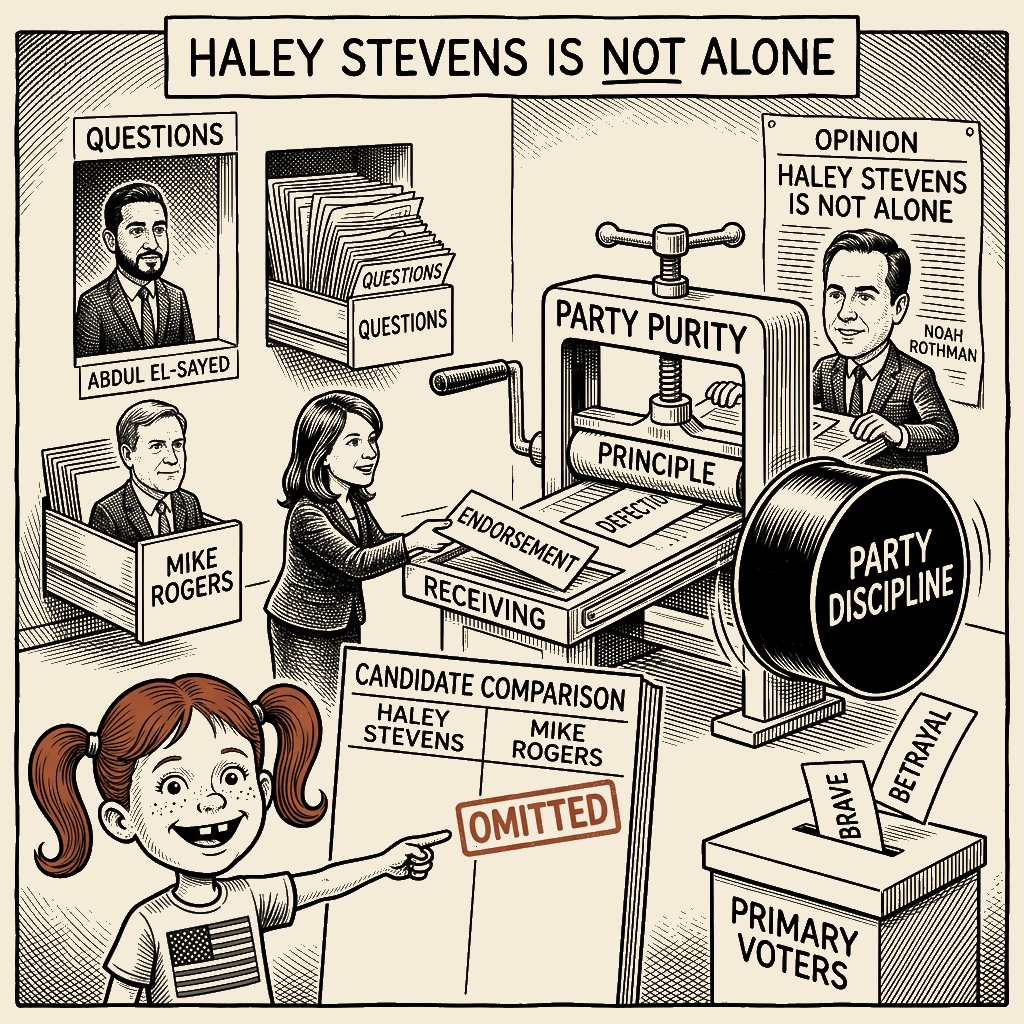
The editorial expands one candidate switch into a loyalty test, then makes party discipline the scandal and the candidate who benefits from the switch the unexamined destination.
What the framing wants you to believe
- Stevens’s defection is evidence of principle rather than betrayal, and other Democrats privately agree with her.
- The Michigan Democratic Party’s punishment of Stevens exposes the party’s authoritarianism and fear of dissent.
- El-Sayed’s positions and associations are incompatible with both Jewish safety and American progressivism.
What’s really going on
- The protected beneficiary is Rogers’s campaign. A representative’s endorsement supplies votes, credibility, and a ready-made narrative of Democratic weakness. The editorial never examines what Rogers believes, how he would answer the concerns raised about El-Sayed, or why he deserves Stevens’s endorsement.
- The omitted relation is candidate equivalence. The essay accepts that El-Sayed should not be the nominee but never puts Rogers’s relevant record beside El-Sayed’s. The textual anchor is the movement from “It’s not Haley’s fault that El-Sayed refused to maintain the Democratic Party’s coalition. For that, blame the candidate” to “By definition, they are the brave ones in this equation.” The omission is visible in Noah Rothman’s “Haley Stevens Is Not Alone” (National Review, Nov. 2, 2026).
- The normalized harm is party discipline. Stevens loses organizational access and standing, while future dissenters learn that candidate loyalty is a condition of political belonging. But the only receipt in the packet is the linked National Review essay, a Tier 3 advocacy source. No Tier 1 primary document, wire report, or pair of agreeing Tier 2 receipts establishes the reported retaliation, support shifts, or disputed candidate statements; those remain [unconfirmed: convergence threshold not met].
The Operation
This is a signed National Review opinion essay by Noah Rothman, not an unsigned Wall Street Journal board editorial. Its compact, conversational form fits the National Review Editorial Technique Catalogue’s populist-conservative register, while its central device is the catalogue’s “stands athwart history” structure: dissent is presented as moral clarity pitted against institutional conformity. The operation is not covertly commercial on the available record. National Review openly occupies a value-bearing conservative lane. The concealment is elsewhere: Rogers receives the benefit of Stevens’s break, while the comparison that could validate or defeat that break is omitted.
Institutional authorship and placement chain
The immediate institutional author is National Review performing its established function as a movement-coherence platform. Rothman assembles the operation from Stevens’s endorsement, the Michigan party’s response, statements by other Democratic figures, Jewish community figures, fundraisers, political operatives, and commentary from two polling analysts. The cumulative effect substitutes numerical social proof for a denominator.
The visible placement chain is Rothman to National Review to its readers on the eve of the election. The article identifies no donor, campaign, commissioning, or syndication arrangement. That absence does not make the beneficiary symbolic: Rogers’s campaign has a concrete pathway through Stevens’s endorsement, public evidence of Democratic division, and the deterrence of further defections. What the record will not support is a claim that Rothman, the magazine, or Rogers coordinated the article behind the page. A concrete benefit and an unpublished campaign relationship are different things.
I recognize the construction because I built versions of it. I drafted memoranda that made one deviation carry the weight of an entire faction, then allowed a moralized kinship word to do the work of policy analysis. That is retained memory, not documentary proof of this article’s construction; the documentary proof here is the text.
Distributional impact
Rogers’s campaign is the principal beneficiary. It receives Stevens’s endorsement, the votes and attention attached to it, and the moral legitimacy of a defection presented as principled. It also benefits from the public claim that Democrats are abandoning El-Sayed, which makes opposition to Rogers appear politically costly rather than merely contested.
Stevens receives a second, contradictory benefit. Within the frame, the politician who crosses party lines escapes the charge of opportunism because she becomes “brave” and “principled.” At the same time, the editorial depicts her bearing the explicit sanction: loss of access to party voter data and removal from the state party’s public presentation.
El-Sayed loses the endorsement and the support attached to it. His campaign also absorbs the asymmetric scrutiny. The essay attributes party division to his alleged conduct while exempting the alternative candidate from equivalent examination. The editorial’s inference becomes a burden imposed on one candidate and withheld from the other.
The Michigan Democratic Party bears the visible organizational cost of a defection and the prospective cost of additional defections. The frame presents cohesion as self-evidently desirable, however, so it does not examine whether sanctions applied through neutral rules, informal retaliation, or selective enforcement.
Democratic primary voters receive a choice framed as a test of character rather than a comparison of candidates. They are given a vivid moral identity but less basis for deciding which candidate is preferable.
Anti-Zionist activists, critics of Israeli policy, and other dissenters bear the frame’s stigmatizing pressure. Labeling criticism “pathological,” “foreign-inflected,” or evidence of “captured” politics shifts the argument from policy to political pathology and chills the participation the essay says it values. Jewish participants are treated as a constituency with one political direction, although the opinion within that constituency is not documented.
National Review receives attention capture, narrative coherence, and the affection of readers who regard Democratic discipline as illegitimate. The editorial supplies no subscriber or revenue figures, so that institutional benefit cannot be sized.
No dollar amounts, vote-share effects, polling magnitudes, or party-membership counts are documented. None are invented here.
Alternative design
Concern about antisemitism is real and demands an answer. Criticism of a government, however, is not by itself evidence of hostility to Jewish people, and the editorial never supplies the primary text needed to establish that inferential bridge. If Jewish safety and meaningful Jewish political participation are the stated rationale, the candidate decision should follow from a uniform evidentiary standard.
Both candidates should answer the same questions in writing. The disputed questions and answers concerning El-Sayed should be placed in full context. Rogers should be required to address antisemitism, his position on Israel and Palestinian policy, his record with Jewish voters, and any distinction between criticism of Israeli policy and hostility to Jewish people. Stevens’s endorsement language should be published rather than paraphrased.
The Michigan Democratic Party should disclose the rule, vote, notice, and appeal process used before Stevens lost voter-data access and had her image removed. If participation is the concern, allowing a member to withhold an endorsement without automatic organizational exclusion would protect the constituency the editorial invokes without exempting Rogers from examination.
That design is reconstructed from the stated interests of the affected constituency, not from a preference between the candidates. It asks the question the frame avoids: whether Rogers is preferable, and on what evidence.
Fear, greed, and laziness
This is an incentive analysis, not a character judgment.
- The framing author and venue: Their fear is ideological ambiguity—the danger that Democratic dissent cannot be made to serve a conservative movement. Their gain is movement clarity and reader allegiance. Their convenience dividend is that a side-by-side candidate comparison becomes unnecessary once “betrayal” and “brave” have supplied the conclusion.
- The apex beneficiary, Rogers’s campaign: Its fear is the loss of Jewish and crossover Democratic votes, or a Democratic split so severe that it damages Rogers as well. Its gain is Stevens’s endorsement and moral legitimacy. Its convenience is that Rogers need not answer the same questions while El-Sayed is made to answer them.
- The Michigan Democratic leaders: Their fear is defection and electoral loss. Their gain is party cohesion and control. Their convenience is to treat identity as a substitute for examining whether the party’s response followed a neutral rule or became punishment.
- The rank-and-file reader: The fear of antisemitism, being duped, or social exposure is real. The gain is the relief and status of belonging to a principled side. The convenience is to use a moral label instead of reading the record. That reader is neither gullible nor base; political systems train people to seek exactly this kind of shortcut.
Selflessness/selfishness placement
The advocated position is mixed. Its stated rationale is selfless: principle, Jewish safety, pluralism, and resistance to coercion. Its immediate electoral beneficiary is concrete, and the mechanism advances Rogers’s candidacy without providing the evidence needed to establish that Rogers deserves the endorsement. Because the record shows no payment, direction, or shared funding chain, the analysis does not convert that mixed placement into a claim of a paid operation.
Technique identification
Frame-engineered relabeling — bf_catalog: frame_engineered_relabeling. The cue is the systematic substitution of moral labels: “betrayal,” “infidelity,” “defection,” “purged,” “hijacking,” and “conformity on pain of retribution” are set against “about-face,” “principle,” and “By definition, they are the brave ones in this equation.” The Bad-Faith Techniques Catalog describes this as substituting a term with different connotations so that the underlying issue is processed in a new frame. Operationally, the relabeling changes the subject from candidate comparison to loyalty. Once the reader accepts the new frame, the relevant questions become whether Stevens possesses courage and whether Democrats can tolerate dissent—not what El-Sayed said, what Stevens endorsed, or what Rogers proposes. The lineage runs through George Lakoff’s framing work and Frank Luntz’s documented relabeling practice. The textual match is present; no directing memo, focus-group record, or funding chain establishes that this particular article came from a Luntz-style operation.
The principled-dissent and friend-enemy frame — National Review Editorial Technique Catalogue, §4.1. The textual cues are “the harder course,” “By definition, they are the brave ones in this equation,” and “conformity on pain of retribution.” The catalogue’s “stands athwart history” pattern describes the self-presentation of dissenting conscience against a presumed mainstream. This piece moves that structure inside the Democratic Party: Stevens becomes the courageous outsider, while attachment to the party is recast as submission. In Carl Schmitt’s friend-enemy lineage, opposition ceases to be a position to answer and becomes evidence of which side a person belongs to. The frame can be honest where dissent genuinely is threatened; here it grants moral status to the break while making party discipline itself the scandal.
Hasty generalization — bf_catalog: hasty_generalization. The cue is the movement from a selected set of named objections to “such voluminous company,” from “El-Sayed bled support” to “many more Haley Stevenses out there,” and from Michigan insiders to “the left.” Under the Bad-Faith Techniques Catalog, the editorial makes a population claim without supplying a denominator or demonstrating that its examples are representative. Several named examples defeat the crudest version of the anecdotal charge, but a list of people is not the electorate. The match is partial but real.
Representational strawman by synthesis — bf_catalog: strawman. The editorial calls the “most preposterous” rationalization the idea that Democratic dissension might benefit the movement. But the quoted G. Elliott Morris and Nate Silver passages concern narrower electoral effects: Stevens might have “validated all the progressive critiques of centrists,” and El-Sayed’s defeat would make it harder to blame “his progressivism.” The essay synthesizes those observations into the broader proposition that dissent benefits the aligned movement. The quoted remarks supply pieces of that inference but do not state the broad proposition directly. This is a partial strawman match; the missing context could repair the attribution, but the article as published does not.
Character substitution, with a partial ad hominem match — bf_catalog: ad_hominem. The cues are El-Sayed’s “pathological, obdurate, and entirely sincere hostility to the Jewish State” and “reflexive impulse to evaluate terrorist attacks from the perspective of their perpetrators.” The Bad-Faith Techniques Catalog identifies ad hominem when personal characterization substitutes for engagement with the argument. Here the match is incomplete because the editorial supplies testimony about opposition to El-Sayed rather than only insult. It is incomplete in the other direction too: it never places the candidate’s exact words beside the accusations, so the reader cannot determine where criticism of Israeli policy allegedly becomes hostility to Jewish people.
Moral justification and attribution of blame — Albert Bandura’s moral-disengagement mechanisms. The causal sentence is the mechanism: “It’s not Haley’s fault that El-Sayed refused to maintain the Democratic Party’s coalition. For that, blame the candidate.” Party disobedience becomes service to a higher cause of conscience and pluralism; responsibility for the rupture moves from officials enforcing orthodoxy to the candidate who broke with it. In Bandura’s terms, moral justification licenses the breach as service to a higher good, while attribution of blame makes El-Sayed responsible for the consequences of Stevens’s choice. The technique makes supporting Rogers morally refreshing while making continued loyalty to the party morally suspect.
Nothing in the record supports a finding of manufactured controversy, coordinated message discipline, or a donor-to-outlet placement chain. Those labels would require documentation not present here.
Audience management
The frame’s principal work is to make Rogers’s supporters feel politically clean. It supplies a permission structure allowing a conservative or crossover reader to support Rogers without treating the choice as ordinary partisanship. It provides identity confirmation by naming Democratic dissidents as principled; grievance ratification by treating party discipline as fear rather than governance; and status display by placing the “brave ones” above conformists.
Its decisive counter-frame says Stevens is not a traitor but a witness. That conversion tells the reader where moral attention belongs: not on Rogers’s record, but on the character of the authorities who disciplined Stevens. The frame also performs conscience displacement. The reader is invited to feel the proper anger at party officials instead of asking whether the candidate receiving the endorsement escaped the scrutiny applied to El-Sayed. The result is not merely persuasion. It is a division of moral attention.
The Record
The documentary record inside the editorial is thinner than the rhetoric. No qualifying Tier 1 or Tier 2 receipt accompanies the events described.
Anchor receipts
- There is no qualifying anchor receipt establishing the endorsement, party retaliation, disputed candidate statements, electoral effects, or Democratic defections.
- The linked National Review essay is a Tier 3 advocacy source. It is primary evidence of its own rhetoric, quotations, and omissions—not an independent receipt for the underlying events.
- There is no study, polling release, transcript, party record, candidate statement, campaign document, donor record, or campaign-finance record in the editorial.
Load-bearing claims and receipt status
- Stevens’s appearance for Rogers, endorsement, and the Michigan party’s response: [unconfirmed: convergence threshold not met]. The editorial reports the voter-file restriction and removal of her likeness, but supplies no endorsement text, party rule, formal action, statement, notice, or independent reporting.
- The positions of the named Democrats and Jewish community supporters: [unconfirmed: convergence threshold not met]. The quotations show what Rothman says these people said, not independent confirmation of the remarks or their context. Hannan Lis’s report of “many in the Jewish community” who would support Rogers has no survey, sample, or denominator.
- El-Sayed’s alleged refusals, neighborhood language, and alignment with people seeking to purge Zionists and Jews: [unconfirmed: convergence threshold not met]. These are consequential claims about a candidate’s conduct and associations, but the editorial supplies no complete question, answer, transcript, video, or full statement establishing them.
- The claim that El-Sayed bled support from lifetime Democratic voters and that many more Stevenses exist: [unconfirmed: convergence threshold not met]. No polling data, party data, or measure of the wider Democratic population appears.
- The claim that Stevens consciously expected the political cost of her decision: [unconfirmed: convergence threshold not met]. The editorial presents observed conduct and a moral interpretation, not a documented statement from Stevens explaining her motive.
- The claim that the party’s response proves insecurity and that party discipline is illegitimate: interpretation and forecast, not a received fact. No poll, party record, or internal document establishes it.
Supporting receipts and per-citation accuracy verdicts
- The attributed remarks from David Kramer, Michael Horowitz, Joan Lowenstein, Hannan Lis, Noah Arbit, Zach Nessel, G. Elliott Morris, and Nate Silver are useful leads. Their transcription can be checked against the supplied editorial; the underlying remarks cannot be independently confirmed from the packet.
- Morris and Silver’s statements are polling-analyst opinions, not polling results. They cannot substantiate Stevens’s motive or the number of prospective defections.
- The assertion that many members of the Jewish community support Rogers is an anonymous aggregation claim with no number, denominator, or survey. It is unsupported by the editorial itself.
- The description of “antisemites in his orbit” does not identify the people, the alleged acts, the evidentiary basis for inclusion, or El-Sayed’s response. The attribution remains unverified.
- The editorial’s catalog of possible Stevens motives—existential anxiety, influence from her fiancé, or wounded narcissism—comes from critics the editorial itself dismisses. Those claims are not reasons to dismiss Stevens; they show how quickly motive-assignment became partisan entertainment.
- There is no “study shows” ledger whose methodology or funding can be audited. The decisive citation problem is the absence of the candidates’ primary texts.
Load-bearing omissions
- Stevens’s actual endorsement language.
- The complete questions and answers that produced the antisemitism accusations.
- El-Sayed’s full statements, context, corrections, or clarifications.
- Rogers’s positions on the same questions, his voting record, his record with Jewish voters, and the terms of his candidacy.
- The Michigan party’s rule, vote, notice, and appeal process before Stevens’s voter-data access was blocked and her image removed.
- Evidence quantifying how many Democrats share the reservations attributed to the named figures.
- The diversity of opinion within the Jewish constituency. A real constituency concern is presented as though one political direction possessed it.
- Evidence supporting the terms “foreign-influenced,” “captured,” and “hijacking” as descriptions of organizational direction rather than rhetorical accusations.
- Any documented relationship between National Review, Rogers’s campaign, the Michigan party, or the quoted critics.
- Any polling, funding, or campaign-effect receipt establishing either hidden coordination or measurable electoral benefit.
Missing-information declaration
There is no leaked-memo reference in the source packet. Retained memory is used only to identify a general operator pattern and is expressly non-verifiable; it is not evidence about this article’s authorship, funding, coordination, or effect. No assumption has been substituted for missing electoral or institutional data, and no claim is made that the editorial was commissioned or that Rogers’s campaign coordinated its publication. If the party roles were reversed, the same tests would govern the substitutions, the social-proof sample, the missing candidate comparison, and the absent denominators. The finding is about how this argument works, not about which party is congenial to the conclusion.
How to Recognize This
This is the party-purity frame: choose a contested decision, attach honor or treason to it, and make the target’s identity carry the evidentiary burden.
The mechanism is cumulative. First, the editorial selects vivid conduct. Second, it supplies a moral name. Third, it omits the comparison that would test the claim. Finally, it closes with a system-level crisis. The reader is not required to examine either candidate. The reader is required to choose a side and recognize a friend.
Four textual signals will help you catch it next time:
- Honor words arrive before evidence. “By definition,” “brave,” “principled,” “selfish,” and “betrayal” do the argumentative work that quotations and records should do.
- An institutional analogy substitutes for a procedure. “Stalinist” may characterize a regime; it cannot tell you whether a state party followed a neutral rule or imposed a partisan punishment.
- The rejected candidate receives a character diagnosis while the alternative escapes comparison. Read the adjectives surrounding the rejected candidate, then ask for that candidate’s exact words and the alternative candidate’s exact words.
- The closing jumps from one case to a predicted wave. “There are many more” requires organizational or electoral evidence. Without it, the sentence is a drumbeat, not a forecast.
The technique works because it compresses a difficult comparison into a moral identity. The reader gets relief from uncertainty, status inside the frame, and permission not to investigate. That relief is valuable to the capture operation because stopping is cheaper than reading.
When you see the pattern, trace the claim stack. Get the endorsement. Get the disputed exchange. Get both candidates’ positions. Read the party’s actual rule, minutes, notice, and appeal record. Ask who receives the vote, legitimacy, attention, or institutional benefit. Search for the same vocabulary across the syndication network; repetition is not proof of coordination, but it is a reason to investigate. If a study appears, trace its funding chain and methodology. Here there is no study to rescue the argument—there are missing documents.
Then rewrite the passage descriptively: who did what, where, when, and with what consequence. Reduce the automatic activation of the moral label. Delay the moment when the adjective arrives, because the frame’s first achievement is to make you too angry to ask what the document says.
I used to build versions of this grammar. That is retained memory, not documentary proof of this article’s construction. The trick is not the noun “betrayal”; it is the substitution performed by the noun. It tells you that the relation between the candidates no longer needs checking because your loyalty has already become evidence.
You do not have to decide whether Rogers is better than El-Sayed, or whether El-Sayed deserves the criticism, to recognize the operation. Both judgments matter. The frame wants to make recognition contingent on choosing its side. Do not buy that bargain. When the adjectives arrive before the record, slow down. Open the document. Then decide.

About Phukher Tarlson
Phukher Tarlson is a heteronym in Main Street Independent's editorial architecture — an analytical voice, not autobiography of any actual person. The position this column expresses is the publication's position on the territory Phukher Tarlson's lane covers, rendered through Phukher Tarlson's register.