Responding to: Free the Civics Schools — Timothy K. Minella · 2026-11-01
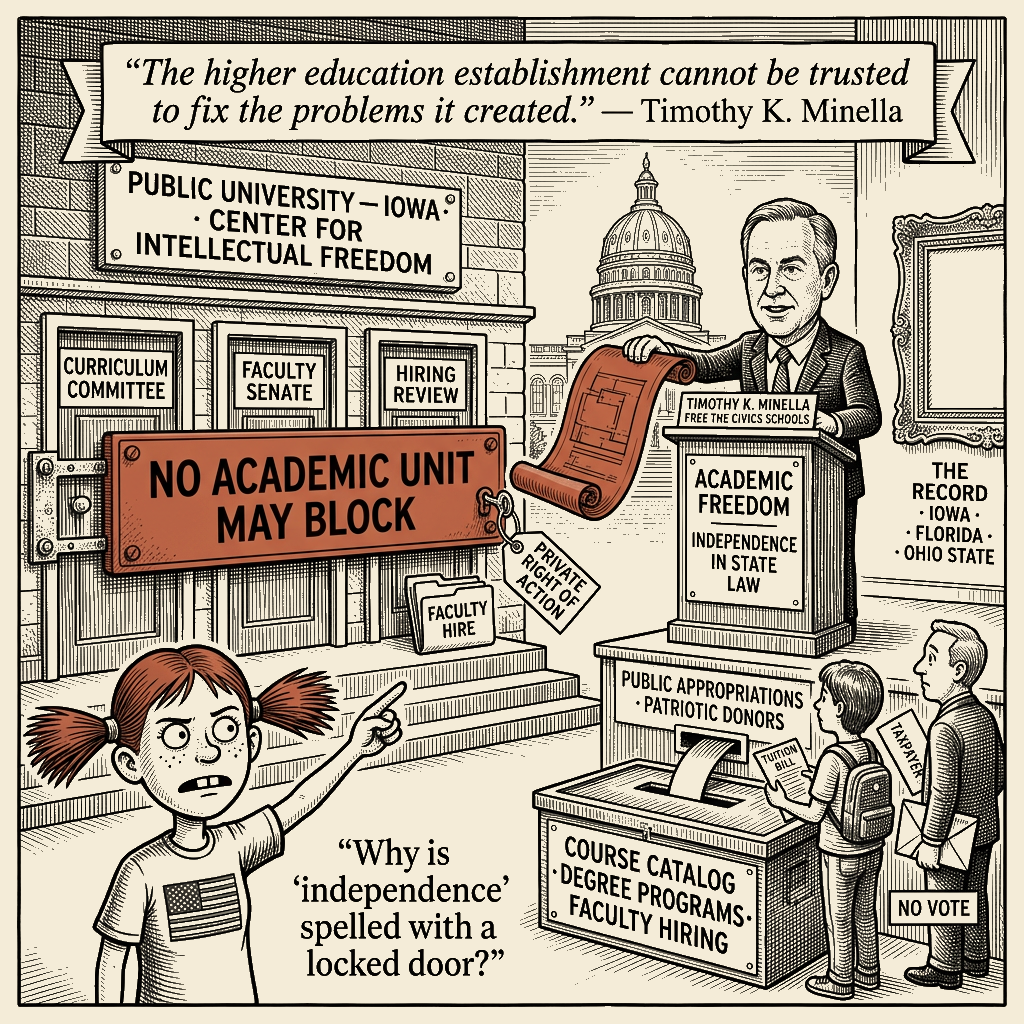
Why is ‘independence’ spelled with a locked door?
What the Piece Argues
The piece argues that civics schools housed at public universities are meant to restore rigorous teaching of American constitutional government and Western political traditions. It treats faculty and administrative resistance as evidence that incumbent university institutions have been ideologically captured and should not retain authority over schools created to challenge prevailing views. Its proposed remedy is statutory protection from outside vetoes over course catalogs, degree programs, and faculty hiring, together with a private right of action for full-time faculty.
Receipts
The move is to turn a complaint about alleged ideological capture and institutional obstruction into a demand for categorical autonomy from the university housing the school.
-
The framing wants you to believe
- That alleged ideological capture, combined with the institutional resistance Minella cites, is sufficient reason to deny incumbent faculty and administrators any veto over a civics school.
- That statutory power over courses, degrees, hiring, and enforcement is the minimum condition of academic freedom rather than a special-interest exemption from ordinary governance.
- That institutions associated with the decline of civics education should lose authority over schools intended to revive it, regardless of what shared procedures those schools encounter.
-
What’s really going on
- The article says the proposed model would stop other academic units from blocking a civics school from placing courses in the catalog, offering degree programs, or hiring faculty; it would also give full-time faculty a private right of action against the university for statutory violations. (Timothy K. Minella, “Free the Civics Schools,” National Review, November 2026.)
- The mechanism is a deliberate transfer of power: no-veto authority removes ordinary academic review, private enforcement strengthens the school’s position against its host, and control over curriculum and personnel becomes more concentrated inside the school.
- The direct beneficiaries are school leadership and faculty, who gain freedom from outside review; state officials, who gain a politically appointed platform; and donors, who gain a protected venue for their preferred civic project. The costs are dispersed among students, taxpayers, and competing academic units that lose authority over shared decisions.
- Minella uses Iowa’s Center for Intellectual Freedom as a warning case, arguing that its autonomy was undermined before it could protect itself. The source supports a case for targeted safeguards against retaliation; it does not establish that every disagreement, delay, or procedural objection at another university is hostile obstruction.
- The article cites resistance at Florida and Ohio State and relays John Sailer’s claim that the American Association of University Professors was preparing to “knock out” civics schools, but it reproduces no governing-board vote, administrative record, or AAUP planning document. It also supplies no appropriation total, per-student cost, legal-cost estimate, or state fiscal note.
The Response Ladder
Polite Reframe
When to use: For a persuadable legislator, university colleague, or donor who shares the concern about ideological interference but needs an accountable way to protect serious teaching.
Take Elena Marín, a hypothetical state senator asked to vote on the model. A public-university administrator who blocks a course, degree, or appointment because the program refuses to recite the department’s political catechism has interfered with academic freedom; that should be documented and corrected. But Minella’s model does more than prohibit interference. As the article describes it, no other academic unit may block a civics school’s catalog courses, degree programs, or faculty hires, and full-time faculty receive a statutory right to bring legal action against the university. (Minella, “Free the Civics Schools,” November 2026.)
Minella’s evidentiary center is Iowa. The source says the state’s authorizing legislation founded the Center for Intellectual Freedom, then says the University of Iowa administration undermined the center’s autonomy. That conflict deserves a full accounting. The article identifies no written directive, board vote, hearing record, or judicial decision showing what was blocked, who ordered it, or what injury followed. A serious accusation requires serious receipts; legal insulation cannot be built on an article’s summary alone.
The article’s leap is categorical: “The higher education establishment cannot be trusted to fix the problems it created.” One administrator can interfere; one provost can interfere; one board can interfere. The model answers every alleged failure by creating exceptions for one academic unit and giving that unit a legal claim against the institution that houses it. That is not proof of capture; it is a permanent presumption of it written into law.
Academic freedom is legitimate. Serious civics courses, curricular independence, and the right to dissent from a prevailing faculty consensus are legitimate. None of those values requires a state-created unit to be immune from ordinary academic rules. We can defend rigorous teaching with conflict-of-interest disclosure, fair procedures for appointments and curriculum, published standards, and appeal rights. Those are the values the article invokes before asking for the no-veto provisions and faculty litigation right described above.
Elena Marín can protect the school without writing the university out of itself. If the legislature means to answer documented interference, it should write rules that can be tested, audited, and challenged—not rules declaring one program beyond challenge. The article’s model would make the protected school both rule-maker and litigant against the institution that houses it. That is the conflict of interest the article says it is trying to cure.
Mockery and Ridicule
When to use: For bystanders in a newsletter reply, group chat, or public thread who need to see how “academic freedom” is being sold as a firewall around public money.
The Goldwater Institute model would put a velvet rope around a civics school: no other academic unit may block the course catalog, the degree, or the hire. The state pays the bill, the school appoints its faculty, and the university is told to stand outside like a jealous uncle at a wedding. Iowa’s authorizing legislation already created a special statutory Center for Intellectual Freedom; the model would turn that precedent into a campus passport stamped “NO QUESTIONS ASKED.”
That is not what a public university should become. It is a state-funded academic principality with a litigation button. The phrase doing the work is “civics schools’ independence in state law.” But independence from bad interference is not immunity from every public responsibility.
The argument presents a false dichotomy: either hostile academia retains control or the school receives categorical immunity. The article cites Florida, Ohio State, and Iowa as flashpoints, but the named resistance cases arrive without the governing-board votes or administrative records needed to show what happened and who did what. That is not a conspiracy theory; it is an evidentiary hole with a citation pasted over it.
The sales pitch is simple: money in, strings forbidden. We do not mock the student who wants a serious constitution course, and we do not mock the faculty member who wants due process. We mock the blueprint that promises “independence” while asking taxpayers to admire its impartiality.
Nuclear Satire
When to use: For an audience already persuaded that ordinary academic governance has become political capture and willing to hear the entire architecture named without diplomatic padding.
Picture the University of Iowa as a vast Gothic cathedral of peer review, with the Center for Intellectual Freedom assigned a private chapel in the narthex. Iowa’s authorizing statute built the chapel. The Goldwater blueprint now installs a drawbridge, an enforcement button, and a moat labeled NO ACADEMIC UNIT MAY BLOCK. The university supplies the land and the money; the chapel need answer to no cathedral.
Call it the University of Sovereign Exception. The state legislature writes the charter. The school governs its academic affairs. Other units cannot block its courses, degrees, or hires. Its faculty can sue the institution that houses them. Public appropriations and “patriotic donors” fill the treasury, while ordinary university governance disappears like incense in an academic HVAC system.
That is not academic freedom; it is a quarantine declared by the patient to certify that only the patient may be healthy.
Here is the evidence missing from the cathedral: the article names the University of Florida, Ohio State, and the University of Iowa as resistance cases, but it contains no primary board vote, administrative record, or governing document establishing the alleged obstruction. It quotes John Sailer’s claim that the AAUP was preparing to “knock out” civics schools, but supplies no AAUP planning record. The foundation is a fog with a citation sticker. A building on that foundation is not a university; it is a propaganda bunker with a course catalog.
The report’s authorship seals the point: Minella and Beienburg are not detached observers of a settled institutional problem; they are participants in the school-building project writing the legal template for its immunities. That does not make every concern false. It makes “independence” an interested advocacy claim for a public institution, not a neutral legal presumption.
The alternative is not capitulation to a captured university. The alternative is sunlight: disclosed conflicts, published budgets and minutes, ordinary accreditation and student protections, neutral appeals, and periodic outside review. Those are the checks skipped by the no-blocking rule and private-action remedy. We defend dissent inside institutions capable of self-government. We do not build cathedrals to the state and call the disappearance of public accountability academic freedom.
Profane Scorched-Earth
When to use: For the reader who needs the cathartic release of naming the whole architecture without the institutional fig leaf.
Welcome to the University of Sovereign Bullshit: the state supplies the cash, and the civics school slams the door on the university holding the checkbook. The Goldwater model is explicit: other academic units cannot block courses, degrees, or faculty hiring. That is not academic freedom. That is a fucking state-funded academic principality with a litigation button.
Academic freedom means you may publish a stupid-ass argument, teach it, get corrected in the marketplace of ideas, and keep your job. It does not mean your school can appoint itself a government inside a government, bar every other unit from blocking its decisions, and demand a statutory right to sue whenever somebody asks a normal question. Iowa’s authorizing statute already made the Center for Intellectual Freedom a statutory special case; the model asks lawmakers to make damn near every campus a special case.
And the enemies? The piece cites “bitter opposition from faculty and administrators,” points to Florida, Ohio State, and Iowa, and quotes John Sailer’s claim that the AAUP was preparing to “knock out” civics schools. But the article supplies no primary board vote documenting those fights and no AAUP planning document. That is bullshit by omission: make the enemy broad, make the receipts vague, and pray nobody checks the institutional record.
Here is the inversion, plain: “independent” means immunized. “Academic freedom” means accountable to no one except the people who drafted the immunity. “Civics school” means a public-money political land grant with a campus and a private enforcement clause. The model creates exactly that structure: concentrate control, then spread the cost and the blame across everybody who did not get a vote.
And if the answer is that these schools will save the republic, the proposal tells us exactly what “save” means: public appropriations, authority over appointments, control of the catalog, and a right to sue. If that is enough to remake a public university without the university’s consent, then the principle is not academic freedom. It is institutional secession. And the fucking tax falls on students and taxpayers who never voted for either side.
So yes: protect dissent. Protect scholars who can say the unpopular thing without an administrator crushing their program. But protect the public university too—open the minutes, publish the money, disclose conflicts, preserve ordinary review, and let students and faculty use ordinary processes without needing a golden legislative key. Iowa’s Center for Intellectual Freedom and the proposed Goldwater model are the records at issue; the principle we will not surrender is simple: power with sunlight, money with receipts, and law with a door anyone can knock on. The rest is the same old bullshit wearing a new campus flag.

About Malcolm Little King
Malcolm Little King is a heteronym in Main Street Independent's editorial architecture — an analytical voice, not autobiography of any actual person. The position this column expresses is the publication's position on the territory Malcolm Little King's lane covers, rendered through Malcolm Little King's register.