Responding to: I'm Dr Abdul El-Sayed. This is why I want Michigan's vote for Senate · 2026-11-02
Three wins for whom? Michigan pays.
What the Piece Argues
The piece advances one central talking point: “Rogers wins when working Michiganders lose.” It argues that Rogers’s defense of Trump’s trade war and Iran War conceals a distributional bargain in which Michigan households absorb higher prices while Rogers and the special interests behind him retain wealth, access, and policy protection. It counters that frame with El-Sayed’s campaign for Senate, presenting more than 700 events in over 120 cities and the principles “money out of politics, money in your pocket, and Medicare for All” as the alternative.
Receipts
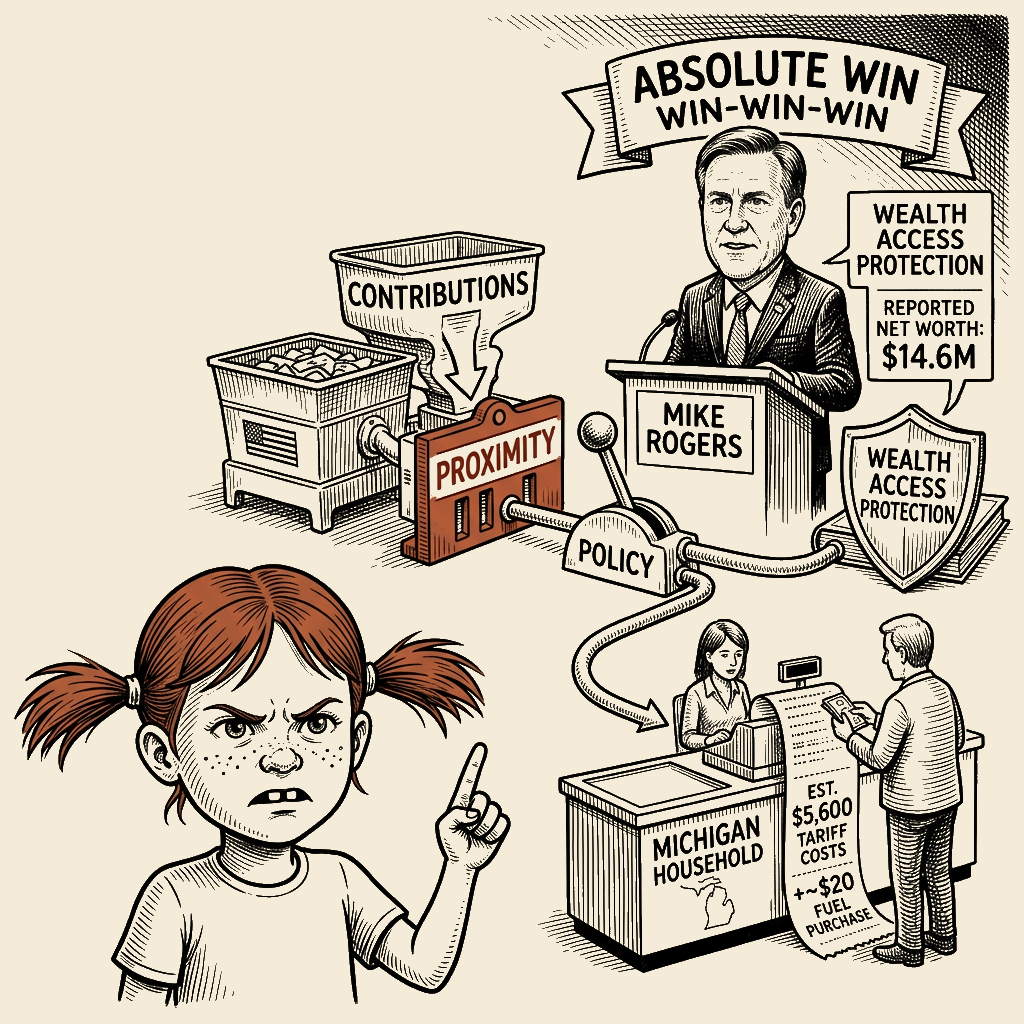
Rogers calls the trade war and Iran War wins while Michigan households pay the bill.
- The framing wants you to believe: “Absolute win” and “win-win-win” describe broadly shared prosperity rather than costs transferred from Michigan families to politically protected interests.
- The framing wants you to believe: A candidate enriched by corporate advising can judge the wisdom of the policies those corporations have an interest in preserving.
- The framing wants you to believe: Naming a policy a victory settles the question instead of requiring the public to examine who gains, who pays, and how much each side receives.
- The bill reaches households: The article reports that experts estimate the average Michigan household is paying $5,600 in tariff costs, plus about $20 more per fuel purchase because of the Iran War. (Fox News Opinion, Nov. 2, 2026)
- The wealth sits on the other side of the ledger: Rogers’s net worth reportedly ballooned to $14.6 million after he left Congress and advised corporations he had regulated as a legislator.
- The contribution-and-vote pattern is consistent: Big Pharma contributed more than $1 million, and Rogers voted 19 times against expanding children’s health coverage and lowering prescription-drug costs. Big Oil contributed millions, and Rogers backed higher gas prices. Wall Street contributed millions, and he backed higher credit rates. Trump-aligned super PACs contributed millions, and Rogers backed the Iran War.
- The mechanism is access: Contributions and corporate ties purchase proximity to office; proximity shapes policy; policy protects the interests that financed the candidate; the candidate then sells that outcome as a “win.”
- The omitted fact is the addressee: A “win-win-win” slogan never says who wins. Michigan families are told to absorb the prices; Rogers and the interests aligned with him are positioned to keep the wealth, access, and policy protection.
The Response Ladder
Polite Reframe
When to use: For a persuadable family member, coworker, or fellow voter who knows something is wrong but needs the argument placed in moral and practical terms.
Consider the mother in Escanaba whom the piece describes attending her first political rally because, in her words, “no one ever comes to Escanaba.” She is not a mascot for either side; she is a person who wants government to stop treating her town as disposable. Rogers calls the trade war an “absolute win,” while the same article reports that working families are struggling with gas, groceries, and healthcare. A policy cannot be an absolute win for the people who must pay its price.
The receipts make the distributional claim concrete: the article estimates $5,600 in tariff costs for the average Michigan household and roughly $20 more each time a driver fills the tank. Rogers, meanwhile, is reported to have accumulated $14.6 million in net worth by advising corporations he regulated. A political leader who becomes materially enriched while households absorb the cost of his governing preferences has not delivered a win; he has converted public power into private advantage.
Shame the donor class, not the working voter. Insist that “Michigan first” has a measurable meaning: household costs fall, health coverage expands, and donor access does not purchase office. El-Sayed offers three usable measures—money out of politics, money in your pocket, and Medicare for All—and a campaign practice of more than 700 events in over 120 cities. We put Michigan first by judging every policy by whether Michigan families can afford the life the policy claims to defend.
Mockery and Ridicule
When to use: When the “absolute win” line has stopped persuading and you need to expose its mechanism for the audience around you.
So the trade war is an “absolute win” because the average Michigan household gets to pay an estimated $5,600 in tariffs and then enjoy the ceremonial privilege of paying about $20 more every time it puts gas in a car. That is not a victory parade. That is the checkout line, except the customers are being charged for the privilege of being defeated.
The article also puts Rogers’s $14.6 million net worth beside his history of advising the corporations he regulated. Strip away the folksy “Michigan first” hat for a second: Rogers is not a servant of the public; he is the special interests’ servant, and the Senate campaign is the most polished commission he has ever received.
Big Pharma contributed more than $1 million, and Rogers voted 19 times against expanding children’s health coverage and lowering prescription-drug costs. Big Oil contributed millions, and he backed higher gas prices. Wall Street contributed millions, and he backed higher credit rates. That is not public service; that is a vending machine with a pinstripe suit, dispensing favors and collecting contributions.
Meanwhile, Trump reportedly booked at least $2.2 billion in income in 2025, and Trump-aligned super PACs are funding the political machine around Rogers. The machine calls the price “absolute win” because the people collecting the bill are not in the room when the slogan is written. People repeat the line because they have been taught to confuse the survival of their employers with their own survival. Let Michigan voters hear the receipt and decide for themselves.
Nuclear Satire
When to use: When the false-win frame has hardened into political mythology and the beneficiaries need to be named without retreating into civility.
Imagine Michigan redesigned as a toll plaza where every ordinary purchase requires a ceremonial surrender: $5,600 in tariffs for the household, about $20 for every tank of gas, and higher grocery and healthcare bills when inflation is released into the streets. In this sacred economic theater, the customer is the only person who can lose. Yet the politicians conducting the ritual call it an “absolute win.” That is not a policy debate. That is a church service for a prosperity that exists only in the donor’s wallet.
Now enter Mike Rogers, former legislator turned corporate counselor, net worth reportedly $14.6 million. The campaign biography says he advised the corporations he regulated. Strip away the Senate pin, and the man is a corporate lobbyist with a campaign receipt printer. He does not need to purchase a policy outright; he only needs enough access to make the policy favorable, raise the money to preserve the seat, and turn the seat into more access. The circular machine begins to eat the public.
Big Pharma funded Rogers, and he voted nineteen times against expanding children’s coverage and lowering prescription-drug costs. Big Oil funded Rogers, and he backed higher gas prices. Wall Street funded Rogers, and he backed higher credit rates. Then Trump-aligned super PACs load the cash, and Rogers backs the war while Michigan families face higher gas and grocery prices. This is not public service. It is a machine made of money and law, lubricated by fear and decorated with flags.
Call the slogan what it is: “win-win-win” is a serial-numbered claim with no unit price, no addressee, and no accountability. The people have already received the invoice; the politicians are preparing the victory lap. Justice that arrives only after the donors have been paid is not justice; it is billing with a campaign logo.
The indictment is structural and morally clean: money that buys policy must not buy a Senate seat. A government whose scoring system is donor return is not democracy; it is a corporate renter occupying public office, collecting rent while the tenant is turned out. Put every ounce of pressure on the donor machine—not on the worker, farmer, or voter—and demand a candidate who means the same thing by “Michigan first” that the receipt requires: lower household costs, expanded health coverage, and money out of politics.
Profane Scorched-Earth
When to use: For the reader who has the receipts and needs catharsis. Aim the anger at Rogers, Trump, and the donor class—not at the working voter.
Oh, fuck it, let’s say the thing: if Michigan households are carrying an estimated $5,600 in tariff costs and another $20 every time they fill the tank, then “absolute win” is a damn lie sold by people who do not pay the bill. That is not economics; that is the checkout line with a flag pasted over the receipt. The article says Rogers’s net worth is $14.6 million. The article says working families are paying. One of those two sides is using the word “we” to mean somebody else.
Rogers calls the trade war an “absolute win” and the Iran War a “win-win-win.” Three wins for whom? The piece’s answer is blunt: “Rogers wins when working Michiganders lose.” Big Pharma contributed more than $1 million, and Rogers voted 19 times against expanding children’s coverage and lowering drug costs. Big Oil contributed millions, and he backed higher gas prices. Wall Street contributed millions, and he backed higher rates. Fucking hell, that is not public service. That is a subscription service for rich bastards with a Senate campaign as the renewal notice.
Then Trump-aligned super PACs load the cash, and Rogers backs the war while Michigan families face higher gas and grocery prices. So no, this is not a debate about one candidate’s foreign-policy preferences. It is a fight over whether the machinery of war, tariffs, drug prices, and rates serves Michigan’s households or the wealthy interests that finance the machine. The receipts answer it.
The piece’s reported contribution-and-vote pattern names the common oppressor in Rogers’s campaign: the donor-class machine that turns office into access, access into leverage, and leverage into policy. That is why the war, tariffs, drug prices, and gas prices belong in one indictment. It is one machine. The receipts are the serial numbers on its parts.
And no, fuck no, the working Michiganders hearing this and voting are not the enemy. The mother in Escanaba who went to her first rally because “no one ever comes to Escanaba” is not the problem. The teacher in Detroit, the farmer in Ithaca, and the people lining up for hours are not the problem. The problem is Mike Rogers and the special interests writing checks to his campaign while his “win” becomes their invoice. Aim the damn anger where the receipts point, not at your neighbor.
The line is plain: money out of politics, money in your pocket, Medicare for All. Those are the three principles in the piece, and they are the anti-machine. We do not need to waste one second on Rogers as a person. We need to defeat him. We do not need to dehumanize the voter. We need to humanize the cost, name the beneficiary, and take the office back. A political machine that cannot survive an honest vote is not democracy’s machinery; it is its fucking parasite.

About Malcolm Little King
Malcolm Little King is a heteronym in Main Street Independent's editorial architecture — an analytical voice, not autobiography of any actual person. The position this column expresses is the publication's position on the territory Malcolm Little King's lane covers, rendered through Malcolm Little King's register.