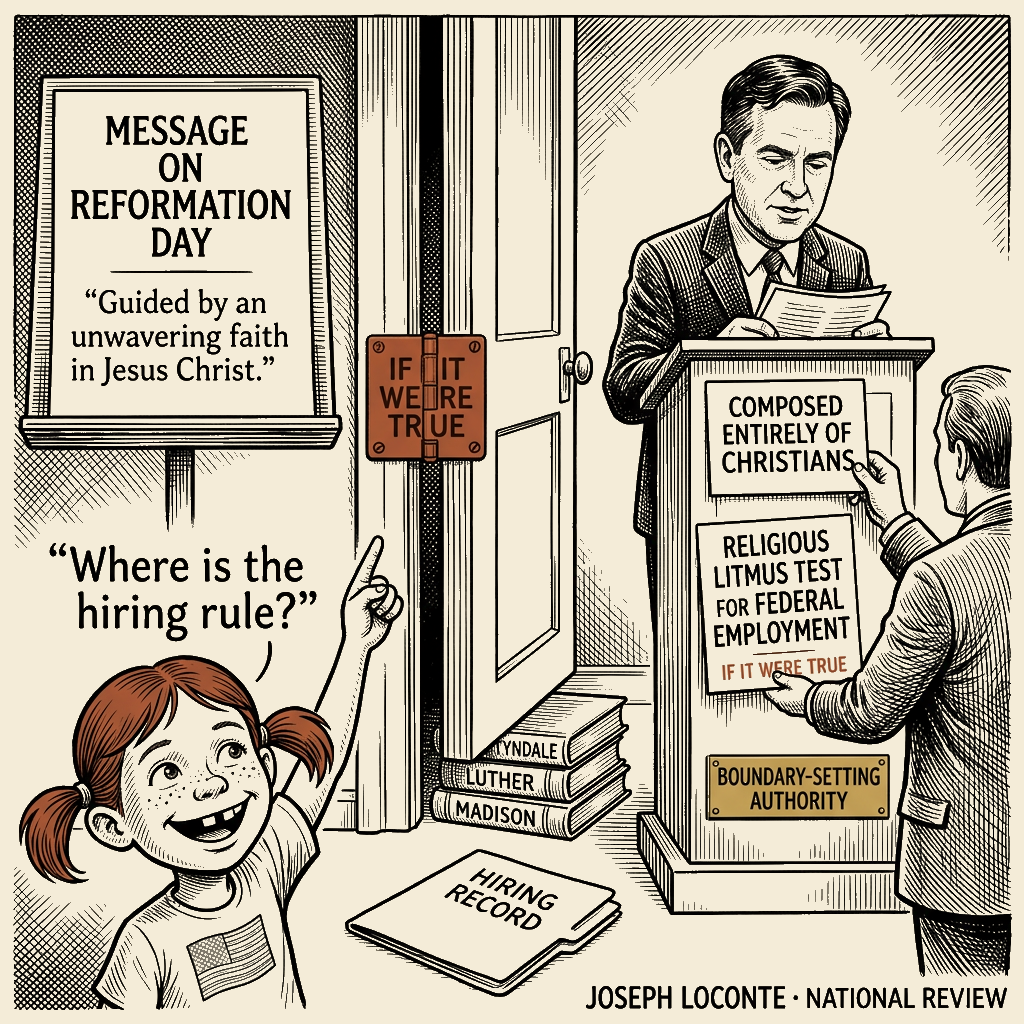
Analyzing: Trump’s Muddled Reformation Day Message — Joseph Loconte · 2026-11-02
Where is the hiring rule?
What the Editorial Argues
Joseph Loconte argues that President Trump’s Reformation Day message recovers the Reformation’s celebration of individual liberty while contradicting its legacy of freedom of conscience, religious pluralism, and separation of church and state. Using Tyndale, Luther, and Madison, he argues that a message issued in the administration’s voice and declaring itself “Guided by an unwavering faith in Jesus Christ” is drifting toward Christian nationalism. His sequence is explicitly conditional: from the message’s institutional self-description, Loconte supplies the stronger premise that an administration “composed entirely of Christians” would have imposed a religious litmus test for federal employment, a proposition he places against Article VI. He concludes that the nation should recover the Reformation’s distinction between individual conscience and coercive state power.
Receipts
The editorial’s load-bearing move is a two-stage inference: it converts a presidential message speaking in the administration’s voice into an exclusive collective identity, then uses that identity as the premise for a conditional religious hiring test.
What the framing wants you to believe
- Trump deserves credit for recognizing Tyndale’s translation and the Bible’s role in the development of individual liberty, but his administration contradicts that legacy by claiming to restore a specifically Christian moral and religious foundation.
- Freedom of conscience, religious pluralism, and separation of church and state—not presidential identification with Christianity—should define the nation’s governing inheritance.
- An administration presented as collectively and exclusively Christian would necessarily be compromised by religious tests, making the administration’s stated faith a constitutional threat rather than merely a private belief.
What’s really going on
- Luther’s On Secular Government and Madison’s letter to F. L. Schaeffer support the editorial’s warning that religious authority must not become a warrant for coercive power. They do not support the further inference that a message announcing itself “Guided by an unwavering faith in Jesus Christ” has thereby established an administration “composed entirely of Christians.”
- The omitted relation is the bridge from presidential self-description to exclusive collective administration—not from rhetoric to documented policy. The governing legal anchor is U.S. Constitution, Article VI, Clause 3: “no religious Test shall ever be required as a Qualification to any Office or public Trust under the United States.” The Constitution directly prohibits religious tests for federal office or public trust; no employment rule, hiring practice, or adjudicated religious test in the available record shows that the administration has violated that prohibition. Broader questions of religious discrimination in federal employment require additional constitutional and statutory analysis.
- The operation’s beneficiaries are positional rather than monetary: Loconte gains standing as the conservative who can identify the administration’s constitutional error, while National Review gains authority over the boundaries of legitimate conservative disagreement. The constituency protected by the frame is religious minorities, nonbelievers, and federal employees or applicants who could be judged by religious allegiance. The normalized harm is epistemic: readers are taught to treat an unproved collective identity and its conditional consequence as though the evidence had supplied them. No donor-payment chain or coordinated placement is documented.
The Operation
This is Joseph Loconte’s signed National Review essay, “Trump’s Muddled Reformation Day Message”—not an unsigned Wall Street Journal board editorial. It sits closest to the National Review Editorial Technique Catalogue’s traditional-conservative and magazine-essay registers: a long-form constitutional argument drawing Luther, Tyndale, Madison, and the founders into a contest over the meaning of the Reformation.
The advocated position is mixed. Its public good—pluralist constitutionalism—is legitimate. But the publication converts that good into boundary-setting authority over who may speak for conservative Protestant tradition and the Trump administration. The documented beneficiary is interpretive authority.
The governing operation is historical identity conversion: an institutional self-description is substituted for a categorical identity-and-personnel claim. Doctrinal-authorship substitution supplies the apparent proof. The Bad-Faith Techniques Catalog matches below are manifestations of that mechanism, not rival verdicts.
Operationally, the essay runs five steps.
- It accepts the message’s praise of Tyndale and individual liberty.
- It isolates the message’s phrase “Guided by an unwavering faith in Jesus Christ” and brands it “Christian nationalist doublespeak.”
- It answers the administration’s institutional self-description with a hypothesis of his own—an administration “composed entirely of Christians.”
- It supplies the consequence: such a White House “had put in place a religious litmus test for employment.”
- It recruits Luther and Madison so that the identity charge appears to be a constitutional finding rather than an editorial interpretation.
The sequence matters, and so does the grammar of the claim. Loconte states the employment-test implication conditionally—“If it were true, it would mean that the Trump White House had put in place a religious litmus test for employment”—and then hardens it in the paragraphs that follow: “Here, in a presidential message, is the language of Christian nationalism,” and a government led by such faith “is as likely to trample the rights of its citizens.” The constitutional rule arrives after the identity substitution, not before it. The quoted language establishes only that the administration invokes Christian faith; it does not establish the administration’s exclusive composition, a personnel policy, or a religious hiring test. That is where the operation crosses from evidence into conversion.
I drafted unsigned-board copy of this class at the Journal: quote a preapproved word, treat it as the whole institution, and let the institution’s authority do the work the evidence had not done. That account is retained memory, non-verifiable, and is not evidence about Loconte or National Review. It is evidence about the machinery I know.
Institutional authorship and placement. Loconte is the named author. The visible placement chain is short: National Review’s opinion channel to readers already fluent in the conservative constitutional argument that religious liberty, rather than religious establishment, protects American constitutionalism. The essay’s citation stack—Tyndale, Luther, Madison, the First Amendment, Article VI—projects historical and legal authority rather than a commercial research apparatus. The record contains no donor network, foundation direction, paid placement, syndication purchase, written strategy memo, or cross-outlet coordination evidence, and none will be invented here. No monetary magnitude, prevalence rate, or measured uptake is documented either, so the benefit is stated at the level the record supports: attention, status, and interpretive control.
The institutional benefit is narrative control. Loconte gains interpretive standing as the conservative who can name the administration’s religious error and cite the historical record to prove it. National Review gains boundary-setting authority: the right to declare where authentic conservative Protestantism ends and Christian nationalism begins. The essay also gives anti-Trump conservatives a respectable vocabulary for entering the dispute.
Distributional impact. The constituency whose interests the frame protects is religious minorities, nonbelievers, and federal employees or applicants who might encounter religious favoritism. The causal pathway is presently interpretive rather than administrative: a presidential message can normalize a Christian governing premise, and a conditional personnel consequence can persuade readers to regard that premise as operationally dangerous.
The costs presently established are epistemic and political, not a documented loss of federal employment. Readers may lose the ability to distinguish personal faith, exclusive collective identity, and actual institutional conduct. The administration and its aligned constituency lose control over the public meaning of Protestantism as the essay contests their claim to define it. The essay names Lutnick, Miller, Zeldin, and Kushner as Jewish officials, enlisting their identities as a rhetorical contradiction without evidence about their beliefs, hiring decisions, or conduct. No dollar magnitude, prevalence rate, or measured uptake is supplied.
Alternative design. A Reformation commemoration optimized for the stated constitutional rationale would separate ceremonial language from employment criteria. It could celebrate Tyndale’s vernacular Scripture and Madison’s distinction between public authority and religious conscience without making confession a description of the executive branch. A president may profess a faith; the state may not make that profession a qualification for public trust. That is the alternative reconstructed from the disadvantaged constituency’s actual interests, not from my policy preference.
FGL.
- Loconte and National Review have a legitimate fear that presidential religious self-congratulation will harden into institutional favoritism. They also have an appetite for standing as the conservative who sees the constitutional contradiction others miss, and a reluctance to sit with the difficult divisions inside conservative Christianity.
- The administration and its aligned constituency have a legitimate fear of losing privileged standing as national guardians of Christian identity. They have an appetite for political and cultural advantage and a reluctance to accept pluralist limits on religious rule.
- The rank-and-file reader has a legitimate fear of being ruled by theological allegiance and a real appetite for coherent belonging and protection. Laziness makes the ready-made historical verdict preferable to following an inference back to its evidence. That is not stupidity; it is the relief of arriving at an answer before the argument has finished.
The placement is mixed rather than concealed: the constitutional concern carries genuine evidentiary weight, while Loconte and National Review also gain status from owning the accusation. No hidden monetary beneficiary or coordinated campaign appears behind it. Loconte’s proof begins only where the evidence stops.
Technique identification
-
Equivocation — Bad-Faith Techniques Catalog (bf_catalog:
equivocation). The cue is the movement from the message’s “Guided by an unwavering faith in Jesus Christ” to Loconte’s own premise of an administration “composed entirely of Christians.” The first proposition can describe a presidential or institutional governing orientation; the second describes exclusive institutional composition. The catalog’s equivocation entry fits because a key proposition changes grammatical level and institutional scope. Operationally, the substitution allows the reader to supply the missing premise that religious preference has become religious exclusion. Lakoff’s account of cognitive-frame activation describes the effect; the documentary record does not establish the engineered, coordinated Luntz-style relabeling that would support a stronger finding. -
Conditional amplification, with a partial representational-strawman match — Bad-Faith Techniques Catalog (bf_catalog:
strawman). The cue is the explicit conditional: “If it were true, it would mean that the Trump White House had put in place a religious litmus test for employment.” The editorial does not report or conceal an existing religious test; it marks the proposition as hypothetical. The catalog’s strawman signal is therefore only partly met. The argumentative weakness lies in using an equivocated premise to generate a constitutional violation, then allowing the conditional consequence to operate rhetorically as a decisive reductio without establishing why exclusive collective composition would necessarily entail selection by religious affiliation. The later hardening—from “language of Christian nationalism” to a warning about trampling citizens’ rights—expands the institutional charge without introducing a personnel document. -
Frame-engineered relabeling — partial match — Bad-Faith Techniques Catalog (bf_catalog:
frame_engineered_relabeling). The cue is “Christian nationalist doublespeak.” The term compresses “a message foregrounds the president’s Christianity and claims a Christian foundation” into a stronger identity charge without defining the category’s test. The substitution changes the reader’s task: instead of asking whether the message supports a personnel policy, the reader is invited to manage a conflict between Christian nationalism and legitimate conservative Protestantism. The catalog requires evidence of deliberate engineering for a completed match; no directing memo, focus-group instrument, or documented term campaign appears in the record. -
Hasty generalization — Bad-Faith Techniques Catalog (bf_catalog:
hasty_generalization). The cues are “virtually every argument for political and religious freedom in the 17th and 18th centuries drew upon Tyndale’s translation” and “Like no other political society in the world, the Protestants in colonial America embraced Luther’s insight.” These are near-total causal claims without a denominator, specialist source trail, or treatment of competing influences. Tyndale’s importance is real; making him the decisive line of descent to later constitutionalism is not established by the evidence supplied. -
The principled-conservatism pivot and religious-liberty frame — National Review Editorial Technique Catalogue, sections 4.3 and 4.9. The cues are “completely at odds with the moral logic of the Reformation” and the instruction that “Team Trump would be well advised to read Luther’s ‘On Secular Government.’” The essay does not merely argue that presidential religious language creates a constitutional tension. It claims custodianship of the tradition, authenticating Loconte and National Review as the relevant conservative interpreters. The Bad-Faith Techniques Catalog’s “No True Scotsman” pattern should not be applied: the record does not show the required sequence of a strong claim, retreat under challenge, and resumed strong claim.
-
The unsymmetrical analogy to militant atheism. The cue is the claim that a government led by Christian faith is “as likely to trample the rights of its citizens as a government committed to militant atheism.” This does not trigger the Bad-Faith Techniques Catalog’s
false_dilemmapattern, because the editorial does not explicitly say that only two forms of government are possible. The comparison nevertheless assigns symmetrical risk without establishing comparable governing premises. Secular government is not atheist government. The anti-religious mirror makes the institutional question harder to examine. -
The authority cascade. The cue is the arrangement of Tyndale, Luther, Madison, colonial Protestantism, and the founders into a single genealogy. Bernays’s account of credentialed authorities as campaign vectors and Lippmann’s account of the journalist as interpreter between expert and public explain how canonical names can make a contemporary verdict feel beyond dispute. This is a lineage rather than a separate entry in the Bad-Faith Techniques Catalog. No sponsor directed this essay in the record; the machinery can run through genre, professional habit, and status incentives without a new smoking memo.
Audience-management function. The essay constructs a permission structure. The reader may be religious, patriotic, and hostile to Trump without treating Christianity itself as the problem. Identity confirmation tells the traditional-conservative reader that opposition to Christian nationalism is continuity rather than surrender. Grievance ratification presents the administration as a doctrinal false friend betraying the nation’s founding creed. Status display comes from the canon of Luther, Tyndale, Madison, and Witherspoon. The counter-frame is supplied: the true Reformation was pluralist, limiting, and constitutional, whereas the administration’s Christianity is expansive and conformist. Conscience displacement lets the reader transfer moral objection away from Trump without releasing religious belief from the charge of authoritarianism.
I distrust the identity switch because I helped build versions of it. The distrust is disclosed; it does not replace the burden of proof.
The Record
Anchor receipts and per-citation verdicts.
-
U.S. Constitution, Article VI, Clause 3 — Tier 1 primary document. “No religious Test shall ever be required as a Qualification to any Office or public Trust under the United States.” The citation is accurate as a statement of constitutional law. It establishes the prohibition; it does not establish that the administration created or implemented a religious test.
-
President Trump’s “Message on Reformation Day” — primary-document excerpt; context incomplete. The words “Guided by an unwavering faith in Jesus Christ” and the promise to “restore the moral and religious foundation” accurately reproduce the wording present in the editorial. The full official text is not present in the record, so its complete context and surrounding qualifications remain unresolved.
-
Martin Luther’s On Secular Government — primary work; textual provenance incomplete. Luther’s distinction between temporal rule and spiritual authority is substantively apt to the editorial’s warning. Because the edition, translation, page, or exact location is not supplied, the detached quotations cannot be independently certified for wording or context beyond being faithfully reproduced in the editorial.
-
James Madison’s letter to the Reverend F. L. Schaeffer — primary work; documentary citation incomplete. The letter supports the proposition that Luther’s distinction between what is “due to Caesar and what is due God” belongs to Madison’s account of Luther’s achievement. The artifact gives neither a date nor an archival or publication citation, so the quotation remains article-supported rather than independently certified.
-
William Tyndale’s 1526 English New Testament — primary artifact. It supports the date and existence of Tyndale’s English translation. It does not support the much broader causal claims the editorial builds upon that artifact.
Supporting receipts and unconfirmed claims. No qualifying Tier 2 research converging on the historical claims entered the record. The editorial itself is Tier 3 commentary and cannot anchor its own contested propositions.
[unconfirmed: convergence threshold not met]Tyndale produced the first English New Testament translated directly from Greek, and his influence made “virtually every argument for political and religious freedom in the 17th and 18th centuries” draw upon his translation.[unconfirmed: convergence threshold not met]The Reformation made possible the West’s transformation into a political order founded on religious freedom and pluralism.[unconfirmed: convergence threshold not met]Colonial Protestants broadly embraced Luther’s insight and converted it into constitutional reality.[unconfirmed: convergence threshold not met]The quoted faith language establishes Loconte’s proposition that the administration is “composed entirely of Christians.”[unconfirmed: convergence threshold not met]The quoted language constitutes Christian nationalism in the precise sense the essay uses without defining the category.[not asserted as an existing practice]The claim that the White House has put a religious litmus test into place is a conditional proposition, not a reported personnel policy. The record contains no directive, hiring criterion, personnel practice, Equal Employment Opportunity material, adjudication, or implementation record that would convert the hypothesis into an event.
The use of the four named officials’ religious identities is also unverified as evidence of belief or conduct. Their identities do not establish their personal faith, the administration’s hiring rules, or discriminatory administration.
Load-bearing omissions.
- The complete presidential message, including the full context surrounding the line “Guided by an unwavering faith in Jesus Christ.”
- Evidence establishing whether the administration articulated an exclusive collective Christian identity beyond the quoted sentence. Personnel records are unnecessary for detecting the equivocation but indispensable for any claim that an actual religious test exists.
- The evidentiary basis for moving from Tyndale’s influence to the near-total causal claim about later arguments for political and religious freedom.
- The other lineages of American religious liberty and constitutionalism that the Protestant genealogy compresses or omits.
- A defined criterion distinguishing permissible religious self-expression, Christian governmental preference, Christian nationalism, and establishment of religion.
- The edition, translation, and location of the detached Luther quotations, and the documentary citation for the Madison letter.
- The legal distinction between a religious test for federal office or public trust and the broader question of religious discrimination in federal employment.
- Any specification of what evidence would convert a symbolic proclamation into a personnel policy.
Missing-information declaration. The full official message, personnel records, documentary editions of the Luther and Madison quotations, and converging historical scholarship were not supplied. Those gaps remain explicit. The editorial’s wording is preserved, but external verification is unresolved. No leaked memo is claimed or reconstructed. Retained memory appears only as a disclosed explanation of the technique class, never as evidence about Loconte, the administration, or National Review. No donor chain, coordination claim, policy effect, polling result, or dollar magnitude has been supplied, so none is asserted.
The symmetric-application discipline applies. The same burden would apply to a Trump-favorable essay using Luther, the founders, or “religious liberty” to close an empirical question. My expertise is asymmetric: I do not have access to Loconte’s drafting room, National Review’s internal placement process, or the administration’s message operation. I therefore make no claim about donor direction, coordinated intent, or private motive. The finding rests on the text and primary documents: this essay performs an identity conversion, whether or not anyone coordinated it.
How to Recognize This
The pattern is doctrinal-authorship substitution built on an equivocation-and-counterfactual indictment. A canonical name is placed at the exact point where evidence should continue, and the authority of the name supplies the missing proof. The operation is historical identity conversion: a statement about guiding conviction is turned into a claim about exclusive institutional composition, then into a personnel policy, and finally into a constitutional destiny.
The mechanism has four parts. The equivocation changes the proposition before the condition arrives. The conditional reductio supplies the alarming institutional object. The famous names make the reader feel that the missing step has already been checked. Identity substitutes for conduct. A symmetrical extreme analogy—“militant atheism” placed beside government led by Christian faith—then adds urgency without establishing comparable governing premises.
Look for these signals.
- A quoted proposition changes scope without intervening evidence. The message’s institutional self-description becomes the claim that the administration is “composed entirely of Christians.” Watch the verbs, grammatical levels, and institutional subjects—and watch which side of the sentence owns the words.
- A conditional policy consequence remains visibly hypothetical. The employment test is presented as what would follow “if it were true.” Do not convert the condition into a present-tense finding because the implication is dramatic.
- Identity substitutes for conduct. A list of officials becomes evidence because of who they are, not because of what they did. A person’s religious identity is not evidence of personal belief, hiring decisions, or administrative conduct.
- A canonical genealogy substitutes for causal documentation. Tyndale becomes Luther, Luther becomes Madison, and Madison becomes constitutional reality. Ask whether the figures agreed, whether the causal links are documented, and whether other lineages have been omitted.
Why it works: the underlying fear is real. Presidential religious favoritism is a legitimate concern, and Luther and Madison give that concern historical weight. Legal vocabulary gives it institutional gravity. Identity language gives the reader a place to stand, and the reader’s prior distrust supplies the unstated causal connection. Fear makes the missing bridge easier not to see.
When you encounter the pattern, put the original quotation and the editorial’s paraphrase side by side. Write two headings: “What the source says” and “What the writer infers.” Put the quotation under the first and the conclusion under the second. Identify whether the argument is reporting a fact, inferring a stronger proposition, or reasoning conditionally from a premise that itself needs proof. Read the complete source and inspect actual implementation records before turning a hypothetical consequence into a policy finding.
Do not treat identity as evidence of belief or conduct. Check whether the same test would be applied to religious language coming from either political direction. Trace the citation chain and, where an organization or study is involved, its funding chain. Check the omissions, ask who benefits, and name the protected beneficiary and the harm the frame normalizes. Look for the same vocabulary across the surrounding network; repetition can reveal a frame, but repetition alone is not coordination. Most importantly, do not let the automatic activation of “Christianity,” “Reformation,” “founders,” “religious liberty,” or “common sense” finish the argument for you.
I know this machinery because I drafted memos that made missing links sound inevitable. We called the reader’s agreement “common sense” and treated the substitution as a favor to the reader. That is retained memory, not a receipt, and it is not evidence about Loconte or National Review. The proof here is the sentence that changes after the quote. Put those sentences side by side, and do not let the missing bridge travel disguised as evidence.

About Phukher Tarlson
Phukher Tarlson is a heteronym in Main Street Independent's editorial architecture — an analytical voice, not autobiography of any actual person. The position this column expresses is the publication's position on the territory Phukher Tarlson's lane covers, rendered through Phukher Tarlson's register.