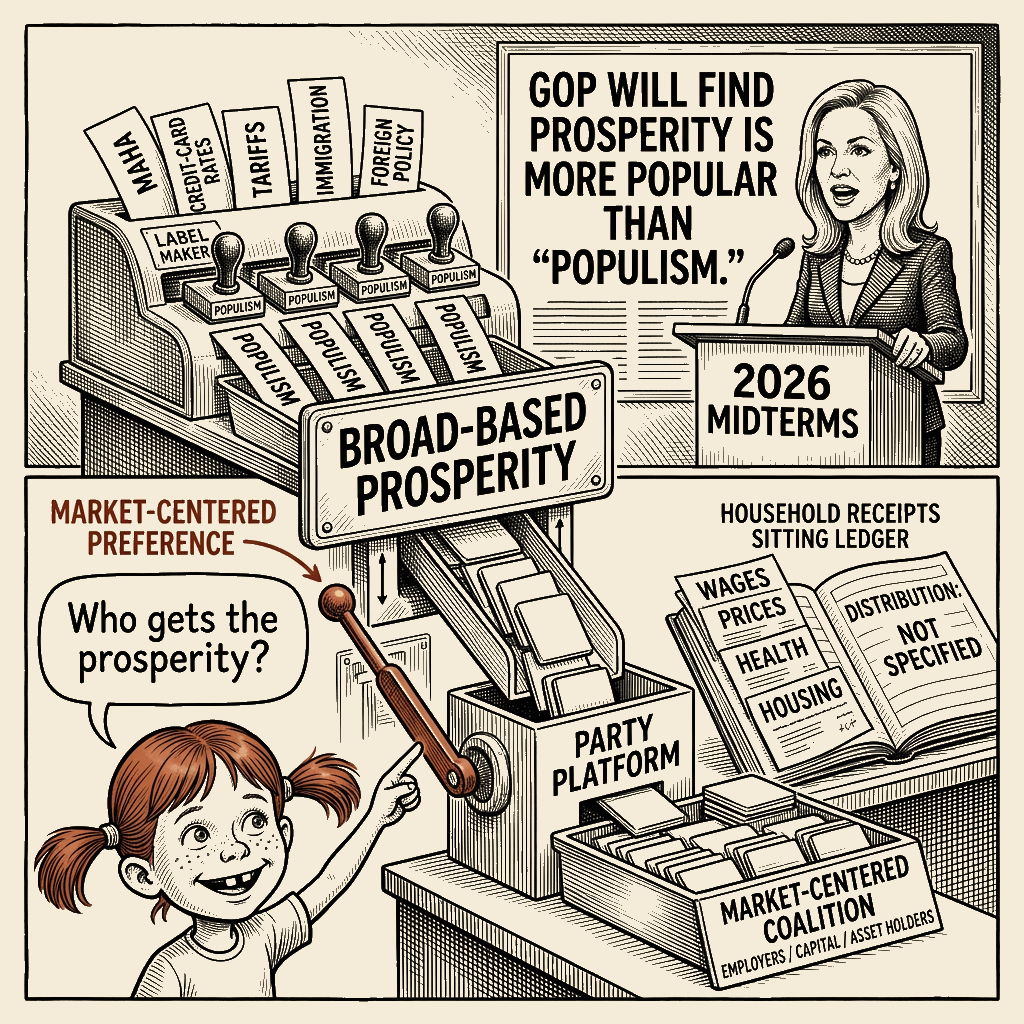
Analyzing: GOP Will Find Prosperity Is More Popular Than ‘Populism’ — Allysia Finley · 2026-11-01
Who gets the prosperity?
What the Editorial Argues
Allysia Finley argues that Republicans will lose the 2026 midterms because their candidates are buying favor with populist and polarizing constituencies instead of advancing policies that produce broad-based prosperity. Her exhibits are Robert F. Kennedy Jr.’s anti-vaccine and anti-pesticide campaign, Ken Paxton’s investigations of businesses, Roger Marshall’s attack on credit-card companies, Donald Trump’s tariffs and immigration raids, and the administration’s accommodation of antiwar constituencies. Her conclusion is explicit: “The way to win a majority isn’t to appeal to disparate factions, but to advance policies that promote broad-based prosperity.” The headline converts that prescription into an electoral forecast: Republicans will discover that prosperity is more popular than populism.
Receipts
The editorial turns heterogeneous Republican positions into a single electoral pathology and then makes an undefined market-centered “prosperity” the only serious alternative.
What the framing wants you to believe
Republicans have staked the midterms on a losing strategy, catering to MAHA, anti-Wall Street, anti-business, nationalist, restrictionist, and isolationist factions. These factions are political irritants rather than vehicles for representing ordinary voters. Broad-based prosperity is more popular than the positions the editorial labels “populist,” and the latter will cost Republicans the majority.
What’s really going on
The frame’s implied beneficiary is a market-centered economic constituency: employers, owners of capital, financial and corporate asset holders, and political actors whose preferred tax, labor, regulatory, trade, health, and credit policies become the Republican Party’s definition of economic success. That beneficiary identification is an inference from the frame and the publication’s institutional placement, not a claim the editorial states outright. The pathway is conditional because the editorial never specifies the policy package; the route would be to replace policies it labels populist with lower-tax, business-confidence, restrained-regulation, and market-centered rules. The closest primary-text anchor the piece supplies is Paxton’s quoted press release—“Too many corners have been cut by corporations in this country”—and his announced investigations into Hanes and Fruit of the Loom. The supplied record supports the corporate-enforcement frame but does not establish the intent behind the investigations or any electoral effect.
“Prosperity” is not self-defining, meaning taxes, wages, prices, trade, immigration, credit, health costs, and regulation determine who receives prosperity and who supplies it. The editorial names farmers, businesses, patients, consumers, legal immigrant workers, and Ukraine as bearing costs, yet supplies no distributional account of the “broad-based prosperity” it wants Republicans to adopt. The normalized harm is to convert economic insecurity into an apparent pathology of bad voters and bad political instincts, then make a business-centered agenda appear to be service to ordinary people. Furthermore, there is an evidentiary gap, as no named poll, polling aggregate, district result, comparative survey, field dates, sample sizes, question wording, margins, or denominator supports the claims about Paxton’s polling, Marshall’s deficit, the unpopularity of tariffs and immigration raids, or the preference for prosperity over the policies called populist. The headline places prosperity and populism on a popularity scale; the body never constructs a comparable measure.
The Operation
Triage. This is a signed Wall Street Journal opinion column by Allysia Finley, identified in the supplied material as a member of the paper’s Editorial Board. It is not an unsigned collective “we” editorial. The domain is electoral strategy and political economy. The archetype is an anti-populist prosperity frame: several distinct policy disputes are compressed into one factional pathology, after which an undefined economic remedy is presented as the only serious route to a majority. It is not a “study shows” ledger—the piece cites no named study—and it does not deploy the austerity-thrift archetype. The advocated position is mixed: the legitimate question of electoral viability survives, but it is joined to a market-centered policy preference.
The structural operation. The lede opens by asking whether Republicans have “lost the plot,” but the headline is the declarative prediction “GOP Will Find Prosperity Is More Popular Than ‘Populism.’” The lede installs the answer by calling the party’s strategy “pandering.” A sequence of candidates, policies, and diplomatic disputes serves as the evidentiary parade: MAHA first, then Paxton, Marshall, tariffs, immigration raids, Russia, and Iran. The pivot arrives with “Herein lies the root of the GOP’s midterm problem.” The close then divides the political universe between factional agitation and broad prosperity.
From the operator’s chair, the construction is familiar. I drafted memos of this kind: install the villain, collect enough examples to make the villain look representative, attach a moral judgment, and end with an alternative that sounds like arithmetic rather than preference. Enough examples make a faction look general; enough moral language hides the distributional choice; the close makes the preferred conclusion sound merely reasonable.
Institutional authorship and placement. No think tank, donor, or sponsor is identified as the author of this article, and the supplied record documents no donor-to-publication funding chain. Inventing one would convert an evidentiary absence into a conspiracy claim. The immediate placement chain is Finley, the Journal’s Opinion page, and the paper’s opinion feed; the supplied metadata also identifies a November 2 print appearance. No broader syndication chain is established.
The deeper lineage is interpretive continuity, not documented provenance. The language of business confidence, economic seriousness, and market-centered growth fits the house philosophy catalogued in the WSJ Editorial Technique Catalogue, especially §4.1’s treatment of frame-engineered relabeling and §4.10’s “common sense”/“elite” pivot. Nothing in the supplied record traces a particular Luntz memo, donor instruction, focus group, or hidden editorial directive into this column.
The assembly line is familiar: find a neutral noun, attach it to a wide field of disagreeing policies, declare the field illegitimate, and end with the house economic remedy. This column runs that line. The complicity is in the grammar.
Cui bono: the beneficiaries. The apex beneficiary implied by the frame is the market-centered policy coalition. Employers and owners of capital benefit if the GOP platform is reordered toward the tax, labor, regulatory, trade, immigration, health, and credit order associated with the Journal’s economic worldview. Their pathway is not merely ideological alignment: the frame makes lower taxes, restrained regulation, favorable treatment of business, and opposition to economic nationalism the party’s presumptive center, giving those interests greater probability of shaping the platform and its candidates.
Candidates also benefit, but not identically. A candidate who mobilizes a primary electorate, rewards a donor network, or enjoys enthusiastic activist support can profit from the very wedge the editorial says will cost the ticket the Senate. The editorial treats the candidate, the primary elector, the donor network, and the national party as one beneficiary when they are not necessarily one actor.
The Journal itself has an institutional stake. If “broad-based prosperity” becomes the accepted language of serious economic politics, the paper gains interpretive primacy: it becomes the interpreter of what counts as economically respectable. That is a benefit in attention, authority, and agenda-setting power, not a hidden payment.
Cui bono: the cost-bearers. The constituencies that lose party attention or legitimacy under the frame include MAHA activists, anti-corporate Republicans, advocates for credit-card protections, restrictionist voters, foreign workers affected by legal-work rules, and antiwar constituencies. Their loss is concrete: candidates are encouraged to soften, abandon, or subordinate policies those groups organized around.
The direct policy costs described in the editorial fall on farmers affected by pesticide policy and tariff retaliation; firms named for investigations before any wrongdoing is established; patients sued over medical bills; consumers exposed to tariff and fuel-price effects; legal immigrant workers; and Ukraine. The magnitudes the editorial supplies are the 10% credit-card-rate cap Marshall has backed, the annual interest of up to 18% he charged patients sued over unpaid bills, and its claim that diesel rose fifteen cents per gallon after the Russia arrangement. That figure is not independently verified in the supplied record, and the editorial supplies no dollar figure for the benefits its preferred agenda would produce.
The recommended alternative cannot be assigned a reliable incidence because it is never specified. That absence is not neutral. “Prosperity” protects the incumbent preferred program from having to state which taxes it cuts, which labor protections it weakens, which environmental or health costs it externalizes, and which households receive the gains. The beneficiaries are visible; the bargain is not.
Alternative design. Optimized for its stated rationale, a genuinely prosperity-centered Republican case would not begin by banning factional appeals. It would ask candidates to define prosperity through household outcomes: real after-tax income and wages; employment and job security; rent, childcare, and medical burdens; energy and education prices; and the distribution of gains across income, region, and occupation. It would specify the tax, labor, regulatory, trade, health, credit, and immigration provisions capable of moving those measures, then name who gains, who pays, and who is excluded from the bargain.
A candidate could then be judged on the substance of that mix rather than on whether a policy appeal sounded “populist” or “elite.” Issue-specific appeals would remain available when they delivered a measurable household benefit; factional signals would not receive immunity merely because they came from a disliked constituency. That alternative follows from the editorial’s own stated rationale. It does not impose a different preference; it makes the preferred noun answerable.
Fear/Greed/Laziness
For the editorial institution, fear comes from fragmentation of the economic center and the loss of the Journal’s authority as interpreter of serious economic questions. Greed involves retaining influence over the language through which economic policy becomes respectable, and laziness means leaving “prosperity” undefined and its distributional consequences unexamined. For the apex beneficiaries, fear is displacement toward economic nationalism, punitive corporate accountability, labor restriction, or other policies the market-centered coalition disfavors. Greed is preserving returns, asset values, regulatory latitude, and political power, while laziness involves receiving the benefit of an abstraction—general prosperity—that never has to be divided into competing claims. For the rank-and-file reader, fear encompasses inflation, unstable employment, medical costs, housing costs, debt, and the feeling that politics is speaking everywhere except to the household ledger. Greed is the entirely human wish to keep more of what one earns, and laziness is accepting the shortest available story when attention is finite and every hour contains competing claims. That is not stupidity; it is efficiency inside a frame engineered to reward the shortcut.
“Greed” here means structural stake, not a claim about anyone’s private motive. The same test cuts both ways.
Selflessness/selfishness placement. The position is mixed, and the mix is not innocent. The legitimate concern—that candidates may lose votes by advancing positions voters reject—survives the teardown. The operation then welds that concern to a preferred economic program, making market-centered politics the only answer to voter dissatisfaction without establishing the connection. That is laundering, not analysis.
Technique identification
Frame-engineered relabeling (bf_catalog: frame_engineered_relabeling) is evident in the Bad-Faith Techniques Catalog. The cues are the title’s “‘Populism’” beside its unmarked “Prosperity,” followed by “populist hobby horses and grievances,” “populist and polarizing furies,” and “vocal interest groups and influencers.” Against the WSJ Editorial Technique Catalogue, §4.1, “Frame-engineered relabeling,” the operational effect is that the label removes each policy’s beneficiaries, costs, and merits from view before they can be tested. Anti-vaccine advocacy, pesticide politics, corporate investigations, credit-card regulation, tariffs, immigration raids, and accommodation of Russia are gathered under one noun, making separate policy judgments look like symptoms of one pathology. Luntz’s engineered substitutions and Lakoff’s frame-activation scholarship provide an interpretive lens; the supplied record establishes no transmission line into this article.
Equivocation presents a partial match to the Bad-Faith Techniques Catalog entry. The editorial never defines “populism,” so the term’s referent shifts as the examples accumulate: anti-corporate activism, tariff policy, immigration enforcement, and foreign-policy accommodation are treated as members of one category without a stated criterion. Operationally, the undefined noun prevents the reader from applying a consistent criterion to the policies. The match is incomplete because the absence of a definition makes the pattern semantic vagueness rather than a demonstrable clean switch between two precise senses.
Hasty generalization also offers a partial match to the Bad-Faith Techniques Catalog entry. The cues are “Republicans have lost sight of what ordinary voters care about” and the conclusion that the listed disputes represent the route to a majority. A curated sequence of candidates, races, and controversies is generalized into a theory of the electorate. The match is partial because polling is invoked, although no representative sample or denominator is supplied. Lippmann’s construction of the public as a media-made stereotype illuminates the operation, but the editorial does not provide the evidentiary bridge it needs.
The “common sense”/“elite” rhetorical pivot appears in the WSJ Editorial Technique Catalogue, §4.10. The textual cues are “ordinary voters” set against “vocal interest groups and influencers they imagine are important.” The division lets the reader occupy the sensible-majority side while dissenters appear as organized special interests. It performs identity confirmation and status display without requiring the reader to examine why farmers, patients, workers, immigrants, or antiwar voters might have reasons beyond manipulation. Bernays’s engineered consent and Lippmann’s stereotype construction are interpretive lenses here, not documented provenance.
Circumstantial ad hominem is a partial match to the Bad-Faith Techniques Catalog entry on ad hominem. The recurring cues are “pandering,” “ideological crusades,” “hobby horses,” “even dumber,” “desperately seeks,” and the speculation “Maybe Mr. Paxton thinks.” Instead of demonstrating why the policies fail, the prose substitutes motive-label and character for case. The documented finding is the rhetorical substitution, not a claim about any candidate’s private motive. Personal scandal may bear on electoral viability, but “Maybe” cannot convert possibility into finding. Bandura’s attribution-of-blame mechanism is the interpretive lens: the candidates’ supposed character becomes the explanation for the electorate’s behavior.
A false dilemma presents a partial match to the Bad-Faith Techniques Catalog entry. The closing sentence—“The way to win a majority isn’t to appeal to disparate factions, but to advance policies that promote broad-based prosperity”—contrasts two strategies as though they exhaust the field. A third strategy—targeted issue appeals combined with broad economic gains, or a campaign organized around material outcomes while using different rhetorical registers for different constituencies—is omitted. The move makes “prosperity” look like the only politically serious destination. The match is incomplete because the sentence is also legitimately readable as a recommendation against one strategy rather than a proof that no hybrid exists.
There is no documented “study shows” ledger, coordinated message discipline, manufactured controversy, or hidden sponsorship in the supplied artifact. I do not manufacture those patterns to make the operation look larger than the record permits.
Audience-management function. The editorial supplies a permission structure: the reader may reject factional policies without examining the material interests those policies represent. It performs identity confirmation by dividing sensible ordinary people from manipulated special interests; grievance ratification by telling Republicans that their leaders have “lost the plot”; status display by marking broad prosperity as more sophisticated than factional grievance; and a counter-frame that replaces distributional conflict with politics versus prosperity. Finally, it performs conscience displacement: the party can abandon constituencies whose concerns have been labeled illegitimate without owing them an explanation of what replaces the policy, while support for a market-centered agenda can feel morally clean because the editorial has represented it as service to ordinary people.
The Record
The supplied artifact is primary evidence for what Finley argued and which quotations she selected. It is not independent evidence that the causal account is correct. It contains no named poll, polling aggregate, district result, comparative survey, or cross-cycle case study supporting the central proposition that broad prosperity is more electorally popular than the policies called populist.
Receipt status: the editorial is Tier 3 commentary. Without an independent primary document, wire report, peer-reviewed source, or pair of transparent Tier 2 analyses in the packet, the factual propositions below carry the tag [unconfirmed: convergence threshold not met] as to their independent truth. The quotations establish what the editorial reported, not the accuracy or electoral effect of the underlying assertions.
-
MAHA and vaccine politics. The artifact reports statements from Robert F. Kennedy Jr. and Zach Lahn, including “spiritual battle” and the description of removing Covid vaccines from the market as “a pro-life mission.” It also reports the claim that the mRNA position is baseless. No rally transcript, recording, or independent public-health receipt accompanies these assertions in the supplied record. [Unconfirmed: convergence threshold not met.]
-
Paxton’s corporate investigations, polling, and motive. The quoted attorney general’s press release says, “Too many corners have been cut by corporations in this country.” The release is quoted in the artifact without a date or headline, and the underlying release is not included. The artifact also reports announced investigations into Hanes and Fruit of the Loom. It supports what the editorial says Paxton adopted; it does not establish that the tactic was designed to distract from his legal problems or that his polling declined. No pollster, date, sample, baseline, or margin is supplied. The required receipts are the dated full press release, relevant investigation documents, and a pollster release containing fieldwork dates, question wording, sample size, baseline, and margin. [Unconfirmed: convergence threshold not met.]
-
Marshall’s credit-card policy, litigation, and Kansas position. The artifact reports a proposed 10 percent rate cap, references the Durbin bill, and says Marshall sued patients over unpaid medical bills while charging annual interest of up to 18 percent. It also reports that Marshall trails Adam Hamilton and supplies Kansas election benchmarks. Both percentages remain editorial-attributed. The required receipts are the bill text, docket materials showing the proposed rate, the complaint or opinion establishing the interest charged, and the underlying poll or election results supporting the comparison. [Unconfirmed: convergence threshold not met.]
-
Tariffs, immigration raids, and Vance. The editorial attributes Republican vulnerability to tariffs and immigration raids and reports measures intended to make legal work harder for skilled immigrants. No executive document, policy text, constituency polling, or before-and-after comparison is supplied. The quoted language establishes rhetoric; it does not establish electoral effect. [Unconfirmed: convergence threshold not met.]
-
Russia, sanctions, and diesel. The editorial reports a Russia-related presidential action and says diesel increased by fifteen cents per gallon afterward. It identifies no order, fuel category, geography, price series, date range, or comparison method. The figure remains an artifact-attributed claim. The required receipt is the EIA’s Weekly Retail Gasoline and Diesel Prices series, matched to the relevant grade, geography, and dates before and after the presidential action, together with a method explaining the comparison. [Unconfirmed: convergence threshold not met.]
-
Historical and institutional benchmarks. The artifact states that Kansas has not elected a Democrat to the Senate since 1932, that Trump won the state by sixteen points in 2024, and that the Texas House impeached Paxton on corruption allegations before the Senate acquitted him. No official election return, impeachment record, or Senate disposition is included in the supplied text. The required receipts are the official election returns, the House impeachment record, and the Senate’s final disposition. The corruption language remains an allegation and not a finding. [Unconfirmed: convergence threshold not met.]
-
The electoral proposition. “Broad-based prosperity” is not tied to a comparative survey question, ballot test, district result, or cross-cycle evidence. The claim that Republicans will lose because prosperity is more popular than populism is an election forecast and has not yet been scorable against an election result. [Unconfirmed: convergence threshold not met; forecast not yet scorable.]
Supporting receipts. The artifact records candidate statements, a Paxton press release, congressional sponsorship, a presidential sanctions decision, a diesel-price change, and polling references. Those items establish what the editorial selected and attributed. The underlying rally transcript, full press release, bill text, polling reports, sanctions order, price series, and data tables are not included in the supplied record.
Per-citation accuracy verdicts. The artifact contains no conventional scholarly citations, no named study, no poll citation, and no linked report. It presents its direct quotations as quotations, but no recording, transcript, video, or full press release is available for independent comparison; the record establishes what the editorial quoted, not the accuracy of every underlying utterance. “Recent polls,” “reports,” “this month,” and “last week” do not meet the documentation threshold. Candidate announcements are used properly to establish what candidates advocated, then improperly used to establish electoral consequences. No deliberate misquotation can be established from the supplied record, and none should be alleged.
Load-bearing omissions
The editorial never defines “populism” or states a rule for which candidates and policies qualify. It never defines “broad-based prosperity” through wage, income, price, housing, employment, health-cost, or household-balance measures. It gives no tax, labor, regulatory, trade, immigration, health, or credit provisions for the agenda it recommends. It supplies no distribution of gains and losses under that agenda, meaning “Broad-based” is a verdict, not a demonstrated incidence pattern. It provides no pollster, dates, sample, question wording, margin, denominator, or cross-tab for any polling claim. It offers no evidence connecting the selected candidates’ positions to a common movement in opinion or showing that the named issues share one cause rather than several. It does not explain whether the targeted positions fail because they are electorally unpopular, substantively wrong, or both, as a forecast is made to do the work of an explanation. It gives no explanation for why farmers, patients, workers, immigrants, antiwar voters, or anti-corporate Republicans support their candidates beyond “furies,” “hobby horses,” and “influencers.” It does not distinguish the incentives of individual candidates, primary voters, donor networks, party professionals, and national officeholders. It supplies no symmetric record of Democratic factional appeals beyond the Biden examples, no comparable-cycle test of economic populism, and no evidence that its preferred market-centered policies produced broad household gains. It provides no counterexample, such as a Republican candidate or cycle in which a targeted appeal expanded prosperity or improved the party’s coalition.
Missing information and assumptions. The supplied packet contains no pollster reports, candidate press releases, full rally transcript, bill texts, dockets, executive orders, price-series methodology, or underlying economic data; independent verification was therefore not possible from the packet. No leaked memo, donor instruction, focus-group claim, or concealed coordination is carried because the record establishes none.
Two assumptions remain. First, “prosperity” carries the Journal’s market-centered policy valence because of the board placement and business readership; that is an inference from institutional context, not a policy statement in the editorial. Second, the quoted candidate statements are accurately reproduced. If either assumption fails, the distributional conclusion narrows; the visible operation of labels, omissions, and source handling remains.
How to Recognize This
This is frame-engineered relabeling (bf_catalog: frame_engineered_relabeling) in the Bad-Faith Techniques Catalog, operating as prosperity-by-substitution: a contested political noun is made pathological while the favored policy direction is made to sound like common sense.
The mechanism is substitution. The reader is invited to stop evaluating MAHA regulation, corporate accountability, credit-card rates, tariffs, immigration rules, and foreign policy one at a time. “Populism” supplies a single interpretive key. Once the examples have been gathered under that key, the evidence appears to confirm a diagnosis rather than support any policy’s merits. “Prosperity” then becomes the unchosen alternative—a word that sounds empirical even though the editorial never supplies the measure.
Four textual signals will help you recognize it next time.
The first signal is a scare-quoted noun set against an unmarked virtue noun. Here the title quarantines “Populism” while “Prosperity” carries no quotation marks and no authorial distance, and the asymmetry does the work. The second signal involves unlike constituencies collected under one disease word; ask whether the named policies share a mechanism or merely share an author’s dislike. The third signal is polling becoming atmosphere; ask what pollster, dates, question, sample, and baseline apply, because without those answers, the polling supplies mood rather than evidence. The fourth signal is a remedy noun with no ruler. “Broad-based prosperity” sounds measurable until the editorial is asked which prices, wages, jobs, households, and distribution it means.
A fifth signal is motive-language doing evidentiary work. “Pandering,” “ideological crusades,” “hobby horses,” and “desperately seeks” substitute a story about character for a case about policy.
The pattern works because it gives the reader a position before the facts: enemy, majority, remedy, finish. It turns a policy dispute into a status test, and the reader gets to pass the test by recognizing the label. The frame is not intricate. It does not need to be.
When you see it, write down the actual policy each candidate supports instead of accepting the factional label. Replace every label with the underlying policy text. Ask who receives concrete protection or gain; ask who pays in money, time, freedom, risk, or lost opportunity. Ask what the proposed remedy measures and what document would be required to prove it. Trace the institutional authorship and placement chain. If the piece rests on a study, trace that study’s funding and methods—though no study is cited here. Compare the vocabulary across the outlet’s recent and syndicated work; repetition is a question requiring evidence, not proof by itself. Apply the same evidentiary standard to the other party and to unpopular positions on either side.
Finally, delay the frame’s automatic activation. Write the claim without the adjective. Supply the beneficiaries and costs before deciding what the claim means. Ask for the measurement. Ask who is protected. Ask who pays. Ask what the frame has made impossible to say.
This grammar is an instrument of complicity: put the approved noun in the title, put the disfavored noun in quotation marks, make a distributional choice sound like arithmetic, and let the reader mistake activation for deduction. The result turns market preference into common sense and dissent into noise. That is the form’s complicity, not an answer to it.
The point is not to ask the reader to trust the witness. The point is to leave the reader with the wiring showing. Next time, when the label arrives before the evidence, stop. Ask what the label displaced, who benefits, who pays, and what document the claim would need in order to survive. The frame loses much of its authority when the reader can see the wiring.

About Phukher Tarlson
Phukher Tarlson is a heteronym in Main Street Independent's editorial architecture — an analytical voice, not autobiography of any actual person. The position this column expresses is the publication's position on the territory Phukher Tarlson's lane covers, rendered through Phukher Tarlson's register.