Analyzing: EJ ANTONI: Overseas wars put affordability on hold, but that’s only temporary — Ej Antoni · 2026-11-02
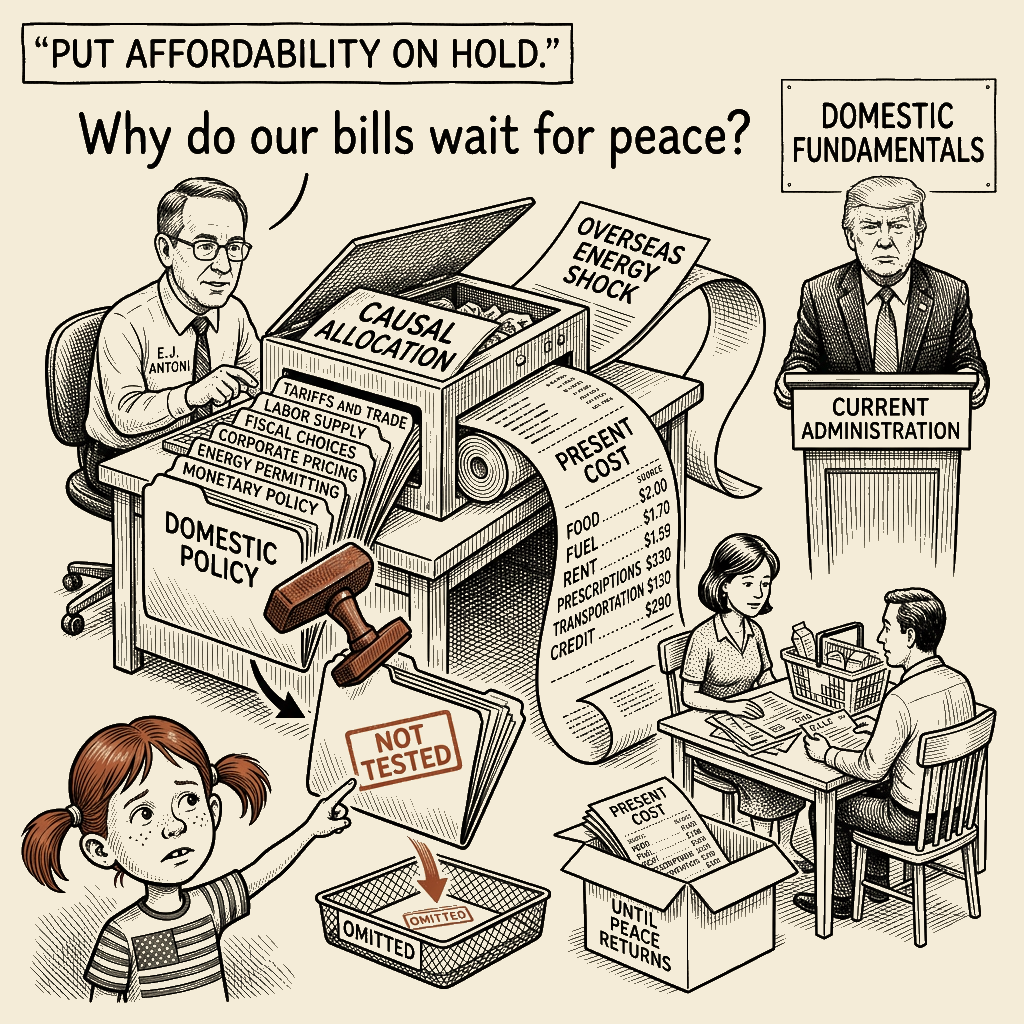
Why do our bills wait for peace?
What the Editorial Argues
The editorial argues that the affordability crisis began under the Biden administration, when prices outpaced earnings, and that real weekly pay began recovering under the current administration until conflicts with Iran and in Ukraine disrupted energy markets and supply chains. It attributes the renewed rise in prices, interest rates, and mortgage costs to that external energy shock rather than to domestic monetary, fiscal, trade, labor, regulatory, or corporate-pricing decisions. If the conflicts end, it predicts, energy markets will normalize, inflation expectations and interest rates will ease, and affordability will recover because the underlying domestic fundamentals remain sound.
Receipts
The move is to convert present domestic costs into a temporary foreign-caused interruption.
What the framing wants you to believe
- Biden-era inflation caused the accumulated loss of purchasing power; the current administration was repairing it; the Iran and Ukraine conflicts interrupted that repair.
- The present reversal is an external energy shock, not evidence that domestic policy is raising prices or failing to make families more prosperous.
- Once the wars end, energy prices will normalize and affordability will improve almost automatically. Until then, the current hardship is a temporary intermission rather than a verdict on the governing record.
What’s really going on
- The protected beneficiary is the Trump administration and the Republican coalition. Assigning the earlier injury to Biden and the current injury to overseas wars removes the governing coalition’s domestic choices from the causal conversation. E.J. Antoni and the Heritage Foundation gain authority as the interpreters of economic reality; Fox News has a concrete attention pathway through the article’s embedded videos, cross-promotional headlines, and subscription prompts. No payment or secret coordination is alleged.
- The omitted relation is the interaction among the foreign shock and domestic trade policy, labor supply, fiscal choices, corporate pricing, energy permitting, production, and monetary policy. The normalized harm is the household paying more for food, fuel, prescriptions, transportation, rent, and credit now while repair is made conditional on peace.
- One proposition is independently anchored: inflation is a rate of change in prices, not the price level, so slower inflation does not by itself undo accumulated increases (BLS, Consumer Price Index). As evidence for its economic claims, the editorial is Tier 3 commentary by E.J. Antoni, “EJ ANTONI: Overseas wars put affordability on hold, but that’s only temporary,” in Fox News Opinion. Its promise of “falling prices” therefore needs to say whether it means lower inflation or an actual reversal of the prior price level. The source provides no calendar publication date.
The Operation
Triage and authorship. The column is a signed Fox News Opinion piece by E.J. Antoni: it carries a foxnews.com address, Fox video and story modules, and Antoni’s byline. It is not an unsigned WSJ editorial; the collective “we,” the third-graf turn, and the house-board editorial voice are absent. The domain is economic policy, and the archetype is a signed think-tank causal ledger built around a foreign-shock blame-transfer and a temporary-affordability forecast. The advocated position is mixed, leaning selfish: affordability, employment, and peace are presented as general goods, while the allocation of credit and blame protects an incumbent political record.
Antoni identifies himself as the Heritage Foundation’s chief economist and Richard F. Aster fellow and as a senior fellow at Unleash Prosperity. The placement chain runs from the Antoni-Heritage credential to Fox’s opinion page and then through Fox’s surrounding videos, headlines, and subscription prompts. Those are concrete pathways to authority, agenda-setting influence, attention, and revenue. The column discloses no donor payment, grant, shared talking-point memorandum, or editorial direction, and none will be invented. Issue advocacy and placement establish the beneficiary; conspiracy is not needed, and is not alleged.
The construction. This class of argument was built in four beats: take the old antagonist, establish a measurable injury, insert a recovery under current management, break that recovery with an interruption outside the frame, then promise that the interruption will end and the original policy record can remain untouched.
The prose follows all four beats. Biden supplies the old villain. Prices outpacing earnings supplies the measurable injury. The roughly 2% rise in real weekly pay from January 2025 through what the editorial calls “this February” supplies the recovery under current management. The Iran conflict and Ukraine war supply the interruption. “Once peace returns, affordability will follow” closes the sequence and makes further domestic action unnecessary.
I drafted memos like this—not these wars, but the same causal subtraction. The craft was not necessarily in falsifying a number. It was in choosing the baseline, the villain, the verb, and the point at which the inquiry should stop. “Not domestic; rather overseas” is one of the hinges I used to install. It did not have to be a lie to do its work. It only had to terminate the argument where management wanted it terminated. My moral standing is not evidence, and my bitterness is not a receipt. The wiring is the evidence.
Who benefits. President Donald Trump and the Republican coalition benefit politically if households treat the current reversal as an overseas accident rather than as grounds for examining trade, labor, fiscal, regulatory, permitting, or monetary-policy choices. The benefit is conditional, but its pathway is concrete: an accountability shield can preserve governing-party support by displacing blame.
The Heritage Foundation and Antoni benefit institutionally when their preferred tax, regulatory, and energy frame appears as neutral economic explanation. The pathway is professional authority and agenda-setting influence, not an undocumented payment. Fox News benefits from an opinion item that reinforces its audience’s political identity while directing readers toward additional Fox content and subscription paths; the column does not quantify that traffic.
Who pays. American households bear the food, fuel, prescription, and transportation costs described in the editorial. Renters face the loss of the affordability gains the piece says were achieved after January 2025. Prospective buyers face higher mortgage rates compounded by higher home prices. The editorial discusses diesel, making trucking-dependent businesses and small employers plausible incidence channels, but it does not quantify how much they absorb or pass forward.
The editorial’s own magnitudes—a movement from roughly $60–$70 per barrel to $100–$120, and a roughly doubled monthly payment on a median-priced home over four years—show the scale it wants the reader to imagine. Because the piece supplies no budget denominator, income distribution, regional incidence, or counterfactual, those magnitudes remain editorial claims rather than verified estimates of who paid what. The incidence is clear enough to identify the cost-bearers; its magnitude is not established by the available record.
Alternative design. An affordability-centered design, reconstructed from the interests of the people carrying the bill now, would not make peace a prerequisite for accounting. It would measure energy pass-through by sector and household income; provide means-tested assistance for food, utilities, transportation, and rent arrears; protect renters and small carriers during the shock; accelerate safe domestic production and logistics where feasible; and place the domestic policy channels beside the foreign shock rather than behind it. It would publish a dated forecast with conditions capable of falsifying it. That is what an alternative designed around the stated rationale—affordability—would require.
Fear, greed, and laziness. The same categories must be applied without contempt.
- Antoni and the Heritage Foundation: fear of losing standing as the interpreter of economic reality; greed for credit for the favored policy frame; and laziness about testing the counterfactuals that could embarrass the frame.
- Trump and the Republican coalition: fear of voters connecting household costs to the governing record; greed for office and policy continuity; and laziness about owning the tradeoffs of the preferred program.
- The rank-and-file reader: fear of bills, debt, and another failed promise; greed for security and a chance at the American Dream; and laziness in accepting a clean causal story after a day of difficult arithmetic. That laziness is not stupidity. It is the relief of one sentence that makes the world make sense.
- The households carrying the costs: their fear and constrained money are real. Their immediate need for relief is not laziness, gullibility, or moral failure.
The selflessness/selfishness placement is mixed, leaning selfish. The preference for affordability, employment, and peace is legitimate. The exclusive credit and exclusive blame are not.
Technique audit.
-
False dichotomy / false dilemma — Bad-Faith Techniques Catalog, bf_catalog:
false_dichotomy, drawing on Douglas Walton. The textual cue is: “today’s higher prices are not from the government devaluing the currency by spending, borrowing and creating too much money. Rather, this is an energy shock.” The construction creates a two-item causal menu—domestic monetary action or foreign energy—and then removes the domestic item without testing it. Operationally, it prevents comparison at the point where domestic policy could interact with the shock. This is a behavior-pattern finding, not an assertion about Antoni’s private intent. -
Frame-engineered relabeling — Bad-Faith Techniques Catalog, bf_catalog:
frame_engineered_relabeling; MSI WSJ Editorial Technique Catalogue §4.1. The textual cues are the title’s “put affordability on hold” and “that’s only temporary,” followed by “once peace returns, affordability will follow.” The relabeling converts a level effect—the accumulation of prices already above their earlier baseline—into a waiting period. The reader is invited to experience current loss as an intermission in a favorable story rather than as a transfer from household income to creditors, energy suppliers, or other protected interests. The catalogue traces this lineage to Luntz’s term-engineering work and Lakoff’s framing research. The stricter evidence needed to call this a coordinated relabeling campaign—internal direction, focus-group testing, or a shared memorandum—was not supplied. The relabeling operation is visible; a term-testing campaign is not. -
Displacement of responsibility, distortion of consequences, and euphemistic labeling — Albert Bandura’s moral-disengagement framework. The cues are “overseas conflicts reversed some of that progress,” “There’s nothing wrong with the domestic fundamentals underpinning the American economy,” and “it’s crystal clear that once peace returns, affordability will follow.” The first phrase displaces agency from the decisions surrounding the conflicts, sanctions, shipping, energy supply, and domestic policy into an agentless shock. The certainty sentence distorts consequences by collapsing a contingent forecast into a promised endpoint. “On hold” is a partial instance of euphemistic labeling: present harm becomes an intermission. There is no dehumanization, and no blame is assigned to families for their hardship; the moral disengagement runs through causal displacement.
-
Technocratic-credential ledger and multiple-audience targeting — comparative use of MSI WSJ Editorial Technique Catalogue §§3.7 and 4.3. The cues are Antoni’s credential-heavy byline and the numerical claims “roughly 17%,” “about 4% less,” “roughly 2%,” and “fastest pace in at least four years.” This is not literally the catalogue’s “study shows” template; no study is cited. It is the same authority structure: credential plus numerical specificity in place of an inspectable evidence trail. Republicans receive the blame shield; conservative readers receive the tax, regulatory, and energy frame; economic readers receive the manufacturing, wage, and productivity claims; households receive the gasoline, grocery, and mortgage ledger. The messages are compatible, so multiple-audience targeting is not automatically bad faith. Here it becomes a permission structure because no third causal lane is offered.
-
Selection asymmetry and conclusion-by-assertion — adjacent to MSI WSJ Editorial Technique Catalogue §§4.9 and 4.14. “Nothing wrong with the domestic fundamentals” is the cue. The editorial does not examine the domestic causes that could make the statement false; it treats the absence of an audit as the result of an audit. This is not a literal blue-state-failure or academic-countercase template, but it uses the same selection mechanism: only the facts preserving the preferred conclusion enter the frame.
-
Closing-line cadence and inverse threat inflation — comparative use of MSI WSJ Editorial Technique Catalogue §§3.5 and 4.13. The cues are “it’s crystal clear that once peace returns, affordability will follow” and “All the other pieces of the puzzle are already in place.” The closing is built for extraction, quotation, and retransmission. Where the catalogue’s threat-inflation closer turns a policy dispute into an existential emergency, this piece runs the inverse: it deflates the present threat by placing repair in a confidently narrated future. Both closers control what remains after the reader shuts the page.
The lineage is the old one. Walter Lippmann’s interpreter translates a complicated world into a public frame; Edward Bernays’s lineage is the danger of treating consent as an engineered product that can be passed off as common sense. The present artifact establishes the form and the placement, not a concealed funding chain. The omission is the argument.
Audience management. The principal function is a permission structure: accept the present harm, but do not ask which domestic choices produced it. Identity confirmation tells the intended Republican reader that the governing record is vindicated by the very fact that an overseas enemy has become the explanation. Grievance ratification comes from naming overseas conflicts as the source of the reversal. Status display comes from Antoni’s titles, fellowships, and numerical fluency. The artifact’s counter-frame says: “Democrats say they’ll make life affordable. Your wallet may disagree.” It defeats the opposing claim without requiring the line to be Antoni’s own. Conscience displacement lets the reader support the favored program without treating the intervening household bills as a moral cost. The piece does not need to persuade every reader. It needs to make the next question feel unnecessary.
The Record
Source audit. The documentary record behind the column is thin, and the argument’s authority is inversely proportional to that thinness. The column is E.J. Antoni’s signed Fox News Opinion piece, “EJ ANTONI: Overseas wars put affordability on hold, but that’s only temporary.” The artifact gives no calendar year for “this February” and no publication date that resolves the phrase, so “this February” remains the editorial’s wording rather than becoming a dated interval. As evidence of what was said and how it was placed, the column is primary. As evidence for its economic claims, it is Tier 3 commentary.
There are no formal citations to adjudicate. The article reproduces no primary table, names no research report, and identifies no methodology. The embedded Fox headlines—including “VERY REAL” and “DOMINO EFFECT”—are link modules rather than citations supporting the argument.
The proper primary trails are the BLS CPI and employment-cost series, Federal Reserve H.15 and related rate series, EIA petroleum data, and Freddie Mac’s Primary Mortgage Market Survey. The column cites none of them and provides no dates, benchmark series, endpoint definitions, or author calculations. No specialist trade-press investigation, cross-spectrum think-tank analysis with transparent methodology, or other Tier 2 receipt appears in the available record.
Load-bearing claims and verification status.
- The Biden-era wage and inflation baseline: inflation supposedly exceeded 9% in 2022; nominal weekly pay rose roughly 17% while purchasing about 4% less. The column provides no earnings series, price index, endpoint dates, or calculation method. [unconfirmed: convergence threshold not met]
- The post-January 2025 recovery: real weekly pay supposedly rose roughly 2% from January 2025 through what the editorial calls “this February” and reversed half the cumulative losses of the Biden years. The article does not define “reversed half” mathematically or identify its wage and price measures. [unconfirmed: convergence threshold not met]
- The oil shock: oil supposedly moved from roughly $60–$70 per barrel to $100–$120, with the Iran conflict and associated supply-chain disruption causing the movement. No benchmark, date, grade, region, production series, inventory series, or underlying commodity source is identified. [unconfirmed: convergence threshold not met]
- The Ukraine, diesel, and interest-rate mechanism: Ukrainian strikes supposedly worsened shortages of oil and petroleum products, especially diesel; the resulting inflation expectations supposedly raised mortgage rates. The general pass-through mechanism is plausible, but the article provides no production, refining, inventory, export, shipping, price-attribution, rate chronology, or counterfactual evidence establishing it as the primary cause here. [unconfirmed: convergence threshold not met]
- The housing burden: interest rates supposedly rose at their fastest pace in forty years; higher home prices and mortgage rates combined to double the monthly payment on a median-priced home over four years; housing affordability supposedly fell each month from a three-year high to its lowest level since July 2024. No affordability index, price series, rate series, down-payment treatment, or monthly chronology is given. [unconfirmed: convergence threshold not met]
- The domestic-fundamentals claim: manufacturing expansion, job growth, private investment, and AI-driven productivity are offered as evidence that the domestic economy remains sound. The article identifies no production series, employment series, investment measure, productivity series, attribution method, or time horizon. [unconfirmed: convergence threshold not met]
- The terminal forecast: the conflicts will end, energy markets will normalize, inflation expectations and interest rates will fall, and affordability will follow. The forecast depends on unestablished premises about the duration of the conflicts, the persistence of supply-chain disruption, the behavior of energy prices after normalization, and the speed and reach of interest-rate relief. [unconfirmed: convergence threshold not met]
These claims remain part of the analysis as Antoni’s assertions, not as established facts. External verification is unresolved; they have not been silently discarded or converted into opposite claims.
Per-citation accuracy verdicts.
- There are no formal citations to verify. The embedded Fox headlines cannot confirm the body’s claims because the article neither quotes evidence from them nor identifies what in them bears on the argument.
- The distinction between the inflation rate and the price level is accurate. The problem is not that distinction; it is the editorial’s failure to specify whether its promised post-peace “falling prices” means a lower rate of increase or a reversal of accumulated prices.
- “Energy is an input cost in every product and service consumers buy” is directionally useful but literally overbroad. Pass-through differs by industry and can be offset or amplified by contracts, inventories, margins, competition, and substitution.
- “Interest rates followed as lenders demanded a higher return” compresses monetary policy, Treasury yields, expected inflation, term premiums, and mortgage-market spreads into a single lender-centered assertion without a causal model.
- The Ukrainian-strike claim supplies no production, refining, inventory, export, shipping, insurance, or price-attribution evidence.
- “AI is fueling productivity growth” is a causal assertion without a productivity series, industry attribution, or time horizon.
- “There’s nothing wrong with the domestic fundamentals” substitutes a conclusion for an examination. It cannot function as evidence for itself.
Load-bearing omissions.
- The domestic causal ledger: tariffs and trade policy, immigration and labor supply, fiscal choices, corporate pricing power, domestic production and permitting, and the Federal Reserve’s response to the combined shock.
- The actual policy text: the editorial praises “tax and regulatory reform” and “sound energy policy” without naming a statute, regulation, effective date, baseline, or distributional consequence. Nothing in that claim can be checked against a policy document.
- The incidence of harm: differences by income, housing tenure, age, region, and firm size. Average weekly pay does not reveal whether the lowest-paid workers gained or lost; median home-price figures do not distinguish renters from owners.
- The energy mechanism: U.S. production, refining capacity, inventories, imports, sanctions, shipping insurance, and the provisions of any actual settlement.
- The decomposition of mortgage rates: monetary policy, expected inflation, Treasury term premiums, and mortgage-market spreads.
- The counterfactual: what prices, wages, employment, energy use, and interest rates would have done without the conflicts, and how the article’s favored domestic policies would have performed under the same shock.
- The endpoint’s conditions and timing: “once peace returns” is not a forecast unless peace is defined, dated, and connected to specified energy and interest-rate mechanisms.
- The internal tension: the editorial correctly explains that lower inflation does not lower the price level, then predicts broad “falling prices” without demonstrating that prior increases will be reversed rather than merely offset by lower energy costs.
- Funding and coordination: no donor chain, grant, shared messaging document, or editorial direction is disclosed. The beneficiary finding rests on issue advocacy and placement, not an invented payment trail.
No underlying BLS, Federal Reserve, EIA, or Freddie Mac tables or author calculations are available for review. Internal Heritage or Fox correspondence, funding records, a counterfactual model, and responses from competing economists are likewise unavailable. No leaked memo specific to this piece is available in the record. My recollection of drafting comparable memos is retained memory and non-verifiable; it informs the technique analysis, not the piece’s funding, coordination, or intent. I therefore do not apply the Bad-Faith Techniques Catalog’s “manufactured controversy,” “astroturfing,” or “coordinated message discipline” entries. The documentary threshold for those techniques is not met by ideological alignment and repetition alone.
How to Recognize This
The pattern has a plain name: the temporary-shock accountability shield. It protects a favored domestic record by moving present costs across a border and into a future tense. War, regulation, inflation, supply chains, or some other emergency becomes the temporary cause; the governing record becomes the durable foundation; the reader is asked to wait because peace, “normalization,” or “resolution” will repair what the current policy has postponed.
The mechanism is simple. A preferred policy receives active verbs—reforms “spurred,” policies “kept inflation down,” investment “is booming.” The adverse result receives an external actor—conflicts “reversed” progress, energy shocks “caused” prices to rise. One sentence then converts the causal dispute into a forecast, and the forecast does the political work that the missing evidence cannot.
Four textual signals will help you recognize it next time:
- Passive causation for bad news; active agency for preferred policy. Compare “overseas conflicts reversed some of that progress” with the claim that tax and regulatory reform was “spurring economic activity and wage growth.” Ask which actors disappeared between the two sentences.
- A two-cause explanation presented as complete. Look for the “not X; rather, Y” construction. Here X is domestic monetary and fiscal causation and Y is foreign energy. A clean replacement story is not evidence that the omitted causes are absent.
- A future endpoint without a dated path. “Once peace returns,” “supply chains take time to heal,” and “affordability will follow” sound like mechanisms until you ask what peace means, how long normalization takes, what happens to sanctions, insurance, production, and rates, and what evidence would prove the promise false.
- Credential and numerical precision without a traceable receipt. A fellowship title can identify expertise. It cannot substitute for the underlying table, date range, benchmark, calculation, or funding disclosure. The more specific the numbers sound, the more important it is to reproduce them.
There is also a clean falsification test. If energy benchmarks normalize while rents, food costs, credit burdens, and mortgage payments remain elevated, the temporary-shock frame has failed. If affordability recovers before peace, its causal sequence was wrong. If the domestic fundamentals are as sound as the editorial insists, the same timeline should continue improving except where the foreign shock is demonstrably doing the work.
It works because it gives the reader a moral and causal simplification. Fear supplies the urgency—families are already hurting. Identity supplies the preferred culprit. The future supplies permission to postpone judgment. The reward is not merely a belief about oil prices; it is permission to keep supporting a political program without charging that program for the bills incurred in its name.
When you see the pattern, trace every number to its series, definition, date range, and funding. Reproduce the dates and calculations. Draw separate lines for the price level, the inflation rate, wages, energy prices, and interest rates; a falling rate of increase does not draw down the accumulated level. List every causal channel the editorial omitted, then require the author to rule them out rather than merely deny them. Ask who receives credit, who receives blame, who is asked to wait, and who benefits while waiting. Search for the same vocabulary across the syndication network, but do not infer coordination from repetition alone. Finally, reduce the frame’s automatic activation by writing the source’s causal sentence in two columns: “What the article says caused this” and “What else may bear on it.”
I built versions of this operation. I did not build the conflicts described in this article. I built the sentence that made the cost disappear into a future tense. That is why I know the tell.
The next time the frame appears, do not begin by asking whether the writer used ugly words. Ask which variable disappeared. Then ask who received credit for what remained, who was told to wait, and when the promise expires. Open the source, restore the omitted relation, and do not let a forecast about the end of a war close the argument about who is paying for it. Until the account is repaired, “temporary” is not an explanation. It is an invoice sent forward.

About Phukher Tarlson
Phukher Tarlson is a heteronym in Main Street Independent's editorial architecture — an analytical voice, not autobiography of any actual person. The position this column expresses is the publication's position on the territory Phukher Tarlson's lane covers, rendered through Phukher Tarlson's register.