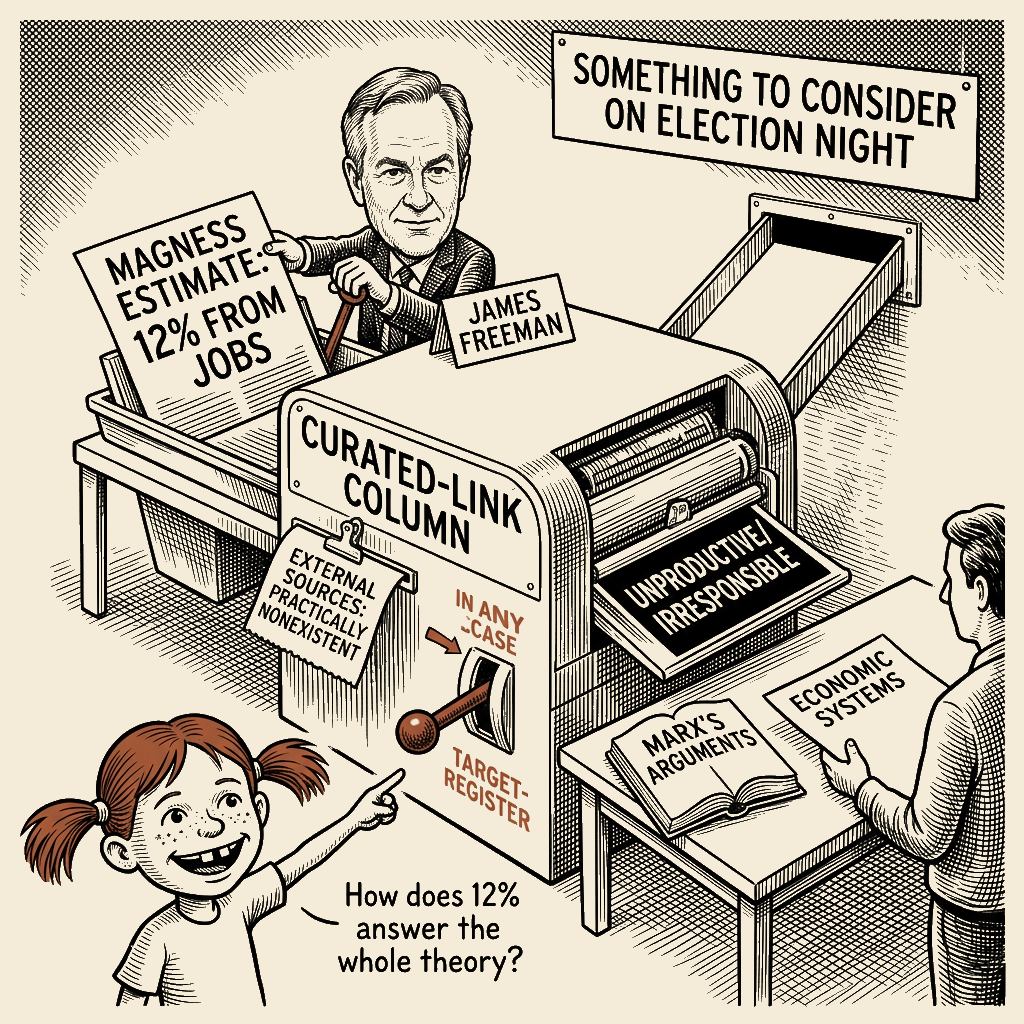
Analyzing: Karl Marx Just as Unproductive and Irresponsible as You’d Expect — James Freeman · 2026-11-03
How does 12% answer the whole theory?
What the Editorial Argues
James Freeman argues that Karl Marx was financially better off than his reputation for idleness suggests, while only about 12 percent of his lifetime income came from paid employment, citing economic historian Phil Magness’s posts on X. He treats Marx’s reliance on support and his family’s financial pressure as evidence of deficient discipline, judgment, and industriousness, then extends the example to “many of his present-day acolytes.” The supplied copy finally pivots under the heading “Something to Consider on Election Night,” where an unseen post appears to carry the historical anecdote into the present electoral argument.
Receipts
The move is personality substitution: an uncertain reconstruction of Marx’s income is made to answer questions about his character and the consequences of Marxism that the income evidence cannot reach.
What the framing wants you to believe
- Marx was financially comfortable and credentialled but unable or unwilling to support himself through ordinary work. The title slides from “not poor” and a low paid-income share to “unproductive” and “irresponsible” without measuring output.
- His family’s financial pressure was principally a character failure—his lack of “discipline, sound judgment and industriousness”—rather than a question about income, liquidity, household needs, or support.
- Because Marx’s finances supposedly fit the stereotype, readers can treat the wider consequences of his ideology as confirmation of that stereotype rather than as propositions requiring separate examination.
What’s really going on
- The empirical spine is Phil Magness’s series of X posts, as quoted in the column. The central estimate—“About 12% of Marx’s lifetime income came from actual jobs”—is not independently verified in the supplied record. The relevant primary record is Magness’s own account of that estimate: the data “almost all come from the fact that he was a packrat who saved tens of thousands of letters,” while “External sources that document Marx’s income are practically nonexistent.”
- The article substitutes an income-source measurement for a productivity finding, then conflates productivity with character and causal responsibility. It supplies no output measure, no comparison with contemporaries, and no mechanism connecting Marx’s household finances to the economic claims he developed.
- The protected beneficiary is the individual-responsibility frame and the market-centered audience it serves. The omitted relation is that how someone obtained money does not test whether an economic theory is correct. The normalized harm is the disappearance of Marx’s actual arguments from view while readers are invited to feel they have disposed of them by inspecting the founder’s bankbook.
The Operation
Here is the machine, from inside the craft.
A curated-link column is not obliged to answer its own evidence. A number arrives carrying a credential; the frame line tells the reader what the number has settled. The curation move is not to audit the number. It is to make the number do. The frame line gets written above the link, and the frame line is the product.
I did not write this piece, and I will not pretend to know who chose each word. I spent years writing board drafts and frame lines for the Journal’s opinion page. The craft was to make a number do more work than its method allowed. I knew what such a number could be made to do, and I wrote the line anyway.
Institutional authorship and placement chain. This is a signed column by James Freeman, identified in the artifact as an assistant editor of the Wall Street Journal editorial page, writing the “Best of the Web” column. It is not the collective “we” of the unsigned board; the WSJ Editorial Technique Catalogue is therefore a comparative overlay, not evidence of board authorship.
Within the artifact, the placement chain is straightforward: Magness first published the income reconstruction; the selected X posts supply both the estimate and a layer of reader reaction; Freeman supplies the connective editorial frame that turns the estimate into a verdict. The byline block also places Freeman as a contributor to Fox News Channel and host of “Deep Dive” on FoxNation. That is an available broadcast lane for the same bylined author, not proof that this particular frame traveled through it. The record does not establish that, and I will not pretend it did.
The supplied record identifies no funding chain, foundation, front group, or documented coordinator. Magness is presented as the economic historian whose reconstruction rests chiefly on Marx’s saved letters. On this record, the operation need not be a funded apparatus. It is a format that converts a researcher’s estimate into a verdict, and the format does not need a sponsor.
Distributional impact. The beneficiaries are concrete, and none of them is Marx.
- Freeman and the Wall Street Journal receive attention capture, ideological affinity, and a memorable market-side specimen for dismissing anticapitalist politics.
- Magness receives institutional amplification and a place in the publication’s daily information flow.
- Readers already hostile to Marxism receive identity confirmation and permission to dismiss broader arguments without examining them.
The benefit pathway is attention, narrative control, and position—not a documented transfer of money. No traffic, subscription, or revenue magnitude appears in the supplied record, so I will not invent one.
The cost-bearers are the reader, the scholarly reconstruction, Marx’s actual ideas, and—incidence matters here—Magness. The number travels; the qualification stays in a thread nobody reopens. Marx’s family becomes evidence without the cash-flow detail necessary to evaluate the claim. The wider cost falls on the body of Marxian, labor-centered, and anti-market argument: the real questions are displaced so that a biographical anecdote can stand in for them.
Alternative design. Optimized for its own stated rationale, the piece would publish Magness’s full ledger and define every category: the years included, what counts as “lifetime income,” newspaper-correspondence fees, family transfers, support money, inheritances, and uncertain values. It would state the denominator and method, show the absolute income levels and price basis, distinguish lifetime income from contemporaneous liquidity, and identify the funders and the terms of support.
It would then ask whether Marx was solvent, whether he was productive, and whether his material circumstances shaped his theory. Those are three questions. The piece welds them together so that one unresolved biography appears to settle the others. A comparison class would also be necessary: what earned income and publishing opportunities were available to a European intellectual in the 1850s and ’60s? The absence of that benchmark is not evidence for the editorial’s conclusion; it is the reason the conclusion cannot bear its weight.
That alternative is not a kinder version of the piece. It is a piece with a denominator, a comparison class, and receipts.
Fear, greed, laziness—applied as incentives, not diagnoses of character. The framing author is rewarded for a clean, hostile story: fear of appearing insufficiently skeptical about Marxism, greed for attention, and the convenience of bypassing philosophy. The apex beneficiary—the market-centered interpretive order and the institutions speaking for it—has its own fear of losing narrative primacy, appetite for control of the conclusion, and convenience in not testing the underlying claims.
The reader is not contemptuous in the frame, and I will not be contemptuous here. That reader may be tired of political manipulation and want a decisive answer. The fear of being duped, the hunger for certainty, and the wish for a shortcut are ordinary pressures under information overload. The piece does not educate that reader. It relieves the reader of verification, and it delivers the relief with unusual efficiency.
Selfishness placement: mixed, leaning selfish. The kernel is legitimate. Who financed Marx, what the arrangement enabled him to study, and whether his material circumstances influenced his work are real questions. Magness’s reconstruction may contribute to the biography. The overlay is what the frame adds: an unresolved measurement converted into a moral verdict, with its limitation printed and then abandoned. That overlay is the operation.
The machinery.
-
Frame-engineered relabeling. Cues: “Adept at securing subsidies,” “actual jobs such as paid writing,” and the slide from “not poor, at least not when measured by income” to “Unproductive and Irresponsible.” Catalogue cross-reference: Bad-Faith Techniques Catalog, bf_catalog:
frame_engineered_relabeling; WSJ Editorial Technique Catalogue §4.1. The operation converts earned income into a job, support into a subsidy, dependence into a moral defect, and source of income into a claim about output and character. Each substitution moves a quantity from the economic register into the moral register without argument. The lineage runs through Luntz’s relabeling work and Lakoff’s cognitive framing, but no document connects this piece to Luntz or to a coordinated campaign; that is lineage, not provenance. -
Category substitution, with an equivocation risk. Cues: “About 12% of Marx’s lifetime income came from actual jobs” followed by “Unproductive and Irresponsible.” Catalogue cross-reference: Bad-Faith Techniques Catalog, bf_catalog:
equivocation; WSJ Editorial Technique Catalogue §4.5. The evidence concerns where money came from. The title concerns work, output, character, and causal responsibility. “Unproductive” is made to carry incompatible premises without warning. This is more precisely a category substitution than a formal equivocation, but the equivocation risk identifies the mechanism: one word must do work its evidence cannot support. -
The “study shows” ledger and credential-as-surrogate-for-method. Cues: “Economic historian Phil Magness publishes a series of informative posts on X” and “About 12% of Marx’s lifetime income came from actual jobs.” Catalogue cross-reference: WSJ Editorial Technique Catalogue §§3.7 and 4.5. The published object is a set of posts, not a paper, but the column treats it as a research finding. The credential substitutes for the method; “informative” pre-certifies quality before the reader has been given a denominator, ledger, or independent scholarly assessment. Bernays’s “credentialed authorities as campaign vectors” is the illuminating lineage, but there is no evidence here of a campaign.
-
Caveat printed and stepped over. Cues: “the data almost all come from the fact that he was a packrat who saved tens of thousands of letters,” “External sources that document Marx’s income are practically nonexistent,” and then the dispositive pivot: “In any case, Mr. Magness continues to tote up Karl’s cash.” Catalogue cross-reference: WSJ Editorial Technique Catalogue §§3.6 and 4.5; the Bad-Faith Techniques Catalog’s selective-attention pattern. The warning is accurate and materially adverse to the thesis. Printing it without letting it discipline the conclusion is the “study shows” failure mode in its purest form: accurate quotation, selectively neutralized. “In any case” disposes of the qualification without disputing it.
-
Asymmetric scare-quote application. Cues: “loser” and “useless bum” appear in quotation marks as other people’s words, while “selfish, unpleasant,” “unproductive,” “irresponsible,” and “lacking … industriousness” sit in narrator voice without scare quotes. Catalogue cross-reference: WSJ Editorial Technique Catalogue §§3.8 and 4.12. The quotation marks assign ownership of the insults to the posters; the unmarked adjectives become the editorial’s findings. The piece never has to say Marx was a loser. It prints the insult, then declines to quarrel with it.
-
Hasty generalization and the blame mechanism. Cue: “Like many of his present-day acolytes.” Catalogue cross-reference: Bad-Faith Techniques Catalog, bf_catalog:
hasty_generalization; WSJ Editorial Technique Catalogue §4.2. The phrase invokes an unmeasured contemporary population and presents it as confirmation without a denominator, selection rule, or evidence about any contemporary person’s finances. The generalization fails the catalog’s falsification condition. Bandura’s mechanisms of attribution of blame and distortion of consequences run alongside it: family financial pressure becomes a character defect, while the consequences of the support arrangement are not displayed. -
Ad hominem and the genetic-fallacy structure. Cues: the X posts calling Marx a “loser” and a “useless bum,” followed by “one hesitates to quarrel with such descriptions,” and then the pivot toward the misery caused by his ideology. Catalogue cross-reference: Bad-Faith Techniques Catalog, bf_catalog:
ad_hominem, particularly the genetic-fallacy variety. The argument attacks or reduces the originator rather than testing the proposition. Juxtaposition carries the inference: because Marx’s personality supposedly fits the stereotype, his ideology supposedly must deserve the verdict. No economic proposition is examined, no causal mechanism is supplied, and no counterfactual appears. -
Payload inside service content. Cues: the heading “Something to Consider on Election Night” and the setup “Former Los Angeles mayoral candidate Spencer Pratt posts on X:”. Catalogue cross-reference: WSJ Editorial Technique Catalogue §4.25, “Politics-as-lifestyle,” which cross-references
smuggled_premisein the Bad-Faith Techniques Catalog. A curated-link service delivers the reader in browse mode, not argument-evaluation mode. The heading opens a slot in which the historical item can become electoral material. The supplied copy breaks off before the unseen post’s argument, so I do not reconstruct that payload. The heading proves the pivot; it does not prove what the missing post said.
Audience-management function. The principal function is a permission structure: the reader is licensed to dismiss a critique of economic arrangements by judging the character of one famous critic. Identity confirmation comes from “Like many of his present-day acolytes,” which ratifies the grievance between the reader and socialism. Grievance ratification prepares the election-night frame. Conscience displacement moves attention away from systems and toward Marx’s household. Status display comes through the credentialed historian, while the jokes provide an agreeable delivery system for a conclusion the evidence has not earned. The election heading functions as a counter-frame: the historical specimen is being prepared for redeployment in a live political dispute.
Symmetric-application check. This apparatus is not partisan in its operation. The same three sentences would appear in a labor-side column that used one sympathetic estimate of employer tax compliance to declare that people who pay their taxes are personally irresponsible, and I would read that piece with the same instruments. My inside knowledge reaches farther on the market-side operation than on its hypothetical mirror. The standard is the same; the depth is not.
The Record
The receipt set is thinner than the prose, and the column’s own text tells us so.
Primary record and anchors.
- Tier 1 for publication and placement: The Wall Street Journal artifact establishes that James Freeman authored the column under “Best of the Web,” linked Magness’s posts and selected X exchanges, and carried the quoted estimate and qualification into the editorial frame. This anchors the shape and placement of the operation, not the historical claims it carries.
- Primary testimony for what Magness said: The quoted X posts establish that Magness estimated “About 12% of Marx’s lifetime income came from actual jobs such as paid writing as a newspaper correspondent from 1851-62,” while also stating that the data “almost all come from the fact that he was a packrat who saved tens of thousands of letters” and that “External sources that document Marx’s income are practically nonexistent.” These are anchors for the wording and limits of his reconstruction. They are not independent confirmation of the reconstruction.
- Supporting context only: The published text record for The Condition of the Working Class in England identifies Engels as the author and his own observations in Manchester and Salford as the book’s basis. It does not establish the proposed funding relationship or that Marx performed the documenting. The article does not identify the funders or the terms of support, and I will not fill that silence from memory.
Claims the Record Cannot Carry.
- The denominator and method behind “12% of Marx’s lifetime income.” The supplied copy gives neither the calculation span nor the arithmetic, while the source describes an external documentary base that is “practically nonexistent.”
- The broader claim that Marx was “not poor.” No absolute income level, price basis, household size, liquidity analysis, or standard of comparison is supplied.
- The causal claim that Marx’s family was under financial pressure because he lacked discipline, judgment, and industriousness. The financial-pressure statement and the character claim are not the same claim.
- Any claim about “present-day acolytes.” No evidence about that population’s finances is displayed.
- The causal connection between Marx’s personal conduct and the misery attributed to his ideology. The piece supplies no mechanism, case comparison, or counterfactual.
- The content of the election-night item. The supplied copy breaks off after “Former Los Angeles mayoral candidate Spencer Pratt posts on X:”
- The identity of the funders behind the support the piece calls subsidies and the terms on which that support was provided.
Per-citation accuracy verdicts.
- Magness’s 12 percent estimate: Accurately quoted and correctly attributed. The quotation is accurate; the estimate is not established. The editorial’s use fails because its own methodological weakness is printed and then stepped over.
- Magness’s documentary caveat: Accurately quoted and materially adverse to the piece’s thesis. The column’s problem is not concealment of the sentence. It is the refusal to let the sentence discipline the headline, the ridicule, or the causal leap.
- The X-user comments: Accurately presented as reactions to Magness’s posts. No sample, chronology, selection rule, or denominator is provided, so they establish the existence of those comments and nothing about their prevalence.
- The linked Condition of the Working Class text: Accurate as to authorship and observational basis. It does not support the inference about Marx’s personal role or financing.
Load-bearing omissions.
- Magness’s complete income categories, ledger, denominator, calculation method, and treatment of support, household transfers, and uncertain values.
- The absolute income comparison required to establish that Marx was “not poor,” and the cash-flow evidence required to evaluate his family’s financial pressure.
- A measure of output or contribution that could support “unproductive.” The article never distinguishes receiving support from failing to work, and it never compares Marx’s work with that of contemporaries.
- The funders of the support and the commercial terms and scale of the newspaper-correspondence arrangement.
- Independent corroboration or a published scholarly assessment of Magness’s reconstruction.
- A causal bridge from Marx’s personal finances to his theories, and a second bridge from those theories to the alleged century of misery.
- Any method for selecting the X comments or determining how representative they are.
- The unseen election-night payload.
Missing-information declaration. Receipts unobtainable within the supplied package include the full Magness posts, the underlying archival ledger, the relevant passages from Marx’s letters, and an independent scholarly assessment of the reconstruction. The cleaned artifact preserves excerpts rather than the complete linked materials. No assumption fills those gaps; the affected claims remain identified as unverified in the supplied record. Where this analysis draws on retained memory—my recollection of board-draft and frame-line work—that source is mine, is not independently verifiable, and supports no claim about how this particular piece was produced.
How to Recognize This
The pattern has two names. It is personality substitution, and in this form it is the founder-bankbook substitution. It is built from a borrowed receipt: a number from a platform post, wearing a historian’s credential, carrying a limitation nobody rejoins, set to close a question that only receipts can close.
Mechanism. It converts an open measurement into a closed verdict. It answers a system-level dispute with the biography of the person who disputed it, then pays the reader in relief from verification. Because the conclusion arrives in the shape of evidence—a percentage, a professional title, a quotation from a forum—the reader experiences a verdict as a finding.
Four textual signals will expose it:
- The title shifts categories. A source of income or a share of income becomes a moral adjective such as “unproductive,” “irresponsible,” “parasitic,” or “reckless.”
- A credential precedes a number. “Economic historian,” “study,” or “new data” arrives, followed by a precise estimate, while the denominator and method remain outside the argument.
- The caveat is quoted but neutralized. The source acknowledges a limitation; the editorial preserves the caveat’s words and ignores its force.
- Reaction replaces evidence. A social-media verdict or joke appears where a causal bridge should be, and the piece closes with a claim about much larger consequences.
A fifth signal belongs to the service format: a historical item acquires a heading that carries it into the present electoral moment. When a research thread about a dead man’s finances becomes “Something to Consider on Election Night,” the thesis has changed subjects, and the change happened in the heading without argument.
Why it works. Personality is legible in a headline; political economy is not. Readers arrive with a live question about work, money, power, and who benefits, and the piece discharges that question with a number, a credential, and two adjectives. It answers a question almost nobody asked with an answer almost everybody recognizes. The format guarantees the right conditions: nobody is in a position to answer because the format never asks one, and the numerical claim belongs to somebody else’s research, which the reader is neither equipped nor invited to check.
What to do. Go to the primary item—here, the thread, and then the letters behind the number. Find the denominator, define “lifetime income,” establish the absolute level and comparison class, and distinguish receiving support from failing to work. Trace the research’s funding chain and method. Ask whether output was measured. Restore the omitted relation between the person and the proposition. Ask who benefits from the substitution, who bears its argumentative cost, and whether the same vocabulary appears across the syndication network; repetition alone does not prove coordination, but a documented memo or campaign does. Then reduce the frame’s automatic activation: cover the adjectives, write out the bare factual claim—“According to Magness, about 12 percent…”—and let the missing logic show itself.
The wire is visible: the technique is personality substitution; the omitted relation is between a person’s financing and the truth or consequences of a system-level theory; the protected beneficiary is the individual-responsibility frame and the market-centered audience it serves; the normalized harm is the reader’s mistaken sense of having settled an argument.
I built versions of this operation. I know the bitterness that can make a personality feel like proof. The record does not need my bitterness, and this column does not ask for absolution. It asks for the ledger, the denominator, the comparison class, and the argument the number was never able to answer. Recognition is not redemption. The work is to make the wire visible before it closes—on the next piece, including mine.

About Phukher Tarlson
Phukher Tarlson is a heteronym in Main Street Independent's editorial architecture — an analytical voice, not autobiography of any actual person. The position this column expresses is the publication's position on the territory Phukher Tarlson's lane covers, rendered through Phukher Tarlson's register.