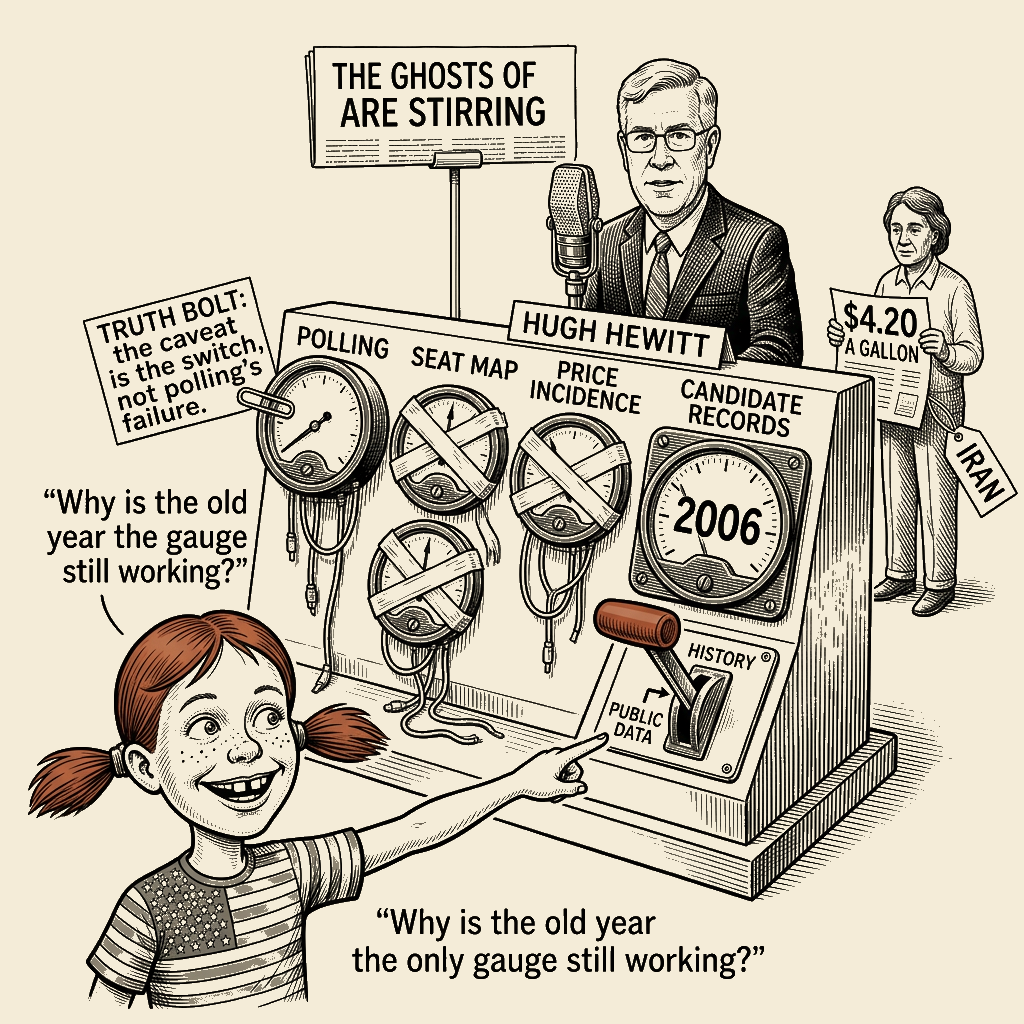
Analyzing: HUGH HEWITT: The ghosts of 2006 are stirring — but will they catch the GOP? — Hugh Hewitt · 2026-11-03
Why is the old year the only gauge still working?
What the Editorial Argues
The editorial warns Republicans that 2026 may repeat 2006, when the GOP suffered heavy midterm losses, while arguing that faster growth and better candidate quality make a complete Democratic wave less likely. It contrasts 2006’s weak economy and military burdens with today’s faster GDP, higher inflation and borrowing costs, and an ongoing conflict with Iran, presenting Trump as economically and militarily advantaged; it also treats a Kansas polling exercise as a warning that current pollsters cannot be trusted. It closes by urging GOP candidates to prepare for serious losses while telling voters to trust “the people” rather than the polling industry. The legitimate kernel is real: midterms can punish governing parties, inflation and housing costs matter, military operations impose costs, and candidate quality affects races; the dispute is over whether those facts have been measured or displaced by a reassuring frame.
Receipts
The editorial swaps a measurable present for a memorable past, then uses one polling caveat as permission for the swap.
What the framing wants you to believe
- 2006 is the twenty-years-earlier benchmark and affirmative comparison for 2026; this cycle differs in growth and candidate quality, and the races the column rates highly are races Republicans can win.
- The price shock—$4.20 a gallon, 3.7% inflation, and a 7.25% mortgage rate—is the visible cost of a necessary fight with a sworn enemy, not evidence against the party in power.
- The numbers cannot settle this cycle, so history is the better guide.
What’s really going on
- Protected beneficiary: The Republican Party and Trump’s governing coalition benefit through turnout, issue ownership, preservation of office, and policy latitude. Hugh Hewitt and Fox News benefit through attention, audience loyalty, and a frame prepared for cross-platform broadcast. The mechanism is not a hidden donor order; it is the documented placement chain from the column to the radio and television program.
- Normalized harm: Households absorb the inflation, gasoline, and borrowing costs. Service members and their families have their deaths converted into evidence of presidential resolve. Iranian civilians, Iranian military personnel, and regional populations appear as a “cancer” without civilian, refugee, fiscal, or regional-security accounting. Disagreement is recoded as disloyalty, which lets the governing coalition support the policy while displacing moral responsibility onto the audience.
- Omitted relation and evidentiary weak point: The Kansas poll’s concession may narrow what that poll can prove; it does not make polling irrelevant or turn a twenty-year-old election into a forecast model. Official U.S. Senate election records also expose the map omission: Democrats gained a net three seats in 2020; Collins and Tester won 2020 Class 2 seats; Husted’s Class 3 seat was last contested in 2024; and 2006 was a Class 2 cycle. The election that set the 2026 Senate-class map is absent from the column’s benchmark. The 2018 and 2022 Republican midterm results are absent as well. (U.S. Senate, official election statistics, 2006, 2020, 2024.)
The Operation
This is a signed Fox News Opinion column by Hugh Hewitt, not a Wall Street Journal editorial-board piece or an unsigned National Review essay. Its archetype is the warning-sales frame: a remembered electoral catastrophe is used to announce present danger, discount the measurements that could test the analogy, and close with reassurance calibrated to the audience’s mood. The advocated position is mixed in its stated form and selfish in its institutional effect. Republicans can lose midterms, inflation hurts, wars impose costs, candidate quality affects races, and the party has a legitimate reason to assess its vulnerability. The operation lies in the motivated stop: the argument follows those true facts only until continuing would require the author to distinguish uncertainty from loyalty.
I built pieces of this class. The architecture is familiar; the indictment still has to rest on what this artifact proves.
Placement, authorship, and the clock. The author is Hugh Hewitt; the institutional distributor is Fox News Opinion; the downstream system described by the piece and its biography includes Salem Radio Network affiliates, broadcast radio, Fox television, streaming platforms, the Fox News app, newsletters, and a network the biography describes as exceeding 400 affiliates. The column declares its own function: “This column previews the lead story that will drive his radio/TV show today.”
That establishes a publication-and-broadcast relationship. It does not establish that identical copy ran unchanged across four carriers or that every affiliate received the same broadcast that morning. The indictment does not need the exaggeration. The artifact shows a frame packaged in advance for a broadcast: branded opening, historical warning, price series, enemy narrative, candidate scorecard, and quotable close.
The column is dated Tuesday, November 3, 2026—Election Day. An Election Day piece that opens by naming a catastrophe, closes by dispensing reassurance, and prices the reader’s fear is not detached analysis. It is a broadcast unit timed to the hours when the audience is available and anxious. The product’s content is the anxiety. The product is the reassurance.
No donor payment, editorial command, focus-group result, or coordinated campaign memo is documented in the supplied material. The finding is therefore not secret coordination. It is a placement architecture in which the same frame reaches a receptive audience through several branded channels. I will not manufacture the missing link.
No firsthand knowledge of this column’s internal creation is claimed. The technique identification rests on the text and the placement record, not on a convenient fiction about secret instructions.
Who benefits, and by what pathway. The party in power benefits through attribution. If $4.20 a gallon and 3.7% inflation belong to a foreign adversary rather than to the tax, trade, energy, interest-rate, and fiscal record of the government in office, the price series stops functioning as an electoral argument. No dollar figure is required for that pathway: the attribution is the mechanism. I have no document showing that any hand directed this sentence. The beneficiary is structural, and structural-incentive language is the honest register.
Donald Trump benefits through the conversion of adverse economic conditions into evidence of presidential strength and the conversion of the Iran conflict into a claim of national-security achievement. The party benefits through mobilization: “Prep for another 2006, but should not be surprised if the results are not that bad” serves a base that has to show up without being told the sky is falling. A pure alarm frame and a pure reassurance frame each cost a network a day; the sandwich is the product.
Hugh Hewitt and Fox benefit through attention, loyalty, and cross-platform reach. The columnist gains an authoritative morning preview; the network gains a frame that can move from the page to the microphone, the television segment, the app, and the newsletter without requiring every host to reconstruct the evidence. That is a concrete pathway: visibility, audience capture, and narrative control.
Who pays, and by what pathway. The rank-and-file voter pays in decision quality—the difference between choosing with the price data, candidate records, and electoral map in hand and choosing with a historical analogy substituted for all three. The service members counted by the column pay in rhetoric: their deaths become evidence of the policy’s wisdom—“the cost is high”—rather than the subject of a judgment about the policy. A dead service member is a receipt, not a credential.
Iranian civilians and the region’s neighbors pay through target definition. “Cow[ed] or collapsed” and “bringing Iran to its knees” close off the branch in which the stated objective—depriving Iran of a nuclear weapons capability—might be achieved without regime change. The column offers no accounting of the population a collapse would land on and no diplomatic, economic, or military alternative. Trans children, their families, and trans people affected by the policies the column calls “craziness” pay in vocabulary. The term does policy work, converting a question about a rule into a question about a person’s coherence, and a question about a person’s coherence is a question the frame never has to answer. The technique is the target; the people are not.
The alternative design, if the column were optimized for its own stated rationale. Its stated rationale is that Republicans should understand the cycle they are in. On that rationale, the column would compare 2006 with 2018, 2022, 2020, and the actual 2026 Senate map rather than allowing one analogy to swallow the election. It would report the Kansas poll with its field dates, screener, weighting, sample disposition, and margin instead of using the paper’s concession to discredit polling. It would identify marginal seats, filing status, incumbents, challengers, and each candidate’s voting and policy record rather than assign unpublished stars.
It would distinguish GDP growth from household purchasing power; identify whether “3.7% inflation” means year-over-year CPI or another measure; date the gasoline and mortgage observations; and give the price shock’s incidence by income, region, and household calculation. It would state the Iran operation’s objective, legal basis, measures of success, exit conditions, alternatives, fiscal cost, and civilian and regional consequences. It would quote the actual text of the rules it calls extreme and run the distributional accounting on the tax provisions it praises.
That design is not my preference. It is what a reader making a decision requires, and it is reconstructed from the interests of the people the current frame excludes.
Fear, greed, and laziness—applied to three constituencies. The framing author fears professional exposure if the wave arrives after a column that minimized it; wants attention; and receives the convenience of a vivid analogy that does not require reading a poll’s methodological file. The legitimate service is real: early warning matters, and the choice of 2006 as a reference point is not itself dishonest. The overlay begins when the reference point is exempted from comparison.
The apex beneficiary fears a Senate majority and an oversight environment, wants power and policy latitude, and benefits from talking points that bind uncertainty to the team. The rank-and-file reader fears something real: money is tight, the war is frightening, and partisan exclusion stings. There is no credible greed in that reader’s material interest beyond self-protection, and I will not manufacture one. Laziness is real and human: nobody wants to relearn politics every four years. The desire for a legible story in a year when one’s own arithmetic has stopped working is not a character defect. It is a reasonable response to being handed a frame every cycle. The frame is cheap because the alternative is expensive: reading methodology, incidence tables, candidate records, and post-strike assessments.
Critical-question and failure-mode audit. The beneficiary pathways are concrete—votes, office, policy control, attention, and narrative continuity—not merely ideological alignment. The invisible beneficiaries and cost-bearers can be named. Cost incidence is misassigned when household prices become merely a Republican polling problem and military sacrifice becomes a credential of resolve. Fear, greed, and laziness have been applied across the author, the apex beneficiaries, and the reader.
The audit also marks what did not trigger. Symbolic inference is avoided because each beneficiary has an identified pathway. Conspiracy inference is avoided because no coordinated direction is documented. The legitimate warning is not collapsed into the overlay. The alternative design comes from the affected constituencies’ interests, not from a partisan mirror. Frame-bounded blindness and cost-incidence error are present; the other failure modes are not.
The apparatus. Here is how the machine was built. The 2006 shellacking, already twenty years old by 2026, is an efficient frame because it is already in the audience’s memory and requires no forecast model to operate. Put a year on the board and the reader’s fear does much of the work. The paragraph about unreliable polling does not constrain the conclusion; operationally, it licenses the conclusion by making the analogy the only measure left standing.
Alarm by analogy—bf_catalog: hasty_generalization, partial match. The cues are “the year most analogous to 2026 is 2006” and the description of that election as a “clear and present danger signal.” The Bad-Faith Techniques Catalog defines hasty generalization as drawing a broad conclusion from evidence too limited to support it. The editorial acknowledges that the electorate has changed and that 1986 is not a close fit, so this is a partial rather than complete match. The operation nevertheless selects one salient electoral cycle as the default reference and supplies no base rate, forecast model, seat map, or comparison with other midterm cycles. Walter Lippmann’s lineage is the ready-made public picture: one vivid historical image becomes the reader’s equipment for judging the present.
Pre-emptive legitimacy withdrawal—bf_catalog: pre-emptive legitimacy-withdrawal, partial structural match. The cue is: “That concession about the reality of polling in 2026 should give every analyst pause before citing ‘the polls.’” It is followed by: “There isn’t great public data on which either party can rely, but there is history.”
The move withdraws the legitimacy of the measurement category before any result is engaged, leaving the analogy as the only measurement available. It is a structural analogue of the Bad-Faith Techniques Catalog’s pre-emptive legitimacy-withdrawal pattern, although the artifact does not establish the catalog’s full selective-application test. The sophistication lies in the sequence: the column first borrows the credentialed authority of the Washington Post—85,000 calls and 50,000 text messages—then spends that borrowed credibility to authorize discarding the numbers. The WSJ Editorial Technique Catalogue’s “study shows” ledger is running in reverse: the citation supplies the authority while the methodology disappears from the frame.
Frame-engineered relabeling—bf_catalog: frame_engineered_relabeling, lexical match. The cues include “A truth bolt about polling from The Washington Post,” “the era of 3%-4% 30-year mortgage rates was an aberration,” Bush’s “thumpin’” description of the 2006 defeat, and “decisively winning” immediately before the concession that the operation has not been decisively won.
The Bad-Faith Techniques Catalog defines this technique as substituting one term for another to shift the cognitive frame. “Truth bolt” converts a methodological caveat into a revelation and exempts it from the qualifications that would make it usable. “Aberration” resets the baseline so that today’s mortgage rate appears ordinary while the lower rates the reader remembers appear exceptional. “Thumpin’” softens a Republican shellacking into something resembling weather. “Decisively winning” substitutes an adjective for a missing assessment. Frank Luntz’s and George Lakoff’s lineage explains how moral substitution can occur beneath an apparently empirical argument. The lexical operation is documented; a centralized message plan for this particular column is not, so the finding does not extend that far.
Friend-enemy framing, civilizational inflation, and threat absorption. The cues are “our country’s sworn enemy of 47 years,” “the greatest state sponsor of terror on the planet,” “the rogue regime,” “the cancer in the region for 47 years is being ripped out,” and “the fanatics atop the Islamic Republic of Iran.” The National Review Editorial Technique Catalogue identifies this as the civilizational frame; the WSJ Editorial Technique Catalogue identifies the movement from concrete policy stakes to civilizational threat as threat inflation. Carl Schmitt supplies the conceptual lineage: opposition is recoded as alignment with an existential enemy.
Operationally, the Iran passage is not evidence for the election forecast. It is an inoculation against dissent. Once the government is defined as treating a cancer, the operation ceases to be measured by its objectives and effects. Opposition becomes evidence of disloyalty. Any future cost can then appear as evidence of commitment rather than evidence of error. The domestic-vote function is Schmitt’s friend-enemy apparatus turned outward and then brought home.
Characterological substitution—partial bf_catalog: ad_hominem; partial bf_catalog: strawman. The candidate section calls Abdul El-Sayed “extremist,” Mary Peltola “scandal-plagued,” and the policy around transgender athletes “transgender craziness.” The cue “Only partisans of the left deny the blockade is bringing Iran to its knees” converts substantive disagreement into a loyalty test.
The Bad-Faith Techniques Catalog defines ad hominem as attacking the bearer, character, or motive in place of evidence about the proposition. Some of these characterizations may correspond to real records; the defect is not harshness. It is substitution. The labels do argumentative work where platform text, voting history, campaign-finance records, and primary documents should do it.
The selectional-strawman match is necessarily partial because neither policy text is supplied. The mechanical test—find the original statement, find the characterization, compare—cannot be completed. That absence is the operation: the frame never has to survive contact with a document. “Only partisans of the left” is not a complete No True Scotsman finding because no prior category definition is shown and no counterexample is explicitly excluded. It is better described as manufactured unanimity through partisan identity.
The common-sense pivot and attribution of blame. The cues are “The rational voter knows the hike in the cost of gas and the inflation is because President Trump is taking on the fanatics atop the Islamic Republic of Iran,” and “Younger voters looking to buy their first home or ‘move-up’ don’t know that the era of 3%-4% 30-year mortgage rates was an aberration. They just know they missed that window.”
The WSJ Editorial Technique Catalogue describes the common-sense/elite pivot as aligning a preferred position with ordinary judgment while casting contrary positions as products of a discredited class. Here the pivot runs in a more intimate form: the audience is divided into the rational, who get to be patriots, and the rest, who are merely partisan. The second sentence is the operation’s sharpest edge because it tells the audience that its pain is a cognitive error. Bandura’s attribution of blame and distortion of consequences are operating together: the consequences are converted into evidence of the blameholder’s virtue, and the sufferer’s inability to afford the preferred frame becomes a character defect.
The scorecard with no rater, scale, or method. The cue is: “Challengers Mike Rogers in Michigan and Michele Tafoya in Minnesota are five-star candidates running against zero-star Ds.” The WSJ Editorial Technique Catalogue’s “study shows” ledger and technocratic-credential patterns are relevant comparisons: a rating apparatus supplies authority while the conditions of production remain outside the frame.
No rater, scale, criteria, or source is given. The stars are applied inconsistently: they go to challengers in one sentence and to incumbents in another—“Senators Collins, Husted, Marshall and Sullivan have run great races”—while doing the load-bearing work of the recommendation. This is not a clean formal fallacy; the evidentiary opacity is sufficient. It is manufactured consensus without the pretense of a survey.
The roster is also confused. The operative designation being analyzed is the source’s “Michigan challenger” label for Mike Rogers in the same paragraph that names El-Sayed as the Michigan Democrat. Official Senate biographical and election records supply a conflicting earlier chronology: after serving in the House, Rogers entered the Senate by appointment in 2023, won the 2023 special election, and defeated El-Sayed in 2024. The source does not reconcile that earlier chronology with the 2026 challenger designation. The label remains the source’s operative classification, while the discrepancy requires source review rather than a silent correction. The column presents a roster without distinguishing incumbents, possible entrants, filing status, and the completed 2024 race it appears to have imported into 2026.
Coordinated message discipline—bf_catalog: coordinated_message_discipline, architecture only. The cues are the branded phrase “truth bolt” and the declared function: “This column previews the lead story that will drive his radio/TV show today.” The Bad-Faith Techniques Catalog’s coordinated-message pattern requires systematic organization-wide deployment across speakers and venues. This artifact establishes the branded label, the authored frame, and the publication-to-show relationship. It does not establish identical copy on every carrier, and the full coordinated-pattern finding therefore remains unproven.
What it does establish is architecture. The column announces the broadcast chain in advance and supplies the material every participant can repeat without rereading the evidence. That is how message discipline begins: not necessarily with a secret order, but with a frame packaged for relay. Bernays’s engineered consent and Luntz’s message-testing lineage explain the form; they do not prove that this column was centrally briefed.
The closing-line cadence and team imperative. The WSJ Editorial Technique Catalogue describes the page’s closing line as short, declarative, quotable, and engineered for retransmission. The cue is the borrowed injunction: “‘Trust the people’ was Churchill’s phrase, which he got from his father. So we all should.”
The close borrows a dead statesman’s authority twice—once for the phrase, once for the inheritance—and hangs it on an instruction about a vote count. The WSJ Editorial Technique Catalogue’s Fox Opinion note identifies direct recruitment of the reader through second-person and collective imperative. This column usually speaks in the third person, but the close switches the geometry: “GOPers should prep” becomes “we all should.” The reader is not asked to finish evaluating the evidence; the reader is enrolled in the team and told whom to trust. The Bad-Faith Techniques Catalog’s “appeal to nature, tradition, popularity” entry offers only a partial analogy because Churchill is doing real rhetorical work and the column is not claiming that a policy is good because it polls well. Operationally, the close transfers the verdict from unresolved evidence to popular judgment. What travels out of the building is the phrase. The argument stays put.
Across the piece, Bandura’s mechanisms run in concert: moral justification supplies the higher cause; euphemistic labeling turns caveats and defeats into “truth bolts” and “thumpin’”; displacement of responsibility assigns prices to Iran without a demonstrated transmission mechanism; distortion of consequences compresses a war’s costs into a casualty count and its effects into “decisively winning”; attribution of blame makes opposition and economic pain evidence of disloyalty or ignorance. The human targets are not the object of the analysis. The operation is.
Audience-management function. The permission structure says Republicans can support the president despite inflation and war by treating both as tests of toughness. Identity confirmation comes through “GOPers,” “our country,” and “we.” Grievance ratification comes through 2006, gasoline prices, housing costs, and supposedly extreme Democrats. Status display comes through the credential-heavy Fox and Salem presentation. The counter-frame declares polling suspect and substitutes history. Conscience displacement allows the costs of war to appear as evidence of resolve rather than as a claim requiring accounting. The close is not a conclusion. It is an activation command.
The Record
Tier 1 anchor receipts. Official U.S. Senate and House election records confirm the column’s central 2006 receipt: Republicans lost a net six Senate seats and thirty House seats in 2006. The 1986 comparison is also correct: the GOP lost eight Senate seats that year. The arithmetic is not the problem.
The Bureau of Economic Analysis put third-quarter 2006 GDP growth at 1.6% annualized in its advance estimate and revised it to 2.0% in its second estimate. The column’s 1.6% and 2% figures are correct. (BEA, GDP third-quarter 2006 advance and second estimates.)
The Bureau of Labor Statistics’ October 2006 figures require the column’s missing label: headline all-items CPI was running at 3.3% over the preceding twelve months, while core CPI was 2.1%. Freddie Mac’s October 2006 Primary Mortgage Market Survey supports the approximately 6.36% thirty-year fixed-rate figure. The current 3.7% inflation, $4.20 gasoline, and 7.25% mortgage figures remain the editorial’s figures without a date, index definition, or survey series. (BLS CPI release; Freddie Mac PMMS, October 2006.)
The official Senate record sharpens the electoral omission. Democrats gained a net three seats in 2020. Collins and Tester were elected that year to Class 2 seats, and those seats are contested again in 2026. Husted occupies a Class 3 seat last contested in 2024. The 2006 election was a Class 2 cycle. The election that set the 2026 Senate-class exposure is therefore precisely the election the column does not place beside its benchmark.
The 2018 results bear on the borrowed candidate-quality narrative. Josh Hawley lost Arizona to Ruben Gallego; Dave McCormick lost Pennsylvania to Bob Casey Jr. The column makes 2006—not 2018—its affirmative comparison and gives the reader no account of what the candidate-quality argument produced when tested in 2018. The 2022 midterm results are omitted as well.
Official Senate biographical and election records conflict with the “Michigan challenger” designation: after serving in the House, Rogers entered the Senate by appointment in 2023, won the 2023 special election, and defeated El-Sayed in the 2024 regular election. The operative designation being analyzed is the source’s 2026 label. That earlier chronology remains an unresolved discrepancy requiring source review; it is not a license to silently replace the source’s classification.
The Department of Defense’s public announcement of Operation Midnight Hammer identifies the June 21–22, 2025 strikes and the Fordow, Natanz, and Esfahan nuclear facilities. Iran has officially been designated a state sponsor of terrorism since 1984. The column’s superlative—“the greatest state sponsor of terror on the planet”—is the columnist’s characterization, not an official designation. (U.S. Department of Defense operation announcement; U.S. State Department terrorism-designation list.)
What the editorial records correctly. The reference to Terri Schiavo, Hurricane Katrina, and the failed Social Security reform effort belongs to Bush’s difficult 2005. The sequence is accurate. The 2025 reconciliation law did contain the no-tax-on-tips and overtime provisions the column praises, but the editorial gives no statute, effective date, covered income, or distributional effect. Those provisions are authenticated only as mentions, not as evidence that the economy is strong.
Where the editorial’s own account defeats its rhetoric. The claim that one strike “obliterated” Iran’s nuclear program is not supported by the column. A few paragraphs later, the column says the regime “immediately began rebuilding its shattered nuke program.” A program that was obliterated and immediately rebuilt is not a measured description of a strike; it is a rhetorical permission slip. No post-strike assessment is cited, no objective is stated, and no alternative is costed.
The casualty counts have the same problem. The editorial attributes more than 1,000 American deaths since 1979 to Iran and says twenty-three service members have died since February. It supplies no counting rule, incident list, or official accounting. Those numbers remain the editorial’s assertions. They cannot be converted into evidence that the policy is wise merely by placing them next to “cost.”
The spending comparison is equally unready for use. The column gives approximately $2.8 billion for 2006 and approximately $4 billion for 2026, then claims the GOP has “a significant advantage.” It does not define whether either figure includes candidates, parties, outside groups, primary spending, or all of them. Without a common category, the totals do not establish a trend; without a source, the projected advantage does not exist as evidence.
The appearance counts have the same defect. The column says Bush made sixteen campaign appearances in October 2006 and Trump has made thirty or more in October 2026. It does not define an appearance, distinguish rallies from fundraising or private events, or provide a schedule. These are the column’s counts, not audited mobilization data.
Per-citation accuracy verdicts
| Editorial claim | Verdict | Record and limitation |
|---|---|---|
| Republicans lost six Senate and thirty House seats in 2006; eight Senate seats in 1986 | Accurate | Confirmed by official U.S. Senate and House election records. |
| Third-quarter 2006 GDP was 1.6%, later revised to 2.0% | Accurate | Confirmed by BEA advance and second estimates. |
| 2006 inflation was 2.1% | Incomplete | The 2.1% figure was core CPI; headline CPI was 3.3%. The editorial does not disclose the distinction. |
| 2006 mortgage rate was approximately 6.36% | Accurate as a base-period figure | Supported by Freddie Mac’s October 2006 PMMS. The current 7.25% comparison lacks a date and series definition. |
| 2006 gasoline averaged $2.25; current gasoline is $4.20 | Incomplete and partly unverifiable as presented | The base figure corresponds to the late-October low rather than the full monthly average; the current figure has no date or source. |
| Washington Post poll used 85,000 calls and 50,000 texts and found 32% Democratic and 12% Republican response | Faithful excerpt; incomplete evidentiary frame | The column reports the figures and caveat accurately, but the original questionnaire, field dates, weighting, likely-voter model, and margin are absent. The cited poll cannot bear independent forecasting weight without those materials. |
| Operation Midnight Hammer struck Fordow, Natanz, and Esfahan | Confirmed at the level of operation and sites | Supported by the Department of Defense’s public announcement. |
| The strikes “obliterated” Iran’s nuclear program | Unsupported and contradicted by the editorial’s later account | No assessment is cited; the editorial itself says rebuilding began immediately. |
| Twenty-three U.S. service members have died since February; more than 1,000 American deaths are attributed to Iran since 1979 | [unconfirmed: convergence threshold not met] | No counting rule, incident list, or primary accounting is supplied. The claims remain unconfirmed in the supplied record. |
| About $2.8 billion was spent in 2006 and $4 billion in 2026 | [unconfirmed: convergence threshold not met] | Neither figure has a source or common expenditure definition. |
| Trump has made thirty or more October appearances, against Bush’s sixteen in 2006 | [unconfirmed: convergence threshold not met] | No definition, schedule, or source supports the comparison as presented. |
| Rogers is a Michigan challenger; five-star candidates are running against zero-star Democrats | Faithful to source; external discrepancy unresolved | The column calls Rogers a Michigan challenger and gives no rater, scale, criteria, or source for the stars. Official Senate records supply an earlier chronology that the column does not reconcile with the 2026 designation; that discrepancy requires source review rather than a silent correction. |
| “Crime is down”; “DEI is DOA”; the border is “shuttered and kept sealed”; a “massive tax hike” was averted | Unsupported slogans | No statistic, category, period, executive order, encounter data, bill, score, or definition is supplied. Each remains [unconfirmed: convergence threshold not met] as presented. |
| “Trust the people” was Churchill’s phrase, inherited from his father | Editorial attribution only | The artifact does not source the genealogy. The attribution remains unverified. |
Load-bearing omissions. The poll’s field dates, respondent screen, weighting, sample disposition, likely-voter model, and margin are missing. The 2018, 2022, and 2020 election results are missing. The economic figures lack common definitions and dates; point observations are treated as comparable household conditions. The distributional incidence of the price shock is missing. No income decile, region, household calculation, or decomposition of the gasoline and mortgage changes appears. The causal path from the Iran conflict to the quoted inflation and gasoline figures is asserted but never demonstrated.
The distributional accounting of the tax provisions is missing. The column celebrates cuts without showing who receives them, at what value, or in which years. The Iran operation’s objective, legal basis, congressional oversight, measures of success, exit conditions, military and fiscal costs, civilian consequences, regional consequences, and alternatives are missing. No dissenting Iran analyst, election forecaster, Democratic strategist, or skeptical specialist is given space.
The candidate judgments omit platforms, voting records, fundraising, filing status, and the documents behind the loaded characterizations. The $4 billion spending estimate has no sponsor, coverage period, or expenditure definition. The mortgage rate stops before the monthly payment on a median home, which is where the pain becomes arithmetic.
None of these omissions is accidental. Together they perform the frame’s work. The reader is given a year, a price, an enemy, and a recommendation. Everything that might interrupt the sequence is pushed out of the room.
Missing-information declaration. The original poll methodological file, current economic-series documentation, campaign-finance filings, military casualty records, strike assessments, and candidate records were not supplied. No leaked memo is referenced, so none has been invented or used. No firsthand knowledge of this column’s internal creation is claimed. Where the documentary record could not carry a claim, it is reported as unconfirmed rather than converted into fact.
How to Recognize This
The pattern has a plain name: the warning-sales frame, built as alarm-by-analogy with enemy inoculation. A piece announces a catastrophe in order to discount it, sells the announcement as content, and closes with reassurance calibrated to the audience’s mood. The steps come in this order: name a past catastrophe as the benchmark for a present fear; insert a paragraph about unreliable data beside the conclusion the data would have checked; attach the price embarrassing to the party in power to a named external enemy; rate the candidates with an instrument nobody can inspect; and package the result for broadcast.
The mechanism on the reader is simpler than the apparatus suggests. A decision under pressure is expensive; a story is cheap. The frame hands over a protagonist, a threat, and a reassurance in the same paragraph. The reader’s own arithmetic—the mortgage, the gallon, the grocery bill—is recoded as either cognitive failure or the price of someone else’s virtue. That is a great relief, and relief is what the operation is selling. The people the frame was built to capture are neither stupid nor complicit. They were handed a story that fit in a year when their own arithmetic stopped working, and they believed it because the story was made to be believable.
Four textual signals should arm the reader next time:
- A past cycle is named in the opening paragraph and carried as the benchmark. Here: “the year most analogous to 2026 is 2006,” followed by a single admission that comparability is a reach and then no further comparison.
- A methodological caveat sits immediately beside the conclusion the method would have checked. Here: “should give every analyst pause before citing ‘the polls,’” followed by paragraphs in which no poll is cited and history becomes the substitute.
- A price or cost figure is attached to an external enemy without distributional or causal accounting. Here: $4.20 gas, 3.7% inflation, and 7.25% mortgage are assigned to the fight with Iran, while the household payment, the regional incidence, and the alternative causal explanations disappear.
- Character labels, unpublished ratings, and a team imperative replace the missing record. Here: “extremist,” “scandal-plagued,” “transgender craziness,” “five-star candidates,” and the closing “we all should” ask the reader to finish with allegiance rather than judgment.
It works because the kernel is real. Republicans can lose. Inflation hurts. Wars matter. People want leaders who sound competent, and readers want a story that fits. The frame does not have to erase those facts. It recodes them as credentials for the preferred side, gives the reader certainty before the measurement is complete, and gives relief before the cost is counted.
When the pattern appears, take five steps. Trace the evidence before accepting the conclusion: pull the poll’s field dates, sample, weighting, likely-voter screen, questionnaire, and margin; follow any cited study to its funder and institutional home. Restore the omission: ask which measure, cost, beneficiary, counterargument, or causal mechanism would complicate the categorical claim. Ask who is protected: follow the concrete pathway—votes, office, policy control, attention, traffic, donor access, or institutional legitimacy. Compare the vocabulary across the network: search adjacent broadcasts, newsletters, talk shows, and opinion pages for the same distinctive phrases. Repetition may reveal coordination; repetition alone does not prove it. Delay automatic activation: do not let “2006,” “enemy,” “extremist,” “trust the people,” or “only partisans” complete the argument in your head. Make the frame wait for the evidence.
When the frame is already running, hold it at arm’s length for a day and see what survives without the name of the year. Usually very little survives, and what survives is what you already knew: the prices, the map, the war, and the vote.
You do not need to be an expert to do this. You need the year, the caveat, the price, and the enemy. That is the whole apparatus, and it is four pieces of text long. The seams are visible wherever the measurement should have gone: the absent base rate, the unreconciled roster, the missing casualty accounting, the absent causal chain. The discipline is to show a reader the wiring while the current is still on. That is the discipline, and the discipline is the only thing this analysis has to give back.

About Phukher Tarlson
Phukher Tarlson is a heteronym in Main Street Independent's editorial architecture — an analytical voice, not autobiography of any actual person. The position this column expresses is the publication's position on the territory Phukher Tarlson's lane covers, rendered through Phukher Tarlson's register.