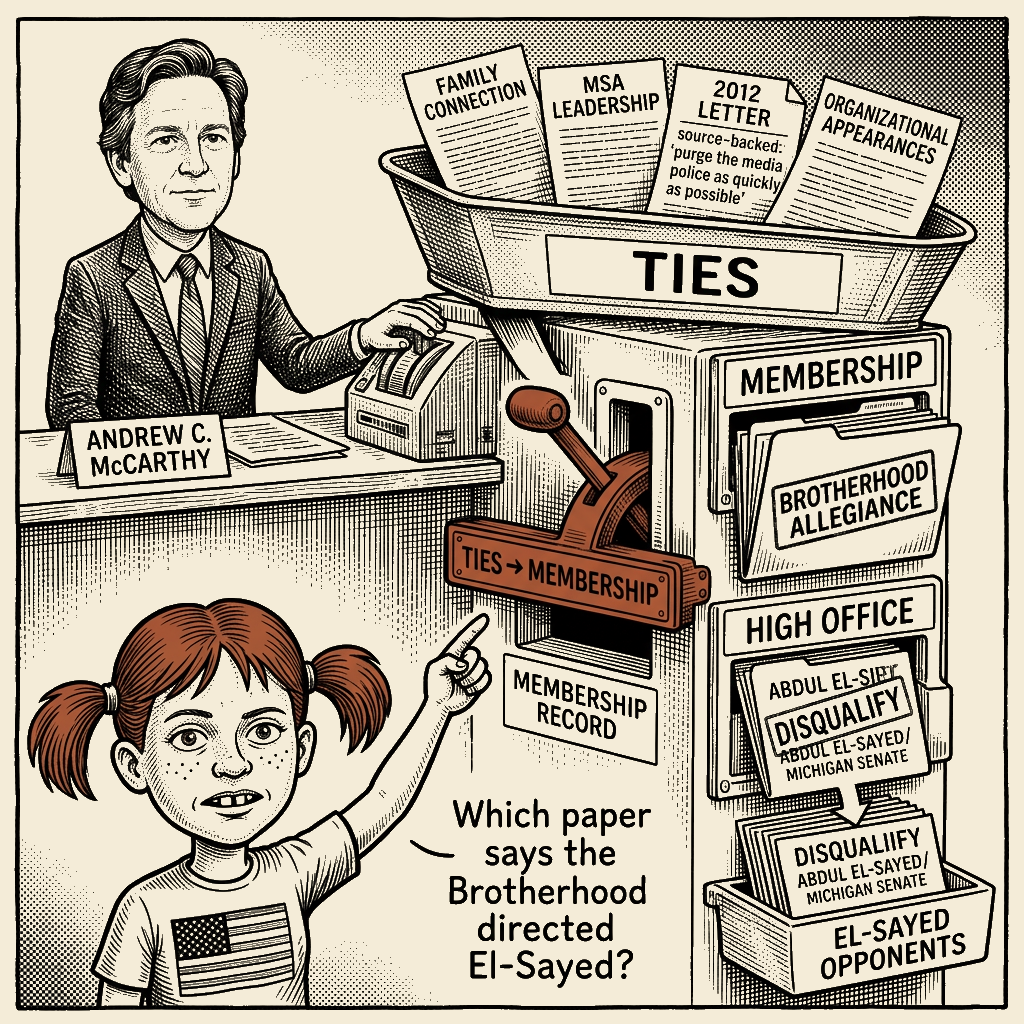
Analyzing: Abdul El-Sayed: The Gerry Adams of the Muslim Brotherhood — Andrew C. McCarthy · 2026-11-02
Which paper says the Brotherhood directed El-Sayed?
What the Editorial Argues
The editorial argues that Abdul El-Sayed’s family connections to the Egyptian Muslim Brotherhood, his co-signature of a 2012 letter urging Mohamed Morsi to purge Egypt’s media and police, and his leadership in the University of Michigan’s Muslim Students Association and appearances before ISNA, the Muslim American Society, and CAIR make Brotherhood identification and ideological commitment inseparable. Using Gerry Adams’s denial of IRA membership as its organizing analogy, the essay treats El-Sayed’s denials as evasive and his family and organizational connections as evidence of Brotherhood objectives. It argues that the combination should disqualify him from high office absent a convincing renunciation. The 2012 letter is the strongest of the essay’s claims because it records El-Sayed’s own advocacy rather than his affiliation, and the essay surrounds it with the Brotherhood’s internal rhetoric and its 2004 federal prosecution to give the associations their weight.
Receipts
The editorial turns a documented record of family connections, student leadership, one co-signed political letter, and appearances before Brotherhood-linked organizations into a categorical Brotherhood verdict.
What the framing wants you to believe
- El-Sayed’s family background, MSA leadership, organizational appearances, and the 2012 letter demonstrate Brotherhood allegiance rather than mere association.
- His position on Morsi’s purge — and with it the Brotherhood’s anti-Western, sharia-supremacist objective — leaves “no daylight” between his views and the Brotherhood’s.
- Like Adams’s denial of IRA membership, El-Sayed’s denials are made to do the work of proof while the underlying membership question stays open.
What’s really going on
- The receipts establish a serious organizational record and some genuinely troubling individual conduct. They do not establish formal Brotherhood membership, an operational role, material support, or knowledge of the Brotherhood’s internal strategy. Adjacency is not allegiance. Proximity is not direction. Activity is not command. Historical conduct is not present policy. Denying an allegation is not proving it.
- The omitted relation is the bridge itself. No order, directive, leadership decision, instruction, payment, or internal record shows the Brotherhood directing El-Sayed; none shows his MSA chapter taking Brotherhood commands; none shows him understanding the letter’s consequences when he signed it or abandoning it since. The essay fills that gap with analogy, legal gravity, organizational suspicion, and the candidate’s refusal to perform a renunciation.
- The protected beneficiary is the conservative electoral and anti-Brotherhood advocacy apparatus — the candidate’s opposition, the advocacy organizations whose dossiers supply the raw material, and the outlet — which receives a ready-made disqualification issue. The normalized harm is that a legitimate question about infiltration becomes generalized suspicion of Muslim civic association, with El-Sayed required to disprove the broadest possible version of the charge.
The anchor for the Brotherhood-level claim is the Justice Department’s 2004 Holy Land Foundation indictment and the evidence presented in the resulting prosecution, as quoted and characterized in the essay: that record supports a narrow organizational indictment of the Brotherhood, and it does not, without more, support a claim about El-Sayed’s membership or conduct. The anchor for the candidate-level claim is the 2012 letter itself, which the essay quotes accurately and reads well past its scope.
The Operation
Triage first, because the register tells you what the machine is. This is a signed National Review magazine essay by Andrew C. McCarthy; the supplied URL identifies it as a November publication — not an unsigned Wall Street Journal board editorial, and not a “study shows” ledger. The byline, the essay’s own cross-references to the author’s prior National Review columns, and the register all identify National Review. In the NR Editorial Technique Catalogue’s taxonomy it sits principally in Register D, the magazine-essay register, with the sharper civilizational language associated with Register A. Its archetype is the civilizational frame wrapped around an association-to-membership substitution. The position advocated is selfish at the candidate-disqualification layer: the receipts are real, the bridge is not, and the immediate beneficiary is a political operation, not the public-safety interest the essay invokes.
The operation, step by step. The order is the mechanism.
First, the analogy preloads identity. “The Gerry Adams of the Muslim Brotherhood” is not a neutral comparison. Adams enters the frame already carrying the Troubles, the IRA, alleged terrorism, and a political wing’s claim to distance itself from armed action; El-Sayed is made to enter carrying that history before the reader has examined a document. The comparison identifies no structural equivalence between Sinn Féin and the IRA on one side and the MSA, ISNA, and the Muslim Brotherhood on the other. It assigns a role. One man denied formal membership in an armed organization while serving as its political face; the other allegedly denies affiliation with an Islamist movement while participating in its organizational ecosystem. The essay needs the visual and moral resemblance, not the institutional particulars.
Second, family and organizational ties supply proximity. The sister’s statement about the family’s activity in the Brotherhood’s Egyptian branch, the father-in-law’s ISNA leadership, and El-Sayed’s MSA vice presidency, board service, and outreach chairmanship build a web around the candidate. The web is the point: the essay does not need to prove that each tie carries command if it can make the reader experience the ties as one network.
Third, the Morsi letter supplies personal conduct. The request that Morsi “purge the media and police as quickly as possible,” along with the signatories’ rejection of voices “courting America and Europe,” is the line the essay wants the reader carrying into every later fact. Because El-Sayed co-signed, the essay can claim the Brotherhood’s agenda was not merely an inherited accusation — he advocated it in his own name. The letter is then made to do work it cannot do alone: proof that the candidate shared the Brotherhood’s religious objective, received its direction, and still carries it into the present election.
Fourth, the Brotherhood’s own documents enlarge the stakes. The 1991 Akram memorandum’s “grand Jihad” and “sabotaging” language, the 2004 indictment’s charge that the Brotherhood sought “the globalization of Islam through social engineering and violent jihad,” Banna’s declaration that Islam’s nature is “to dominate, not to be dominated,” and Qaradawi’s boast about conquering America and Europe “not through the sword but through da’wa” place the 2012 letter inside a vast ideological architecture. The documents establish the rhetoric the essay attributes to Brotherhood figures. The editorial converts attributed rhetoric into the candidate’s settled creed and then into the Brotherhood’s active American strategy.
Fifth, the renunciation demand converts refusal into apparent confession. The sentence that the letter is “not disqualifying for a candidate for high American office — at least absent a convincing renunciation” is the payoff. By that point the candidate is already inside the category. To leave it, he must not answer the evidence; he must perform a renunciation emphatic enough to satisfy the frame. His failure to do so is read as confirmation. The burden has moved from proof to protest, from evidence to identity, from the accuser’s burden to the target’s burden of exculpation.
This sequence is familiar from comparable opinion-making: put the vivid analogy in the lede, make association the first domino, borrow the gravity of primary documents, let the verbs outrun the sources, then shift the burden from proof to renunciation so the reader feels the answer arrived before the evidence.
Institutional authorship and the placement chain. The institutional author is Andrew C. McCarthy; the chain is visible in the essay itself. McCarthy’s The Grand Jihad: How Islam and the Left Sabotage America (2010) and Spring Fever: The Illusion of Islamic Democracy supply the interpretive spine. The Hudson Institute’s 2008 report by Zeyno Baran supplies the account of an internal instruction that Muslim American Society leaders should answer negatively when asked about Brotherhood membership. The Investigative Project on Terrorism supplies its dossiers on the MSA, ISNA, and El-Sayed. The Washington Free Beacon supplies the candidacy-specific reporting on El-Sayed’s sister and father-in-law. Federal court records supply legal gravity. The Adams comparison supplies immediate narrative recognition.
That is a placement chain, not proof of secret coordination among every institution named. No document here shows that National Review, the Beacon, the IPT, the Hudson Institute, and the author sat in one room to compose this essay, and I will not manufacture one. The operation does not require that conclusion. A placement chain is enough when the published sources speak in compatible terms and the author supplies the connective judgment. Nor does the essay disclose the funding or institutional posture of the organizations whose work it marshals; I name their advocacy posture and their dossier product, not a funding chain I cannot source.
Distributional impact. The beneficiaries are identifiable even where no dollar figure is supplied. National Review gains an issue that places the movement’s preferred candidate inside a familiar radical genealogy, and gains a closing line engineered for retransmission. McCarthy gains another application of the interpretive system he developed in The Grand Jihad and Spring Fever. The IPT gains reputational authority from being called the source of an “excellent dossier” and from having its material framed as decisive. Conservative candidates and organizations opposing El-Sayed gain a salient line that can be repeated in debates, fundraising, and advertising: the Brotherhood does not need to show an American political network if one candidate can be made to carry the label. The frame fuses “Democrat,” “left,” and “Brotherhood” in a single clause.
The cost-bearers are named more clearly. El-Sayed bears the immediate cost of categorical illegitimacy: votes, donors, staff, and the ability to answer on his own terms. Arab-American and Muslim-American voters may be driven from him by an association they never chose. Muslim students bear the diffuse cost of seeing ordinary campus participation rendered as “indoctrination.” Antiwar and democratic-socialist voters bear the cost of having their political concerns absorbed into a religious-conspiracy frame. The MSA, ISNA, the Muslim American Society, and CAIR acquire a taint simply by appearing in the evidentiary chain. The public loses a reliable rule for deciding which organizational relationships matter and which do not.
No polling, fundraising, vote-share, or dollar magnitude appears in the supplied editorial. The essay does supply “45” co-signatories for the 2012 letter, approximately “600” MSA chapters, and a list of “29” entities in the 1991 memorandum. Those numbers describe documents and organizations. They do not measure El-Sayed’s relationship to the Brotherhood or the electoral effect of the essay. I will not invent the missing magnitudes.
The alternative design. If the stated rationale is preventing the Brotherhood from gaining an operational platform in high office, the design should be optimized for that end rather than for the convenience of the analogy. It should separate five questions: family connection, co-signature, organizational office, ideological agreement, and material or operational support. It should demand direct evidence for the conduct alleged — a membership record, an instruction, a payment, an operational assignment, or a documented present position supporting unconstitutional action — and should not treat attendance at a meeting as proof of command. It should publish the complete 2012 letter and the candidate’s full explanation of it, not excerpts. It should apply the same standard to candidates of every political and religious identity. And it should ask what response the candidate gave, what he or she has repudiated, and what remains contested. That design serves anti-Islamist vigilance without making every Muslim civic association a substitute for proof of Brotherhood membership.
Fear, greed, laziness. FGL here is an incentive lens, not mind-reading.
- The framing apparatus fears an electoral or institutional opening for the Brotherhood. Its appetite — greed in the non-monetary sense — is for issue ownership, status, and the satisfaction of appearing among those who saw the danger first. Its laziness is the institutional convenience of allowing “association” to do work that “membership” and “conduct” would have to prove.
- The movement beneficiary fears displacement in the Michigan race and in the larger political order. Its greed is for power, attention, and a coalition held together by a vivid threat. Its laziness is the convenience of letting a slogan close a record the apparatus has not actually audited.
- The rank-and-file reader faces a real fear: constitutional conflict and political violence are serious matters, and the Brotherhood’s documented rhetoric is not benign. The reader also wants the pleasure of being on the defensible side, and wants the relief of an answer that arrives already assembled. Laziness here is not stupidity. It is the understandable wish not to reconstruct decades of organizational genealogy at the end of a long day. The frame makes the reader complicit by invitation: one need only recognize the threatening name, because the conclusion has been supplied.
- El-Sayed and his supporters fear the stigma. They have an ordinary, legitimate electoral interest in winning the office — an interest the analyst may call greed only in the incentive sense, without alleging corruption. Their avoidable exposure is any failure to answer a direct question clearly. Symmetry requires recording that failure if the record proves it. It does not permit the answer to be presumed in advance.
The techniques.
-
Equivocation — the load-bearing engine. The Bad-Faith Techniques Catalog’s
equivocationentry describes one term used in two distinct senses. The essay says “Questions about El-Sayed’s ties” and then places under that word a sister’s reported family activity, a co-signed letter, an MSA vice presidency, board work, outreach leadership, and appearances before ISNA, the Muslim American Society, and CAIR; near the close it calls his “denials of his ties” laughable. “Ties” shifts among kinship, acquaintance, co-signature, membership in affiliated organizations, ideological agreement, and formal Brotherhood membership. “The Brotherhood” itself shifts among the Egyptian movement, its international organization, its alleged American affiliates, Hamas, and organizations the essay calls Brotherhood creations. The operational effect is not semantic neatiness: it lets the essay demand a denial broad enough to cover every adjacency while reserving formal-membership language for the conclusion. A candidate might produce records showing he was never a member and still fail the essay, because he never denied his family’s activity, his MSA office, his signature, or his appearances. -
Genetic fallacy. The Bad-Faith Techniques Catalog’s
genetic_fallacyvariant of ad hominem covers dismissing a claim by reference to its origin. Here the sister’s acknowledgment that the family had “long been” active in the Brotherhood’s Egyptian branch is used to establish the candidate’s own allegiance. Family history is not evidence of the direction of El-Sayed’s beliefs, speech, or conduct; it is evidence about his family. -
Begging the question and the manufacture of obviousness. The essay moves from “Questions about El-Sayed’s ties … persist” to “entirely rational inferences,” says “it should be obvious” the MSA is not a mere social club, and concludes that “Nothing about his background suggests any daylight between his views and the Muslim Brotherhood’s animating objective.” The Bad-Faith Techniques Catalog’s
begging_the_questionentry names the pattern: the conclusion is smuggled into the factual scaffolding. The circular structure is exact — organizations associated with the Brotherhood establish Brotherhood identity; El-Sayed’s role in them establishes Brotherhood identity; that identity then explains the conduct and organizations that supplied the original association. The WSJ Editorial Technique Catalogue’s “common sense”/elite pivot and its dispositive markers are relevant as a structural analogue: the essay labels its own synthesis “rational” and “obvious,” granting the conclusion priority over the evidence and making resistance look like failure of perception. -
Pre-emptive legitimacy-withdrawal. The cue is the essay’s own statement that the letter is “not disqualifying for a candidate for high American office — at least absent a convincing renunciation.” The Bad-Faith Techniques Catalog’s
pre-emptive legitimacy-withdrawalpattern withdraws legitimacy from an actor in advance of specific findings, on identity or categorical grounds rather than conduct. The withdrawal is also asymmetric: a formal membership or material-support finding could support disqualification, while a family branch, an MSA office, and a co-signed letter support scrutiny. The essay converts scrutiny into a presumption and then treats the candidate’s failure to erase the wider category as confirmation. -
Frame-engineered relabeling and the civilizational frame. The essay’s headings — “Domination, Not Coexistence” and “Sharia-Supremacist Indoctrination” — and its language of “sabotage,” “grand Jihad,” “destroying the Western civilization from within,” and “conquer America” and “conquer Europe” are textual cues. The Bad-Faith Techniques Catalog’s
frame_engineered_relabelingentry, drawing on Frank Luntz’s documented memos and George Lakoff’s framing scholarship, describes substitution of loaded terms to shift the terms of perception. The NR Editorial Technique Catalogue’s civilizational frame describes the inflation of a policy dispute into a struggle over the survival of a civilization; the WSJ Editorial Technique Catalogue’s threat-inflation closer is the structural analogue, carrying a concrete dispute past its factual scale so urgency can do the conclusion’s work. Carl Schmitt’s friend-enemy lineage is visible in the frame: the Brotherhood is cast as an existential Western enemy, and El-Sayed becomes a carrier whose contamination can be inferred through association. The legal and primary-document receipts do not need the civilizational chorus. The chorus makes the analogy feel inevitable before the evidentiary gap has been closed. -
False dichotomy. The cue is “Nothing about his background suggests any daylight between his views and the Muslim Brotherhood’s animating objective.” The Bad-Faith Techniques Catalog’s
false_dichotomyentry names the pattern: two options presented as exhaustive when others exist. The exhaustive pair here is “he holds the Brotherhood’s objective” and “his record shows daylight from it,” and the erased third possibility is the one the available record permits: El-Sayed signed a 2012 statement after Morsi’s accession through democratic processes and presented the signatories as leaders of the Egyptian community in America; the supplied record contains no Brotherhood directive naming him and no present position showing that the 2012 judgment remains his policy. -
Hasty generalization. The cue is the claim that the MSA “is not a mere campus social club” but an “indoctrination organization,” generalized across approximately 600 chapters. The Bad-Faith Techniques Catalog’s
hasty_generalizationentry covers a general conclusion drawn from a sample too small or unrepresentative to support it. The essay supplies no denominator: how many chapters were controlled, how many members participated, how many did not, how many existed without Brotherhood direction. -
Coordinated message discipline — applied to the Brotherhood, not to the essay. The essay quotes Baran’s 2008 report that an internal instruction “explicitly instructs group leaders to respond negatively if asked whether they are part of the Brotherhood.” The Bad-Faith Techniques Catalog’s
coordinated_message_disciplineentry covers systematic deployment of agreed language and responses across speakers and venues. This is the strongest point of contact between the Adams analogy and the documentary record: institutional non-membership is not naturally exculpatory when the institution is documented as directing members to deny membership. The evidentiary limit is document-specific. It shows why denials require independent checking; it does not show that El-Sayed received or followed the instruction. A receipt at the organizational level cannot be silently transferred to the individual level. -
The dossier-as-ledger and the source-citation asymmetry. The essay calls the IPT’s MSA dossier “excellent,” treats the IPT’s El-Sayed series as a catalogue, and repeatedly routes readers from the IPT to court documents and institutional pages. The WSJ Editorial Technique Catalogue’s “study shows” ledger is the analogue: a research product becomes the evidentiary spine while its funding, institutional position, and methodological limits go unexamined. The asymmetry the WSJ catalogue documents is visible here in the credential ledger — “an excellent dossier,” “a helpful dossier,” “ISNA was proven,” declarative verbs applied to sources that enlarge the Brotherhood characterization, with qualifications and contrary evidence absent from the page. The problem is scope, not worthlessness. An MSA history can establish organizational relationships; it cannot by itself establish what El-Sayed believed, what decisions he made, or what the Brotherhood knew about him. Edward Bernays’s lineage explains the credential-transfer mechanism — respected institutions can make a proposition feel authoritative without supplying the missing proof. Naomi Oreskes and Erik Conway’s documentation of the Tobacco Strategy explains the assembly of ominous material from interested research organizations into an apparent public record, and here the analogy holds only in method, not in funding structure; I attacked Oreskes across the cable years, I was wrong, and the record her book compiles supports the reading.
-
Erudition and the historical analogy. The Gerry Adams opening is not decoration. It establishes a genuine investigative question: can a public figure serve as the spokesman of an organization while formally denying membership? The NR Editorial Technique Catalogue’s erudition-as-armor entry is relevant, though the catalogue correctly notes the device is not inherently bad faith. Here the history does argumentative work and exerts pressure through emotional familiarity: Adams becomes a fixed point, and every later resemblance begins to look like confirmation. Walter Lippmann’s lineage is useful because the Adams passage distinguishes public image from institutional reality — a distinction that should make the writer ask whether the appearance of leadership establishes formal affiliation. It should not make the appearance itself the answer. The analogy identifies the question; it cannot decide El-Sayed’s case.
Bandura’s mechanisms are running in concert. Moral justification licenses the disqualification as constitutional defense. Displacement of responsibility moves the question from what the institutions did to what El-Sayed and his family did. Distortion of consequences turns the documented Brotherhood record into an imminent civilizational threat. Attribution of blame makes the candidate responsible for purging a category of association. The WSJ Editorial Technique Catalogue’s austerity-thrift archetype is the nearest structural analogue — the reader gets to feel virtuous while another person’s political life is made harder — but the specific cluster here is moral justification, displacement of responsibility, distortion of consequences, and attribution of blame. The essay does not deploy dehumanization, and it should not be charged with a technique it does not use.
The audience-management function is complete. The threat frame supplies a permission structure for extraordinary inference. It offers identity confirmation to readers who regard themselves as defenders of constitutional order. It ratifies grievance by placing a Democratic candidate inside a movement many readers already regard as hostile. The author’s two books, his prior National Review reporting, and the dossier stack perform status display. El-Sayed’s biography is recast as a counter-frame against the ordinary account of a local candidate with left-wing positions. And the civilizational conclusion displaces conscience: readers can support exclusion without feeling that they have examined a man rather than absorbed a warning.
The Record
The supplied package contains the editorial, not the underlying archival files. “Tier 1” below therefore means the essay points to a primary legal, organizational, or contemporaneous document; direct comparison with that document remains externally unresolved. The essay’s facts are preserved as the source presents them, and each receipt should be read for what it is made to do.
Anchor receipts.
- Tier 1, primary legal record as presented — the 2004 Holy Land Foundation indictment and trial evidence. The essay quotes the indictment’s characterization of the Brotherhood as committed to “the globalization of Islam through social engineering and violent jihad,” and states that several Brotherhood operatives were convicted while ISNA and NAIT were designated unindicted co-conspirators. These are the principal receipts for the Brotherhood’s institutional posture and the American financial chain alleged in the prosecution. They do not connect El-Sayed to the Brotherhood.
- Tier 1, internal Brotherhood memorandum as presented — the 1991 Akram memorandum. The essay says the memorandum was introduced into evidence in the prosecution and quotes its “grand Jihad” and “sabotaging” language. If the quotation and evidentiary status are accurate, it supports the existence of internal Brotherhood rhetoric and strategy. It does not establish that every American affiliate shared that intent, or that El-Sayed knew of it.
- Tier 1, signed political letter as presented — the 2012 Arabic-language letter. The quoted request that Morsi “purge the media and police as quickly as possible,” the rejection of voices “courting America and Europe,” the signatories’ support for “the revolutionary decisions taken by the president,” and El-Sayed’s description of the signatories as “leaders of the Egyptian community in America” directly support the narrower documentary claim that he co-signed a statement urging Morsi to purge the media and police and rejecting voices “courting America and Europe”; “authoritarian purge” is the essay’s characterization of that position. The letter does not state that El-Sayed belonged to the Brotherhood or establish the complete motive behind his signature.
- Tier 1, institutional records as presented — the University of Michigan MSA charter, board minutes, and newsletter. These support El-Sayed’s vice presidency, board service, newsletter work, and chairmanship of the outreach committee, and place the chapter within the MSA of the United States and Canada and the Great Lakes council. They do not by themselves prove indoctrination, formal Brotherhood membership, or El-Sayed’s knowledge of Brotherhood strategy.
- Tier 1, organizational statements as presented — MSA National’s 2005 “A Little Taste of History” post and 2007 affiliation statement. These support institutional continuity between the MSA and ISNA, including the MSA National president’s seat on the ISNA council and the joint annual conference. They do not prove that every MSA chapter was controlled by the Brotherhood or that participation in a chapter constituted Brotherhood membership.
Supporting receipts.
- Tier 2 supporting context — the Hudson Institute’s 2008 report by Zeyno Baran. It supplies the reported instruction that Muslim American Society leaders should deny Brotherhood membership when asked. It supports the existence of that instruction; it does not establish El-Sayed’s affiliation.
- Tier 3 advocacy research — the IPT’s MSA, ISNA, and El-Sayed dossiers. These are valuable indices to court records, chapter minutes, newsletters, organizational pages, testimony, prior reporting, the Zaid Naman speech, and the circuit on which El-Sayed later appeared, as the essay claims. Because the IPT is an advocacy research organization, its work is supporting context rather than a final evidentiary authority; every material proposition should be traced to the underlying record.
- Tier 3 reporting — the Washington Free Beacon account of El-Sayed’s sister and father-in-law. The report supports the claim that the sister made the quoted statement and that Tayeb Jukaku has held leadership positions in ISNA. Family activity and an in-law’s organizational role do not establish El-Sayed’s own membership or ideological identity.
- Tier 3 commentary — McCarthy’s two books and prior National Review columns and podcast comments. These establish continuity in the author’s interpretive frame and the placement chain. They are not independent confirmation of the claims made in this essay.
Unconfirmed claims.
- Formal or operational Brotherhood membership by El-Sayed: [unconfirmed: convergence threshold not met]. The supplied text contains no membership record, oath, internal directive naming him, payment, operational assignment, or candidate admission.
- The 2012 letter proves ideological identity with the Brotherhood or a shared objective: [unconfirmed: convergence threshold not met]. The primary letter proves the request and the signatories’ stated position, not the full inference drawn from them.
- El-Sayed was indoctrinated through the MSA: [unconfirmed: convergence threshold not met]. The essay establishes activity and an organizational charter, not the content of his instruction, beliefs, or decision-making.
- His family’s Egyptian Brotherhood activity establishes his allegiance: [unconfirmed: convergence threshold not met]. One reported family statement cannot carry that individual-level inference.
- El-Sayed’s likely election demonstrates the Brotherhood’s progress in America: [unconfirmed: convergence threshold not met]. No measurable placement chain or electoral evidence connects the outcome causally.
- The MSA’s current scale and the 29-entity organizational list as independent facts: [unconfirmed: convergence threshold not met]. The essay relies on the IPT and the 1991 memorandum rather than supplying separate verification.
Per-citation accuracy verdicts.
- 2012 letter: Accurate use of the quoted request; overextended inference. It proves what El-Sayed urged in 2012 — it does not establish membership, Brotherhood direction, or a continuing position.
- Akram memorandum: Potentially decisive for the Brotherhood’s internal rhetoric; irrelevant by itself to El-Sayed. The essay slides from the first proposition to the second.
- 2004 indictment and Holy Land Foundation record: Appropriate as an organizational anchor if the legal status is stated precisely. An indictment alleges. The essay supplies no designation instrument, opinion, or trial record showing the exact scope of the “unindicted co-conspirator” designations it invokes; a finding concerning NAIT does not silently become a finding concerning ISNA’s entire network, every MSA chapter, or El-Sayed personally.
- MSA charter, minutes, and newsletter: Appropriate for proving El-Sayed’s roles and the chapter’s formal structure. They do not prove that the chapter was an indoctrination cell in the manner the essay asserts.
- MSA and ISNA institutional statements: Appropriate for organizational continuity and joint activity. They do not establish that ISNA directed every MSA chapter or that appearance at an ISNA event signified Brotherhood membership.
- Hudson report: Appropriate for the reported denial instruction. It cannot carry an inference about El-Sayed without evidence that he was within the directed chain.
- IPT dossiers: Appropriate as research guides. Repetition across an author’s own series does not create independent convergence; the underlying documents must be inspected.
- Washington Free Beacon family reporting: Appropriate for what the sister is reported to have said. It cannot prove El-Sayed’s own views.
- Banna and Qaradawi quotations: Accurate as attributed rhetoric of named Brotherhood figures. Their function is ideological enlargement, making a 2012 political letter the visible edge of a totalizing program; they cannot establish El-Sayed’s adoption of either position without a demonstrated line of knowledge, influence, and policy.
- McCarthy’s books, columns, and podcast comments: Interpretive context, not independent receipts.
The present-tense case is weaker still. The essay calls El-Sayed a candidate for a Michigan Senate seat, states that he is not a DSA member, declares that he has offered no convincing renunciation, and treats his current organizational relationships as continuing. It produces no dated renunciation, no current chapter record, no campaign filing establishing the alleged organizational network, and no present statement by El-Sayed answering the Brotherhood allegation. The number of MSA chapters is likewise offered without a dated organizational census and without evidence that the chapters are uniformly controlled. The captioned photograph of Adams is a presentational instrument too: it supplies instant recognition, not equivalence.
Load-bearing omissions.
- The editorial does not reproduce El-Sayed’s actual denials, his explanation of the letter, or his response to these allegations.
- It does not distinguish formal membership from family connection, co-signature, student leadership, conference attendance, friendship with Brotherhood adherents, or lawful political association.
- It does not examine whether El-Sayed understood the letter’s consequences when he signed it, whether he later rejected the purge, or what changed — and what did not — between the letter and the present campaign.
- It does not document ideological control of the MSA chapter by chapter, does not show that El-Sayed’s chapter operated as a Brotherhood cell, and does not provide the chapter’s internal instructional materials.
- It does not supply the designation instruments, dates, or scope for the legal designations it invokes.
- It does not show the full 2012 letter, the other 45 signatories, or the context in which the signatories identified themselves as Egyptian-community leaders.
- It does not distinguish primary documents from the essay author’s interpretations, does not assess the source chain behind the family reporting, and does not disclose the funding or institutional posture of the IPT.
- It does not apply its disqualification standard symmetrically to candidates associated with organizations hostile to its own coalition.
- It does not supply a documented instance in which El-Sayed, his MSA chapter, or any organization in his network carried out sabotage against a U.S. institution.
- It does not examine the concrete alternative: disclosure of organizational relationships, renunciation of specified conduct, and investigation of actual operational support.
Missing-information declaration. The underlying archival documents were not supplied for direct inspection, and no external receipts were available in this package. The assumption filling the remaining gap is that the article’s quotations and institutional descriptions reproduce the cited materials faithfully; that assumption remains open to source review.
The essay’s evidentiary chain therefore proves less than its rhetoric demands. The internal Brotherhood documents establish hostile rhetoric within the organization’s own reported history. The MSA statements establish institutional continuity. The court record, as described, establishes legal action around specified entities. The Morsi letter establishes El-Sayed’s advocacy of a purge. What the essay never establishes is the proposition that turns the entire chain into a disqualification: that El-Sayed belonged to the Brotherhood, took direction from it, approved its totalitarian program, and continued to do so. That absence would be decisive if the essay allowed it to be an absence. It does not. It fills the gap with analogy, legal gravity, organizational suspicion, and the candidate’s refusal to perform a renunciation. The result is not evidence stronger than its sources. It is evidence made to perform work its sources never performed.
How to Recognize This
This is the association-to-allegiance machine. It begins with a vivid predecessor whose moral identity is already settled, attaches the target to that identity through family, friendship, schooling, or organizational contact, converts historical affiliation into present direction, and then treats the target’s refusal to reject the inherited identity as proof.
The mechanism works because it gives the reader identity before the reader examines evidence. Gerry Adams arrives with the Troubles already attached; El-Sayed arrives with the Muslim Brotherhood already attached. The analogy supplies a conclusion in advance, organizational material supplies apparent corroboration, and the demand for renunciation makes refusal look like confession. Threat inflation then raises the cost of hesitation. The reader does not merely learn something; the reader is given permission to reach the answer the apparatus wanted.
Four textual signals are worth watching for next time.
- Watch the noun change. “Family,” “letter,” “student leadership,” “conference appearances,” “affiliations,” “ties,” and “membership” are treated as variants of one thing. The test is simple: if the subject could deny the most specific relationship without denying the others, the argument is asking him to disprove a moving target.
- Watch the burden change. The editorial demands “a convincing renunciation” where the narrower question would be: what specific act, instruction, payment, or public position proves participation? A demand for categorical separation is not proof of organizational membership.
- Watch the scale of the verbs. “Sought,” “attended,” “appeared,” “co-signed,” and “helped write” become “supported,” “operated,” “advanced,” and “belongs to.” Each jump is made in the passive machinery of association rather than through an explicit argument — and then the stakes leap from candidate conduct to “sabotage,” “conquest,” and the destruction of Western civilization.
- Watch what the cited document can actually bear. A court indictment can establish an organization’s alleged conduct. An internal memorandum can establish rhetoric inside an organization. A letter can establish what its signers urged. An MSA charter can establish a chapter’s formal affiliation. None proves, without another record, what the subject read, received, joined, or materially supported.
It works because the reader receives the ending before the bridge is built. The dread supplies missing causation. The historical analogy supplies missing specificity. The dossier and legal records supply evidentiary gravity that spills beyond their scope. And the request for renunciation allows the conclusion to look like the product of caution when it is in fact the product of equivocation.
When you see the pattern, make the relationship table before passing judgment: connection, evidence, what it proves, and what it does not prove. Trace every organizational name to a primary document. Ask whether the inference runs from act to membership, from adjacency to allegiance, or from association to disqualification. Ask who receives attention, money, votes, or political leverage from the frame; if the answer is only that the named organization sounds dangerous, the pathway is missing. Compare the vocabulary across the publication, its podcast network, allied advocacy organizations, and campaign materials — repetition documents deployment, and repetition alone does not need to prove hidden coordination.
Then split the proposition. Membership, affiliation, knowledge, direction, and present policy are five different questions, and each needs its own document. Distinguish an allegation, an indictment, a designation, a finding, and a conviction; they are not interchangeable. Read the organization’s own current statements rather than treating a historic internal document as the organization’s complete present mind. Insist on the candidate’s response and compare it against the underlying records. Follow the citation chain to the primary document and ask whether the conclusion travels with the evidence or is added at the next relay. And reduce the automatic activation by translating the loaded labels back into their constituent claims: “indoctrination organization” becomes a set of teachings and practices requiring evidence; “co-conspirator” becomes a specified legal designation requiring the court record; “project in America” becomes a network, an influence, and a policy that must be demonstrated separately; “Gerry Adams of the Brotherhood” becomes a claim about formal membership, organizational role, concealment, and direction that must be proved rather than bestowed by a headline.
I know the sequence because I helped build versions of it. The witness is not the man who sees clearly and asks the reader to admire the sight. The witness is the man who can show the wiring he once used, without asking anyone to trust his moral weather. Next time the frame appears, make it produce the bridge it concealed: the actor, the document, the knowledge, the direction, the present consequence. The operation loses its most useful disguise when the reader can see that “I do not deny” is not the same sentence as “I am directed,” and that the answer to a question of allegiance must arrive as evidence rather than as identity.

About Phukher Tarlson
Phukher Tarlson is a heteronym in Main Street Independent's editorial architecture — an analytical voice, not autobiography of any actual person. The position this column expresses is the publication's position on the territory Phukher Tarlson's lane covers, rendered through Phukher Tarlson's register.