Analyzing: The GOP’s Defeat Was Truly Massive — Karl Rove · 2026-11-04
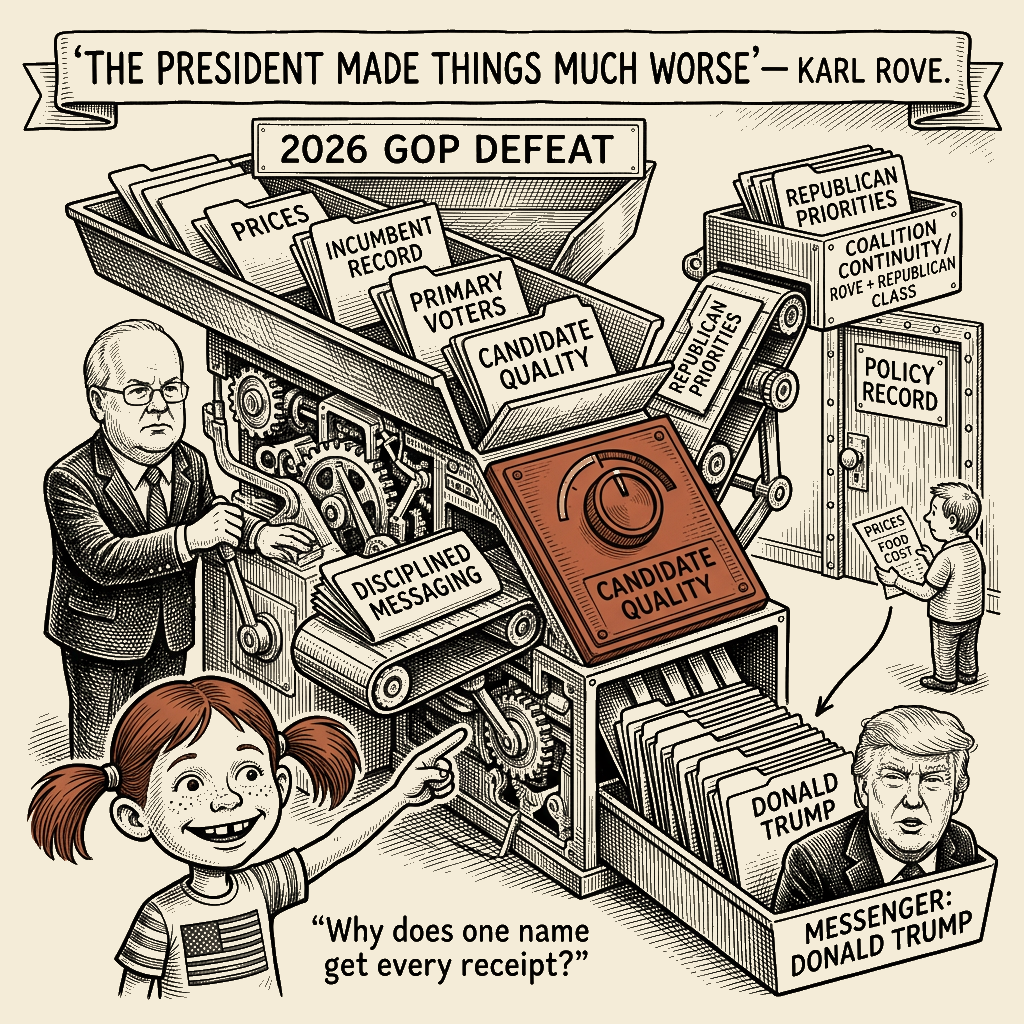
Why does one name get every receipt?
What the Editorial Argues
Karl Rove argues that Republicans suffered a severe 2026 midterm defeat across federal and state offices, with the cost of living and voters’ rejection of Donald Trump’s economic priorities forming the immediate electoral environment. He attributes the scale of the loss to Trump’s campaign style, self-congratulatory economic message, proposed $5,000 election payment, handpicked candidates—especially Ken Paxton—and insistence on remaining the campaign’s center of attention. His conclusion is that Trump has crippled his own party, will face more Republican defections, and has made judicial confirmation effectively foreclosed for at least two years, perhaps six.
Receipts
The editorial converts a many-cause Republican electoral defeat into a one-man verdict about Donald Trump.
What the framing wants you to believe
- The 2026 result was not merely a Democratic wave. Trump’s conduct, economic messaging, rallies, endorsements, and candidate choices made an already toxic environment worse.
- Voters registered their anger over prices, corruption, presidential priorities, and what the editorial calls Trump’s self-interest, while Republican candidates and message discipline failed.
- Trump has broken his own party. Republicans will now break with him, his presidency is “crippled,” and judicial confirmation is effectively foreclosed for at least two years, perhaps six.
- Rove reports that Republicans fell from 53 Senate seats to no more than 46; that Democrats were expected to hold around 258 House seats, a pickup of at least 43; and that Democrats gained at least five governorships, at least 500 state legislative seats, and at least 11 chambers. Those figures establish the claimed scale, not the claimed cause.
What’s really going on
- The protected beneficiary is the wider Republican governing coalition and the professional political class surrounding it. The proposed repair lets Republican candidates distance themselves from Trump without placing the coalition’s economic program, governing record, or institutional machinery on trial. That is a concrete pathway to political distance and narrative control; the accompanying material establishes no donor commission or coordinated placement chain.
- The omitted relation is the increment: how much of the result belongs specifically to Trump rather than to price levels, wage growth, incumbency, candidate quality, primary voting, congressional district lines, or the national environment. The article preserves those forces as context, then reserves the decisive causal language for one man: the president “made things much worse” and “burned the Republican Party to the ground.”
- Source anchor: Karl Rove, “The GOP’s Defeat Was Truly Massive,” The Wall Street Journal, November 4, 2026, citing the NBC News exit poll for its cost-of-living, priorities, economy, prices, and corruption figures. Because the poll release, question wording, methodology, field dates, sample, weighting, and margin of error are absent from the accompanying material, the exact percentages and their use as causal evidence cannot be independently verified.
The Operation
I helped build versions of this operation, so I can describe its architecture without pretending to know what Rove privately intended. From inside the opinion-page operation, this piece follows a clean blame-allocation sequence: establish the scale, install the national environment, isolate the messenger, convert style into mechanism, and close with institutional consequence. The sequence is visible on the page; it does not need an invented conspiracy to explain its effect.
This is a signed Wall Street Journal op-ed by Karl Rove, not an unsigned editorial-board piece. The board’s collective “we,” third-graf turn, and institutional grammar therefore should not be projected onto it as a house-style fingerprint. The topic is the 2026 midterms and the Republican losses; the archetype is a poll-led post-election blame-allocation memo. The election returns establish the scale of the loss, the exit poll supplies its emotional vocabulary, and a turn after the results converts a coalition-wide result into a diagnosis of Trump’s personal management deficiencies. The advocated position is mixed: messaging and candidate selection can affect margins, while the allocation of blame also serves Rove’s standing and the interests of Republicans seeking distance from Trump.
The operation is moderate in machinery and serious in effect. No invented conspiracy or covert placement chain needs to be alleged here. The concealment works openly: real defects are granted, then made to carry a conclusion the defects cannot bear.
Institutional authorship and placement. Rove is not merely a commentator observing a distant campaign. The accompanying author biography identifies him as a former senior adviser and deputy chief of staff to George W. Bush and as president of Karl Rove + Company, an Austin-based public-affairs firm. That biography says the firm represented more than 75 Republican candidates across 24 states, along with nonpartisan causes and nonprofit clients. Rove also writes a weekly Journal op-ed and appears as a Fox News contributor. Those facts establish his standing, professional interests, and cross-platform reach; they do not establish his role in the 2026 campaign.
The publication record places the piece on the Journal’s opinion page and establishes an RSS-delivered URL and a November 5 print appearance. The Fox affiliation gives the diagnosis a broader potential audience, but the accompanying material does not establish that this op-ed traveled there. It also establishes no donor commission, foundation instruction, advisory role for Rove’s firm in the 2026 cycle, or coordinating organization behind the piece. None should be invented. The incentive is structural rather than conspiratorial: a former party strategist and professional political operator gains status by being the diagnostician of the disaster, while the institutional class he once served remains largely outside the blast radius.
Who benefits.
The distribution is not symmetrical, but it is not imaginary either.
The clearest beneficiaries are Rove and the Republican strategists, candidates, and officeholders who want political distance from Trump. The column supplies them with a public warrant: the result becomes not a rejection of conservative politics but a bill for Trump’s celebrity, candor, rally schedule, and candidate selection. Their pathway is political position and narrative control, not money. The accompanying material documents no transaction, payment, or donor payoff.
The deeper beneficiary is the existing Republican policy coalition. The proposed repair is “disciplined messaging focused on economic concerns,” not a rejection of the economic frame that produced the dissatisfaction. A new messenger can therefore be installed without requiring the old coalition to answer for its governing record. That is the protected interest the causal compression conceals.
Trump is the paradoxical secondary beneficiary. He bears reputational damage and diminished influence over party nominees, but the one-name diagnosis keeps him indispensable to Republican politics. The column explicitly says he obtained what he wanted: attention, nomination influence in key contests, and an audience offering “comfort.” A party that has learned to blame everything on Trump remains a party organized around Trump.
The cost-bearers are more diffuse. Trump loyalists are converted from a constituency into an explanation for Republican defeat. Republican officeholders receive an off-ramp—distance from Trump while retaining conservative credentials. Voters whose concern is the cost of living are moved from an economic question to a personality contest. The policies and institutions that may have contributed to their conditions are left for another argument, after the argument over who to blame has been won.
The claimed magnitude is large: losses across Senate, House, gubernatorial, and state legislative offices, with Rove reporting Republican Senate seats falling from 53 to no more than 46. Those figures remain externally unverified. The sole claimed spending magnitude—nearly $500 million for Ken Paxton’s Senate campaign—has no filing or reporting evidence and cannot establish relative spending or causal effect.
Alternative design.
If the postmortem were optimized for its stated rationale—accountable representation and a stronger economy—it would separate presidential performance from the performance of Congress, incumbent candidates, state governments, primaries, and the party platform.
It would begin with certified returns and a map-adjusted Senate baseline, so seats the party could not plausibly gain are not counted as evidence against the messenger alone. It would compare primary voting with general voting, use split-ticket results to determine whether voters separated Trump from Republican candidates, and separate presidential, congressional, gubernatorial, and legislative outcomes. A common narrative is not a common cause.
It would compare price and real-income changes across income groups, identify which policies affected those changes, test campaign spending against comparable races, and assign remedies to the level of government responsible for each failure. For voters whose ballots were driven by prices, that design would examine economic policy as well as political communication.
For intraparty repair, it would add candidate-selection rules, a primary-voter compact, and an explicit succession strategy. The editorial never chooses between those designs. It lets electoral explanation perform the work of intraparty positioning.
Fear, greed, and laziness. Applied symmetrically, FGL describes incentives rather than proving private motive.
- The author and professional Republican class: Fear that a structural defeat will expose the failure of the whole governing model, including their own strategic premises; greed for the status and attention that come from being the diagnostician of the disaster; and laziness that favors explaining other people’s defect over auditing the model they built.
- The protected institutional beneficiary: Fear of losing the coalition and its power; greed for continued access to the movement’s donors, activists, offices, and attention; and laziness that makes a communications correction cheaper than a substantive policy reckoning.
- The rank-and-file reader: Fear born of prices, corruption, and political disorder; greed for the satisfaction of a legible culprit; and the understandable preference for one coherent explanation over a multivariable audit. The reader deserves evidence, not contempt.
- Trump: Fear of losing control and historical standing; greed for attention and nomination leverage; and a preference for the rally as a substitute for governing. Those incentives do not erase the documentary case against him. They explain why the personalized frame is available and attractive.
Selflessness placement: mixed. The proposition that messaging, candidate quality, and candidate selection affect electoral margins is legitimate and may be correct. The allocation of blame also serves Rove’s renewed political authority and the interests of Republicans seeking distance from Trump. Nothing in the record establishes a coordinated scheme, and none is needed.
Technique map
-
Concentrated attribution of blame — Bandura’s attribution-of-blame mechanism. The textual cues are “the president made things much worse,” “those handpicked by Mr. Trump,” and the closing charge that Trump, his policies, and his candidate choices “burned the Republican Party to the ground.” Operationally, the move concentrates distributed institutional failure into personal guilt. That permits conservative readers to blame Trump for a historic defeat without examining how Republican candidates, primary voters, donors, party messaging, or the governing record contributed. Bandura’s mechanism matters because attributing blame lowers the moral cost of accepting the preferred explanation. The claim that Trump may be culpable is not the issue. The issue is causal monopoly: stopping at the named individual leaves the relations that made his choices effective unexamined.
-
Frame-engineered relabeling — bf_catalog:
frame_engineered_relabeling; the WSJ Editorial Technique Catalogue’s frame-engineered-relabeling entry. The sharpest cues are “Then there was candidate quality,” the proposal that Trump spend “more time being president and less as campaigner-in-chief,” and “He called it ‘the weave.’ It was really a mess.” The substitutions change the frame through which the result is processed: a multi-level electoral repudiation becomes “candidate quality”; presidential governance becomes a malfunctioning campaign persona; and improvised speech becomes disorder. Operationally, the causal load moves from the coalition, its platform, and its institutional choices onto a replaceable messenger and a handful of handpicked nominees. The Bad-Faith Techniques Catalog requires evidence of deliberate engineering for a full finding, and no evidence of such engineering appears in the accompanying material. This is therefore a partial catalog match, not a claim that Rove received Luntz-style instructions for this article. -
Poll ledger and source-citation asymmetry — the WSJ Editorial Technique Catalogue’s “study shows” ledger. The cue is “In the NBC News exit poll,” followed by a ledger of percentages, and then “With numbers like that, Republicans were going to have a tough night.” An NBC exit poll is not a think-tank advocacy study, so the catalogue entry is not a literal fit; the structural resemblance is exact. The report becomes the legitimacy device while methodology and competing explanations disappear. The poll establishes what respondents called important; the editorial converts salience into an explanation of how votes were caused. Issue salience and causal effect are not the same thing. The problem is not that the poll is necessarily false. It is that the poll’s authority is detached from what the poll can establish.
-
Multiple-audience targeting — the WSJ Editorial Technique Catalogue’s multiple-audience-targeting analytic. “Disciplined messaging” addresses professional campaign managers; “handpicked” ratifies the grievances of anti-Trump Republicans; “no chance of confirming a conservative Supreme Court justice” reminds movement lawyers what remains at stake; and “candidate quality” gives donors a selection problem rather than a program problem. The sentence “Apart from the outcome, the president got what he wanted from the midterms” serves Trump’s loyalists with validation, Rove’s readers with a diagnosis, and Republican elites with permission to distance themselves. The later prediction that Republicans “afraid to break with the president will now do so” gives that audience a political script. One argument serves several constituencies without requiring them to share one account of why the coalition lost.
-
Selective attention and a partial false dilemma — bf_catalog:
false_dilemma; the WSJ Editorial Technique Catalogue’s selective-attention logic. The cues are the nationwide figures for Senate seats, House seats, governorships, state legislative seats, and legislative chambers, followed by an explanation centered on rallies, priorities, and a few candidates. The editorial does not examine split-ticket voting, ballot measures, incumbents’ records, or whether the same Trump-centered explanation fits statewide, legislative, and federal results. Separately, “more time being president and less as campaigner-in-chief” presents governing and campaigning as a zero-sum allocation without demonstrating that time allocation caused the result. The false-dilemma match is partial because the language expresses a tactical preference rather than an explicit either-or choice; the omitted causal evidence remains part of the pattern. -
Threat-inflation closer — the WSJ Editorial Technique Catalogue’s threat-inflation pattern. The cues are “leaves the Trump presidency crippled,” “There’s no chance of confirming a conservative Supreme Court justice,” and the final image of the party “burned … to the ground.” The close converts a severe electoral result into a regime emergency. That inflation makes the personalized diagnosis feel commensurate with the stakes and gives the reader a consequence vivid enough to carry out of the article.
The lineage is documentary; the article-specific application follows from its visible structure. George Lakoff’s cognitive-framing work explains how labels redirect causal attention. Frank Luntz’s relabeling memos document the power of substituting the word that carries the preferred frame, but no specific Luntz memo appears in the accompanying material and no such directive is independently authenticated here. Walter Lippmann explains the credentialed interpreter who tells the public how to understand its own verdict. Bandura explains how blame can be concentrated until institutional responsibility becomes psychologically unnecessary.
Audience management. The principal function is a permission structure: Republicans may accept that the economy and the party were punished without accepting that the coalition’s governing record must be surrendered. For anti-Trump Republicans, the article provides identity confirmation and grievance ratification. For the professional class, it provides status display and a marketable product—discipline, better candidates, sharper messaging. For movement readers, it reassures them that institutional continuity remains possible. For Trump, it creates a concentrated reputational bill. Its counter-frame replaces “the party lost because Democrats won” with “the party lost because Trump broke it.” Most importantly, it performs conscience displacement: the coalition can change personnel without changing its moral account of itself.
The candor is the cover. The article concedes the national environment so that it can keep the coalition outside the indictment. It supplies real information while concentrating causal responsibility where its conclusion requires. That concentration is the self-interested part.
The Record
Tier status. The Rove op-ed is Tier-3 commentary and cannot serve as an independent anchor for its own factual assertions. The NBC News exit poll is the only explicitly named external source, and neither its release nor its methodology accompanies the editorial available for analysis. No primary document, official return set, wire-service aggregation, or independently corroborated Tier-2 research accompanies the central claims. The specific figures and causal conclusions below therefore carry [unconfirmed: convergence threshold not met]. The source-observable framing does not depend on pretending those gaps have been filled.
1. Electoral scale — Tier-1 receipts required. Rove reports that Republicans fell from 53 Senate seats to no more than 46, with losses in Iowa, Kansas, Ohio, South Carolina, Texas, Georgia, North Carolina, and Maine; that Democrats were expected to hold around 258 House seats, a pickup of at least 43; that Democrats gained at least five governorships and a gubernatorial majority for the first time in 16 years; that they picked up at least 500 state legislative seats and flipped at least 11 chambers; that they took the state Houses in Georgia, North Carolina, and Texas and full control of the legislatures and governorships in Michigan, Minnesota, Pennsylvania, Wisconsin, and possibly Arizona; and that the entire statewide Republican ticket in Texas lost. The relevant records are official federal and state returns, wire-service aggregation, congressional records, and certified state legislative results. None accompanies the article, so the figures remain externally unverified: [unconfirmed: convergence threshold not met]. The qualifiers—particularly “around,” “at least,” “no more than,” and “possibly”—must remain attached to any comparison.
2. The voter-priority figures — the named primary survey is not available. The column attributes to the NBC News exit poll: 38% approval for Trump; nearly half calling the cost of living a “crucial” consideration and another 40% calling it “major”; nearly two-thirds saying Trump’s policies made the economy worse and 62% saying the policies raised prices; nearly two-thirds saying he had the wrong priorities; 62% saying he put personal interests above the country; and 90% calling government corruption a “crucial” or “major” factor. The poll release, exact question wording, field dates, sample, weighting, and cross-tabs are not included. The numbers are preserved as the editorial’s sourced claims; their exact content remains [unconfirmed: convergence threshold not met].
3. “The president made things much worse” — the core causal claim. The sentences “With numbers like that, Republicans were going to have a tough night” and “the president made things much worse” require a counterfactual comparison the article does not supply: changes across similar districts, shifts among Trump voters, state-level controls, split-ticket results, or some defensible estimate of the president’s marginal effect. The poll can establish what respondents said. It cannot, by itself, assign the margin to Trump. The causal claim therefore remains [unconfirmed: convergence threshold not met].
4. The $5,000 proposal, rallies, and the Lincoln Memorial performance. The receipts would be the campaign’s own statements about the proposed payment, the full text or transcript of the relevant remarks, the rally record, and polling showing whether the proposal changed voter intent. Rove writes that the proposal “backfired” and that “Most Americans took it as a thinly veiled bribe,” but the editorial supplies no polling or other supporting evidence for those characterizations. The phrases “the weave,” “the most successful economy,” and “a Golden Age of America” are reproduced from the editorial, but the surrounding transcripts are unavailable for context and accuracy checking. External verification of those claims remains [unconfirmed: convergence threshold not met].
5. Ken Paxton’s spending, margin, and historical place. The column says the Texas attorney general’s Senate campaign cost nearly $500 million, that he lost by 12 points, and that he became the first Republican nominee to lose a Texas U.S. Senate seat since 1988. Federal Election Commission filings, official returns, and the comparable 1988 result would settle the numbers. The article cites none of them, leaving the claims [unconfirmed: convergence threshold not met]. Even if accurate, the spending figure cannot establish candidate quality without a comparison across comparable races and a mechanism connecting spending to the margin.
6. The half-century judgment and the institutional prognosis. “One of the worst in a half-century” requires a historical series and a stated measure—seat share, vote share, a defined set of comparable midterms, or something else. “No chance” of a conservative Supreme Court confirmation in the next two years, “maybe the next six,” and the forecast of Republican defections are predictions. They may later be tested against the record; they are not present-tense receipts. The claim that Democrats “happily agreed” also assigns a collective motive without documentary evidence; it is rhetoric, not evidence. The comparison is [unconfirmed: convergence threshold not met].
Supporting receipts. The editorial and its author biography establish that this is a signed WSJ op-ed by Karl Rove and reproduce his biography. That biography provides relevant context for his expertise, professional interests, and cross-platform standing. It does not establish that he or his firm had any advisory role in the 2026 cycle. No conclusion here rests on an undisclosed document, and no leaked memorandum is offered as proof.
Load-bearing omissions
- The editorial supplies no certified returns or map-adjusted Senate baseline. Without the baseline, the movement from 53 seats to no more than 46 cannot be read as a referendum on the messenger alone.
- It supplies no poll methodology, question order, weighting, sample description, field dates, margin of error, or cross-tabs.
- It provides no cross-tab showing which voters who called the cost of living crucial then rejected Trump, and no comparison question showing how voters who disliked Trump nevertheless supported Republican congressional candidates.
- It provides no split-ticket evidence. If voters separated their judgment of Trump from their judgment of Republican candidates, the singular Trump explanation would require substantial qualification.
- It does not distinguish presidential, congressional, gubernatorial, state legislative, and primary outcomes. A common narrative is not necessarily a common cause.
- It names no specific economic policy behind the reported price increases and provides no price, wage, income-distribution, or tax record with which to test responsibility.
- It does not examine Republican incumbents’ voting, fundraising, or geographic performance; primary-election competitiveness; endorsements; or whether the allegedly poor candidates shared a measurable pattern beyond losing.
- It treats the spending figure for one candidate as evidence without comparing it with other Senate races or supplying a mechanism connecting spending to the margin.
- It offers no counterfactual evidence for the claim that disciplined messaging would have changed the result.
- It does not state whether Rove or his firm had an advisory role in the 2026 cycle. The analysis therefore draws no inference from that silence.
- It does not identify the policy interests that would remain protected if Trump were replaced while the coalition’s economic framework remained intact.
Per-citation verdicts
- NBC News exit poll: Source attribution is present, but the exact figures cannot be checked from the available evidence, and the editorial misuses issue salience as causal proof.
- Federal, state, and legislative results: Faithfully preserved as Rove’s reported claims, but externally unverified and without an official or wire-service anchor.
- Nearly $500 million in Paxton spending: Unsupported in the available record and insufficient on its own to establish candidate quality or electoral effect.
- 12-point loss: Unsupported in the available record. The article’s characterization of the contest as “not even close” cannot substitute for certified returns.
- First since 1988: Unsupported in the available record. No historical series is supplied.
- $5,000 voting proposal: Unsupported in the available record. No primary source, exact context, or polling about its effect is provided.
- Post attributed to X: “I wasn’t on the Ballot and if I was, we would have won IN A LANDSLIDE” appears verbatim in the editorial, but its date, full post, and surrounding context remain unresolved.
- “One of the worst in a half-century”: An evaluative comparison without a defined measure, denominator, or historical benchmark.
Missing-information declaration. The available documentary record contains the editorial and the author biography, not the poll release, official returns, wire-service aggregation, campaign-finance filings, rally transcripts, policy receipts, or historical election series needed to settle the central claims. No leaked memorandum is offered as proof, and no private recollection has been used to fill a factual gap. The source-observable framing supports the identification of the operation; it is not evidence that Rove coordinated this piece, that Trump directed the narrative, or that any hidden funding chain exists.
How to Recognize This
The pattern is one-name causal capture, also recognizable as the messenger-causes-the-loss frame. A broad outcome is compressed into a single moral agent, and the compression is presented as explanation. The true half of Rove’s argument—that messaging, candidate quality, and candidate selection can affect margins—is retained. The omitted relation is distributed causation. The protected beneficiary is the surviving governing coalition and its professional class. The normalized harm is the conversion of voters’ material concerns into a personality dispute, leaving the coalition’s governing record insulated from accountability.
The mechanism is straightforward. Human beings do not want to live inside causal fog, especially after a shock. A large defeat demands an agent; otherwise blame has no address. One name gives the reader control, identity, and the satisfaction of having found the cause before the next election arrives. Poll percentages then supply the appearance of measurement around a causal conclusion the editorial does not independently establish.
The textual signals are available on first encounter:
- The broad result arrives first, and perception becomes causation soon afterward. Watch the movement from “The results were catastrophic for Republicans” to “the president made things much worse,” especially through “With numbers like that, Republicans were going to have a tough night.” Ask what the cited poll measured beyond what voters said.
- Style substitutes for mechanism. Watch “He called it ‘the weave.’ It was really a mess,” then look for “candidate quality” without comparable races, incumbents’ records, primary-competitiveness measures, or any rule separating a weak candidate from a weak environment.
- The proposed remedy stays inside messaging and candidate management even though the evidence describes an economic or institutional crisis. Ask what the remedy leaves untouched.
- The close names one cause and inflates the consequence. Watch the movement from Trump’s personal management to a “crippled” presidency, “no chance” of judicial confirmation, and a party “burned … to the ground.”
It works because blame is cheaper than accounting. A person is easier to remember, easier to oppose, and easier to replace than a system of policy, institutional behavior, and distributed responsibility. The frame is also partly true. Candidate quality matters. Messages can move voters. A president can consume attention with rallies and rhetorical improvisation. The true half earns trust; the omission hides inside the transition from evidence to conclusion. The reader gets a clean explanation without having to compare seat shares, poll methods, price data, or alternative causes.
When the frame appears, do five things:
- Obtain the cited poll release and read the questions, not merely the percentages.
- Normalize the result against official returns, a map-adjusted baseline, and split-ticket data.
- Build a causal table with the candidate, district, electorate, spending, primary vote, and message evidence; then ask what evidence would falsify the one-name explanation.
- Trace the vocabulary across the publication and adjacent syndication network, but treat repetition as a lead rather than proof of coordination.
- Ask the quietest question in the room: who benefits if this defeat is personalized, and what policy relation disappears when it is?
Then reduce the frame’s automatic activation by writing two separate sentences: “The results were…” and “The cause was….” The first must be checkable before the second is allowed to stand. The test is not whether the named leader deserves blame. The test is whether the cure protects the coalition that produced the result.
The bitterness in me wants a villain. That preference is not evidence. The grammar is easy to recognize when one name carries every failure and the news itself becomes the evidence. The technique is simple: take a result, find a person, and let the person absorb the whole account. It works because a person is easier to carry than a structure.
That is why the grammar deserves distrust; it is not why the analysis is right. The analysis is right because one name is not an analysis.
When the one-name frame arrives, stop the name. Make the table. Follow the omission. Carry the recognition forward.

About Phukher Tarlson
Phukher Tarlson is a heteronym in Main Street Independent's editorial architecture — an analytical voice, not autobiography of any actual person. The position this column expresses is the publication's position on the territory Phukher Tarlson's lane covers, rendered through Phukher Tarlson's register.