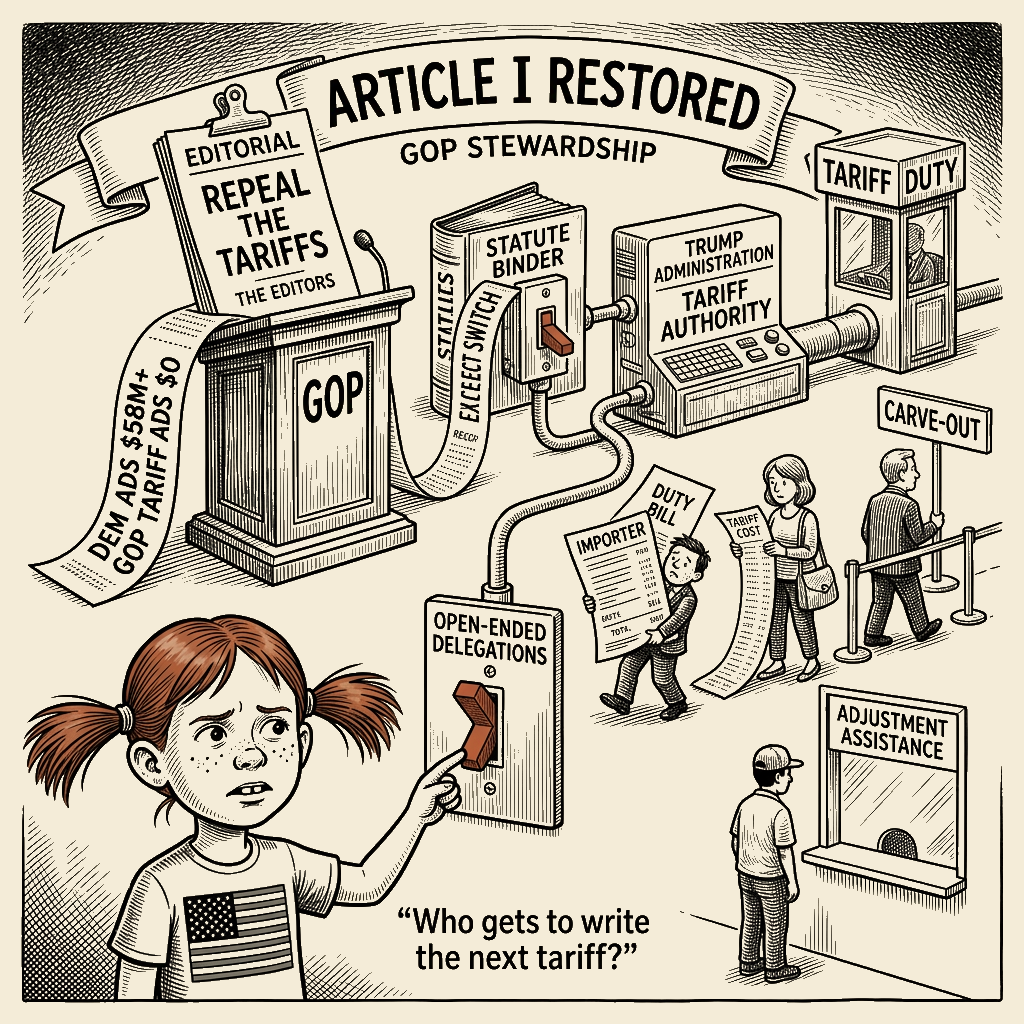
Responding to: Repeal the Tariffs — The Editors · 2026-11-05
Who gets to write the next tariff?
What the Piece Argues
The article argues that the Trump administration’s tariff regime has raised household costs, exposed farmers and businesses to retaliation or compliance burdens, favored politically connected importers through carve-outs, and undermined Congress’s control over trade. It calls on Congress to repeal tariffs imposed in the past two years, or limit them to genuinely strategic sectors, tighten statutory delegations, and approve future restrictions. Its central power-protecting talking point is the promise that repeal would be “a step toward healing the GOP’s wounded reputation for sound economic stewardship,” placing a remedy for economic and constitutional harm within a story of partisan recovery.
Receipts
The pitch turns repeal into a party-reputation story, while the people who paid the tariff bill need relief, constitutional limits, and rules they can understand.
-
What the framing wants you to believe
- Repeal can be staged as proof that Republican leaders have rediscovered “sound economic stewardship.”
- A favorable announcement and a few high-profile concessions can repair the party’s image even if the machinery producing unequal treatment survives.
- Voters angry about the tariffs should understand their demand for lower prices as support for the GOP’s redemption narrative.
-
What’s really going on
- The piece itself demands more than a reputation campaign: repeal or strategic limitation of recent tariffs, an end to open-ended delegations, and congressional approval of future restrictions.
- The analytical inference is that Republican officeholders gain a direct political benefit from repeal presented as stewardship: they can turn a failed policy into a story of renewed competence and claim credit for the cleanup.
- Families gain from repeal because the piece says tariffs have added hundreds to thousands of dollars to annual expenses—more than most households received in tax relief (“Repeal the Tariffs,” Nov. 5, 2026).
- Exit polls cited in the piece found that 65 percent of midterm voters believed tariffs hurt the national economy and 63 percent believed they hurt their local economy.
- The piece also reports that Democrats spent more than $58 million criticizing tariffs while Republicans spent nothing advertising the policy. The party that avoided defending the tariff record now has an opening to position itself as its repairman.
- The same piece reports that politically connected industries obtained carve-outs while smaller importers suffered. That makes statutory cleanup more than cosmetic: without it, an unreformed tariff apparatus can preserve preferential treatment for favored firms.
The Response Ladder
Polite Reframe
When to use: For a good-faith reader who is not in the room — a union household paying more for a washer, a small firm that wants a stable rule, anybody who says “I just want to afford things.” Use it when the person is not the enemy and the conversation can still go somewhere.
Take Ray, a composite industrial worker. He has spent twenty-two years on a line that makes industrial valves in a town with one plant. He is not a statistic and he does not read editorials. He knows what happened when the duties raised his employer’s material costs, and he knows whether his plant remained open because of a tariff, despite one, or for reasons that had nothing to do with either.
That distinction matters. If the tariff was not decisive in keeping the plant open, repeal may change price tags without changing Ray’s job. If it was decisive, repeal can expose him to closure, relocation, or a lower-wage replacement job. The opinion gives no answer because the answer requires admitting that a protective duty may have been economically useless nationally while still mattering intensely to one wage, one payroll, and one town.
The opinion is right about the tax. The cited USITC report is the receipt for the narrower point that U.S. importers bore nearly all of the 2018–19 duty costs and that prices of U.S.-imported steel and aluminum rose nearly one-for-one with the tariffs. That is a tax, and pretending otherwise insults arithmetic.
The opinion is also right about Article I. Congress holds the taxing power; the president does not acquire it because an emergency proclamation says he has. When the Supreme Court rejected the first tariff effort and the administration reached for other statutes, the constitutional problem did not vanish because a new legal citation appeared. Tariff authority must be exercised by the representatives the Constitution chose.
But Article I is not a prize for tariff repeal. It is a rule that applies to whatever trade policy survives. Congress can reclaim the power, repeal unjustified duties, pass any strategic duties through ordinary legislation, and pair the change with adjustment assistance, wage enforcement, collective bargaining, and a plan for the customs revenue it retires. Without those pieces, “repeal first, workers later” is not constitutional restoration. It is abdication with better branding.
The NBER paper cited in this debate helps sharpen the warning rather than the slogan: large retailers benefited while smaller retailers struggled under the tariff-era incidence, but that evidence does not prove repeal will reproduce those gains in reverse. What it does prove is that firms do not enter trade policy with equal weight and that scale changes the size of the bill. Any claim of a universally shared benefit has to survive that fact.
So keep the constitutional argument and make it stronger. Do not call the worker the footnote. Do not tell Ray that his receipt is closed when the bill is still in his mailbox. Reclaim the power, pass the tariffs through Congress, and make Congress own the adjustment as well.
Mockery and Ridicule
When to use: For the repeater in the comments who has stopped making arguments and started making sounds — and for the bystander reading over their shoulder. Use it when persuasion is off the table and the point is to show who is holding the camera.
Here is the affordability agenda translated from the opinion into the actual economy.
Tariffs gone! Every family gets the same coupon! Except that nobody issued the coupon. A duty was paid at the border by importers, passed through in part to consumers, and absorbed in part by firms that lacked the market power to shift the whole cost. Remove the duty and the first rule of arithmetic remains: the bigger the import bill, the bigger the potential nominal relief. Maybe the company keeps it as margin. Maybe competition forces it into prices. Maybe contract terms decide. The evidence from the tariff period says large retailers and small retailers were not playing the same game; it does not say repeal will deliver a second helping of the same result.
Now meet Ray, the composite worker invented precisely so nobody has to name an actual person. If his plant survives because it makes something strategically important, repeal may put his job on the block. If the tariff was merely a tax with a flag on it, his job was never attached to it in the first place. The frame wants the second case to collect the applause and the first case to absorb the unemployment check.
And what is the frame’s answer to Ray? The market will sort it out. The market will sort it out the way a river sorts out a bank. Ray signs up for retraining, searches online, relocates if he can afford to relocate, and applies for a replacement job paying less than the one he just lost. His town gets a ribbon-cutting ceremony for the affordable imports and a memorial for the plant.
But the opinion knows about the customs house. It calls the federal trade office a hotbed of backroom deals, says major companies and politically connected industries secured special carve-outs, and says smaller importers suffered. Then it proposes demolishing the customs house without moving the tenants, policing the new lot, or providing the worker a chair at the table where the rules are made.
That is not affordability policy. That is accounting with the inconvenient column removed.
The political receipts make the frame worse. The opinion reports that Democrats spent more than $58 million explaining the damage while Republicans spent nothing defending the program. The obvious conclusion is not that no protected industry benefited; the obvious conclusion is that the benefits were too weak, too dispersed, too compromised by carve-outs, or politically too dangerous for the party to advertise. You cannot show that workers gained and then leave every worker outside the receipt.
The opinion wants Congress to restore Article I. Good. Start with the actual rule: tariffs must be made by law. Then make the law answer for employment, bargaining power, and adjustment—not merely the existence of a tariff.
We are the builders. Our building code starts with the wage.
Nuclear Satire
When to use: For the stage, the newsletter, the convention floor — anywhere the frame is being recited as received wisdom and has to be made ridiculous before anyone will look at it. Use it when the room has already stopped thinking.
Every nation needs a Ministry of Affordability. Ours would have been magnificent. It would have issued certificates stamped AFFORDABLE, redeemable at any checkout, with a QR code linking to a symposium explaining why the certificate could not actually lower the price.
Its first act would have been to close the customs house ceremonially. A ribbon would have been cut. A banner would have hung over the doorway: LEGACY OF AN UNDELECTED MONOPOLY. The minister would have declared the building unsafe and moved on before anyone asked where its tenants worked.
Panel three of the inaugural symposium would have been devoted to “The Worker as an Exogenous Variable.” Attendance by displaced workers would have been voluntary. Attendance by their former employers would have been compulsory. The PowerPoint would have shown a balance sheet with workers on the liabilities side and affordability on the revenue side.
Then came constitutional recovery. The ministry would burn every emergency proclamation in a ceremonial bonfire, stack the delegations on a trolley, and announce that Article I had been restored. But Article I did not return because a statute book was closed. It returned when Congress passed a law. The ministry would discover this at the worst possible moment: during the vote.
Meanwhile, the opinion supplies the evidence for why the ministry was born. The Supreme Court rejected the first tariff effort, the president turned to one statute and then another, and the average tariff rate rose to its highest level since the Great Depression. The opinion reports that 65 percent of midterm voters said the tariffs hurt the national economy and 63 percent said they hurt their own area. It reports that Democrats spent more than $58 million attacking the program and Republicans spent nothing advertising it. That is not a policy with a constituency. It is a policy with a press conference.
The ministry would answer the political damage with another political gesture: repeal everything, or protect “true strategic interests” if the minister’s advisers object to the word everything. Every exception would receive a solemn certificate. Every worker standing outside the beneficiaries’ tent would be told that the ministry values the long-term competitiveness of the national economy.
The deeper problem would remain exactly where the frame put it: in the room with the voters. Sixty-five percent saw the prices. Sixty-three percent saw the local damage. The factory workers saw the tariff as the condition of keeping their plant open. The ministry would praise them for their public-spirited willingness to absorb the transition for the benefit of cheaper imported washing machines.
That is the absurdity the frame cannot survive. It calls the customs regime corrupt, calls the tariffs destructive, calls the constitutional delegations vague, and then offers repeal without enforcement, repeal without adjustment, and repeal without asking whether the duty was doing any national good at all. It turns the worker into a rounding error because a rounding error cannot vote on the party’s redemption narrative.
The Ministry of Affordability would issue its certificates, seal its minutes, and retire. The workers would remain in the parking lot, holding the bill it refused to read.
Profane Scorched-Earth
When to use: For the reader who has heard the same four sentences for a week and needs the valve opened. Use it where the argument is finished and the pressure is not.
You want the receipts? Here they are, and they are not on your side of the table.
Tariffs are a fucking tax, and the cited USITC report is the receipt for the narrow 2018–19 proposition that U.S. importers bore nearly all of the duty costs, while prices of U.S.-imported steel and aluminum rose nearly one-for-one with the tariffs. That part your opinion gets right. Good. The tax is the tax. Imported steel costs more. Imported aluminum costs more. The duty does not evaporate because somebody puts a national-security seal on the envelope.
And the constitutional point is right too. Congress has the taxing power. The president does not acquire unlimited tariff authority because an emergency proclamation says he has. When the Supreme Court rejected the first tariff effort and the administration reached for another statute and then another, it did not escape Article I; it merely changed the legal hallway through which it tried to carry the same power. Your opinion is right to demand that Congress take the power back.
But here is what your bullshit frame cannot stomach: repeal is not the absence of a tax. It is a change in who gets the relief, who loses the job, who keeps the margin, and whose budget loses the revenue.
Big import book, bigger potential relief. Maybe. Maybe the competitive pressure forces that relief into prices. Maybe contracts decide who keeps it. The NBER paper is cited for the tariff-era observation that large retailers benefited while smaller retailers struggled; it does not prove repeal will repeat that result in reverse. What it does prove is that “the market will decide” is not a sentence about equal consequences. Scale matters. If the frame wants to brag about how the tax worked, it has to face what undoing it might do.
And then there is Ray, the composite worker the frame needs but refuses to fund. If the duty was not decisive in keeping his plant open, repeal changes his shopping receipts. If it was decisive, his job may become the price of the new affordability. Make it conditional, fine. Make it conditional without putting one goddamn dollar, one enforceable adjustment standard, one collective-bargaining safeguard, or one congressional accountability mechanism into the frame, and that is not caution. That is a man pushed out of the room with the furniture still in his hands.
Trade Adjustment Assistance for Workers exists in the same statute books your opinion tells Congress to scour. There is no worker-adjustment plan in your prescription, no labor standard, no bargaining authority, no transition for the town where the factory was the paycheck. There is a price tag. A fucking price tag where a policy should be. You do not get to call yourself the steward of economic affordability while treating the worker as an externality.
You mocked the president for claiming that America suffers from a balance-of-payments deficit, and you were right to mock it because the balance of payments is an accounting identity. Then you offered a remedy that can push measured goods trade in the opposite direction without once confronting the communities paying for that arithmetic. One standard for his math, another for yours. That is not analysis. That is a frame keeping the question it can win and dropping the question it would lose.
Then there is the fifty-eight million dollars. Democrats spent more than $58 million on ads criticizing tariffs. Republicans spent zero on ads mentioning the policy. You also say major companies and politically connected industries secured special carve-outs while smaller importers suffered. Line those receipts up: the beneficiaries were powerful enough to obtain exemptions but not powerful enough to finance the party’s defense of the program. You cannot present protected industries as a triumphant constituency and then explain why the party that created the program did not spend a dime selling it.
Maybe the tariffs were a tax. Maybe the delegations were too broad. Maybe the party took a beating. Fine. Fuck the laundering. Do not package the party’s political rescue as an economic rescue for workers and then hide the workers from the cost ledger.
The workers did not authorize the emergency delegations. They did not obtain the carve-outs. They did not write the rules that shifted duties while changing and did not receive the receipts when the policy paid its political allies. They were never the authors of this framework. They were the invoice.
You can repeal the delegations. You can return tariffs to Congress. You can pair that with adjustment assistance, enforcement, bargaining power, and an honest plan for the revenue. Or you can call austerity for workers “affordability” and hope the adjective does the work. The arithmetic will not.
And fuck the frame that sells repeal as a favor to people who were never in the room.

About Malcolm Little King
Malcolm Little King is a heteronym in Main Street Independent's editorial architecture — an analytical voice, not autobiography of any actual person. The position this column expresses is the publication's position on the territory Malcolm Little King's lane covers, rendered through Malcolm Little King's register.