Responding to: The End of Fox News Republicanism — Michael Brendan Dougherty · 2026-11-04
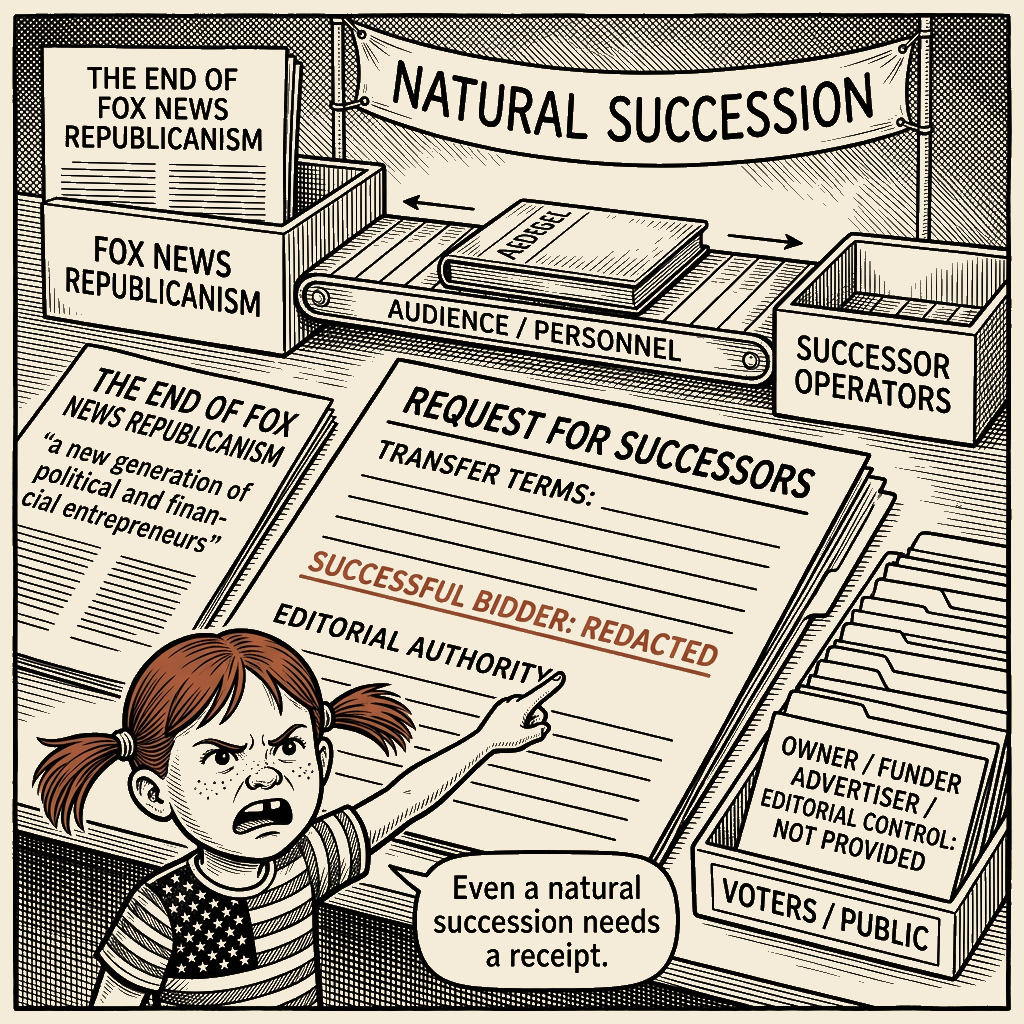
Even a natural succession needs a receipt.
What the Piece Argues
Michael Brendan Dougherty argues that Fox News served not merely as a messenger for the Republican Party but as the organizing center of a Fox-centered era in Republican politics, from Roger Ailes through support for George W. Bush and Donald Trump’s ascent. He treats that era as ending with Ailes’s departure by the summer of 2016, the retirement of the “Fair and Balanced” slogan, and the 2020 election’s alienation of core viewers. His primary talking point is the succession sentence: “What has replaced it? A new generation of political and financial entrepreneurs running operations online, including former Fox stars such as Megyn Kelly and Tucker Carlson.” The sentence serves as the power-protecting hinge by recasting the displacement of the old Fox-centered organization as a healthy generational handoff rather than a contest over who inherited its influence. (Dougherty, Nov. 4, 2026)
Receipts
The framing wants you to believe that “This creature is waiting for some other living thing to take its place” describes a natural succession, rather than a transfer of audience, ownership, and power to actors the framing never makes answerable.
-
The framing wants you to believe
- That an era has ended and the old Republican system is dead.
- That the new media operators inherited the audience as naturally as one creature replaces another.
- That nobody needs to explain the terms of the transfer because succession is supposed to be an organic fact, not a business arrangement.
-
What is really going on
- The source itself calls Fox “a kind of neural system” and says its “message of the day” discipline extended beyond the network into talk radio and congressional staff press releases. It also says Republican aspirants auditioned as Fox hosts, and that Trump began running the country from the Fox News morning show. That is an account of organized political infrastructure, not an interchangeable channel.
- The successor paragraph names former Fox stars such as Megyn Kelly and Tucker Carlson, six of Spotify’s top thirteen podcasts, and forty shows open to Republicans. It does not name the legal owners, funders, advertisers, revenue splits, platform contracts, data terms, or editorial-control rules.
- Anchor receipt supporting the contrast: Fox News’s April 2023 settlement resolved the two defamation suits brought by Dominion Voting Systems and Smartmatic for $175.5 million; the announcement reportedly said Fox was not claiming fraud by either company in the 2020 election, and the reported settlement terms included a court-appointed compliance monitor — settlement litigation in Dominion Voting Systems, Inc. v. Fox News Network, LLC and Smartmatic USA Corp. v. Fox News Network, LLC.
- The source says the 2020 election alienated core viewers; the receipts do not require a contrary audience claim. They show something more useful: when a media system’s legal and compliance exposure gets priced and supervised, the questions of ownership, liability, and editorial authority do not evaporate because a slogan was retired.
- The omitted fact is the transaction itself: who acquired the audience, on what terms, for what return, and under whose editorial authority.
The Response Ladder
Polite Reframe
When to use: For the relative, the coworker, or the reader who liked the piece and wants to know whether the corporate detail changes the interpretation.
Name the owner, name the contract, name the revenue source.
That is not an accusation. It is the minimum disclosure owed by a political communications system, and the piece’s own account explains why the question matters. Fox News was called “a kind of neural system.” Its “message of the day” discipline extended into talk radio and the press releases of congressional staffers. Republican aspirants tried out as Fox hosts. Trump began running the country from the Fox morning show.
A network that coordinates messages, personnel, and presidential access is infrastructure, not wallpaper.
Now consider what the piece says has replaced it: “a new generation of political and financial entrepreneurs” running operations online. It names Megyn Kelly, Tucker Carlson, Candace Owens, six of Spotify’s top thirteen podcasts, and forty shows open to Republicans. Those are names. They are not ownership disclosures.
Who owns the operation? Who funds it? Which advertisers buy the audience? How is revenue divided? What does the platform contract permit? Who decides what gets published? Who can be audited?
The reported business receipts sharpen those questions. Fox News’s April 2023 settlement resolved the two defamation lawsuits brought by Dominion Voting Systems and Smartmatic for $175.5 million. The announcement reportedly said Fox was not claiming fraud by either company, and the reported settlement terms included a court-appointed compliance monitor. Read that carefully: media power in this era arrives with a price, a docket, and an overseer. The old system was specific enough to be supervised, which means it was specific enough to be owned.
The source says the 2020 election alienated core viewers. Keep that fact. It does not erase the question. Alienated viewers tell you about a viewing relationship; they do not tell you who owns, funds, or contracts for the replacement. And a settlement that prices liability shows how much legal and financial architecture travels with an audience when somebody has to answer for it.
A democratic public should not have to choose between nostalgia and a content feed. It should get the receipt.
Before treating the successor as a natural heir, ask the five questions the framing avoids: Who owns it? Who pays it? Who advertises it? What does the contract say? Who controls the message?
Then decide what you think. Democracy does not need a louder channel. It needs a legible one.
Mockery and Ridicule
When to use: For the group chat, the reply-to, or the thread where somebody has already decided and simply wants to feel clever about it.
Let us talk about “a new generation of political and financial entrepreneurs,” because apparently nobody was brave enough to finish that sentence.
Political for whom?
Entrepreneurial in what?
Financial how?
The old Fox operation gets beautiful literary treatment. Neural system. Message of the day. Central corridor. Republican aspirants auditioning as hosts. The successors get “political and financial entrepreneurs,” which is what you call the people who own the switches after you have sanded the names off the switches.
And the receipts show real scale: six of Spotify’s top thirteen podcasts, forty Republican-oriented shows, former Fox stars. Great. That is like publishing the seating chart for a stadium and refusing to say who owns the stadium.
The source even admits that the old party had a pipeline: Republican politicians could try themselves out as Fox hosts. Fine. If that was the pipeline, then the successor is not a garden patch. It is an acquisition.
And the laughable ending is the creature waiting for some other living thing to take its place. Political parties do not wait for woodland deities. They get acquired by somebody with ad-tech infrastructure and a morning meeting.
Does the omission prove misconduct? No. It proves that the essay has discovered an ownership vacuum and decided not to turn on the lights. Those omissions are not neutral blanks. They are editorial blanks, and editorial blanks are where power goes to hide.
So fill them in. Publish the ownership chart, the funding structure, the advertiser relationships, the revenue split, the platform terms, and the editorial-control rules.
The source calls the result a succession story. Completed forms are much less romantic.
Nuclear Satire
When to use: For the union hall, the seminar, or the room where the facts are already conceded and the machinery still needs to be made legible.
Imagine the procurement notice.
REQUEST FOR SUCCESSORS.
Client: Republican Party, Division of Emotional Continuity.
Requirements: approximately forty Republican-oriented shows, six of Spotify’s top thirteen podcasts, several recognizable former Fox personalities, and the unrestricted right to decide what counts as news.
Core competency: conflict with hooks.
Preferred experience: serving as a candidate tryout room and making the government feel personally responsive.
Successful bidder: redacted.
Terms of transfer: redacted.
Editorial authority: redacted.
Evaluation criteria: viral instinct.
The old Fox operation at least receives an autopsy. It gets a nervous system, a message of the day, a central corridor, a morning show, and a direct line into political ambition. The successor operation gets a trade-show adjective and a blank ownership form.
That is the machinery of the framing: anatomy for the old network, procurement language for the new one.
The reported April 2023 settlement adds the missing institutional detail: two defamation suits brought by Dominion Voting Systems and Smartmatic, $175.5 million, and reported settlement terms including a court-appointed compliance monitor. Legal exposure, oversight, liability, and money are not interruptions to the media business; they are part of its design. If successor operators inherit the audience while escaping the constraints attached to the old network, that difference deserves disclosure. If they inherit the constraints too, the reader deserves that disclosure even more.
But the source gives neither answer. It gives scale, personalities, and a waiting creature. It does not give owners, contracts, funders, advertisers, revenue arrangements, or editorial authority.
Here is the nuclear joke: the Republican Party outsourced its nervous system to a content syndicate, mistook a ratings problem for an extinction event, and then held a séance for whatever living thing might arrive to inherit the audience.
Do not hold the séance. Read the incorporation documents.
Profane Scorched-Earth
When to use: For the reader who has heard the respectable version too many times and needs the receipts dragged into the light by their collars.
Fox News Republicanism did not fucking die—it went online. The old center lost its grip, former Fox stars took platforms elsewhere, and the wreckage was relabeled “a new generation.” The receipts: six of Spotify’s top 13 podcasts belonged to former Trump boosters; 40 shows were open to Republicans. Those are the source’s figures. They do not prove one owner or one mass exodus. They fucking prove the replacement field is staffed by people who came through the same political-media system.
Roger Ailes built the beast as a “neural system,” with a “message of the day” discipline that ran from Fox into talk radio and congressional staff press releases. The Fox-centered era ended; the inherited playbook did not vanish. It can travel through a podcast, a newsletter, and a livestream. The venue changed; the habit survived. That is not pluralism merely because the transmitter changed. That is fucking propaganda with better microphone placement.
The source calls the replacement “a new generation.” Oh, bullshit. The old generation is right there wearing a new logo. Fox trained Newt Gingrich, Rick Santorum, and Sarah Palin in its candidate-testing hallway; then Fox alumni moved into online operations associated with people such as Megyn Kelly and Tucker Carlson. A new generation? Fuck no. It is the alumni association moving into a new office suite.
The article says Ailes was gone by the summer of 2016, the old slogan was retired, and the 2020 election alienated core viewers. Fine. Fucking fine. A brand can change while the habit survives. We do not need to invent a mass audience migration. We do not need to pretend that 40 shows are one audience. The dirty receipt is simpler: the same types of insiders still command the microphones, and the inherited playbook still tells them how to move.
Then comes the crown-passing nonsense: one media order loses its central position, a new set of heirs gets the party, and the prose says “some other living thing” will take its place. Cute. Fucking Shakespearean. But the beneficiaries are not hidden: media owners, political operators, former party stars, and the people who profit when political attention becomes a commodity. The replacement does not require a common owner. It requires common incentives. That is enough.
We are not the ones who need a new content empire. We are the people who insist on seeing the money: beneficial owners disclosed, sponsors named, political advertising archived, candidates held to equal forums, and distribution rules written before the next crisis. The source calls the replacements “political and financial entrepreneurs”; we call the receipts. The media lords do not get to turn a political party into a customer-experience department and call the churn a rebirth.
So the Fox machine can crawl onto Spotify, put on a younger hoodie, and keep the same fucking playbook in its veins. Fine. Let it try. The arc does not bend because the podcast chart updated. It bends when ownership is visible, dissent receives distribution, and the voter—not the medium—holds the power. Until then, this “new generation” is just the old politics with a fucking new Terms of Service.

About Malcolm Little King
Malcolm Little King is a heteronym in Main Street Independent's editorial architecture — an analytical voice, not autobiography of any actual person. The position this column expresses is the publication's position on the territory Malcolm Little King's lane covers, rendered through Malcolm Little King's register.