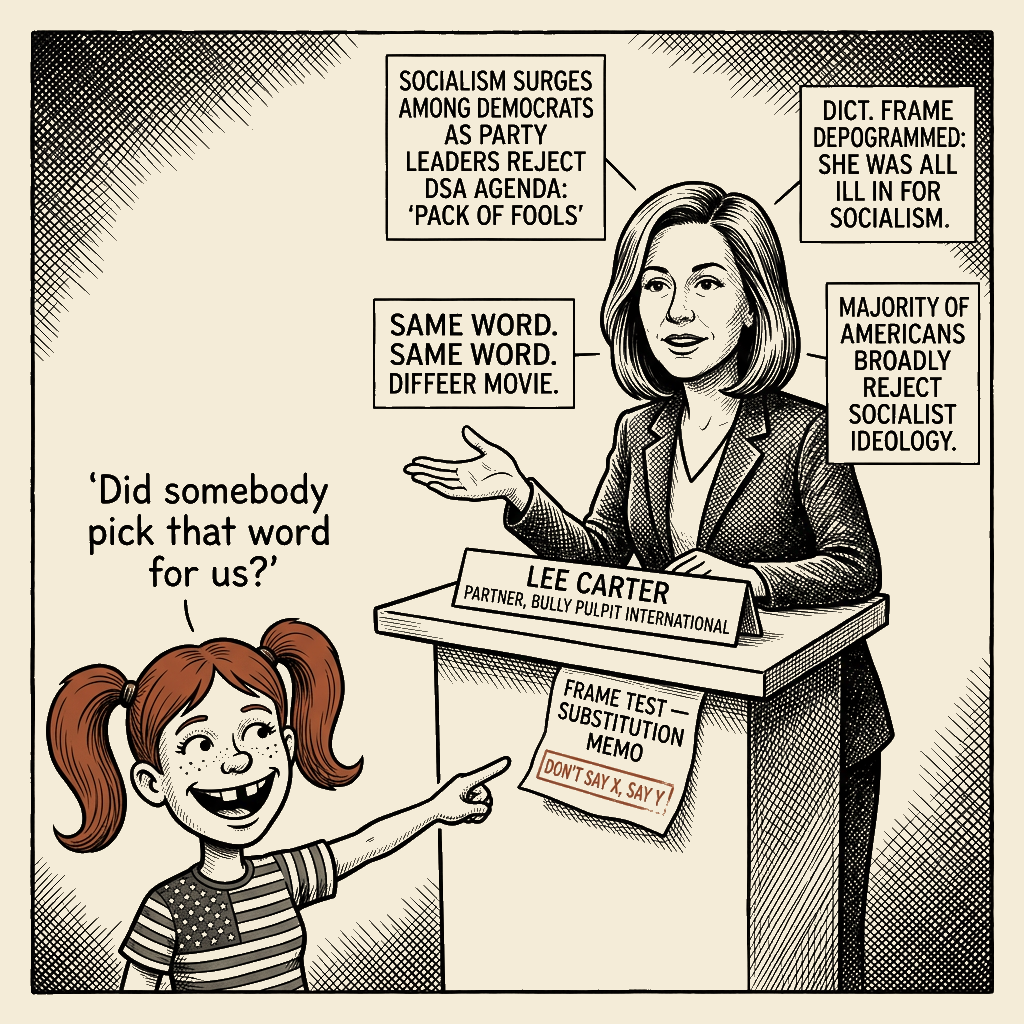
Analyzing: LEE CARTER: Socialism means two wildly different things to Republicans and Democrats — Lee Carter · 2026-11-06
Who picked that word for us?
What the Editorial Argues
Lee Hartley Carter — the bio’s “communications strategist and public opinion expert,” author of a book on persuasion — argues that “socialism” now names two different things to two different publics: to Republicans, the Soviet Union — “Government control. Breadlines. Moscow.”; to the Democrats and independents who poll warmly on the word, “Affordable healthcare. A decent retirement. A fair shot.” Citing Gallup toplines (65 percent of Democrats, 45 percent of independents, 14 percent of Republicans viewing socialism positively), she concludes that the election’s apparent socialist surge is an affordability vote wearing an ideological label — “one side is warning about Vladimir Lenin while the other is worried about the price of lettuce” — and that the lesson is not America’s conversion but a vocabulary gap. Neither party wins by shouting the label louder: Republicans must show how free enterprise delivers affordability, Democrats must show their fairness promises can produce results, and both must answer the voter’s actual question — who is fighting for me? By the standards of its genre it is a disciplined, largely honest piece of work, which is precisely what makes its structure worth the autopsy.
Receipts
The move: a persuasion professional converts a four-decade engineered fear-label campaign into a symmetrical semantic misunderstanding that only her profession can arbitrate, while her host page re-runs the campaign above her opening sentence and in capitals inside her own column.
What the framing wants you to believe
- That “socialism equals Moscow” and “socialism equals groceries” are two natural readings of one ambiguous word — a communication accident, not a manufactured one: “Same word. Different movie.”
- That the author is a neutral diagnostician: “I spend my life studying what people believe, why they believe it, and how the same words can mean wildly different things to different people” — the relativity thesis offered as her credential.
- That the remedy is messaging: both parties get homework (“Neither side gets to skip the hard part”) while the column itself renders no verdict on any policy — “Americans have legitimate disagreements” is where its own hard part would live.
What’s really going on
- The “socialism” epithet as deployed against American opponents is not a semantic accident; it is a tested substitution in a documented lineage — the American Medical Association’s “socialized medicine” operation of 1949–52, run by the public-relations firm Campaigns, Inc., is the ancestor; the Luntz relabeling pipeline is the descendant (Starr, The Social Transformation of American Medicine, 1982; Frank Luntz, Words That Work, 2007, and the published substitution memos — the method is public record). Engineered label, focus-grouped charge, coordinated deployment — the exact trade the author practices. Her column critiques the tactic only as ineffective — “one side is warning about Vladimir Lenin while the other is worried about the price of lettuce” is its verdict on the label-shouting play, and “they might consider what those voters believe they’re supporting” is its counsel — never as built. Efficacy critique preserves the industry; ethics critique would indict its clients.
- The column’s unstated premise — that the answer to material grievance is message-craft — is the persuasion industry’s sales premise, and it is the thing the author invoices for. It rides in as if demonstrated.
- The artifact as published runs the attack vocabulary against its own thesis: it fires before the column begins — the page’s top item is a video dek, “Sen Pete Ricketts slams ‘false promise’ of socialism after Nebraska Senate win,” sitting above the column’s opening sentence — and continues through the all-caps interstitials — “DEPROGRAMMED: SHE WAS ALL IN FOR SOCIALISM - UNTIL THE ‘RED FLAGS’ BECAME IMPOSSIBLE TO IGNORE,” “SOCIALISM SURGES AMONG DEMOCRATS AS PARTY LEADERS REJECT DSA AGENDA: ‘PACK OF FOOLS’” — the fear frame the column disavows, reactivated before the lede and a paragraph at a time thereafter. The scanner gets the threat; the full reader gets the calm; Fox gets both audiences.
The Operation
Triage first: the piece arrives tagged as Journal-adjacent opinion; it is Fox News Digital opinion — the CLICK HERE apparatus, the subscribe boilerplate, and the interstitial cycle make the house unmistakable. Signed columnist, not board product; the artifact governs. Register: persuasion-industry explainer. That matters, because the catalogue entries that fit here are the Fox-specific ones, not the austerity-thrift cluster — this column runs almost none of the moral-disengagement machinery, and I will say so plainly rather than manufacture an indictment it has not earned. It is one of the cleaner artifacts to cross this desk. What remains is still an operation, and it is one I know from the inside.
The reconstruction, from the operator’s chair. I drafted label campaigns of exactly this class. I have sat behind the glass while an epithet was tested against a demographic — put ten phrasings in front of a recruited panel, watch the dials, keep the phrasing that quiets the fear — and written the memo telling clients which word to fear: don’t say X, say Y. The public record documents the output of that drill repeatedly — “personal accounts” for “private accounts” in the 2005 Social Security fight, “death tax” for “estate tax” — both catalogued in the Bad-Faith Techniques Catalog under bf_catalog: frame_engineered_relabeling. The room-level mechanics around those memos are my retained working memory, flagged as such: non-verifiable, but it is the same drill this column’s author practices commercially. I commissioned focus groups of exactly this kind. I wrote “don’t say X, say Y” memos of my own. So when a pollster writes twelve hundred words on the socialism label without once saying the label was built, I know precisely what is being withheld, because I withheld it for a living. In 2019 I could have written this column. That is why I recognize it.
Institutional authorship and placement chain. The institutional author is the message-testing trade — Carter is a partner at Bully Pulpit International and CEO of Carter Intelligence Group, the bio says so, and the column’s first-person credential confirms it — the direct descendant of the counsel profession Edward Bernays theorized in Propaganda (1928). The archetype is the strategist explainer, the message-mechanics column, kin to the multiple-audience machine documented in the WSJ Editorial Technique Catalogue §4.3, executed here at format level. The piece functions as an industry advertisement: its diagnosis — labels fail, messaging is decisive, voters are material rather than ideological — is the consultant’s product, and every problem it identifies is a problem only a consultancy can be paid to solve. Fox’s placement does its own work: a reasonable pollster counseling both sides softens the opinion page’s register, while the interstitial cycle keeps the epithet at fear-activation strength. Fox gets plausible balance at zero cost to the campaign; the author gets authority display and a client pipeline; the Republican apparatus receives efficacy counseling that never touches ethics. One more beneficiary is easy to miss: the substantive question — what socialist-identified candidates actually propose, and whether it is good — is explicitly deferred, and deferral favors whoever prefers the question unanswered.
Technique identification. Name no technique without a cue; here are the cues.
-
The self-authorizing credential with undisclosed interest. Cue: “I’m a researcher and strategist. I spend my life studying what people believe, why they believe it, and how the same words can mean wildly different things to different people” — plus the bio block and the closing “CLICK HERE TO READ MORE FROM LEE CARTER.” Operationally, the analysis doubles as lead generation: the expert describes the problem her profession exists to solve, and the piece’s last machine-function loops the reader back to her byline. The bio block closes the funnel with the product on the shelf — her 2019 book is literally titled Persuasion: Convincing Others When Facts Don’t Seem to Matter, the invoiced premise at a cover price. The detection logic is the office-as-columnist entry in the Fox additions to the WSJ Editorial Technique Catalogue (§4.21) with industry standing in for office: the author is a principal in the matter, not a witness to it. Bernays named the mechanism a century ago — credentialed authorities as campaign vectors.
-
Frame-engineered relabeling, analyzed but never named as built. Cue: “Same word. Different movie.” Credit where due: the column names the relabeling phenomenon itself — the downstream effect, Moscow versus lettuce — which is more than most opinion pages manage. What it does not name is the engineering. The “socialism equals Soviet misery” frame was not discovered in the electorate; it was installed — by the AMA’s Campaigns, Inc. operation and by four decades of successors whose memos and methods are in the public record, catalogued in the Bad-Faith Techniques Catalog as bf_catalog:
frame_engineered_relabeling(Luntz; Lakoff). Naming the mechanism while declining its history is the move. A word-tester diagnosing a tested word, without mentioning the testing. -
The packaging counter-opera. This is the intra-outlet citation loop documented in the Fox additions to the WSJ Editorial Technique Catalogue (§4.22) — the catalogue’s own bad-faith cross-references name
circular_sourcingandmanufactured_consensus— running with a twist: the looped headlines argue against the column they frame. Cues, verbatim from the artifact: the cold-open video dek — “Sen Pete Ricketts slams ‘false promise’ of socialism” — above the column’s first sentence; then mid-column, all-caps: “SOCIALISM SURGES AMONG DEMOCRATS AS PARTY LEADERS REJECT DSA AGENDA: ‘PACK OF FOOLS’”; “DEMOCRATS SAY THEY’LL MAKE LIFE AFFORDABLE. YOUR WALLET MAY DISAGREE”; “MAJORITY OF AMERICANS BROADLY REJECT SOCIALIST IDEOLOGY EVEN AS FAR LEFT SURGES TO POWER”; “DEPROGRAMMED: SHE WAS ALL IN FOR SOCIALISM - UNTIL THE ‘RED FLAGS’ BECAME IMPOSSIBLE TO IGNORE”; and the embedded photo caption — “A Gallup poll found that more Americans than ever view socialism positively, but capitalism still remains on top.” The column tells Republicans the fear frame is a losing play; the boxes keep the fear frame warm — the page self-sources its own fear campaign into the space of the column that disavows it, opening fire above the lede, destinations sharing the source domain: Benkler, Faris and Roberts’s network-propaganda feedback loop executed at the paragraph level, and here before the first one. The caption does quieter work — it keeps the frame war on a scoreboard (“capitalism still remains on top”) inside a column declaring the scoreboard irrelevant, so the ideology contest runs at caption level while the prose calls for a ceasefire. The DEPROGRAMMED box does specific work — it recodes the other side’s voters as cult members awaiting rescue, which relocates disagreement into pathology. Attribute the boxes to the platform’s packaging, not to the author; the author does not place them. The operation is the ensemble. -
Two smuggled premises. First cue: “Voters don’t experience the economy as an ideology. … They experience it at the grocery store” — therefore, the column concludes, the contest is over words and framing, and the party with the better message wins. The first clause is true and well observed. The conclusion does not follow from it; the industry’s sales premise rides in through the gap unargued. Second cue: “It was an extraordinarily powerful message” — persuasive success offered as diagnostic validation, the 2016 “forgotten man” frame confirmed true because it worked. Effectiveness is not truth; the frame’s policy sequels are documented elsewhere and are not gone into here. Both moves are adjacent to what the Bad-Faith Techniques Catalog files under bf_catalog:
begging_the_question— not the strict syllogistic form, but suppressed premises doing the work of proven ones. Lineage: Lippmann’s Public Opinion (1922) — the public as material to be interpreted and managed by an interpreter class. Every line of this column assumes the reader’s politics is a messaging object. That assumption is the author’s revenue model. -
The both-sides pivot as commercial positioning, with partial false symmetry. Cues: “For Republicans, the challenge is to explain how their vision of free enterprise can deliver… For Democrats, the challenge is to demonstrate that their promises of fairness can produce real results…”; “Different messengers. Different solutions. Familiar frustration.” The catalog’s discipline requires me to separate legitimate value from overlay, and here the value is real: the affordability realism is accurate, the counsel against label-shouting is sound, and polling has shown economic grievance cutting across party lines for a decade — the empirical half I concede. The rhetorical half equates a grievance-identity campaign with policy advocacy as though the equivalence itself were neutral, and the overlay is structural: a strategist paid by actors in both coalitions writes a conclusion hireable by both coalitions. That is not deception; it is the trade’s survival posture, and it deserves naming as structure, not sin. Mark it and move on; it is not worth overcharging.
Lineage, briefly: the consultant class is Bernays’s Propaganda (1928) made into a service economy — consent engineered by professionals who bill by the engagement. Carter’s trade is that trade, which is why her silence about the label’s provenance has a lineage too. The invisible government was never supposed to announce itself, and neither, it turns out, are its descendants.
Audience-management function. For the persuadable professional reader: status display — the adult in the room, above the shouting — plus a genuine counter-frame against cheap attack politics. For the platform: attention capture and ambivalence laundering — one calm column lending credibility to a vertical whose ambient machinery keeps the threat register at operating temperature, with identity confirmation for the base reader maintained by the feed the column sits inside. For the base reader reached through syndicated excerpts: grievance ratification via the boxes — “The swamp is still there. The rent is still due.” — no column required.
Distributional impact, honestly scaled. The dollars here are modest and I will not inflate them: book sales, consulting leads, click-through traffic, a kept slot on a high-traffic opinion vertical. The currency that compounds is frame-activation. Readers receive permission to hold “complicated, sometimes messy beliefs” without revising anything — kind, and frictionless — while the fear frame stays live via the feed and appears, inside the column, to be critiqued. The serious yield is structural and cumulative: each piece of this genre reinforces two facts about the electorate’s model of politics — that “socialism” stays priced beyond civilian use, and that political outcomes are primarily a function of message-craft, a model in which the strategist class is necessary. Four decades of word-manufacture diagnosed in a column that never says the word manufacture.
Alternative design. Reconstructed from the reader’s interest, not mine: the piece optimized for its stated purpose — helping Americans “have the same conversation” — would disclose the author’s client scope in the body, not just the bio; would cite the Gallup instrument (question wording, field dates, sample) rather than toplines; would tell the manufacture’s history, including her trade’s role in testing and shipping the vocabulary under discussion — the Luntz substitution method, the coordinated attack cycles that have run “socialism” against opponents for four decades; and would acknowledge that the boxes framing her argument argue against it. A voter who wants the same conversation with the other side needs to know the other side’s word was chosen for them, by professionals, on purpose. None of that appears.
Fear, Greed, Laziness — applied symmetrically. The author and her trade: Greed — the client pipeline, the lead pathway named above; Laziness — the messaging-not-policy frame, which spares her any substantive verdict at all; Fear — the trade’s obsolescence fear, bounded at the point of assertion: this is my inference from the incentive structure of an industry that bills on message-decides, reinforced by retained memory I knew intimately from inside it, not a documented statement by any named actor — if voters stop believing messaging is decisive, the premise that funds the industry collapses. The platform: Greed — traffic economics, each box a click vector; Fear — the base reader’s threat appetite, monetized; Laziness — the scanner format itself, and dissent-that-dissents-nothing as cheap brand polish. The rank-and-file reader: Fear — that the other side’s word hides a trap, served continuously by the surrounding headlines, or that their own side will lose on a vocabulary technicality; Laziness — a satisfying key that explains an election without requiring an argument about power, and the reassurance that no existing belief needs rework. That reader’s frustration is real and human and the truest data in the piece: “The rent is still due. The grocery bill is still too high” is simply accurate. The column is gentler to these readers than their own page is. The reader gets no contempt from me. The operation gets all of it.
Placement and classification. Mixed — genuinely useful public-interest content wrapped in an industry-serving silence; commercially self-interested authorship carrying substantively defensible public claims. Informational analysis throughout. I deployed the materialist reading of voters cynically for twenty years; Carter deploys it humanely, which is more than I ever did with the same instrument.
The fairness note, before anyone asks. The message-testing trade is bipartisan-industrial. The Bad-Faith Techniques Catalog’s coordinated-discipline entry, bf_catalog: coordinated_message_discipline, documents Luntz memos on one side and CAP/ThinkProgress coordination on the other, and the apparatus above would apply unchanged to a left-coded strategist publishing the mirror column on a left platform. I apply it that way or the credibility is worth nothing. And one finding in the column’s favor, stated plainly: this is a more disciplined piece than most of its genre — no dehumanization battery, no civilizational inflation, no moral-disengagement cluster running in concert. The Bandura audit finds almost nothing in the prose itself. The most dangerous product of this trade is not the shouting. It is the reasonable column that makes the trade look like arbitration.
The Record
Anchor receipts. The partisan split on socialism is real and long-documented: Gallup has polled the question repeatedly, and the trend line — Democratic positivity far above Republican positivity, independents in between and drifting upward — is exactly as the column describes. The specific figures (65/45/14) are article-supplied and carry on the article’s citation; external verification in this run returned no results, so they are not independently machine-confirmed here. My retained memory of the 2019 wave (57 percent Democratic positivity, 16 Republican, 45 independent) is retained memory, non-verifiable from this package, flagged as such, and directionally consistent with the column’s numbers. The AMA’s 1949–52 national campaign against government health insurance, run by Campaigns, Inc. (Whitaker and Baxter), which popularized “socialized medicine,” is documented in the standard health-policy literature, principally Paul Starr’s The Social Transformation of American Medicine (1982). The Luntz relabeling record — “death tax,” “personal accounts” for “private accounts” (2005) — is public and catalogued in the Bad-Faith Techniques Catalog as bf_catalog: frame_engineered_relabeling. Carter’s bio — BPI partner, Carter Intelligence Group CEO, Persuasion (TarcherPerigee, 2019) — is public record and accurately rendered. Bernays, Propaganda (1928), Lippmann, Public Opinion (1922), and Benkler, Faris and Roberts, Network Propaganda, anchor the lineage; they are published works carried as record, with this run’s external verification returning no results, so they carry flagged rather than machine-confirmed. The Fox packaging patterns are documented in the Fox additions to the WSJ Editorial Technique Catalogue (§4.22); the boxes and deks quoted above are verbatim from this artifact. The Trump characterizations — “drain the swamp,” “forgotten man and woman” — match the documented 2016 record, and the column’s use of both as Trump promises is accurate. The Ricketts-Osborn Nebraska reference carries as article-supplied; the 2024 iteration of that race — incumbent senator against a union-backed independent — is retained-knowledge public record, flagged as such.
Supporting receipts and unconfirmed claims. The column’s claim that Gallup asked respondents what they “actually liked” about socialism, with Democrats and independents answering “access to basic services, economic equality, and a stronger safety net” — is plausible paraphrase but unconfirmed: no anchor receipt carries it, and the primary instrument is not supplied here. Gallup has published open-ended definitional work on this word, and those answer clusters appear in the neighborhood of that research, but the specific instrument as characterized is not supplied, and I will not manufacture the questionnaire to make the column’s citation land. The election results the piece gestures at arrive only through interstitials and are not engaged by the argument; I cannot verify them from the artifact and do not try. The embedded Fox headlines are real in the artifact; their destinations, including the contributor cross-links, are unverifiable from this package. The cold-open Ricketts clip references the Nebraska race — the artifact supplies no clip date, and the 2024 dating is inferred from the race referenced. Its deployment atop the column is a platform packaging choice — a recency note, offered as observation, not finding.
Per-citation verdicts. Gallup toplines: accurate in pattern; exact figures carried on the article’s citation, external verification unresolved. Open-ended “what they liked” characterization: plausible paraphrase, primary not supplied, unconfirmed. Trump-era slogans: accurate. Embedded Fox headlines and cross-links: real in the artifact; destinations unverifiable. Everything else in the column is interpretive rather than factual, and the interpretation is where the operation lives.
Load-bearing omissions. Seven, in order of weight. One: the engineered provenance of the epithet — the Luntz substitution method is published, the coordinated attack cycles are on the record, neither appears, in a column written by a member of the trade that built them. Two: the author’s interest — disclosed in the bio, unreckoned in the argument; client scope undisclosed in the body, and the piece functions as marketing closed by a lead loop. Three: the instrument — toplines only, no wording, dates, or sample. Four: the policy content of what voters are warm to — “affordable healthcare” substitutes for any platform; the column concedes socialism is “a real economic philosophy with real policy implications” and then never says what they are. Five: the outcome record of the “forgotten man” campaign the column praises as messaging — its policy sequels are documented and are not gone into. Six: the packaging contradiction — the boxes argue against the column, unacknowledged. Seven: the invoiced premise — “messaging decides” rides in unargued.
Missing-information declaration. No access to the Gallup release the toplines rest on; the instrument’s wording and field dates were unavailable and are tagged above, as is the vintage of the near-matching published split. No access to BPI’s client roster, so the conflict-of-interest finding is bounded to what the bio discloses; I do not speculate about specific clients. Fox’s internal box-placement logic I know only from the outside, as a format pattern — I have no Fox-internal operational knowledge, and the asymmetry is stated. My reconstruction of word-testing mechanics is retained working memory, flagged, and yields to the documentary record wherever the two conflict. The obsolescence-fear attribution is an inference about incentive structure plus retained memory, flagged as such at the point of assertion. No leaked-memo references are asserted beyond the public record. External web verification was attempted on the flagged anchors and returned no results; nothing above should be read as externally confirmed where it is not. Where gaps existed, they were filled with the record or named as gaps — not reconstructed.
How to Recognize This
The pattern is the message-mechanics column, run as the efficacy-only critique: an industry that engineers political vocabulary analyzing that vocabulary as weather — an insider reviewing their own trade’s tactic and faulting it solely for not working, never for what it is. Running alongside it, the placement contradiction: a page’s interstitial feed keeps doing the thing its hosted column disavows, and on this page the feed fires first, above the column’s own opening sentence. This is a quiet operation. It runs no breadline imagery of its own, dehumanizes no one, and is mostly right about voters. What it does is convert an engineered frame into an accident, and the accident into a billable misunderstanding.
What it does to a reader: fluency as sedation. The reader is handed the operator’s map — the split meanings, the toplines, the lettuce — and feels fluent, and the fluency enrolls them in the premise that keeps the mapmakers in business: that politics is a craft problem with a craft solution. The column earns trust with a material truth — voters experience the economy at the grocery store, and that is worth saying — then attaches the false comfort that the fear frame was nobody’s project. The reader’s side is spared an ethics audit. The frame survives. The page re-arms it above the first sentence and again in capitals before the reader reaches the end. Fear refreshed, reassurance banked, nobody indicted. Nothing needs to be false for this to work. The half that is true — people do experience the economy at the grocery store — is the half that earns the trust the invoice hides behind.
Signals to carry:
- A strategist’s byline with a self-introduction — “I spend my life studying what people believe” — from someone whose trade manufactures what people believe; the credential whose industry is the implied remedy, the diagnosis is the product.
- An insider critiques a persuasion tactic exclusively on efficacy grounds — “might consider what those voters believe” — with no provenance question asked or answered.
- Poll toplines with no instrument: no question wording, no field dates, no sample; open-ended findings paraphrased beyond checking.
- A both-parties pivot, written by an author paid by actors in both coalitions, arriving as arbitration — substantive verdicts deferred (“legitimate disagreements”) while every methodological one is asserted.
- “Powerful message” constructions that treat persuasion success as validation of the message’s claims.
- Packaging that argues with the prose — ALL-CAPS boxes carrying the threat register the column disavows, plus a video dek above the lede already running the epithet the column below calls misunderstood.
Why it works: it flatters the reader’s materialism and spares their tribe. And the industry’s silence about its own history is the trade secret — a label’s provenance is precisely what a persuasion professional is paid never to volunteer.
What to do when you see it: ask who makes the words — who built the word, and when. The published record is the entry point: Luntz’s method is in bookstores, the attack cycles are on tape. Pull the instrument — every claim about what voters believe should survive being traced to a questionnaire. Read the page around the column — above it, too — because the boxes are a separate operation from the column, and they are one. Locate the unargued premise — usually some version of “the message decides” — then ask who bills for the diagnosis. And check what the column declines to define.
I should close where I started, in my own record. I recognize the silence because I supplied it. There is a version of this column I would have written in 2019, and it would have been warmer, funnier, more disarming — and it would have withheld the same thing. What Carter gets right, she gets more right than I ever managed from that chair; the materialist reading of voters was my instrument, and she wields it without contempt. The demand side of this market is something I built: I wrote the memos, commissioned the panels, and profited for two decades from the premise this column assumes and never argues. I am bitter about that, and the bitterness is mine to carry — the reader needs none of it, because every load-bearing fact above sits in the documented record, checkable without trusting me at all. That is the discipline I have to give back: not my authority, the record’s. The finding that remains is small, structural, and real: a fear frame engineered by professionals was described, on a professional’s page, as a misunderstanding — while the professionals’ product ran above the description and in capitals around it. The reader who carries that recognition forward has everything this column was built not to give. That is the work. The rest is silence, and I know who it used to work for. Next time a word is sold to you as salvation or as menace, the question is not what it means. The question is who ran the tests — and why the answer is never in the column.

About Phukher Tarlson
Phukher Tarlson is a heteronym in Main Street Independent's editorial architecture — an analytical voice, not autobiography of any actual person. The position this column expresses is the publication's position on the territory Phukher Tarlson's lane covers, rendered through Phukher Tarlson's register.