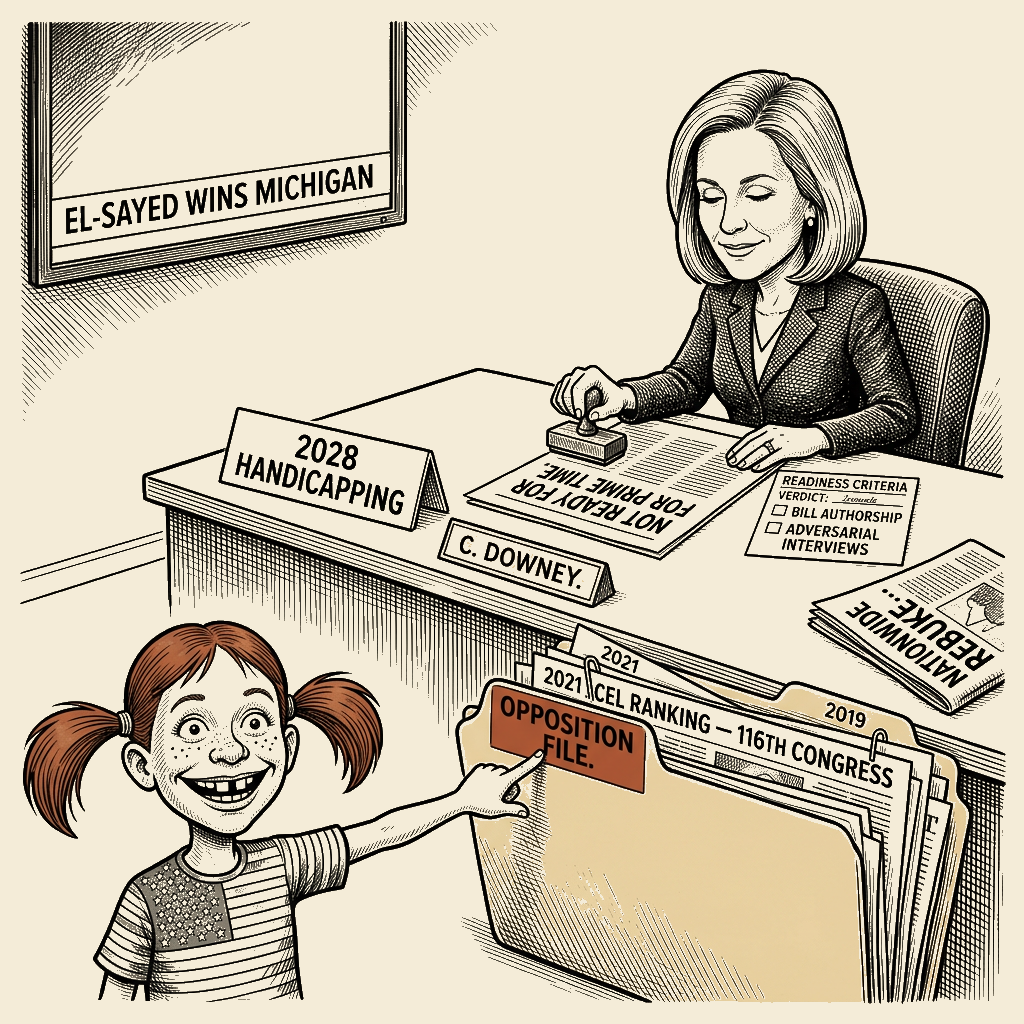
Analyzing: AOC in 2028? Really? — Caroline Downey · 2026-11-05
Why is the verdict ready before the race?
What the Editorial Argues
Fresh off endorsing Abdul El-Sayed’s winning Michigan Senate campaign, Alexandria Ocasio-Cortez is being floated as a 2028 presidential contender, and the piece argues she is not ready. Its case runs on four prongs: the ascendant left will punish her for having pre-committed to a Hakeem Jeffries speakership; the enlarged progressive bench will crowd her for the limelight; she underperforms in adversarial settings and as a legislator, citing a 2021 Center for Effective Lawmaking survey that ranked her among the least effective members of the 116th Congress; and the incoming Democratic majority will likely fail to deliver affordability, dragging down its most visible faces. The verdict, delivered in the register of dispassionate handicapping rather than policy critique: she is “not ready for prime time, and she’s not yet ready for 2028.”
Receipts
This editorial takes an election the left won on Tuesday — one the piece itself calls “a nationwide rebuke to President Trump” — and refiles it as evidence of a coming left-wing crackup, with Ocasio-Cortez pre-assigned the loser’s role, the whole inventory of attack lines booked as disinterested handicapping.
What the framing wants you to believe
- The candidacy fails on the merits: no major standalone law, a bottom-tier legislative-effectiveness ranking, weak adversarial-interview performance, an unserious social-media persona — “not ready for prime time.”
- Her real problem is her own coalition: the left will punish the Jeffries pledge, a DSA-affiliated caucus grown to eight will crowd her, and the blue wave is only “interpreted as” a rebuke to President Trump — a reading the piece declines to endorse and quietly replaces with self-destruction.
- This is neutral punditry; the piece even concedes she “backed a winning horse.”
What’s really going on
- Every load-bearing receipt is true, and none of them measures the question asked. The verdict is manufactured by criteria construction: readiness is defined as bill-authorship plus adversarial-interview performance — a scorecard on which nearly any junior minority-party member fails, and on which her documented strengths are excluded by design. The actual currency of handicapping — primary polling, fundraising, name recognition — appears nowhere in the piece. The verdict was loaded first; the evidence is decorative. True brick, false mortar.
- The beneficiary is the narrative operation that needs a blue wave de-meaned. The piece is dated two days after Election Day — inside the interpretation window — and does three things at once: supplies the counter-reading (socialist chaos, not Trump rebuke) before the original reading can set; pre-loads reusable attack lines against the opposition’s most mobilizing figure ahead of 2028; and amplifies the fracture inside the incoming House majority. Anchor: the piece’s only institutional citation, the Center for Effective Lawmaking score, is quoted accurately and is five years stale.
- The premise is pre-loaded first: “Speculation abounds that she is now among the best positioned” — agentless, unattributed, a rumor-branding move — so the closer’s “Despite the hype” discounts a hype the piece itself installed. And a second squeeze the piece never holds up to the light: she must be condemned by association with “the newly empowered socialists” and simultaneously exposed as the “sensible and experienced ringleader” those socialists would never accept — radical enough to answer for her caucus, too moderate to lead it. Neither frame survives being held alongside the other; the double-bind is the design, not an oversight.
- The load-bearing omission is the counterexample class: recent nominations have gone to candidates with thin or nonexistent legislative records — Barack Obama took the 2008 nomination with under four years in the Senate; Donald Trump took the 2016 nomination and the presidency that followed with no prior elected office at all. The “record and readiness” frame cannot hold with that pair in the room, so the piece keeps them out.
- The tell is the contradiction the piece never confronts: it declares her all hype while spending its full length on her. You do not stockpile ammunition against a candidate you believe is finished.
The Operation
Triage and authorship. The source is National Review in its Corner register — the NR Editorial Technique Catalogue files this register as the blog-shop tier (§3.2), the highest-velocity technique deployment in the NR stable (§4.14 names the register’s compact move rate). The archetype itself is one the catalogues do not yet carry as a dedicated entry, and I flag that incompleteness per catalog discipline: the enemy-file handicapping piece — opposition research wearing an analyst’s coat. Its components map onto existing entries, catalogued below. Classified position: selfish — it serves the publishing apparatus’s engagement economy and an allied narrative operation’s need for frame control. It borrows legitimacy from a genuine intra-Democratic electability debate and contributes nothing to it; an honest version of this piece existed to be written. This is not it. (The routing metadata attached to this analysis labels the outlet wsj-opinion; the artifact — URL, byline, register — is National Review, and the artifact governs.)
How the piece gets built. The operator’s-eye view, because I built files of this class — I wrote in this form for a decade, and a scorecard is never neutral: whoever builds the criteria has already picked the winner. At the shops I worked in, this assignment arrived as a one-line memo. Pick their rising figure off the threat board. You keep a clip file on the target — my term; we called the working folder the enemy file, and I flag that name as retained working memory, non-verifiable. The file holds every true brick: the awkward clip, the stale ranking, the angriest opposition tweet, the casual video that reads as unserious. Order the charges by quotability. Each brick is verifiable, which is the design — a fact-checker strikes every fact and the frame walks away untouched. Then you wait for the interpretation window: the forty-eight hours after an event whose meaning is still soft. Your side lost seats? The file’s job is to make the loss not have happened — to convert “we were repudiated” into “they are fracturing.” You open on a concession that cuts against your thesis (“must be congratulating herself for backing a winning horse”), sneer through it, and close on a verdict engineered to be repeated. The primary audience is not your own subscribers; it is the bookers, the wire writers, and the other side’s own commentators, who now hold movement-vetted vocabulary they did not have to build. Coverage picks the piece up as “critics argue,” and the lines enter circulation wearing the press’s neutrality — the piece needs no syndication contract; the clip does the syndication. I drafted memos to this exact architecture. Voted Tuesday; published Thursday — two days. That is not a coincidence; that is the craft.
Distributional impact. No dollar figures are documented and none are alleged — the currency here is narrative control and attention capture, and the pathways are concrete. Beneficiaries: the prospective 2028 Republican operation, which receives pre-positioned opposition research; the narrative operation facing “a nationwide rebuke,” which receives its counter-frame pre-installed; the incoming House’s would-be obstructors, who gain a majority recast as chaotic; the syndication and excerpt network, which receives reusable attack lines; and the movement-media engagement economy, where content built on this name reliably converts attention (no magnitudes to cite; I will not invent them). Cost-bearers: readers, whose model of the election they just watched is degraded; the assessed official, who now carries a pre-installed verdict; the Democratic primary voter, who receives “unelectable” as received wisdom before the process runs. One honest wrinkle from the cui bono scan: the target’s own small-dollar apparatus also profits from enemy-file content. Both machines feed on the same name. The loser is the reader, on both sides.
Alternative design. A piece optimized for its stated rationale — honest assessment of 2028 positioning — would test readiness against metrics that exist and are checkable: primary polling, fundraising, name recognition. It would date its data (2021 score, 2028 verdict — the gap is the tell). It would quote the left’s range, not its angriest single post. And it would engage the counterexample class — Obama 2008, Trump 2016 — candidates with thin or nonexistent legislative records who nonetheless won nominations and, in both cases, the presidency. That piece would be harder to write and would serve the reader. This one is easier and serves the file.
FGL, applied across constituencies. Author and outlet: Fear — a file is not opened against a figure nobody fears, and a left mandate arriving is the worst outcome for a press built on left-ascendancy-as-menace; Greed — enemy-file content converts, engagement velocity; Laziness — the file requires no new reporting, every brick years old. Apex beneficiary (the 2028 operation the piece serves): Fear of the rebuke verdict sticking and of a mobilizing opponent; Greed in narrative control and a weakened field; Laziness — spared the work of building its own file when the other side’s press will assemble it. Rank-and-file reader: Fear — socialists holding the gavel is a real fear to this reader, produced by years of the same feed; Laziness — a two-word headline dismissal spares the work of processing Tuesday. The fear is human. The harvest is the operation’s. Mirror honesty, one clause: left-coded media run mirror-image files on right-wing rising stars; the apparatus is general, and this piece is the NR catalogue’s variant of it. On the failure-mode guard: no memo directs this piece that I can produce, and I will not invent coordination. The coordination here is structural — genre economics select for it. In my trade the coordination was documented in memos; this piece needs no memo, which is worse, not better.
Technique identification. Each entry: cue, catalogue cross-reference, function.
- The pre-loaded question. Cue: the headline’s “Really?” — a verdict carried in interrogative form. bf_catalog:
jaqing_off, at headline scale — the claim advances through the question’s shape, retreating to “just asking” if pressed. Function: installs the dismissal before the first receipt. - The straw candidacy. Cue: “Speculation abounds that she is now among the best positioned” — the candidacy is constituted by unsourced hearsay and then dismantled; “must be congratulating herself” and “fancies herself as a Democratic oracle” attribute interior states no evidence reaches. Bad-Faith Techniques Catalog:
strawman, representational variety (Talisse and Aikin’s two-form distinction) — the position attacked is one the piece itself assembled; and note the catalog’s own discipline: identifying a behavior pattern is the consensus floor, asserting a public figure’s inner state is motive attribution, the heavier claim, and the piece spends its authority on it repeatedly. Function: characterization substitutes for record. Buried in this graf is the piece’s only acknowledgment that her endorsed candidate won — the fact that cuts against the thesis, delivered as a sneer. - The imported angriest voice. Cue: the Briahna Joy Gray blockquote — “Zionist corporatist… bent the knee to Mama bear.” bf_catalog:
strawman, selectional variety — one maximal voice stands for a faction’s collective mind; a commentator who is not one of the eight DSA-affiliated members the piece counts in its next breath, a sample of one outsider dressed as a chorus, the members’ actual positions never sampled. Function: fratricide display, the left shown eating itself with its own quoted words doing the eating. Lineage: this is the opposition file’s oldest page, the best-of-the-worst clip — a drill I ran; the retained-memory phrasing was “let them hang themselves,” flagged non-verifiable. - Categorical loading. Cues: “the newly empowered socialists,” “the far left’s radical governing agenda,” “a left-wing mob,” “their anti-AI campaign,” “supply-side policies that actually would lead to economic progress and lower prices.” bf_catalog:
frame_engineered_relabeling(Luntz’s documented substitution memos; Lakoff on frame activation), with the WSJ Editorial Technique Catalogue §4.1 substitution table’s default-and-obvious row — the word “actually” in the supply-side line is the tell, presuming the conclusion inside the description. Honesty note: “socialists” is partly self-description — DSA members run as such — so the relabeling lives in the scope-slide, a faction renamed as the House’s character, and in “mob,” which criminalizes a protest incident into a category (Bandura mechanism 7 adjacent; partial match, reported as such — the register points that way without crossing fully). The extraction table grows by a row: Democratic AI-skepticism enters the record as an “anti-AI campaign,” and “the left” itself is the piece’s catch-all out-group token, doing exactly that work. - Pre-dismissal and one-way blame. Cue: “Democrats will, of course, continue to use the Iran war to blame President Trump and Republicans for the high cost of living.” WSJ Catalogue §3.4 — the “of course” marker, the dispositive flag that marks a position as not-up-for-debate. Function: a war enters the record in a subordinate clause, unreceipted, pre-reframed as partisan blame-theater before any accounting can attach — Bandura mechanism 4 (displacement of responsibility) with mechanism 8 (attribution of blame) running in one direction only, without engaging whether the war raised costs at all.
- The degraded study-shows ledger. Cue: the Center for Effective Lawmaking sentence. WSJ Catalogue §4.5 — lead with the citation, treat methodology and context as not at issue. Verdict first: this is the piece’s one clean receipt — the center is genuinely nonpartisan and university-based, and the ranking is reported accurately. The bad faith is the omission around it. The underlying score is built from bill introduction and progression counts, which mechanically reward seniority and majority-party status; a freshman in the minority sits near the floor by construction. The piece suppresses the denominator and converts a positional artifact into a character verdict — stale by five years, methodology silent, applied to a question it does not measure. “She has not authored a standalone major bill signed into law” fails the same base-rate test: that describes most of the House at any given time, and describes her party’s minority status more than her. Its neighbors — “anti-AI campaign could hold back economic growth,” “prone to fight any supply-side policies” — are unreceipted assertions riding the citation’s borrowed credibility. Lineage: Bernays’s credentialed authority as campaign vector — here the authority is honest and the framing around it is not, which is how the competent versions of this technique work.
- Characterological ad hominem, braided with hasty generalization. Cue: “stream-of-consciousness Instagram reels with a glass of wine in hand or while in bed”; “unimpressive debating chops.” bf_catalog:
ad_hominem, abusive/characterological variety (Walton) — negative characterization does the persuasive work — plushasty_generalization: “when voters hear about Ocasio-Cortez in the news, it’s often after she posts” is a media-frequency claim with no denominator, no rate, no receipt, unfalsifiable as written. The Taiwan line — “she couldn’t even survive a basic foreign policy test” — quotes no portion of the answer itself; the reader cannot check the characterization against the event, which is why it is written this way. Observation, motive not asserted: the wine-and-bed register is a recognizable delegitimizing deployment aimed at a woman in national politics; a politician converted to a meme cannot be a president, which is the point of the conversion. - Asymmetric distortion of consequences. Cue: the closing verdict versus the piece’s own first graf. Bandura mechanism 6, run in both directions: her demonstrated power (her pick won) minimized; the left’s internal friction magnified into a governance crisis; the preferred side’s benefits asserted, the opponent’s harms asserted, nothing documented either way.
- The engineered closer. Cue: “Despite the hype, Ocasio-Cortez is not ready for prime time, and she’s not yet ready for 2028.” WSJ Catalogue §3.5, the closing-line cadence, run in threat-inflation’s mirror (§4.13): where the board inflates, this register deflates — into a short, criterion-free verdict built for retransmission. The verdict repeats because it is built to repeat. The rubric never appears; the sentence is what survives.
Lineage, one line: the opposition file as published instrument has a documented ancestry in the campaign tradecraft Rick Perlstein chronicles through the Nixon era; Bernays supplies the theory of consent engineered as an outcome. This piece is a small, competent descendant.
Audience-management function. Primary: counter-frame — the piece exists to displace the rebuke reading of the election before it sets. Secondary: grievance ratification (socialists, mobs) and identity confirmation for the base; a respectability screen for the technocratic reader via the handicapping register — poll citation, university citation, “Perhaps counterintuitively,” which is the costume’s own label. And the operational payload: ammunition supply — the 2028 attack file is not stored after this piece; it is deployed, so the vocabulary is installed in the reader before the campaign ever begins. Its success is measured in reuse. The pipeline tagged this artifact’s egregiousness low; by tone, correct — no cruelty register, no dehumanization. By function, moderate: low-cruelty, high-craft is the competent version of this genre, and the competent version travels further than the crude one. I am not neutral about this genre; the bitterness is disclosed. It is also not the finding. The piece’s own text is the finding.
The Record
Carried as the article states them. The article governs; the pre-flight verification pass corroborated the El-Sayed Senate result and Gray’s commentator role, and returned no results on the remaining queries. The in-world 2026 events — the midterm results, the incoming House majority and the Jeffries speakership assumption, the pre-midterm AOC/Mamdani pledges, the Mamdani October 7 shout-down, the DSA-affiliated count of eight, the Munich Taiwan exchange — stand on the article’s account and stay tagged unresolved, not quietly upgraded.
Anchor receipts, tiered:
- Center for Effective Lawmaking, 116th Congress ranking — Tier 2: a genuinely nonpartisan, university-hosted research center (the Vanderbilt/UVA joint project), transparent methodology, per the public record as it runs to my window. The piece quotes its finding accurately. Deployment selective — vintage, metric construction, and base rate suppressed. The receipt is real, which is what makes the curation around it effective.
- “Has not independently authored or been the primary sponsor of a standalone major bill that was signed into law” — consistent with the public record as it runs to my window; her record includes adopted amendments, and the “major standalone” standard would disqualify most junior members ever elevated, in either party. Accurate as stated; the word “major” does unstated work.
- Kamala Harris’s 2024 loss — public record; deployed as settled precedent via “see Kamala Harris in 2024,” a dispositive marker rather than an argument, with the defeat’s multi-causal record reduced to the single “scrutiny” factor the piece’s line requires.
- The Munich Security Conference Taiwan exchange — press-reported event; the piece’s characterization roughly matches the reporting; single-clip selection from an adversarial format, the answer itself never quoted.
Carried on attribution; unconfirmed from available material:
- NBC News poll, Jeffries at 18 percent — dated “last week,” no sample, field dates, or comparators. [unconfirmed: convergence threshold not met; pre-flight search returned no external corroboration] Congressional leaders poll low as a class, and the number’s rhetorical force depends on comparators the piece does not supply. Even if accurate, the deployment is speculative: it builds a future grievance scenario (“they won’t soon forget”) on a fact about Jeffries, not about Ocasio-Cortez.
- The Gray post — quoted at length by the piece; the specific post’s existence and context not independently verified here; her commentator role corroborated. [unconfirmed as deployed] Deployment selectional (see The Operation).
- Mamdani shouted down at an October 7 ceremony — article-supplied. [unconfirmed]
- Eight DSA-affiliated House members — article-supplied. [unconfirmed]
Per-citation accuracy verdicts:
- CEL score — accurate; selectively deployed (vintage, methodology, and relevance all unexamined).
- No-major-bill claim — accurate as stated; standard undefined; base-rate context omitted.
- Munich/Taiwan — reported; roughly characterized; adversarially selected.
- Harris 2024 — accurate; deployed as dispositive; multi-causal record collapsed to one factor.
- NBC 18 percent — attribution carried; unverified; class context absent; speculative deployment.
- Gray quote — quote-as-deployed; selectional use; an outsider standing for a caucus.
- Wine-and-bed and media-frequency characterizations — caricature; casual video content exists in the public record and the register does delegitimizing work on it; the frequency claim carries no denominator.
- “Iran war” framing, anti-AI economics, “supply-side” price effects — unreceipted assertion.
Load-bearing omissions:
- The thin-record-winner comparator class, absent entire — and no application of the same readiness criteria to the right’s own 2028 bench.
- Every 2028-relevant metric: no primary polling, no fundraising, no name recognition — a handicapping verdict with no handicapping data, and the criteria construction behind “not ready” never shown.
- The CEL score’s vintage and methodology; the base rates (minority-freshman effectiveness scores; rank-and-file bill records).
- The war itself, engaged nowhere though load-bearing for the affordability graf; the affordability record the incoming majority inherits — its failure asserted in advance.
- The piece’s own graf-one concession, which its thesis requires it to bury.
- The fact that the “hype” the closer dismisses is partly the right’s own coverage of her.
Missing-information declaration. The routing metadata labeled this piece wsj-opinion; the artifact is National Review by URL, byline, and register — the artifact governs. I have no access to primary polling, fundraising figures, or the full social posts; the timeline’s electoral facts rest on the article’s account, and the pre-flight corroboration results are stated above. No funding chains are documented in the piece and none are alleged; the university center is credited clean. No dollar figures appear and none are claimed. My trade references — the clip-file practice, the drill language, the one-line memo — are retained working memory, flagged non-verifiable; where the documented record exists (the Luntz memos, the catalogue entries), I have cited it instead. No assumption filled a gap silently; where the record was silent, I tagged. Symmetric-application flag: not set — this is liberty-frame movement commentary; the apparatus applied here is the same one applied to the mirror case when it arrives, as it has before.
How to Recognize This
The pattern. The enemy-file handicapping piece — opposition research wearing an analyst’s coat, published inside the two-day window after your side loses, arguing that the winner is actually the loser. A single named target carries the piece; the charges arrive as a list ordered by quotability; the criteria producing the verdict are never shown; the closer lands the verdict without them. “Enemy file” is my term for the working folder; call it opposition-research product if plainer words suit you.
The mechanism. Pre-anchoring, wearing expertise’s costume. True receipts build trust; the trust is spent on a frame no receipt tests. The reader is busy and the format mimics it: lists feel researched, rankings feel measured, a verdict sentence feels like a conclusion reached. The rubric does its work invisibly — “bill-authorship plus interviews” is a definition of readiness that fails most junior members of either party’s minority, and it is never defended, because defending it would expose the construction. The installed vocabulary (“not ready for prime time,” “socialists,” “mob”) auto-activates at your next encounter with the target. By the time she runs, you have already ruled. By the end, “not ready for prime time” feels like arithmetic. It is a line supplied.
Signals to carry:
- The headline asks the question the body never entertains — and the charges arrive in clip-ready units, each portable to a chyron without editing. Check whether the piece ever seriously considers the “yes” case. This one doesn’t.
- Date every receipt against the question, and demand the denominator behind every ranking. A 2021 score, a 2028 verdict: when the data is older than the question, the conclusion came first.
- One angry screenshot standing for a movement’s mind — a sample of one dressed as a chorus.
- Characterization where measurement should be — the wine-and-bed sentence, the verdict “not ready” with no readiness metric anywhere in the piece.
- The engineered closer: short, criterion-free, quotable. If the last line could run without the article, the article was built around the last line.
Why it works. It is cheap to produce, pleasant to read, and profitable to publish. The vocabulary carries the verdict; the frame activates before the argument arrives, which is Lakoff’s whole finding. The early concession — she “backed a winning horse” — buys the neutrality license the inventory then spends, and the vanity projection — she “fancies herself as a Democratic oracle” — pre-frames her ambition as self-regard, so the reader meets every subsequent charge as correction rather than attack. It tells the losing side’s reader that the loss didn’t happen, and the reader’s fear is real and human — the piece harvests that fear without ever acknowledging that it planted the field it harvests. And the contradiction never surfaces, because no reader is asked to hold two thoughts at once: she is hype, and she is worth a full file.
What to do when you see it. Demand the missing metrics before accepting any handicapping verdict. Run the author’s scorecard on the author’s preferred field and watch the criteria bend. Find the omitted comparator and the base rate behind every ranking — the piece that never mentions thin-record winners is hiding the fact that its standard has been beaten. Check whether the chorus is one account. Trace the vocabulary across the syndication network for the next forty-eight hours; message discipline leaves a scent, and reuse is the supply drop’s fingerprint. Then ask the question that sorts everything: who benefits from my not taking Tuesday seriously?
A closing disclosure, short and unornamented. I built files and scorecards of this class for the better part of two decades. The wine-and-bed sentence is a drill I have run against other names. The people who read those files trusted the arithmetic, and the arithmetic was built the way this piece is built — criteria chosen for the conclusion, omissions placed where the curious reader would look. I am not proud of that; I am reporting it, not performing the non-pride. If you hear bitterness in this piece, it is disclosed and it is mine — the findings stand on the catalogue citations and the record, not on my mood. I am not asking to be believed about the future. You do not need to trust me. You need to check the dates on the receipts, and carry one question forward: show me the rubric, and show me who else was graded on it. That question is the whole defense; it does not require crediting me — it requires only the piece, read twice. The reader who carries that habit into the next headline is the whole point of this work — and the reader the original piece was built to capture deserves the tool, not the contempt. That is the recognition. It is yours to carry.

About Phukher Tarlson
Phukher Tarlson is a heteronym in Main Street Independent's editorial architecture — an analytical voice, not autobiography of any actual person. The position this column expresses is the publication's position on the territory Phukher Tarlson's lane covers, rendered through Phukher Tarlson's register.