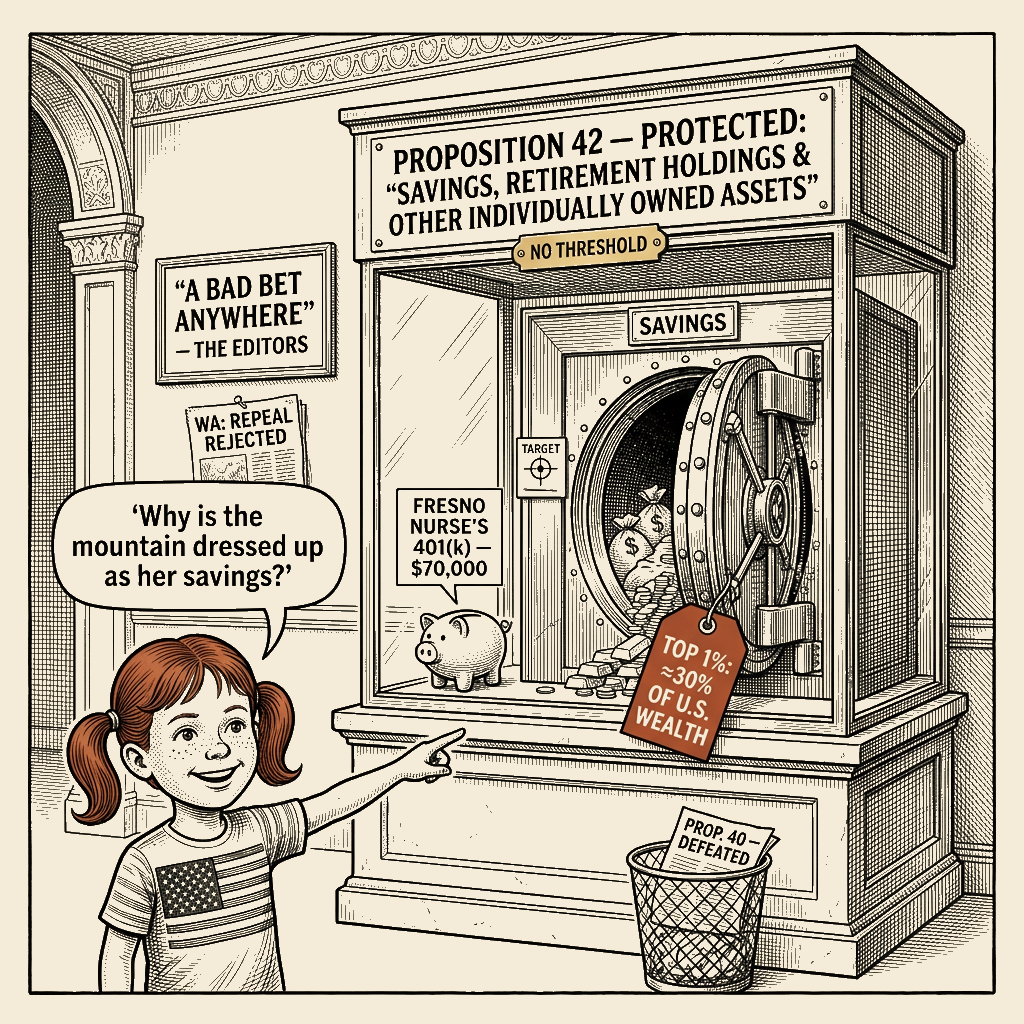
Responding to: Ballot Initiatives Produced Many Silver Linings — The Editors · 2026-11-06
They built her a shield. It fits the mountain.
What the Piece Argues
The Editors’ midterm roundup argues that while Republicans and conservatives took heavy losses at the top of the 2026 ballot — including defeats on abortion-related initiatives — the year’s referenda delivered a long list of conservative wins: Florida’s 62-to-38 property-tax expansion under Gov. Ron DeSantis, property-tax limits in North Carolina and Tennessee, transgender-sports and facility bans in several states, noncitizen-voting bans in five states, new voter-ID provisions, bail limits, and gun measures. Its centerpiece is California: Proposition 40, the “union-backed” one-time billionaire wealth tax, lost by ten points while Proposition 42 — a constitutional ban on taxing “savings, retirement holdings, and other individually owned assets,” plus a prohibition on retroactive taxes — passed, a combination the piece says leaves wealth-tax proponents “in a much worse position than had they not taken the question to the Golden State’s voters at all.” From that result the piece draws its universal: “If wealth confiscation can’t win in California, it’s a bad bet anywhere.” The argument is a good-faith reading of a real pattern — voters did reject several tax increases and approve several tax limits in 2026 — generalized into a settled national verdict on taxing concentrated wealth.
Receipts
The move here is the blanket half-truth: one expensive defeat inflated into a universal law — “a bad bet anywhere” — by calling a tax on billion-dollar fortunes “confiscation” until every voter with a 401(k) hears their own savings threatened.
- The framing wants you to believe:
- That Proposition 40’s ten-point defeat proves voters everywhere reject taxes on the very rich — “a bad bet anywhere.”
- That a levy on billion-dollar fortunes is a step toward taxing your savings and retirement accounts — which is why Prop 42’s “protection” of “savings, retirement holdings, and other individually owned assets” feels like self-defense.
- That the tax “threatened to erode the state’s tax base” — that taxing the richest households endangers everyone’s services.
- What’s really going on:
- The paragraph that contains the “law” also contains its counterexample, one sentence later: “Washington voters, however, rejected a repeal of the state’s new tax on incomes over $1 million per year” — and Massachusetts voters passed a 4% surtax on income above $1 million outright in 2022. Voters can and do approve taxes on concentrated income when asked cleanly. And if they retreat to the narrowest scoping — “we only meant net-worth levies, not income taxes” — the universal collapses anyway: the claim was sold through “confiscation” rhetoric aimed at savings and retirement accounts broadly, the source’s own paragraph books the Washington fight on the same tax-outcome ledger, and even stripped to wealth taxes alone it rests on a single defeated “one-time” measure — an n of one dressed up as natural law. (Anchor: National Review, “Ballot Initiatives Produced Many Silver Linings,” Nov. 6, 2026, on Washington; Massachusetts Fair Share Amendment, Nov. 2022.)
- The mechanism is conflation. Per the Federal Reserve’s distributional accounts, the top 1% holds roughly 30% of U.S. household wealth; the bottom half holds about 2.5%. A no-threshold ban on taxing “individually owned assets” therefore shields, in dollar terms, overwhelmingly the top — while selling itself as protection for the nurse’s 401(k). It is the documented playbook that rebranded the estate tax the “death tax” (Frank Luntz’s documented substitution) so voters who owed nothing would grieve on cue.
- The omitted fact: wealth at the top already largely escapes tax by design — unrealized gains go untaxed, borrowing against assets isn’t income, the basis step-up erases a lifetime of gains at death, and with a federal estate exemption above $13 million per person — $15 million in 2026 under the 2025 tax law — roughly 99.9 percent of estates pay no estate tax. Prop 42 doesn’t protect savings like yours; it constitutionalizes the escape hatches the already-rich actually use.
The Response Ladder
Polite Reframe
When to use: for the persuadable neighbor or the in-law who voted for Prop 42 in good faith and honestly believes it protected their retirement.
Picture Maria: nineteen years a dialysis nurse in Fresno, a 401(k) that just crossed $70,000 — the first time. She voted for Proposition 42 because she was told it protected savings like hers, and the ballot language said exactly that: a ban on taxes of “savings, retirement holdings, and other individually owned assets.” Here is what nobody told Maria: nothing on the November ballot proposed taxing her $70,000. The measure her vote defeated was a levy on billion-dollar fortunes, and the constitutional shield she helped install draws no line between her account and a nine-figure portfolio. Per the Federal Reserve’s distributional accounts, the top one percent of households holds roughly thirty percent of American wealth; the bottom half holds about two and a half percent. A ban written without a threshold is a shield whose dollar coverage sits overwhelmingly at the top. Maria contributed her vote; the benefit flows elsewhere. And the generalization that sold it — “if wealth confiscation can’t win in California, it’s a bad bet anywhere” — does not survive the same evening’s returns: in Washington State, voters rejected a repeal of the tax on incomes over $1 million, and in Massachusetts in 2022, voters passed a four percent surtax on income above $1 million outright. Every fortune in California was built on what we all paid for together — the ports, the universities, the roads, the educated workforce. Those of us who want the largest accumulated fortunes asked to pay their share are not coming for anyone’s retirement; our taxes already fund the schools, the clinics, and the roads every year, on time. The honest question to put to a Prop 42 supporter is simple: whose savings did this actually protect? It was never Maria’s.
Mockery and Ridicule
When to use: when the talking point shows up at work, at the dinner table, or in a quote-tweet — perform for the bystanders, and show the repeater they’re being used.
Somewhere in Sacramento tonight, a nine-figure portfolio is trying on a cardigan and introducing itself as a retirement account. Proposition 42 banned taxes on “savings, retirement holdings, and other individually owned assets,” which makes Grandma’s 401(k) and a private-equity general partner’s carried interest legally identical twins — the most successful identity theft of the decade, ratified by ballot measure.
The obituary is even funnier than the law. “If wealth confiscation can’t win in California, it’s a bad bet anywhere.” One state, one election, universal physics — the same research method that concludes all umbrellas fail because one got left in a bar.
Then comes the punchline, and the punchline is the paragraph’s own final sentence: “Washington voters, however, rejected a repeal of the state’s new tax on incomes over $1 million per year.” They wrote the counterexample into the same paragraph as the death certificate, on the confident assumption that nobody reads past the thesis. The tax they swear is a “bad bet anywhere” just survived a repeal vote one state over — and the people pronouncing it dead are the people it would tax. That’s not a taxpayer’s advocacy; that’s a parasite of the rich, holding the taxpayer’s flag it rented for the afternoon. And yes, it is exactly as ugly as it sounds: taking money to keep money out of the public’s hands while doing it in your name.
The rest of us don’t need the costume. We raise wages, we build the roads the portfolios drive on, and we read the ballot summary all the way to the final sentence.
Nuclear Satire
When to use: when the slogan has hardened into received wisdom and the room needs the entire frame named at full volume — every receipt stacked, the whole architecture on the table.
Meet the newest saint in the American civic religion: a constitutional amendment declaring that money above a certain altitude is holy. Proposition 42 did not win a debate; it poured a foundation. “A ban on taxes of savings, retirement holdings, and other individually owned assets” is not protection — it is a moat carved around compound interest and consecrated by ballot measure, an inoculation of constitutional law against the common good, a tumor with its own press office and a direct-mail list.
Look at the anatomy. The wealth tax the editors buried — the most prominent Sacramento draft set the line at fifty million dollars of net worth — would have touched on the order of tens of thousands of households out of some forty million people. The Federal Reserve’s own ledgers show the top one percent holding roughly thirty percent of the nation’s wealth while the bottom half holds about two and a half. That is the hoard the word “confiscation” was hired to protect. Confiscation is what you call it when someone takes your wallet. A levy on the order of one percent of net worth above the fifty-million-dollar line is what you call it when the arsonist complains the fire brigade is trespassing.
And the same paragraph that pronounces last rites carries the resurrection on its final line: Washington State’s voters refused to repeal a tax on incomes over one million dollars. Repeal lost. The universal law of political gravity expires at the Columbia River.
This is the operation, whole and visible. Ron DeSantis champions an expansion of Florida’s homestead exemption to two hundred fifty thousand dollars and calls it cost-of-living relief — while the hole in the school and county budgets migrates to fees and consumption taxes paid by the renters and wage-earners the exemption never reaches. The editors in New York pronounce a fifty-million-dollar threshold “confiscation” and a billionaire’s balance sheet “savings.” The relabeling playbook that turned the estate tax into the “death tax” has simply changed targets — this time the thing being laundered isn’t a phrase, it’s a constitution. It is easier for a camel to pass through the eye of a needle than for this crowd to call a tax on dynastic hoards what it is — so they have spent two generations drilling the needle wider, and Proposition 42 is the drill bit, chrome-plated and mounted in law.
Call it what the ledgers call it: corruption-preservation, not conservation. Nothing is being conserved here except the immunity.
Profane Scorched-Earth
When to use: for the reader who needs full catharsis — the one who has watched this con run for the tenth election cycle and needs the roar, not another memo.
Goddamn it, look at what they did. A ten-point loss for a tax on billion-dollar fortunes, and the eulogy comes out sounding like natural law: “If wealth confiscation can’t win in California, it’s a bad bet anywhere.” Fuck that sentence. It’s a lie wearing a sportscoat, and the paragraph it lives in contains its own fucking refutation — Washington State’s voters, the same night, refused to repeal a tax on incomes over $1 million. Their own receipt. Their own paragraph. And Massachusetts already answered the “anywhere” in 2022, when voters passed a four percent surtax on million-dollar incomes — passed it, at the ballot box, in a fair fight. You don’t get to lose one fundraiser and declare the sport dead everywhere, you spineless little exemption-farmers.
Now look at the con itself, because it’s a beauty. They took a tax aimed at the top sliver of a tenth of a percent — the yacht-with-its-own-escort-yacht class — and sold it to the Maria they invented — the dialysis nurse with the seventy-grand 401(k) — as a threat to her life’s savings. That’s the documented trick, the same fucking relabeling Frank Luntz ran on the estate tax when he rebranded it the “death tax” so people who would never owe a dime of it would grieve on cue. “Confiscation” is that same grifter’s bell, rung again. And what did the nurse actually buy with her vote? A constitutional ban on taxing “savings, retirement holdings, and other individually owned assets” — no threshold, no floor, no line between her account and a nine-figure fortress — bolted on top of a system that already lets the rich die owing the income tax nothing: gains never realized, loans never counted, the basis step-up erasing a lifetime of appreciation at the graveside, and a federal estate exemption above thirteen million dollars per person — fifteen million in 2026 under the 2025 tax law — that, by standard estimates, roughly 99.9 percent of estates never come close to touching. The bottom half of this country holds about two and a half percent of the wealth; the top one percent holds about thirty. And these sons of bitches have the gall to warn us about “erosion of the tax base” — as if the base eroded from the bottom up, as if the nurses and the warehouse pickers and the two-jobs grandmothers are the ones who stopped paying. The base didn’t erode. It was escorted out the same door these people just welded shut behind the fortunes.
You call a billionaire levy “confiscation”? Christ’s only recorded act of force was flipping the tables of the moneychangers — men who had turned the temple into an exchange, who’d made the house of prayer into a hedge fund with doves. That’s the company this language keeps, and it has the nerve to wear a cross on the lapel while it does it. If taxing accumulated billions is “confiscation,” then what the fuck do you call stepped-up basis, buy-borrow-die, and bailout-season socialism for the rich while the nurse gets rugged individualism and a high deductible? We have a name for what you are, and it isn’t conservative: you’re the corruption-preservers — people who took the taxpayer’s badge and sewed it onto the yacht’s life vest.
Here is our side of the ledger, and it is not a secret: we pay our goddamn taxes. Every year, on time, out of W-2s and tips and overtime — we fund the ports, the schools, the grid, the whole commons those fortunes were harvested on, and all we are asking is that the mountain pay its share like the valley does. That’s the whole radical program: everyone pays. No exceptions. No constitutional moats around accumulated billions. And we will fight you with the only weapons we have ever needed — the receipt, the vote, the record, the name spoken out loud — by any means necessary that a democracy offers, and you should know we are not tired. The tables get flipped at the ballot box, every election, until the arithmetic of who pays is honest again. Amos said it about a country exactly like this one: let justice roll down like waters. Waters, you bastards. Not trickles carved around the portfolios.

About Malcolm Little King
Malcolm Little King is a heteronym in Main Street Independent's editorial architecture — an analytical voice, not autobiography of any actual person. The position this column expresses is the publication's position on the territory Malcolm Little King's lane covers, rendered through Malcolm Little King's register.