Responding to: MEHEK COOKE: Republicans failed the affordability test. This is how to win voters back — Mehek Cooke · 2026-11-05
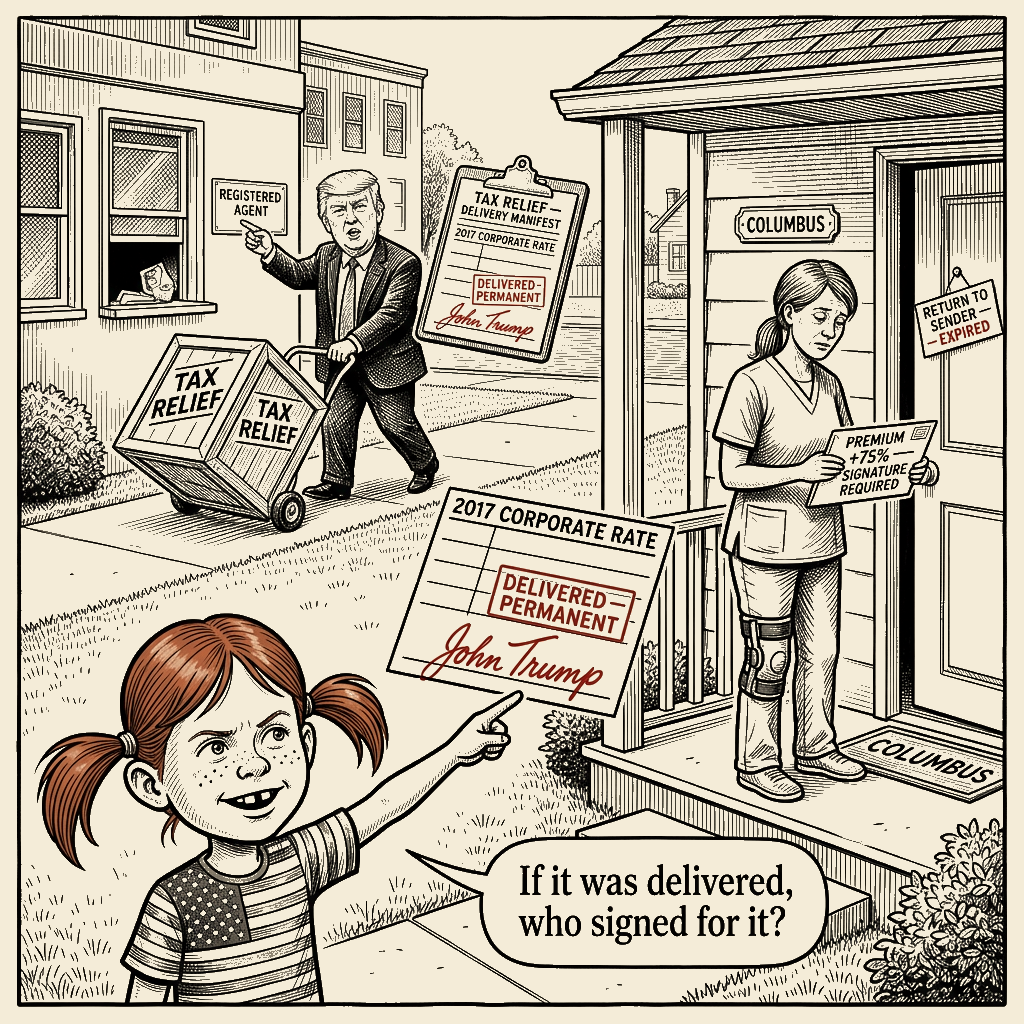
Delivered — just not to her.
What the Piece Argues
The op-ed, published the morning after Democrats won both chambers of Congress, argues that Republicans lost on affordability — a “performance review” of felt pocketbook results, not an ideological realignment or a media artifact. It cites Fox News polling showing cost of living as voters’ top economic concern and only 18% saying their families are better off, along with a post-election KFF analysis showing a 19-point Democratic trust advantage on healthcare. Its central claim is that President Trump did deliver tax relief but the broader affordability gains did not arrive fast enough for families to feel them, while Democrats “respond to government failure by demanding more government.” The prescriptions: a Republican “competence revolution” — healthcare price transparency, housing permitting reform, program audits, published scorecards — with President Trump’s veto power as leverage over the new Democratic Congress.
Receipts
The move here is a relabel: an upward transfer gets renamed a “delivery gap,” so the question becomes when the relief will arrive instead of who it went to. The anchor sentence is the piece’s own: “President Trump delivered tax relief, but Republicans failed to make broader affordability gains arrive quickly enough for families to feel them.”
The framing wants you to believe
- That sentence’s premise — the tax relief was sent to families and simply hasn’t landed yet — a timing problem, “a performance review,” not a verdict on the agenda itself.
- Democrats won only as a protest against slowness; their victory is “an endorsement of socialism” mistaken for a mandate, and the costs families feel come from “more government,” not from who the last four years of tax-and-benefit law actually served.
What’s really going on
- The relief was delivered — upward. The 2017 law made the corporate rate cut permanent while putting the expiration date on the family provisions, and the first year after it produced roughly $800 billion in stock buybacks, a record by standard industry tallies.
- The costs were delivered too — downward. The 2025 law extended the individual cuts, partly paid for by millions cut from Medicaid and food assistance — on CBO’s own score, a score that still added roughly $3.4 trillion to deficits — while letting the enhanced ACA premium credits lapse; KFF’s analysts projected the resulting average marketplace premium jump near 75% in 2026.
- The omitted fact is the direction of travel, and the piece’s own numbers are the receipt: 18% of families better off, 74% rating the economy negatively, a 19-point Democratic trust advantage on healthcare. A delivery gap doesn’t produce a distribution like that. A distribution does.
The Response Ladder
Polite Reframe
When to use: for the persuadable moderates and the good-faith family — the neighbor who voted for costs to come down, believes the tax cut was meant for her, and is still waiting for the relief to feel like relief.
Consider Dana — a home-health aide in Columbus. Two jobs, one bad knee, a son on her plan, coverage she buys on the marketplace. She voted for the promise that prices would come down, and in January her premium nearly doubled when the enhanced tax credits lapsed — on KFF’s projection, the average hit was in the neighborhood of seventy-five percent. Nothing about her situation reads as a delivery delay. She read the invoice.
The piece insists “President Trump delivered tax relief, but Republicans failed to make broader affordability gains arrive quickly enough for families to feel them.” Here is the explanation the sentence skips: the relief was delivered. It just wasn’t delivered to Dana. The 2017 corporate cut was made permanent, and the first year after it produced roughly $800 billion in stock buybacks — a record, by standard tallies — while the promised worker raise never arrived at anything like the advertised scale. The 2025 law extended the individual cuts, partly paid for by millions trimmed from Medicaid and food assistance, on CBO’s own ledger — a ledger that still added roughly $3.4 trillion to deficits. Dana’s family didn’t fail to feel the relief. They financed it.
And the case for doing better doesn’t require anyone to abandon the values the piece invokes — it requires taking them seriously. Free Americans shouldn’t be enslaved to medical debt; liberty is the freedom to leave a bad job, start a business, raise a family, and none of that survives a premium that doubles in one January. We don’t desert our own when they’re down — the aide with the bad knee, the veteran with the nightmares, the kid whose mother works the second shift — because a nation that abandons its own is no nation at all. The piece itself supplies the test: whether a policy “leaves more green in Americans’ wallets.” Fine. Publish the scorecard and run it on Dana’s kitchen table first. We raise wages. We keep families together. We make an insurance premium something you can read before you owe it. On that scorecard, the verdict is already in — the piece just doesn’t want to grade it.
Mockery and Ridicule
When to use: for the bystanders — you’ve stopped persuading the repeater and started performing for the audience watching him repeat it.
The relief was delivered. There’s a tracking number and everything. It was signed for — in permanent ink — at a registered-agent address in Delaware, by a man whose full-time occupation is owning things. What arrived at Dana’s door, also signature-required, was the premium invoice. Same delivery network. Very different routing.
They call it a “delivery gap.” The gap is a routing choice. “President Trump delivered tax relief” — true, as written, and incomplete the way only a motivated sentence can be. The 2017 bill made the corporate cut permanent and put an expiration date on the family provisions: the part that mattered was built to last, the part that touched your paycheck was built to renegotiate. First year after: roughly $800 billion in buybacks, a record. The 2025 sequel extended the cuts, paying for part of the tab with millions cut from Medicaid and food assistance on CBO’s own ledger — a ledger that still added roughly $3.4 trillion to deficits — then let the insurance credits lapse, with KFF’s projection putting the average premium up in the neighborhood of seventy-five percent. And now the same authors stand in front of the wreckage holding a clipboard, announcing a “competence revolution” — audits, scorecards, accountability — for everything except the one program that was actually scored, passed, and delivered exactly as designed. The tax architecture didn’t fail to perform. It performed flawlessly. It performed on us.
Here’s the comedy, and here’s the point: if you voted for costs to come down and your costs went up, you were not a customer whose package ran late. You were the merchandise in someone else’s. The decadence isn’t the deficit — it’s a class that demands audits for the food-stamp line and walks its own line past the scales. We are the builders — of wages, of coverage, of the boring competency of a premium you can price before it owns you — and we would like our country back from the people who confused their portfolio with the economy.
Nuclear Satire
When to use: readers past politeness but short of profanity — the full satirical indictment, irony and extended metaphor stacked on receipts.
Let’s review the restaurant, since service is suddenly the issue: the meal arrived with remarkable punctuality, the food was poison, and the house critic would like the record to reflect how impressed he was by the timing. “Republicans must measure government by what families save.” Measured. Families saved nothing. The people who wrote the law saved their donors a fortune, and that is the savings account this “competence revolution” manages.
Consider what the piece calls competence: a plan to “enforce price transparency” — from the movement that made hospital price transparency federal law on January 1, 2021, watched premiums climb anyway, and then presided over the lapse of the marketplace credits that were actually holding prices down for more than twenty million people. That is not a plan; that is an arsonist grading the fire department on response time. And the “hidden middleman markups” it discovers were already documented, by name, in the FTC’s own investigation: CVS Caremark, Express Scripts, Optum Rx, marking up specialty generics far above independent-pharmacy rates — billions in documented margin. The middleman was not hidden. The middleman was a constituent.
Follow the actual ledger. The Congressional Budget Office scored the 2025 law at roughly $3.4 trillion added to deficits over a decade — the deficit hawks suddenly silent as the museum at closing time — while stripping close to a trillion dollars out of Medicaid, imposing the deepest cut in SNAP’s history, and letting premiums spike for millions, all so the top one percent could bank average cuts of tens of thousands while the bottom fifth received a coupon. Then the same government raised average household costs by on the order of $2,400 a year in tariffs, heaviest on the thinnest incomes — a regressive tax increase sold as a parade. President Trump signed it; the congressional authors voted it; the donors banked it. Those are the documented facts, and they are the whole facts.
And what did the “audit everything” revolution audit? Not Medicare Advantage, whose coding practices cost Medicare tens of billions a year above traditional-program equivalents, per MedPAC — the commission Congress itself created to find exactly this. Not the pandemic loan programs, which hemorrhaged roughly $190 billion in potentially fraudulent payments, per the GAO. No — the scrutiny landed on the shopping cart of the food-stamp mother whose program had just been gutted. Fierce audit of the poor; sovereign immunity for the balance sheet. This is the competence: a parasite with a press strategy, demanding we grade the punctuality of the transfusion it redirected upstairs while the patient bled out on the gurney.
So grade it — grade the ideology itself, because a program that vacuums a trillion dollars upward, taxes the register, more than doubles the cost of the coverage that keeps people alive, and calls the wreckage a delivery problem did not fail to arrive. It arrived everywhere, on schedule, and Tuesday is what the arrival looked like.
Profane Scorched-Earth
When to use: for the reader who has carried the receipts all year and needs the catharsis — gloves off, politeness exhausted, facts still load-bearing.
Fuck the “delivery gap.” It’s a lie with a tracking number. They did deliver. The relief went out the door on day one — to the corporate rate, permanent, locked in; to the buyback window, which swallowed roughly $800 billion in its first year like it was starving; to the shareholders and the registered agents and the men who own things. What got delivered to the rest of us was the other end of the ledger: millions cut off Medicaid and food assistance on CBO’s own goddamn score — the same score that still added roughly $3.4 trillion to deficits — the insurance credits left to lapse so premiums could jump in the neighborhood of seventy-five percent on KFF’s projection, and eighteen percent of families — eighteen — telling Fox’s own pollsters they’re better off. That’s not a package running late. That’s a package running in the other fucking direction.
And now the authors of the invoice want to be the auditors of the national checkbook? Fuck all the way off with that. You don’t hand the audit pen to the men who wrote the bill — as Malcolm X argued in 1964, you don’t take your case to the criminal; you take your criminal to court (“The Ballot or the Bullet,” 1964). The “competence revolution” is the confession wearing a suit: they know exactly what the record shows, and they need you to believe the problem was the paperwork. I’ve passed the collection plate in too many church basements where the lights got paid after the groceries to be told the crisis is paperwork. It was never the paperwork. It was the priorities. They cut the food stamps and the coverage and made the corporate rate permanent in the same breath, then stood up and told you the check was in the mail.
King had the number for this, too. The night before they killed him, in Memphis, he told the crowd about the priest and the Levite who looked at the wounded man and asked, “If I stop to help this man, what will happen to me?” — and about the Samaritan who reversed the question: “If I do not stop to help this man, what will happen to him?” Dangerous unselfishness, he called it, and he put Memphis’s own question in exactly that form: not what happens to us if we strike, but what happens to the sanitation workers if we don’t (Mason Temple, April 3, 1968). The scorecard revolution asks what happens to them if they audit the tax law. King already answered: ask what happens to Dana if they don’t. By the standard of Matthew 25 — what you did to the sick, the hungry, the stranger, the least of these — the last two years aren’t a mixed record. They’re a deposition. So keep your scorecards, keep your clipboard, keep your “principles without delivery” sermon — we’ll take the receipts. We are the ones who feed, clothe, heal, and raise wages, and we are done pretending the people who gutted the coverage get to grade the homework. The relief was delivered, motherfuckers. Check who signed for it.

About Malcolm Little King
Malcolm Little King is a heteronym in Main Street Independent's editorial architecture — an analytical voice, not autobiography of any actual person. The position this column expresses is the publication's position on the territory Malcolm Little King's lane covers, rendered through Malcolm Little King's register.