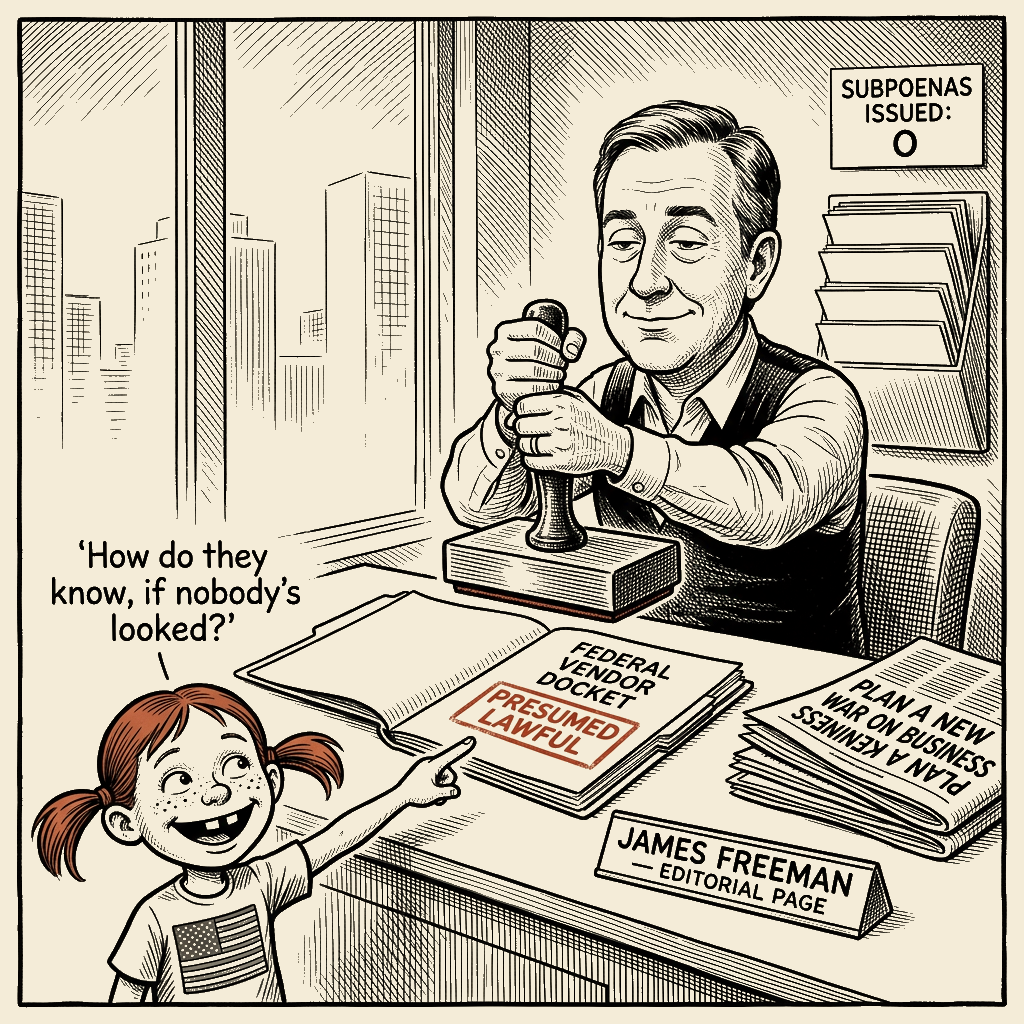
Analyzing: Bernie Bros Plan a New War on Business — James Freeman · 2026-11-06
How do they know, if nobody’s looked?
What the Editorial Argues
James Freeman’s Best of the Web column argues that the incoming Democratic majority — two months before the 120th Congress convenes — is openly planning to convert the “reasonable goal of conducting oversight on Trump family business” into “a broader attack on American companies”: harassment of lawful federal vendors and pressure on businesspeople for their political associations, at a cost that will land on voters who elected Democrats on affordability. It relay-cites reporting by the Washington Post’s Pranshu Verma and by Jeff Stein (identified as writing for the “Washington Sun”), invokes the First Amendment, and calls for “skeptical and independent reporting” on the plans. In its strongest honest form: a warning that a majority elected on a pocketbook message intends to govern by investigation, and that vendetta oversight is a real and documented failure mode, with a history on both sides of the aisle. That kernel is real. This column does not demonstrate it. It asserts it — and the only investigation it can bring itself to bless is the one it calls reasonable.
Receipts
The column announces a war nobody has declared, acquits every possible target of it in advance, and pre-bills you for the prices the war might explain — all before a single subpoena issues.
What the framing wants you to believe
- Democrats are “already discussing” how to turn oversight into war: “The Marxists in the caucus are eager to attack businesspeople merely for doing business.”
- The targets are innocent now and will remain so: “Bernie and his bros want to attack businesses even if the businesses have operated lawfully.”
- You will pay: “Voters seeking affordability may be about to find out how expensive goods and services can be when government investigators spend all day harassing the people who provide them.”
What’s really going on
- No document, hearing notice, resolution, or named member announces any investigation beyond the Trump-family probe the column itself concedes is “reasonable.” The two news citations are delivered in evaluative vocabulary the columnist owns — “investigative assault,” “inquisitors,” “Bernie and his bros” — and the hardest single receipt sits at the summary layer: the attributed block contains the columnist’s own headline coinage, so “Bernie and his bros” is “Bernie Bros” relocated from the headline into a citation slot. The underlying articles’ text is not supplied, so the column’s evidentiary spine cannot be checked against it. Anchor for the core claim: the column’s own text — its concession of the Trump-family probe and its failure to name a second specific target.
- The beneficiaries are legible from the frame’s own architecture: Trump family business interests, whose documented patronage and conflicts are exactly the substance oversight would examine (the House Oversight Committee’s 2021 accounting of federal spending at Trump-owned properties, including Secret Service payments — a training-grounded anchor, tagged in The Record); federal vendors whose government pricing and contracting conduct is what “oversight of vendors” means; and a Republican minority handed a persecution frame for every hearing to come — a pre-installed dismissal frame timed to the gavel-change window, at no cost to the targets. The cost-bearer is the affordability voter, whose chosen remedy is pre-stigmatized before its text exists.
- The load-bearing omission: no committee, no subpoena, no witness, no bill, no exhibited document anywhere in the item. The column argues from plans it characterizes but does not show, and treats the absence of findings — no investigation has occurred yet — as a finding of innocence. The answer to its own question, “Do they even care whether companies have done anything wrong?”, is that nobody has looked yet. That is what an investigation is. And the column’s own second item supplies the counterexample to its first: “President Donald Trump owns this year’s runup in gasoline prices” — price accountability follows the party in power, until the frame needs it to follow the other side.
The Operation
I built versions of this column for two decades, so I can show you the assembly. You pick the target before the facts arrive. You relay another outlet’s reporting through your characterization of it — the gloss travels, the source text rarely does. You supply the nouns: war, assault, inquisitors, bros. You convert the opposition’s coming oversight into your reader’s coming persecution. You pre-assign the price blame forward. Then you leaven the item with a cross-aisle economist and a college-football anniversary so the scan-reader ends warm and comes back tomorrow. The sequence above is retained working memory, not a leaked document — the reader is on notice that it is non-verifiable. The verifiable part is the published text, which runs in exactly that sequence. We called the move “defining the opposition before they define themselves.” It is the trade’s cheapest unit, because intent claims about opponents cannot be wrong until it is too late for it to matter.
The placement is the tell. This column runs in the window between a midterm and a gavel change — the exact window in which the frame that will govern the next two years of coverage is cheapest to install and most expensive to dislodge. A reader who absorbs “War on Business” in November will read every February subpoena as a confirmation of the war rather than as a question to be weighed. That placement logic is retained memory of the trade, not a documentary claim about this column’s construction; the column’s own structure is the evidence here, and it is sufficient.
Institutional authorship and placement chain. The item is authored inside the Journal’s editorial-page apparatus — Freeman is an assistant editor of that page, and a Fox News contributor besides — at the junction of print opinion and cable framing, and Best of the Web is the page’s clipping voice: borrowed news citations framed by page-position commentary. No donor memo is required to explain the frame: the page’s constituency is the class “war on business” protects, and structural incentives need no coordination to produce alignment — the conspiracy-trap guard, structural-incentive language unless coordination is documented, is the honest explanation. The placement chain is the relay — reporting at another outlet, characterization here, then syndication and excerpt circulation in which the characterizations outlive the reporting — and the relay is also a citation economy: the vocabulary (“war on business,” “harassment,” “smear”) is engineered for quotation, which is what “smear” and “harassment” are for. Defending the business class is not this franchise’s hidden interest; it is the product. Every load-bearing word in this item is the author’s own.
Distributional impact. Named beneficiaries: the Trump family’s business interests (reduced political cost, delayed exposure of patronage flows); large federal contractors (chilled scrutiny of pricing and contracting — where such conduct exists, which is precisely what an investigation would determine); the congressional GOP (a ready-made illegitimacy frame); and the page’s affluent readership, which receives identity confirmation that its critics are extremists. One beneficiary class cuts the other way: companies that would benefit from scrutiny of competitors’ conduct — a vendor facing a monopolist’s rigged pricing gains from investigation, not from immunity. Named cost-bearers: taxpayers and agency contracting officers if scrutiny chills; the voters who bought an affordability mandate and will be told investigations cause inflation; the oversight staff who get labeled inquisitors for the work; and the information environment in which the 120th Congress’s actual proposals will now arrive pre-framed. Magnitudes are not quantifiable from this piece, and I will not manufacture a number where the column supplies none; the impact is narrative-positioning, and its pathway is concrete.
Alternative design. Reconstruct the column as it would look if optimized for its stated rationale — protecting lawful vendors and political association, plus honest alarm at partisan overreach, in the interest of the people the frame displaces (taxpayers paying vendor prices, voters who bought affordability): it would name the specific investigations contemplated and engage their merits; it would distinguish scrutiny of conduct (pricing, contract terms, market power) from persecution of status (“serving as a vendor”); it would apply its anti-abuse standard to the oversight enterprises it has historically cheered — the Senate probes launched into the Biden family in 2019, the House Oversight Committee investigation opened in January 2023, and the impeachment inquiry that carried through three committees to its final report in August 2024, the identical family-business-investigation genre this column does not mention; it would welcome the test it itself proposes (“propose legislation, not smear companies”) applied symmetrically; and it would welcome the “skeptical and independent reporting” of corporate pricing it gestures toward with the same energy it brings to skepticism of investigators. The honest design lets the process sort the innocent, publicly, on the record, with documents. The column does none of this, and the gap between the stated rationale and the built artifact is the finding.
FGL, applied across four constituencies. The framing’s author and outlet: fear of a subpoena-armed majority aimed at the reader base; greed in the constituency the page serves, which pays for defense of its own class; laziness in the relay format, which characterizes rather than exhibits. The apex beneficiary: fear of exposure; greed in the flows themselves; and the shortcut — quoting “war on business” is cheaper than defending specific conduct, and a pre-purchased perception is cheaper than disclosure. The federal vendors: fear of pricing scrutiny; greed where pricing power on government contracts exists; laziness in delegating the defense to friendly pages. And the rank-and-file reader — whose fear is real and human: you did vote for affordability, prices are real, and a columnist is telling you the people you elected are Marxists planning your grocery bill. His fear of politicized government is earned — investigations have been used as political weapons, by both parties, within living memory — and his laziness is the format’s product: Best of the Web is engineered to be absorbed in ninety seconds, and this frame is engineered to survive exactly ninety seconds. No contempt attaches to that reader. The operation’s theft is precise: it converts his legitimate safeguard-instinct into a blanket pre-pardon.
Placement: selfish. A real value — guarding against abuse of investigative power, a documented failure mode on both sides — carried inside a selfish overlay that converts it into wholesale immunity for the business class from scrutiny, dressed in the selfless vocabulary of lawful commerce, the First Amendment, and consumer prices.
Technique identification. Every technique named below carries its cue from the column’s own text.
- Frame-engineered relabeling (
frame_engineered_relabeling, Bad-Faith Techniques Catalog; WSJ Editorial Technique Catalogue §4.1). Cues: the headline’s “Plan a New War on Business”; “This investigative assault”; “the inquisitors”; “government investigators spend all day harassing the people who provide them.” Oversight is relabeled as war, assault, and inquisition before any hearing convenes, moving the reader’s frame from examination-of-conduct to persecution-of-commerce. Note the direction: the WSJ Catalogue’s documented substitution table runs euphemistic (tax cuts as “relief”); here the substitution runs pejorative — inquiry becomes “harassment,” examiners become “inquisitors” — and Bandura’s euphemistic-labeling mechanism operates identically in both directions; direction is a production choice. Operationally: every future hearing is pre-loaded with the persecution frame, so the covered company arrives at the microphone as a victim and the examiner arrives as a brawler. Lineage: Luntz’s relabeling memos; Lakoff — the frame activates on the noun, before the argument arrives. The headline’s “Bernie bros” repurposes 2016-era slang for aggressive online Sanders supporters and stretches it over an incoming congressional caucus — smear by generalization. - Pre-emptive legitimacy-withdrawal (Bad-Faith Techniques Catalog entry of that name; Raz and Habermas on the legitimacy-authority distinction; Stanley on identity-grounded delegitimation). Cues: “their plans to abuse it”; “there’s every reason to believe them”; “the inquisitors”; and the motive forecasts assigned to unnamed actors — investigators “who never had any interest in exploring Biden family business,” moderates who “will be tempted for partisan reasons.” The incoming majority’s oversight is illegitimate before any finding; the withdrawal is grounded in identity — “The Marxists in the caucus,” “Beltway leftists” — not in any ruling, finding, or subpoena. Note the double presumption: the column demands presumption of innocence for companies while asserting presumption of bad faith for investigators, in consecutive grafs. The catalog’s detection signals match fully, including selective application — the same page’s posture toward oversight aimed at Democrats has historically carried the opposite valence, a pattern the WSJ Catalogue documents across the lawfare/weaponization frame (§4.19) and the deficit double standard (§4.4).
- Strawman (
strawman, Bad-Faith Techniques Catalog; WSJ Catalogue §4.6). Cue: “If lawmakers think it should be illegal to serve as a vendor to a particular federal agency they should propose legislation, not smear companies.” No lawmaker — and nothing in the column’s own citations — proposes criminalizing vendor status. “Scrutinize this vendor relationship” is transmuted into “criminalize vendor status” — a maximalist proposal constructed, attributed, and knocked down in one sentence, so the refutation can write itself. The page’s documented habit of engaging the maximalist position rather than the proposed one. - Wedge-to-wholesale on an unevidenced chain (
slippery_slope, Bad-Faith Techniques Catalog, Walton’s test; WSJ Catalogue §4.13, the threat-inflation closer here run as the opener). Cues: “use the reasonable goal of conducting oversight on Trump family business to enable a broader attack on American companies”; “investigating large swaths of the economy.” The concession is genuine — which is what makes it a wedge: the reasonable thing is conceded in order to be inflated, one clause later, into comprehensive war. The chain’s links — Trump-family probe → vendor scrutiny → economy-wide war → your grocery bill — are asserted, not evidenced; no support is offered for any intermediate link, and no price mechanism is named. - Tu quoque asymmetry (Bad-Faith Techniques Catalog,
whataboutismfamily, run pre-emptively). Cue: “led by people who never had any interest in exploring Biden family business.” The coming oversight is charged as partisan by invoking a standard the author’s own side did not apply to its own family-business investigation. Appeal-to-inconsistency used to dismiss before engagement — that is the move’s operational signature. - Category labeling without membership (NR Editorial Technique Catalogue §4.4, the folk-devil apparatus, with the Collective Ego Playbook’s folk-devils entry;
ad_hominemlabeling-adjacent, Bad-Faith Techniques Catalog). Cues: “The Marxists in the caucus”; “Bernie Bros”; “Beltway leftists”; “D.C. lefties… getting their ideological jollies.” No names, no count, no documented caucus position asserting the attributed aims. The label substitutes for the evidence a claim would require. Lippmann’s “stereotypes,” in his original sense, are the mechanism: the operation runs at the stereotype level precisely so it never has to run at the member level. - Motive attribution laundered through the question mark (
jaqing_off, adjacent deployment, Bad-Faith Techniques Catalog). Cues: “Do they even care whether companies have done anything wrong?”; “getting their ideological jollies”; “He’s trying to break them, everywhere and at all times”; and “Votes are still being counted (not just in California)” — the parenthetical doing the work a claim would do while remaining deniable. The interrogative and the parenthesis assert while shedding the cost of assertion; the intent claim about Sanders is a claim about a man’s soul, not a finding about conduct. The catalog’s own discipline — behavior-pattern is identification, motive is attribution — is precisely the discipline this column declines, because motive claims are unfalsifiable and that is their value. - Citation-as-gloss (WSJ Catalogue §3.6, the source-citation asymmetry; §4.5, the “study shows” ledger — borrow external product as the spine, frame inside it). Cue: the blocks following “Pranshu Verma reports today for the Washington Post:” and “Jeff Stein reported yesterday for the Washington Sun:” — which contain “This investigative assault will be led by people who never had any interest in exploring Biden family business,” “Bernie and his bros want to attack businesses,” and “He’s trying to break them, everywhere and at all times.” “Bernie and his bros” carries the column’s own headline construction into the attributed block; “inquisitors” and “assault” are editorial-register vocabulary, not report-register. Whether these are verbatim quotations, paraphrases, or the columnist’s commentary slotted into citation formatting cannot be determined from the artifact — and that indistinguishability is the operation. The borrowed byline carries the frame; the columnist owns the language. Flagged per the truth floor: I cannot verify the cited articles’ text from what is supplied; the finding concerns the column’s rendering, not what Verma or Stein wrote.
- The price-attribution flip — the item’s internal contradiction, and its deepest wiring. Bandura’s attribution of blame, aimed forward, on the WSJ Catalogue §4.4 double-standard structure applied to inflation. Cue against cue: item two concedes “President Donald Trump owns this year’s runup in gasoline prices and on Tuesday the political bill came due for his party”; item one pre-assigns future prices to “government investigators.” Under item two, whoever holds power owns prices. Under item one, prices are owned by the people who might examine them — the pricing power of the companies under scrutiny vanishes from the causal map. The rule is not “who sets prices owns prices.” The rule is whose team pays. The column’s own economics invert on contact: vendor prices are set by contract terms and procurement budgets, so if inquiry genuinely moved prices, the column’s stated logic would demand scrutinizing the pricing conduct — not immunizing the entire vendor class in advance. Bandura’s cluster runs in concert here — attribution of blame, distortion of consequences (harassment produces expense, mechanized nowhere), euphemistic labeling, moral justification (the higher cause: lawful commerce and the First Amendment) — and naming the cluster beats naming one mechanism in isolation.
- Multiple-audience targeting (WSJ Catalogue §4.3, the page’s documented four-audience construction). One column, four jobs. The business reader gets “harassing the people who provide them” — a permission structure: stonewall the subpoena, you are the persecuted class. The political class gets “propose legislation, not smear companies” — a citable process objection that survives cable. The populist base gets “Bernie bros,” “The Marxists in the caucus,” “D.C. lefties” — grievance ratification and enemy-naming. The technocratic class gets the Furman item — “Obama Economist Not Entirely Dissatisfied with Trump Economy” — cross-aisle credential laundering in the identity-as-credibility family of WSJ Catalogue §4.18: a Democratic economist’s concession certifies the record the column defends. And the borrowing is selective: the same package that brands the incoming caucus “Marxists” borrows an Obama economist’s satisfaction with the economy — authority is drawn from whichever source flatters the frame in a given week, and the frame never has to agree with itself. Then the thermostat: the mock-humble opener (“Your humble correspondent”), the Rutgers-Princeton anniversary, the joke about colleges overemphasizing sports — the harmless-clipper register that lowers the reader’s guard for the lead item’s frame. Menace, then warmth, so the scan-reader returns tomorrow. I built to that thermostat. It works.
Audience-management function. Permission structure (pre-built dismissal language for the covered class), identity confirmation (your critics are Marxists), grievance ratification (the war on your class is official), agenda pre-emption (the incoming majority’s term is defined before its first hearing) — and above all, inoculation: not to win an argument about any investigation, but to make sure no investigation’s findings ever get a fair hearing. Note the conditional in the column’s own closing register — “encouraging recent spasms of journalism,” and the country “could surely use a lot of skeptical and independent reporting.” Skeptical reporting is welcome. Of the right party. The lineage runs clean: Bernays’s engineered consent — “there’s every reason to believe them” is consensus asserted into existence; Schmitt’s friend-enemy apparatus — “war” constructs commerce’s critics as enemies of commerce as such; Bandura’s mechanisms run in concert — moral justification (protecting “the people who provide them”), relabeling, attribution of blame flipped onto the examiners. Oreskes and Conway documented how interested parties manufactured doubt; the same machinery runs in reverse to manufacture certainty, and I know the shape of it from the inside — I attacked Oreskes for that argument across the cable years, and I was wrong; the record her book compiles supports the reading.
The Record
Anchor receipts. The column’s own text, quoted verbatim above from the supplied artifact — the primary document for what the column argues and how it is built. Rutgers–Princeton, November 6, 1869, history’s first college football game: accurate as the column states it. The 120th Congress convening after the piece’s November 2026 dateline: consistent with the artifact’s frame.
Declared training-grounded anchors (tagged, not smuggled). Three external records this analysis leans on: the House Oversight Committee’s 2021 accounting of federal spending at Trump-owned properties, including Secret Service payments; the House Republican impeachment inquiry into President Biden, opened in 2023, within the fuller reciprocity record — the Senate Finance and Homeland Security probes launched in 2019, and the inquiry carried through three committees to its final report on August 19, 2024; and the 2016 origin of “Bernie bros” as slang for online Sanders supporters. None is a package fact; this pass’s verification sweep returned no excerpts for any of them. They stand as declared provenance, not exhibited receipts — and the frame analysis does not need them, because it runs entirely on Freeman’s published words. The asymmetry finding does lean on the inquiry and the accounting, which is exactly why they are tagged rather than smuggled. The scholarly attributions (Luntz, Lakoff, Bandura, Bernays, Lippmann, Schmitt) are lineage color with declared provenance, per the Catalog’s attribution discipline — behavior-pattern identification at the consensus floor, no claims about anyone’s inner state.
Unconfirmed-tagged claims.
[unconfirmed: source passages absent from the supplied text]— the characterizations of the Verma and Stein reporting. The supplied artifact gives setup lines and glosses; the quoted passages do not appear. The load-bearing words — “assault,” “inquisitors,” “smear,” “break them” — are the column’s own voice, which is the textual basis for reading the post-colon paragraphs as the columnist’s gloss rather than the reporters’ text; the reading is declared, not assumed. I do not reconstruct what the named reporters wrote; the gap is declared. The outlet attribution for Stein (“the Washington Sun”) stands as the article supplies it, with external verification unresolved.[unconfirmed: causal claim asserted without mechanism]— investigators “harassing” providers → higher consumer prices. No data, no pathway, no receipt.[unconfirmed]— “The Marxists in the caucus” as a description of actual caucus membership or positions; no membership evidence offered.[unconfirmed]— “people who never had any interest in exploring Biden family business” as a motive claim about investigators; unfalsifiable as framed.[unconfirmed: characterization only]— the Furman item. “Much to like in a U.S. economy that continues to exceed the expectations of experts” is the column’s framing; Furman’s post is not exhibited. The concession that matters — the gasoline-price sentence — stands in the column’s own voice, which is what makes it usable.
Per-citation verdicts. Verma (Washington Post): relayed, not quoted in the supplied text; accuracy of the relay cannot be assessed; the gloss exceeds what is exhibited. Stein (“Washington Sun”): same condition; outlet name unverifiable from the package, taken as given. Furman (via Lahart): setup quoted, post unexhibited; the item header delivers the conclusion before the evidence is shown — “Not Entirely Dissatisfied” is the takeaway wearing a citation.
Load-bearing omissions. No named investigation beyond the Trump-family probe; no committee, subpoena, witness, bill, or exhibited document anywhere in the item; no statute or conduct specified for vendor scrutiny; no instance of the asserted campaign to punish companies for Republican associations; no text of the cited reporting; no mention of the first-term Trump-conflicts record that gives the oversight its documented object; no mention of the House GOP’s Biden-family inquiry — the identical genre; no engagement with what the affordability agenda actually proposes; no price mechanism; no acknowledgment that no investigation has occurred and therefore no findings exist — innocence asserted from pre-investigation; no acknowledgment of the page’s own record on oversight aimed at Democrats.
Missing-information declaration. Not available to this analysis: the cited articles’ texts; Furman’s post; any announced investigation plans; any caucus statements; dollar magnitudes for impact. No leaked-memo material is invoked here. Where my own operational history appears — the assembly sequence, the placement window, the thermostat — it is flagged retained memory and is non-verifiable by the reader; the documentary record and the column’s text carry the findings. The premises the column takes as given (the 2026 midterm outcome, the 120th Congress’s composition) are taken as premises per the supplied-source rule; no receipt is manufactured for them. No gap was filled with invention.
How to Recognize This
The pattern: the preemptive acquittal. A column that decides the outcome of investigations that have not begun, acquits subjects who have not been examined, and pre-bills you for prices nobody has charged.
The mechanism: burden transfer. It installs a frame before the facts arrive — the “reasonable goal” concession exists to be inflated one clause later; the setup, not the fairness. When the hearings come — witnesses, documents, findings — the reader who absorbed the frame processes all of it through persecution: every subpoena stops being a question (did this company’s conduct warrant scrutiny?) and becomes a data point in the war the headline already declared; every finding is vendetta, every reform is Marxism. The labels do the work the evidence would otherwise have to do. Frames set in advance are cheap to install and expensive to remove, and the ninety-second format is built for exactly this: the gloss travels; the source text doesn’t. It works on you without insulting you — the fear it hands you is real. You did vote for affordability. Prices are real. The column just wires that alarm to the wrong sensor.
Four signals to carry:
- Enemy-category nouns doing the work of evidence — “Marxists,” “inquisitors,” “bros,” “lefties.” When the noun names a person’s politics rather than their conduct, the column is telling you what to feel before telling you what happened.
- The legislation-instead-of-investigation pivot — “propose legislation, not smear companies.” It is a universal solvent for scrutiny; any oversight can be declined this way. Test it for symmetry: if the standard were sincere, it would bind the family-business investigations the author’s own side ran. It never does.
- The motive question mark — “Do they even care whether companies have done anything wrong?” Interrogative form, assertion payload — and watch its sibling, the deniable parenthetical (“not just in California”). Real questions have answers; this one has none, because it is not asking.
- Consequence without mechanism — “how expensive goods and services can be when government investigators spend all day harassing the people who provide them.” When a column moves prices, ask for the pathway — and check whether the same column assigns prices to the party in power when its own party holds the pen.
Why it works: the timing (the agenda window between the midterm and the gavel change, when the frame is cheapest to install); the borrowed authority (other outlets’ bylines carrying the columnist’s language); the deniability (labels carried in quotes and parentheses); and — most of all — the reader’s own legitimate wariness. Investigations have been used as political weapons; the reader knows it; the frame recruits that true belief and points it at a blanket pardon for a whole class.
What to do when you see it: demand the document — the memo, the member, the hearing notice; wars with no document are frames with no evidence. Read the cited reporting directly before accepting the gloss — find what Verma and Stein actually wrote, and note which words survive translation into “assault” and “inquisitors”; when the quote sounds like the columnist, count it as the columnist. Separate the conceded case from the asserted extension and evaluate the extension on its actual text when the text exists. Ask the three questions the column doesn’t: subpoena for what conduct, aimed at whom, on what document? Watch the vocabulary across the syndication network — “war on business” and its siblings will cycle, and when the same nouns appear across outlets within days, that is the Bad-Faith Techniques Catalog’s coordinated-message-discipline entry: a frame being installed, not a coincidence. Run the reciprocity test — would this standard have condemned, at equal volume, the oversight aimed at the Biden family across 2019–2024? The answer is the location of the principle, if there is one. And when the next hearing convenes, name the frame out loud before you read the findings: this is the column that acquitted them in advance.
I deployed this exact move against incoming majorities whose oversight I feared, with better manners and the same architecture, and I told myself it was analysis. It was a purchased verdict. The person I owe for the correction is a reader who once quoted my sentences back to me because he believed them. You do not need my motives to be pure to use what is here — you need the checklist above, and it is above. The bitterness I carry about this trade is disclosed and irrelevant; the documented record does not require me to be right about anyone’s heart, only that you read the documents first and the columnists second. The next time a headline declares a war nobody declared, the reader who asks for the document is doing, in thirty seconds, what this column spent six hundred words making harder. That is the whole discipline. It would have caught me.

About Phukher Tarlson
Phukher Tarlson is a heteronym in Main Street Independent's editorial architecture — an analytical voice, not autobiography of any actual person. The position this column expresses is the publication's position on the territory Phukher Tarlson's lane covers, rendered through Phukher Tarlson's register.