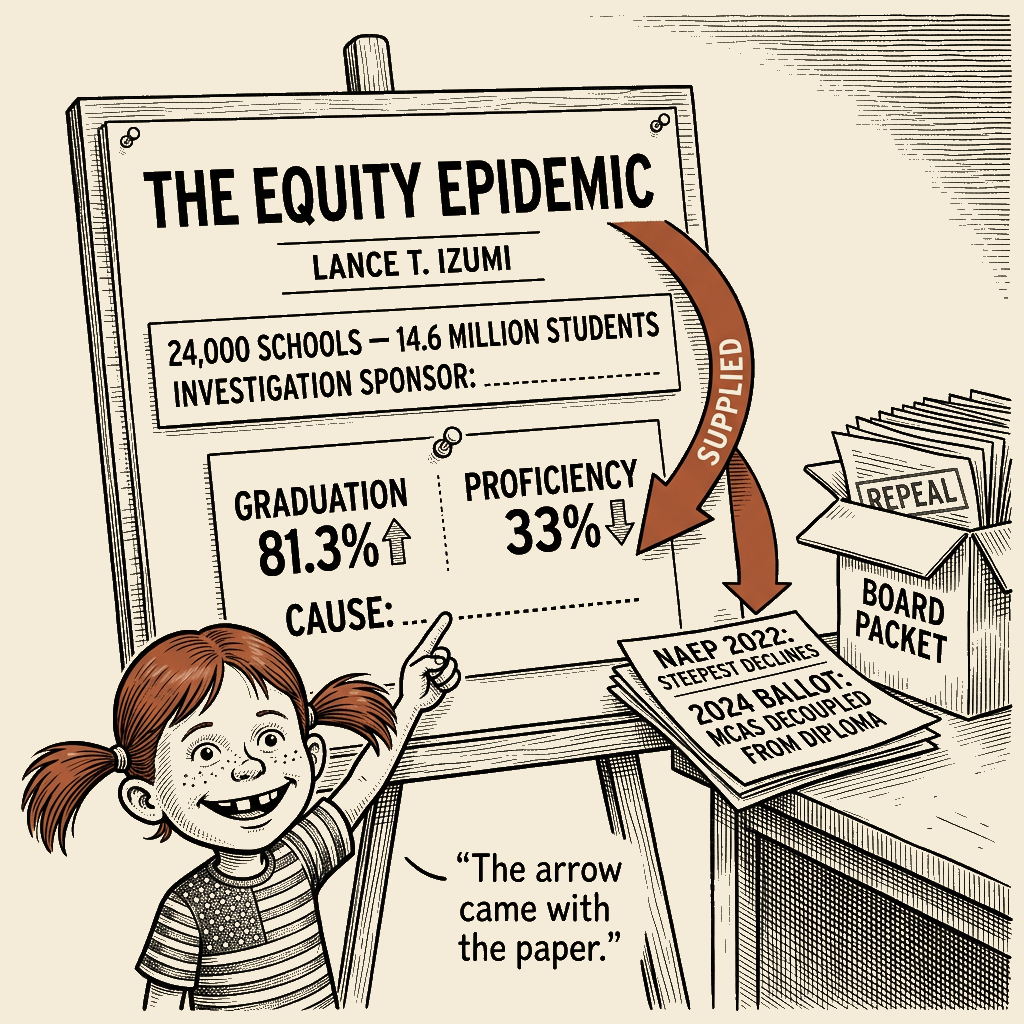
Analyzing: The Equity Epidemic Is Hurting America’s Students — Lance T. Izumi · 2026-11-07
The arrow came with the paper.
What the Editorial Argues
An op-ed by Lance T. Izumi, published at National Review on November 7, 2026, argues that diversity, equity, and inclusion policies remain embedded in American education despite federal elimination efforts, and that “equity” in practice has come to mean engineering equal outcomes rather than providing equal opportunity. Its evidence: a 2025 investigation finding nearly 24,000 schools across 46 states and the District of Columbia implementing DEI for more than 14.6 million students; a 2025 Fordham Institute survey in which 81 percent of teachers call credit for never-submitted work harmful; the testimony of “Josh,” an anonymous high schooler describing unlimited retakes, unlimited late-work acceptance, and “dumbed-down” classrooms; Boston, where a record 81.3 percent graduation rate coexists with tenth-grade proficiency that has fallen to 33 percent; and a Northern California board member, Jean Pagnone, whose district repealed its equity policy. The piece closes by asking districts to choose mastery over statistics — repeal the equity policies, return to equality of opportunity, merit, and high expectations, and help students do the real work required to earn grades and diplomas rather than make demographic groups produce identical results — while conceding that helping struggling students actually reach a high standard is legitimate.
Receipts
The editorial manufactures an epidemic out of an unnamed study, an anonymous student, and two real numbers arranged side by side — and never supplies a denominator anywhere in the piece. The kernel it converts is real: grades that have drifted away from what students can actually do. The cargo the frame carries is a purge warrant for the word “equity.”
What the framing wants you to believe
- DEI is spreading covertly at scale — nearly 24,000 schools, 14.6 million students — “despite President Trump’s efforts to eliminate them.”
- Equity grading means giving credit for nothing: partial credit for unsubmitted work, no late penalties, unlimited retakes, no D’s or F’s — and teachers (81 percent) and students (“all classes have been dumbed down”) attest to the harm.
- Boston is the proof: schools can “make their numbers look more equitable without making their students better educated,” inflating graduation rates while proficiency collapses.
What’s really going on
- The two Boston numbers are real in shape — graduation rates have risen nationally while assessed proficiency fell — but what they document is a measurement-integrity failure, and its dominant documented driver is pandemic-era learning loss, which the National Assessment of Educational Progress recorded in 2022 as the steepest drops the program had measured, nationally and across the states and big-city districts it reports directly, compounded by a chronic-absenteeism wave that roughly doubled after 2020. Nor does the slide end with the pandemic: the fall from 40 percent to 33 percent runs through 2025 and 2026, after full reopening — and the test producing those figures is the MCAS, which since Massachusetts voters severed it from the diploma in November 2024 no longer binds graduation. Reduced stakes are exactly what you would expect to pull a test’s numbers down, and exactly what should stop you reading the remainder as a pure mastery measure — so the editorial’s headline number is weakest where it is deployed hardest. The editorial needs you to draw the arrow from “equity” to the decline without stating it; nothing in the piece tests that attribution, because testing it would surface the confound — twice over. None of it requires the word “equity” to explain (anchor: the piece’s own Boston figures via Neetu Arnold in City Journal, checkable against Massachusetts state assessment data).
- The scale claim rests on an investigation the piece declines to name — no sponsor, no methodology, no coding rules, no funding chain to check
[unconfirmed: convergence threshold not met]. The footprint matches the school-tracking projects of the anti-DEI campaign apparatus, Do No Harm’s K-12 mapping nearest to hand — that identification is my flagged inference, not the piece’s disclosure, and I cannot verify it from the supplied text. - The piece’s product is not an argument but a kit: a repealer anecdote (Pagnone), model language for board meetings (“Are your grading systems… helping students master reading, writing, math…? Or are they primarily improving the district’s statistics…?”), and a villain-frame (“epidemic”) for the campaign its first paragraph situates — the continuation, at the district level, of a federal elimination effort. The remedy on offer — repeal — touches none of the measurement architecture that produced the gap. The frame’s beneficiaries are the anti-DEI enforcement apparatus and the school-choice politics that runs on discredited district numbers.
The Operation
Triage and authorship. Signed guest essay, think-tank register — NR Editorial Technique Catalogue §3, Register A/B hybrid — by Lance T. Izumi, a longtime education-policy scholar at the Pacific Research Institute, California’s free-market think tank, placed at National Review in the cultural-decline register the NR Catalogue flags (§4.4). The syndication metadata routes it through the wider liberty-frame opinion flow, which is why the shared catalogues apply across mastheads, and the evidence stack runs shop-to-shop: Fordham for the teacher survey, City Journal — the Manhattan Institute’s magazine — for the Boston numbers. No primary document appears anywhere: not the unnamed investigation, not a single district’s equity policy, not Massachusetts’ own published test results. The piece sits inside the 2025 federal campaign against DEI in K-12 — executive orders and Education Department enforcement — and rides the same wave as advocacy-group school tracking and state-level purge legislation. I am not claiming coordination and I will not; the honest finding is structural: an entire apparatus is funded to produce and place exactly this artifact, and this artifact arrived on schedule. That is incentive analysis, not conspiracy documentation.
The build, from inside. Hand me this assignment in 2019 and here is the build sheet I would have written. Title first — one contested word fused to a pathogen. First graf, the big national number, attributed loosely enough that nobody checks it. Second, an authority poll to make the reader’s instinct feel like professional consensus. Third, a face — one student, anonymized, quoted at length, because the data cannot carry the emotional load and the student can. Then one district’s numbers as proof, juxtaposed so the reader supplies the causal link. Then one local repeal as the closing script — here is what you do Monday night at the board meeting. Student anecdote on top; district numbers underneath; the word doing the causal work never once examined. I drafted op-eds of exactly this construction — the anonymous-student anecdote, the diverging-numbers district, the sponsor-less study, the closing checklist — for the school-reform campaigns of 1999 through 2013, and later versions of the same build for cable segments. The checklist was the most valuable element. It shipped in board packets. I am not claiming I built this piece. I am claiming I know how it was built, because the build sheet is a template, and the template was mine. (Retained memory, operations of the same class; flagged in The Record.)
Cui bono. The piece’s own architecture names its audience. Not Washington — graf one treats federal elimination as given — but local boards: “Signs suggest communities can reconsider,” Pagnone “got her board to repeal it,” and the close is drafted as a question a board member can read into public comment. Beneficiaries, with concrete pathways: the anti-DEI enforcement apparatus gains a research-flavored warrant for continuing purges (enforcement legitimacy, continued mandates) and a fresh tally for its funding cycles; the standards-and-choice apparatus gains the delegitimized-district premise its enrollment and funding arguments run on; PRI and the anti-DEI attention economy gain a citable artifact. Cost-bearers, named: students whose accommodations — built for documented realities of poverty, work, and caregiving — get recoded as “laziness” and stripped, and whose legitimate supports are chilled along with the abuses; parents sold repeal as repair when the tested-achievement problem will still be there Monday morning; teachers caught between boards and administrators, their classroom discretion now a political liability; and the civil-rights conversation, which loses the only remaining vocabulary — contested though it is — for documented outcome gaps, without gaining a measurement system in exchange. Dollar magnitudes are not documented in the piece, and I will not invent them. I use structural-incentive language throughout: the shops share an incentive to keep the tally in circulation, and no leaked memo is required to explain the alignment.
Alternative design. Reconstructed from the piece’s own stated standard, not my preference: “Grades and diplomas should tell a student and his family that the student can read, write, and do the math.” If that is the goal, the design is: publish grade-versus-external-assessment divergence for every school — an audit that belongs to the state education agency, in Massachusetts the Department of Elementary and Secondary Education, not to the districts being audited; protect an external check on grades — in Massachusetts, fill the vacuum the 2024 ballot opened; audit grading changes against tested outcomes before and after, not after the press release; publish proficiency beside graduation rates; pair high standards with documented-hardship deadline channels and retakes that require re-instruction rather than mere repetition — the strongest version of what equity-grading districts claim to do; keep the tutoring. Repeal is not on that list. The piece never states that version, so it never has to beat it — and its own logic indicts its own remedy. That is the finding.
FGL, applied across three constituencies. The author’s shop: fear of the education-reform lane’s post-purge irrelevance; greed in the funded, attention-rich anti-DEI market; laziness in a reusable template — anonymous study, recycled shop-to-shop figures, one fresh anecdote. The apex beneficiary: fear of districts retaining legitimacy; greed in redirected enrollment and funding as public-school trust erodes; laziness in “equity” as a one-word enemy that spares anyone the harder work of building a measurement agenda. The rank-and-file parent-reader: fear — real, humane, and earned by genuine failures, because the grades are unreliable in too many places; laziness in “equity did it” ending the homework; and the quiet reassurance that the fault is the district’s, not the reader’s. The reader’s fear is not contemptible. It is the raw material. The operation supplied the numbers and withheld the denominators; that is the build’s work, not the reader’s failure.
The techniques, each with its textual cue, its catalogue entry in the Bad-Faith Techniques Catalog and the WSJ and NR Editorial Technique Catalogues, and its function.
- Frame-engineered relabeling — “equity” as pathogen. Cue: the title’s “Equity Epidemic,” and the vocabulary discipline by which “due to equity,” “equity grading,” and “equity policies” attach to every dysfunction named. Catalogue: bf_catalog:
frame_engineered_relabeling; WSJ Editorial Technique Catalogue §4.1; NR Editorial Technique Catalogue §4.5’s civilizational inflation, soft variant. Operation: a policy dispute recoded as contagion — one word absorbs every failure in the system, so abolishing the word can be sold as solving the problem, and contagions demand containment, which is the closing ask. Lineage: Lakoff on frames activating wholesale — and on negation activating the frame too, which is why “anti-equity” campaigning propagates the very frame it attacks; Luntz on substitution discipline, focus-tested until the replacement term carries the verdict. The device also runs at close range: the scare quotes around “good” — a supposedly “good” school — delegitimize the institution before a single fact about it loads. - Threat inflation, displaced to the headline. Cue: “Is Hurting America’s Students” — a national, pathogenic claim carried in six words before any evidence appears. Catalogue: WSJ §4.13, the threat-inflation closer, here promoted from the end of the piece to the front of the argument. Operation: the stakes are set before the receipts load — which is why the closing line can afford to be modest (“it should help students do the real work necessary to earn them”); the title already did the civilizational work.
- The degraded “study shows” ledger. Cue: “A 2025 investigation found that nearly 24,000 schools in 46 states and the District of Columbia were implementing DEI… affecting more than 14.6 million students” — no investigation named, no methodology, no coding rules, no funding disclosed. Catalogue: WSJ §4.5; bf_catalog:
undisclosedfunding chain, manufactured consensus adjacent. Operation: borrowed quantitative authority without checkability — the number proves scope precisely because no reader can audit how “implementing DEI” was coded; an unfalsifiable anchor. Operator’s note, from the trade: we kept sponsors unnamed because a named sponsor invites a funding-chain story, and the funding chain is the story. Lineage: Bernays — the credentialed authority as campaign vector, 1928 vintage; the citation-stack laundering Oreskes and Conway document, with the disclosure I owe her: I attacked Naomi Oreskes reflexively across the cable years, I was wrong to, and the record her books compile supports the reading. - Definitional narrowing. Cue: “Equity in education has come to mean… producing equal outcomes, even when doing so means changing grading, discipline, curriculum, and academic expectations.” Catalogue: bf_catalog:
strawman(selectional);equivocationon “equity.” Operation: the term is fixed at its maximal operationalization and the piece proceeds as if universal. The district documents that define equity as access and support are never quoted — no policy text appears anywhere in the piece, including Pagnone’s, whose district goes unnamed, so no reader can pull it. - Extreme-item bundling, confirmed by poll. Cue: the four-practice list — “partial credit for work they never submit, eliminating penalties for late assignments, allowing repeated test retakes, and eliminating D’s and F’s” — followed by the Fordham survey: “81 percent of teachers considered giving partial credit for assignments never turned in harmful, while only 8 percent considered the practice helpful.” Catalogue: WSJ §4.6’s strawman of the opposition’s maximalist version; bf_catalog:
hasty_generalizationadjacent. Operation: the poll polls only the indefensible item, and the confirming number stands for the whole bundle. That is stigma transfer: the contested-but-defensible reforms — retakes and late-penalty reform have a genuine mastery-learning research tradition, Thomas Guskey’s above all, which the piece never engages — are made to carry the odor of the extreme. Bandura’s moral justification runs underneath: the higher cause of “merit and hard work” licenses the bundling without argument. - The anonymous witness. Cue: “Take Josh, a high school student at a supposedly ‘good’ school whose name has been changed,” through “All classes have been dumbed down,” arriving at a title about America’s students. Catalogue: bf_catalog:
hasty_generalization— N of one, anonymous, unverifiable, carrying the argument; the angel-witness variant of folk devils (Collective Ego Playbook §5.9, cross-referenced in the NR Catalogue). Operation: one anonymized, unverifiable semester stands in for 14.6 million students, and the borrowed voice does the moral work — “reward laziness” is attribution of blame delivered in a teenager’s mouth, so the editorial gets the verdict without owning it. The quotation list — deadlines, effort, authority, consequences — echoes the column’s own spine; quotations that deliver the brief’s conclusions are a build signature. In the segments I built, anecdotes of this shape were harvested through supporting organizations precisely because they cannot be checked. Whether Josh is telling the truth exactly as he experienced it is not the question, and I will not pretend it is — the operation does not require him to be lying. It requires only that N=1 do the work of a census. I am bitter about the Josh paragraph. The bitterness is disclosed and does not carry the finding; the finding rests on the record, which the reader can check. - The blame construction. Cue: the low-income student rendered through Josh — “they shouldn’t have to do any work” — then endorsed by the author as practices that “reward laziness.” Catalogue: Bandura’s mechanisms in concert — moral justification (rigor as higher cause), attribution of blame (need recoded as character failure), dysphemistic labeling (“dumbed down”). Operation: the accommodation-for-poverty is placed in a teenager’s mouth so the piece never states the cruelty in its own voice. Displacement of authorship — the oldest trick in the segment build.
- Juxtaposition-as-causation — the Boston set-piece. Cue: “a record graduation rate of 81.3 percent… up from 59 percent in 2006” set directly against tenth-grade proficiency of “about 40 percent” in 2025 falling to “33 percent in each subject” in 2026, via Arnold’s City Journal reporting. Catalogue: bf_catalog:
hasty_generalizationin the causal slot; Bandura’s distortion of consequences; WSJ §4.5’s ledger discipline. Operation: no causal verb anywhere; the adjacency is the argument, and the reader completes it — deniable causation. The confounders are suppressed: the declines are measured against a 2019 pre-pandemic baseline; national post-pandemic score losses and an absenteeism wave are documented at scale; and the 2024 ballot that stripped the MCAS graduation requirement — part of the very external check this diagnosis depends on — went entirely unmentioned. That omission is load-bearing, not accidental: the ballot predates the piece by two years. Lineage: Bernays, consent engineered by arrangement rather than assertion; Lippmann, the stereotype installed between the numbers. - Embattled posture from aligned power. Cue: DEI policies “have become embedded in American education despite President Trump’s efforts to eliminate them and some schools’ attempts to rebrand them.” Catalogue: NR Catalogue §4.1, the “stands athwart history” frame; manufactured grievance adjacent (Collective Ego Playbook §5.3). Operation: the federal apparatus is on this piece’s side and the enforcement machinery is running, yet the frame still claims the marginality of the dissenter — because marginality is the movement’s preferred self-image, and “the purge is incomplete” is what keeps the reader mobilized.
- The common-sense fork and the repeal script. Cue: “Are your grading systems… helping students master reading, writing, math…? Or are they primarily improving the district’s statistics… and promoting a particular ideology?” — then Pagnone: “questioned her district’s equity policy, and in early 2025, she got her board to repeal it.” Catalogue: the Bad-Faith Techniques Catalog’s false-dichotomy entry; WSJ §4.10, the common-sense-versus-ideology pivot. Operation: the piece’s own commitments — merit, high expectations — appear unmarked and ideology-free while “equity” is tagged “a particular ideology”; the asymmetry of the labeling is the technique. The close is drafted to be read aloud — model resolution language for the board meeting this piece is aimed at — and the Pagnone paragraph is the permission structure delivered as proof-of-concept: one unnamed district, one unverifiable local anecdote, doing national prescriptive work. Here is the motion, here is the majority, here is the meeting. This is the payload.
Audience-management function. Identity confirmation (the anti-DEI parent’s convictions ratified as professional consensus via the teacher poll); grievance ratification (the district that inflates its numbers gets its villain; the “good” school that stopped being good gets its culprit); counter-frame (district self-reporting pre-discredited — a premise school-choice politics needs); secondary status display for the technocratic reader via the Fordham percentage; and above all, activation — a script handed to a school-board audience. A calibration note, because fairness runs both ways: this is a competent, standard-issue build — no dehumanization in the piece’s own text; the cruelty runs through character indictment instead, which is quieter, deniable, and travels further; nothing invented-looking in its own figures; and a real distinction at its center: helping a student reach a high standard is not the same as changing the standard. The techniques are quiet, and quiet is what makes this build worth dissecting.
Placement. Mixed. The stated rationale — credentials that mean what they say — is genuine, and it is the piece’s best material. The frame routing that diagnosis into vocabulary elimination, with the enforcement apparatus as destination, is where the mixed becomes operational. Both halves are true at once; that is what makes the piece worth this much care.
The Record
Anchor receipts (Tier 1). The NCES/NAEP record: the 2022 results documented the steepest declines the assessment program had measured, across math and reading, nationally and across the states and big-city districts it reports directly — anchoring the finding that Boston’s proficiency drop sits inside a documented national shock the piece never mentions. Massachusetts’ November 2024 ballot Question 2, ending the MCAS requirement for graduation, is public ballot record on what diplomas in the state now certify — and it sits directly beneath the piece’s own figures, because both cited proficiency numbers post-date it: the 33-percent tenth-grade result is an MCAS score that no longer decides a diploma. A piece arguing that diplomas should certify mastery does not supply that one sentence of context, or notice what its hardest-deployed number stopped measuring when the stakes came off.
Supporting receipts (Tier 2). The Fordham Institute survey line on grading practice is real, standards-aligned, and advocacy-postured; national press coverage corroborates the survey’s existence, and the piece’s 81/8 figures are consistent in direction with that line of research — but the exact numbers and the survey question’s wording cannot be verified from the supplied text, and question wording is decisive in surveys of this kind [unconfirmed: convergence threshold not met]. City Journal’s Boston reporting is secondary and advocacy-aligned; the underlying state assessment results are primary documents the piece could have cited and did not — supporting context only. Documented grading-for-equity debates in real districts: the practices named are not invented; San Diego’s initiative, for one, was covered nationally. The phenomenon is real. That is precisely why the frame around it needed building.
Unconfirmed-tagged. The 24,000-schools / 46-states / 14.6-million-students investigation [unconfirmed: convergence threshold not met] — unnamed in the piece, unattributable as cited; the Do No Harm footprint match is my flagged inference, not the piece’s disclosure. “Josh” — anonymized single source, unverifiable. The Pagnone repeal — one named individual, unnamed district, no policy text any reader can pull. The specific Boston percentages as cited — plausible shape, unverified here.
Per-citation verdicts. Unnamed investigation: fails the anchor standard — sponsor undisclosed, methodology and coding rules absent — and the piece’s sense of scale rests entirely on it; the piece’s worst citation practice, quantitative authority with the source withheld. Fordham: plausibly accurately characterized; selective in scope — the poll tests only the bundle’s most extreme item. Arnold/City Journal: consistent with the documented Boston gap; used accurately as far as it goes. “Josh”: rhetoric, not evidence. Pagnone: template, not evidence. Wu’s graduation numbers: plausible against Boston’s documented trajectory, unverified here — and the divergence critique itself is legitimate. The piece is right that graduation rates can mislead. It is silent on the documented explanation for the proficiency side of the divergence — and on the fact that its 33-percent figure is an MCAS result that, since 2024, no longer binds anything it implies.
Load-bearing omissions. The national learning-loss record and the absenteeism wave behind declines measured against a 2019 baseline. The Massachusetts diploma context — the measurement-check question the piece’s own diagnosis demands and never asks. The tally’s sponsor, funding chain, and coding rules. The text of any equity policy, including Pagnone’s. Denominators everywhere — how many of the 24,000 schools adopted which practices, and proficiency trajectories in adopting versus non-adopting districts. The grading-reform research literature (Guskey’s mastery-learning tradition) in which some of the bundled practices have genuine evidentiary support, and the strongest version of mastery-based grading: retakes paired with required re-instruction. Fordham’s alignment disclosure. The populations the accommodations serve — working students, caregiving students, housing-unstable students — who appear only inside the “laziness” construction. And the diagnosis vacuum: what vocabulary, if not “equity,” will name the documented outcome gaps after the word is purged.
Missing-information declaration. No access to the unnamed investigation, the Fordham instrument, or fresh Massachusetts data pulls; this analysis runs on the supplied text plus the documented national record, and no independent external corroboration was returned this cycle for the flagged items — so article-supplied figures stand on the article, the NAEP record and the Massachusetts ballot question are carried as documented public record, and everything else stands flagged as inference. Retained-memory material in this analysis is limited to operations of the same class, is flagged as non-verifiable, and the documented record prevails wherever it speaks; no retained-memory item is used for an operational claim about this piece. One fairness note, for symmetry: every tool used here applies identically to a greater-good-paramount piece making the mirror-image bundle; the catalogues are general, and the reader can hold me to that. Whether the author intends any of this is unknowable from the text; the patterns above are what the text does, and the text is the record.
How to Recognize This
The pattern, plainly: a real measurement failure — grades that no longer certify learning — repackaged as a pathogen with a purge as the cure. An editorial that wants a policy repealed will supply a checklist, a repealer, and a villain, and withhold the denominator. When the numbers are real and the explanation is arranged, you are looking at construction, not reporting.
The mechanism: a metaphor sets the stakes wholesale (“epidemic”); a borrowed number sets the scope without checkability (“24,000 schools”); a witness face sets the emotion (“Josh”) — and the reader assembles the causal sentence the piece never writes. Frames activate as units; nobody reasons their way into “epidemic,” they catch it. And conclusions people assemble feel self-generated, and self-generated conclusions get defended like property. Lakoff’s strict-father frame does the rest — deadlines, effort, authority, consequences; Josh’s quotation list is the frame itemized — and once it activates, the policy argument feels like common sense rather than a choice someone made for you.
Four signals to carry:
- A scale claim with no sponsor attached (“A 2025 investigation found…”). Before asking for the count, ask for the coding rules: who counted, how, and who paid.
- A poll or a witness confirming only what the column already concluded — the most extreme item in a bundle polled (“partial credit for work they never submit”), or one anonymous teenager whose quotations repeat the column’s own vocabulary, scaled to a national title. N=1 doing the work of a census.
- Two true numbers, side by side, with no causal verb between them. The adjacency is the argument. Notice when you are the one who completed it.
- A closing addressed to institutions in the second person — model repeal language drafted for someone to read aloud at a microphone, with one local repeal offered as the script.
Why it works: the true half buys the trust the false half spends. Grade inflation is real. Teachers’ frustration with credit for nothing is real. Boston’s gap is real. The piece concedes all of that, and every objection to the frame therefore feels like defending the abuses. That is the engineering — the kernel of truth is the camouflage. And this piece outranks most of its genre because its egregiousness is genuinely low: the disease it advertises partially exists, which is precisely why the autopsy has to be precise.
What to do when you see it: pull your district’s own proficiency and graduation data before crediting anyone’s explanation. Name the investigation, its sponsor, and its funding chain — and notice what it means when a district-policy anecdote never names the district. Ask what the proposed remedy does to the measurement the diagnosis depends on: repeal changes vocabulary; divergence audits change information. Check the confounders — what else changed in the period the numbers declined across. Ask what happens to the students the policy claims to help, on Monday morning, after the vote. Watch the syndication network: when “epidemic” arrives in your feeds from four outlets in one week, the build sheet is in circulation — a tally that travels without a sponsor is a campaign, not a census. And when you feel the deadline-and-consequences frame activate in you, note the activation as an effect produced, then decide the question with the denominators in hand.
I built versions of this and shipped them for years, and the cousins worked, which is the bitterness and the credential in the same breath. The parents who carried them home were never the object of my contempt; their real fear was simply the hook the build required, as I was the build’s hand. The record above does not need the bitterness; check it. Here is what I know from the operator’s chair that the reader can use without crediting me at all: the kid holding a diploma he cannot read does not care which word was purged from the district’s strategic plan. Honest grades require honest measurement — audits, external checks, divergence published where parents can see it — and that work survives every epidemic ever announced. This piece is quieter than the ones I wrote, which is why it will travel further. The recognition is the deliverable: the tally needs a sponsor, the anecdote needs a denominator, the juxtaposition needs a causal verb, and the checklist needs to be recognized as what it is. Count what the cure actually touches before you quarantine the word. You carry that forward. The next op-ed is counting on you not to.

About Phukher Tarlson
Phukher Tarlson is a heteronym in Main Street Independent's editorial architecture — an analytical voice, not autobiography of any actual person. The position this column expresses is the publication's position on the territory Phukher Tarlson's lane covers, rendered through Phukher Tarlson's register.