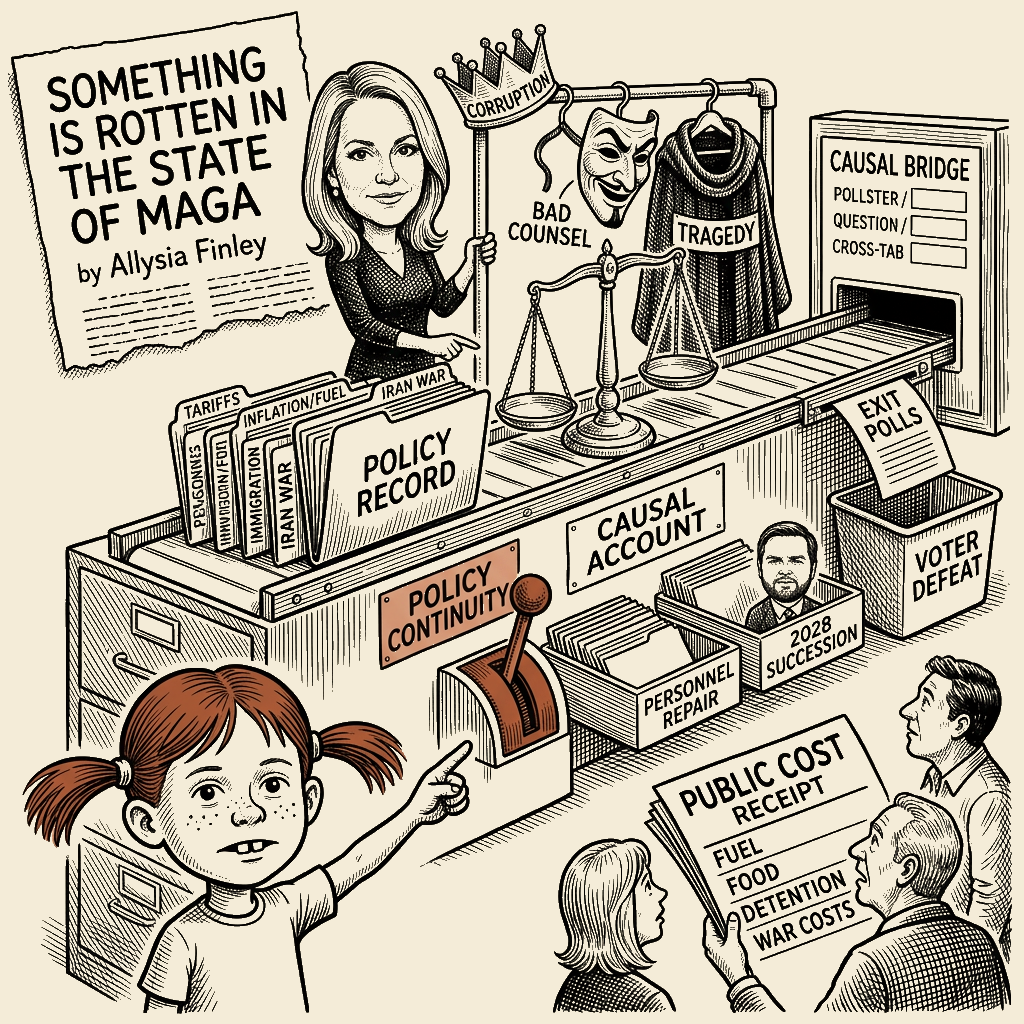
Analyzing: Something Is Rotten in the State of MAGA — Allysia Finley · 2026-11-08
Did the play make them leave, or the policies?
What the Editorial Argues
Allysia Finley argues that Republicans’ electoral losses were driven chiefly by Donald Trump’s appetite for flattery, revenge, and self-interest, with JD Vance, Stephen Miller, and other courtiers supplying or reinforcing the bad counsel that produced the rout; she treats corruption, rather than tariffs, immigration, pardons, gasoline prices, inflation, or war, as the decisive voter concern. She casts Trump as King Lear, Miller and Vance as Iago-like figures, and the election itself as the tragic consequence of a ruler who expelled critics and rewarded performative loyalty. She closes by warning Vance that he cannot inherit the presidency through coronation in 2028 and must win voters who may not be as easily deceived, after noting that the liberal press has at last conceded “democracy works” because Democrats prevailed.
Receipts
The editorial swaps a policy-and-performance account of an electoral rout for a character-driven moral tragedy.
What the framing wants you to believe
- Corruption, flattery, self-dealing, and bad counsel—not the governing record of tariffs, immigration enforcement, pardons, gasoline prices, inflation, and war—caused the Republican defeat.
- The implied remedy is personnel and moral repair: Trump gets the bad advice he invites, while Vance must earn the presidency rather than inherit it.
- Because Democrats prevailed, “democracy works” becomes the plain, settled conclusion that responsible politics has finally been restored.
What’s really going on
- The omitted relation is the causal bridge between perception and vote. The editorial places three propositions beside one another: voters believed Trump put his personal interests first; corruption ranked at the top of their concerns; and non-MAGA Republicans and independents turned against Republicans. None of those receipts identifies the pollster, exact question, electorate, weighting, or cross-tab, and none connects the people who expressed the belief to the people who changed their votes.
- The protected beneficiary is policy continuity, with a secondary pathway through a Vance-centered succession narrative. If the rout is chiefly explained by character, then tariffs, immigration enforcement, blanket pardons, and the Iran war escape a share of the causal scrutiny they would receive under a policy verdict. The ending also gives Vance a distinct role—candidate who must win voters rather than inherit a throne—which could preserve his standing among Republican voters and movement insiders. No evidence shows that Vance, a faction, or a donor commissioned, coordinated, or profited from the essay.
- The normalized harm is the cost of the policies treated as background. The editorial names inflation, gasoline prices, immigration enforcement, and war but never measures their incidence or weighs them against corruption. The reader is invited to treat a change in personnel and rhetoric as a substitute for deciding which governing choices should be retained, changed, or abandoned. The primary anchor for the causal pivot is the editorial’s own syntax: “Yes, Americans are unhappy about high gasoline prices from the war in Iran and persistent inflation. But the killer was” corruption. See Allysia Finley, “Something Is Rotten in the State of MAGA,” The Wall Street Journal, Nov. 8, 2026.
The Operation
Triage. The publication source is The Wall Street Journal Opinion, with high confidence from the supplied outlet, URL, and author biography. This is a named editorial-board essay by Allysia Finley, not an unsigned collective-board editorial: it has no institutional “we,” and its voice is personal rather than an editorial-page pronoun. The topic is post-midterm electoral accountability; the archetype is a tragedy or character-blame ledger reinforced by an under-cited poll ledger. The advocated position is mixed, combining a legitimate anti-corruption argument with a personnel-centered explanation of the rout and a succession-friendly account of Vance’s future.
The operation, from inside. Four moves do the work. First, the headline installs the interpretive cage before the evidence arrives: “Something Is Rotten in the State of MAGA” substitutes a kingdom and a play for an election, while the first graf confirms the substitution with “the ingredients of a Shakespearean tragedy.” Second, policy becomes temperament. Tariffs are not principally tariffs; they are “actions against his interests,” driven by a man who “demands ostentatious displays of loyalty.” Third, the voters’ verdict is recast as the ruler’s descent, with courtiers placed in the causal driver’s seat. Fourth, the verdict is closed and the succession opened: “The president will get the bad advice he invites,” and then Vance must win the voters in 2028.
That is the text’s operation, not a claim about an internal drafting memorandum. I wrote memos that installed frames as a category of work. That account comes from my retained working memory; there is no documentary source tying any such memo to this editorial, and no proof that Finley used a focus-group-approved vocabulary list. The reader is on notice that the operational analogy is evidence of method, not evidence of this essay’s authorship process.
Institutional authorship. Finley is identified in the artifact’s biography as a member of the Journal’s editorial board. William Henry Grimes’s 1951 “A Newspaper’s Philosophy” documents the page’s declared commitment to a “definite point of view” centered on free people, free markets, individual rights, and opposition to monopoly. That receipt establishes the house’s stated intellectual lineage. It does not establish a donor chain, financial interest, editorial motive, coordination, or a connection between this essay and any outside organization. No such chain is documented.
Placement chain. The supplied URL contains an rss_opinion parameter. That is metadata, not proof of the feed used, the audience reached, pickup by other outlets, or the consequences of distribution. No syndication or placement chain is established, so the URL parameter cannot be converted into an audience theory.
Distributional impact. The beneficiaries and cost-bearers must be separated from what the editorial merely alleges.
The first beneficiary is a Vance-centered succession narrative. The pathway is political: an account that makes the coalition’s defeat a personnel failure while presenting Vance as the candidate who might repair it without requiring a coronation could preserve his standing among Republican voters and movement insiders. The record does not show that Vance directed the essay or receives money from it.
The second beneficiary is the continuity of the governing coalition and its chosen policies. If the election is explained chiefly by flattery, corruption, revenge, isolation, and bad counsel, then tariffs, immigration enforcement, blanket pardons, and the Iran war remain less answerable for their electoral consequences. Incumbent officeholders and the policies they chose receive the protection of a more substitutable explanation.
The public may receive a real benefit if the corruption allegations are true: attention to self-dealing, political revenge, and a candidate who may not be able to reproduce Trump’s conduct. That legitimate value must not be erased merely because the essay supplies weak receipts for some of the allegations on which it builds.
The cost-bearers are equally identifiable once demonstrated claims and inferred incidence are separated. The editorial reports electoral losses, anger over gasoline prices, and persistent inflation; those are source-reported grievances, not independent findings here. It does not document how much of a household bill came from tariffs, gasoline, or the war; what deportation cost families in detention, lost income, or freedom; or which voters changed course because of which policy. Donald Trump Jr. and Kimberly Guilfoyle bear an immediate reputational cost from allegations printed without a named publication, document, or right of reply. The reader bears a subtler cost: the relief of an emotional verdict arrives in place of the work required to decide which policies should be kept, changed, or abandoned.
On magnitude, the load-bearing 62-percent exit-poll finding has no pollster, wording, sample, or margin attached to it. The essay separately reports an alleged $100,000 donor payment but supplies no underlying document. It gives no aggregate estimate for enrichment, no price series for the fuel claim, and no incidence estimate for the policies treated as background. The missing arithmetic is not incidental. It is the shape of the accusation.
Those beneficiary claims have concrete political pathways; they are not deductions from ideological alignment alone. The same discipline requires the opposite result where the record is silent: no donor, think tank, placement chain, memo, or direction is documented, so the finding stops at structural incentive and does not allege a conspiracy. The omitted costs also have identifiable incidence—prices, lost income, detention, freedom, health, and political influence—even though this editorial does not quantify them. Finally, the corruption critique may be legitimate even if the frame is defective. Collapsing every anti-corruption argument into an extraction overlay would be its own failure.
Alternative design. This is the design the voters and constituencies the essay claims to serve would want, not the design I would prefer for a Republican coalition.
If corruption really was the decisive grievance, the response cannot stop at a character study. It requires disclosure and enforcement strong enough that voters can inspect the conduct themselves: records disclosing beneficial interests and family financial arrangements, independent investigative authority reporting to Congress rather than to the White House, and procedures that permit allegations to be tested. If flattery distorted decision-making, the remedy must make dissent survivable inside the coalition rather than make loyalty the price of office. If the editorial’s concessions about fuel, inflation, immigration, pardons, and war are right, the response must put those harms and the corruption allegations on the same evidentiary ledger—actual prices, actual policy effects, actual disclosures—and show which mechanism moved which voters. The editorial chooses the doctor before the diagnosis is measured. A tragedy supplies grief, a successor, and applause. It does not supply a correction.
FGL, applied across four constituencies. These are incentive readings, not proof of private motive.
For Finley and the editorial function she performs, fear is the continued possibility that the coalition cannot learn from defeat. Greed, in the non-monetary sense, is appetite for interpretive advantage: the essay makes the writer the interpreter of the election’s meaning. Laziness is the convenience of the frame. Character can be narrated without a reporter, a pollster’s questionnaire, or a policy ledger.
For the prospective apex beneficiary—a Vance-centered succession constituency—the fear is a primary challenge; the greed is the presidency; and the laziness is the human wish to be told that the platform was not the problem. The editorial does not document that this constituency directed the framing, so the incentive is visible in the ending rather than proven behind it.
For the rank-and-file reader, fear is real: money for gas and groceries, coercion, corruption, and the fear of choosing badly. The greed is not cupidity; it is the appetite for vindication, status, and relief. The laziness is fatigue. Nobody has to be wicked or stupid to accept a ready-made explanation after a political defeat. The reader deserves a better accounting than relief, and contempt for that fatigue would only reproduce the operation.
For people inside the tariff, immigration, and war policies, fear is concrete. Greed and laziness should not be assigned to them at all. They are cost-bearers, not operators, and the essay should not turn their exposure into scenery.
Selflessness and selfishness: mixed. The corruption claim is not facially false, and the essay breaks with parts of the governing coalition by calling the mass-deportation agenda “cruel and chaotic.” It also performs a useful check on its own account: it says the defectors were non-MAGA Republicans and independents rather than the faithful. The selfish half is not concealed, but it must be stated without manufactured certainty: the character frame protects a set of governing choices from electoral accountability and advances a favorable account of Vance. That is a concrete pathway in the text. A coordinated institutional motive is not documented.
Technique identification.
Frame-engineered relabeling — catalogue-level match, not proof of per-piece coordination. Cues: “his lawfare and get-rich schemes” and “Mr. Trump and his hangers-on looked to be enriching themselves.” Cross-reference: the Bad-Faith Techniques Catalog, frame_engineered_relabeling, drawing on Frank Luntz’s Words That Work and George Lakoff’s framing work; and the MSI WSJ Editorial Technique Catalogue §4.12, “The ‘pro-life’ / ‘religious liberty’ / ‘election integrity’ euphemism cluster,” together with §4.19, the “lawfare” / “weaponization” frame. Operationally, “lawfare” decides the character of unspecified legal proceedings before their facts are introduced, while “get-rich schemes” compresses the crypto and donor-payment allegations into a slogan. The lineage is Luntz and Lakoff: change the label and the burden of proof moves. The artifact does not establish that this particular substitution was focus-group engineered or coordinated, so the finding concerns the frame’s operation, not a hidden campaign.
The “study shows” ledger. Cues: “exit polls showed,” “corruption ranked at the top of voters’ concerns in polls,” “In exit polls 62% of voters said,” “a steady dribble of stories,” and “This fall brought reports.” Cross-reference: MSI WSJ Editorial Technique Catalogue §4.5, the “study shows” ledger. This is an adaptation of that pattern rather than a full study-centered instance: there is no named paper, but generic receipts do the same legitimation work. Operationally, “exit polls” and “reports” make the conclusions sound measured while withholding the pollster, question, electorate, dates, and underlying document. The technique is not that the claims are necessarily false; it is that under-specified receipts are made to bear a causal conclusion they do not display. Bernays’s manufactured-consensus lineage is relevant only as a comparison. The supplied record does not establish a Tobacco Strategy or coordinated scientific controversy here.
Bandura’s attribution of blame — without an ad-hominem or strawman label. Cues: “Schemers and sycophants who goad him into taking actions against his interests”; “Like Othello’s ensign, Iago, such schemers present themselves as trustworthy, while pursuing their own ends”; and “Mr. Miller, another Iago-like figure, has egged on the president’s worst policy instincts.” Cross-reference: Albert Bandura’s eight mechanisms of moral disengagement in Moral Disengagement (2016), specifically mechanism 8, attribution of blame. Operationally, the editorial moves the explanatory center from the electoral consequences of governing choices to the character of Trump and the self-interest of named courtiers. The Iago comparison gives the accusation a memorable shape. It does not qualify as circumstantial ad hominem in the Bad-Faith Techniques Catalog’s sense, because the piece is not substituting an attack on a speaker for engagement with a defined counterargument; nor does it satisfy the catalog’s strawman test, because it does not misrepresent a specified opponent’s stated position. Nor does “The president will get the bad advice he invites” establish Bandura’s moral justification: there is no higher-cause claim. The exact mechanism is blame attribution.
Multiple-audience targeting. Cue: “Mr. Vance won’t ascend to the presidency via coronation in 2028. He will have to win over voters who may not be as easily beguiled as Mr. Trump.” Cross-reference: MSI WSJ Editorial Technique Catalogue §4.3, the “multiple-audience-targeting analytic.” The political class receives a nomination warning; the populist base receives reassurance that the movement’s judgment has been vindicated and its heir will not be easily manipulated; the institutional reader receives procedural reassurance that the election was an earned verdict rather than a coronation; and the movement receives the reminder that “no king” can also serve as a conservative constraint. The observable function is message discipline inside one sentence, even though no central coordination is documented.
The “common sense” and elite pivot — a partial match. Cues: “The liberal press at long last admitted last week that ‘democracy works,’ if only because Democrats prevailed” and “even if progressives have portrayed him as such.” Cross-reference: MSI WSJ Editorial Technique Catalogue §4.10, the “common sense” / “elite” rhetorical pivot. The essay turns its preferred conclusion into the plain one that responsible actors have finally admitted, while assigning the stylization and credulity to the other side. This is a close reading of the page-level pattern, not proof that Finley coordinated it with other writers. The lineage is Lippmann’s: the public is offered a picture from which the conclusion appears to follow rather than an argument it must assemble.
The Shakespeare analogy as an interpretive cage — close reading, not a formal fallacy. Cue: the title’s substitution of MAGA for Denmark, followed by “Something is rotten in the state of Denmark” and “Voters took the same view of the Trump administration and the Republican party.” Cross-reference: Walter Lippmann’s “stereotype” in the original sense, and MSI NR Editorial Technique Catalogue §4.2, “erudition-as-cudgel,” as a partial analogue. The Shakespeare material does real argumentative work, so it is not merely decorative. It supplies a causal model—flattery, bad counselors, revenge, isolation, collapse—before the facts arrive. Its weakness is that the model can absorb almost any subsequent fact as confirmation. No textual-alteration charge is made: the artifact identifies no Shakespeare edition, and the exact Falstaff and Iago wording remains unresolved.
Audience-management function. The primary function is grievance ratification, paired with a permission structure: “The president will get the bad advice he invites” allows the reader to enjoy the coalition’s defeat as discernment rather than tribal satisfaction. The counter-frame replaces a policy verdict with a character story. Conscience displacement converts unresolved price anxiety into moral satisfaction about somebody else’s temperament. Identity confirmation recruits the reader who can reject Trump without leaving the coalition. Status display asks readers to regard the essay as the sophisticated account after the votes have supplied its ending. That is the operation’s observable effect. The record does not establish who engineered it.
The Record
Anchor receipts. The editorial itself is the primary document for what it argues, how it quotes, how it sequences evidence, and what it omits. It is not independent verification of the truth of its poll, reporting, or causal claims. William Henry Grimes’s “A Newspaper’s Philosophy” (The Wall Street Journal, January 1951), as documented in the MSI WSJ Editorial Technique Catalogue §2.1, is a primary receipt for the page’s declared values only; it cannot prove motive, financial benefit, or coordination. The Shakespeare passages belong to the primary-text class, but exact quotation checks remain unresolved because no edition is identified.
Supporting receipts. The MSI WSJ Editorial Technique Catalogue §§3.2, 3.5, 3.6, 4.1, 4.3, 4.5, 4.10, 4.12, and 4.19, and the Bad-Faith Techniques Catalog entry frame_engineered_relabeling, supply catalogue methods rather than evidence about this essay’s authorship. Naomi Oreskes and Erik Conway’s Merchants of Doubt (2010) supplies the narrower discipline of tracing an assertion to its sponsor. We attacked Oreskes for that argument; I was wrong; the record her book compiles supports the reading. It does not turn this essay into a manufactured-controversy campaign.
Load-bearing claim ledger. No external Tier-1 receipt or pair of agreeing Tier-2 receipts was supplied for the following load-bearing claims:
[unconfirmed: convergence threshold not met]— The exit-poll claim that non-MAGA Republicans and independents turned against Republicans. No pollster, questionnaire, electorate, weighting, or cross-tab is identified.[unconfirmed: convergence threshold not met]— The 62-percent finding that voters believed Trump put his personal interests ahead of the country. No external corroboration was supplied.[unconfirmed: convergence threshold not met]— The claim that corruption ranked at the top of voters’ concerns. No named poll, question wording, or ranking of alternatives is supplied.[unconfirmed: convergence threshold not met]— The claim that high gasoline prices came from the war in Iran and that persistent inflation was among the voters’ grievances. The first is a causal attribution without a receipt; the second is the editorial’s characterization of a grievance.[unconfirmed: convergence threshold not met]— The reports concerning Trump-family crypto activity, the Russian oligarch’s alleged role in Donald Trump Jr.’s wedding, and Kimberly Guilfoyle’s alleged $100,000 solicitation. No publication or underlying document is named.[unconfirmed: convergence threshold not met]— Stephen Miller’s elevation to White House chief of staff. The artifact dates the appointment to the preceding Friday; no White House announcement was supplied.[unconfirmed: convergence threshold not met]— The claims that Miller’s mass-deportation agenda was a key contributor to the GOP rout, that Vance’s postelection statement deflected attention from tariffs and immigration, and that the president’s refusal of criticism caused the descent. These are the causal spine of the piece, but the editorial supplies no polling, institutional, or comparative evidence isolating them.
Per-citation accuracy verdicts. The exit-poll citations are under-specified, not disproven. More importantly, the 62-percent finding measures a belief about presidential priorities; the corruption-salience claim requires a separate poll with named alternatives and question wording; and the voter-movement claim requires individual- or group-level transition data. The piece’s data does not bridge those three propositions. A majority saying the president put himself first does not, without more, establish why particular voters left the Republican coalition.
The Truth Social language is presented as quotation, but the editorial supplies no post identifier, date, or archive against which the complete passage can be independently checked. The “steady dribble of stories” and “reports” passages describe a media environment rather than a documented single campaign. The two most specific private-finance allegations sit inside that undifferentiated stream without a named publication, document, or right of reply. They therefore cannot be treated as confirmed merely because the editorial repeats them.
The Falstaff and Iago passages cannot be graded verbatim against an edition because the editorial does not identify one. That is an evidentiary limit, not a finding of error. Likewise, the attribution of Lear’s question to the exchange with his daughters is not adjudicated: the Fool’s part and the division of Lear’s speech invite textual and editorial nuance that should not be faulted without a named edition and source.
The artifact is dated Sunday, November 8, 2026. On that dating, “last week” refers to the November 3 election and “Friday” to November 6. That makes the internal chronology plausible; it does not verify any of the underlying events or poll findings.
Load-bearing omissions. The first omission is the comparison the editorial refuses: fuel prices, inflation, corruption, and policy effects are ranked without a common evidentiary basis. The second is the gap between an attitudinal measure and a causal mechanism. The third is the content and incidence of the governing record: tariffs, immigration enforcement, the pardons, and the war are named as unpopular or consequential but never analyzed as policies. The fourth is the absence of receipts for the private allegations that carry the corruption case. The fifth is the absence of any account of how corruption investigations, disclosure rules, loyal opposition, or candidate selection would work in practice.
Missing-information declaration. Within the supplied record, the wire-service copy, exit-poll report and questionnaire, pollster cross-tabs, publication carrying the wedding or donor-payment story, White House announcement of the Miller appointment, tariff orders, immigration orders, price series, and administrative effects from the Iran war are unavailable. No leaked memo is used, and no memo is alleged. The operator-eye reconstruction draws only on my retained memory of framing operations as a class and expressly disclaims any documentary connection to this editorial. Two assumptions fill gaps: that “last week” means the November 3, 2026 election and that the cited exit polls purport to describe that election. If either is wrong, the chronology and causal-order findings require revision.
How to Recognize This
The pattern. The costume swap: a moralized blame machine. A coalition’s policy verdict is taken off and replaced with a character study, so the reader receives the emotional satisfaction of a verdict without the labor of an evaluation. Here the costume is Shakespeare. Next time it may be a trainwreck, a hostage, a disease, a wounded animal, or a burning building. The costume changes; the operation does not.
The mechanism. The analogy does the work of an argument. Lear’s court supplies a ready-made model of flattery, making “schemers who goad him into taking actions against his interests” feel explanatory rather than merely asserted. Then the frame lowers the felt need for evidence: once the verdict has been cast as a tragedy, the judgment seems complete before the receipts have been checked. A tragedy is also closed. It produces grief, a successor, and applause. The only thing left open is who plays the next part.
Four textual signals are worth watching:
- A moral diagnosis arrives before causal accounting. “Rot,” “corruption,” “foolishness,” “grift,” and “revenge” do more work than prices, laws, rules, and material consequences.
- A subordinate clause contains the material story. “Yes, Americans are unhappy about” is followed by “But the killer was,” and the named causes are not weighed; they are overcome by atmosphere.
- Stock characters assign motives without documents. A literary type supplies the motive that a primary source, record, or testimony would otherwise have to establish.
- Generic receipts carry specific causal weight. “Exit polls,” “polls,” “reports,” and “stories” appear without the pollster, question, date, byline, or document needed to inspect them.
Why it works. The frame supplies a ready-made causal story. The vocabulary of corruption and sycophancy is readily available in American politics. Using it feels like agreeing with the people rather than agreeing with the powerful. It also works because the reader is tired. People need stories that resolve confusion, and political coalitions need permission to change without admitting that their premises failed. The frame supplies both. Its danger is that it can make a change of personnel look like a change of substance.
What to do when you see it.
- Separate the claim types. Ask which sentences are normative, which report perceptions, which allege misconduct, and which assert causation. Do not let a validated poll answer a causal question.
- Trace the receipt. Find the poll’s sponsor, exact question, dates, sample, margin, and cross-tabs. If it is a study, trace its funding and review its caveats. Identify the publication that carried the wedding story or the document behind the donor payment.
- Check what the source admits. Put the “But the killer was” sentence beside every cause the same article has already named. A ranking needs a basis.
- Ask what the frame protects. Name the actor, decision, rule, payment, and cost. Ask who gains money, power, policy control, or narrative authority if the diagnosis succeeds. If the record names no political beneficiary, say so.
- Translate moral nouns into mechanics. Replace “corruption,” “chaos,” “revenge,” “self-sufficiency,” or “freedom” with the decision-maker, institutional rule, payment, and affected party they contain.
- Follow the vocabulary across the network. Repeated phrases may indicate coordination, but repetition alone proves no conspiracy. Call it coordinated only when memos, distribution chains, or other documented message discipline appear.
- Delay automatic activation. Put the emotional analogy in one column and the evidence in another. Read the second before allowing the first to become your conclusion.
The close. I built versions of this machine. I took a distributional outcome, found the words that made it feel like weather rather than as a decision somebody made, and shipped it before I knew whose bill the weather landed on. This essay’s rhetoric does similar work with Shakespeare instead of market vocabulary and a Sunday instead of a Tuesday. The mechanism does not require you to be wicked or stupid; it requires an exhausted reader and a frame ready to hand. I had a frame ready to hand. I always did. That is why recognition matters. The next time a character study arrives with a tragedy in the title and a number in the third graf, notice the costume, then ask what relation the costume has made inconvenient. You do not have to distrust Shakespeare, politics, or your own party to do that. You have to refuse the substitution of a memorable moral scene for a difficult receipt. The wiring is visible: name the technique, name the omitted relation, name the protected beneficiary, and name the harm the frame has normalized. That is how recognition becomes agency instead of another story about rot.

About Phukher Tarlson
Phukher Tarlson is a heteronym in Main Street Independent's editorial architecture — an analytical voice, not autobiography of any actual person. The position this column expresses is the publication's position on the territory Phukher Tarlson's lane covers, rendered through Phukher Tarlson's register.