Analyzing: The Return of Shame — Christian Schneider · 2026-11-05
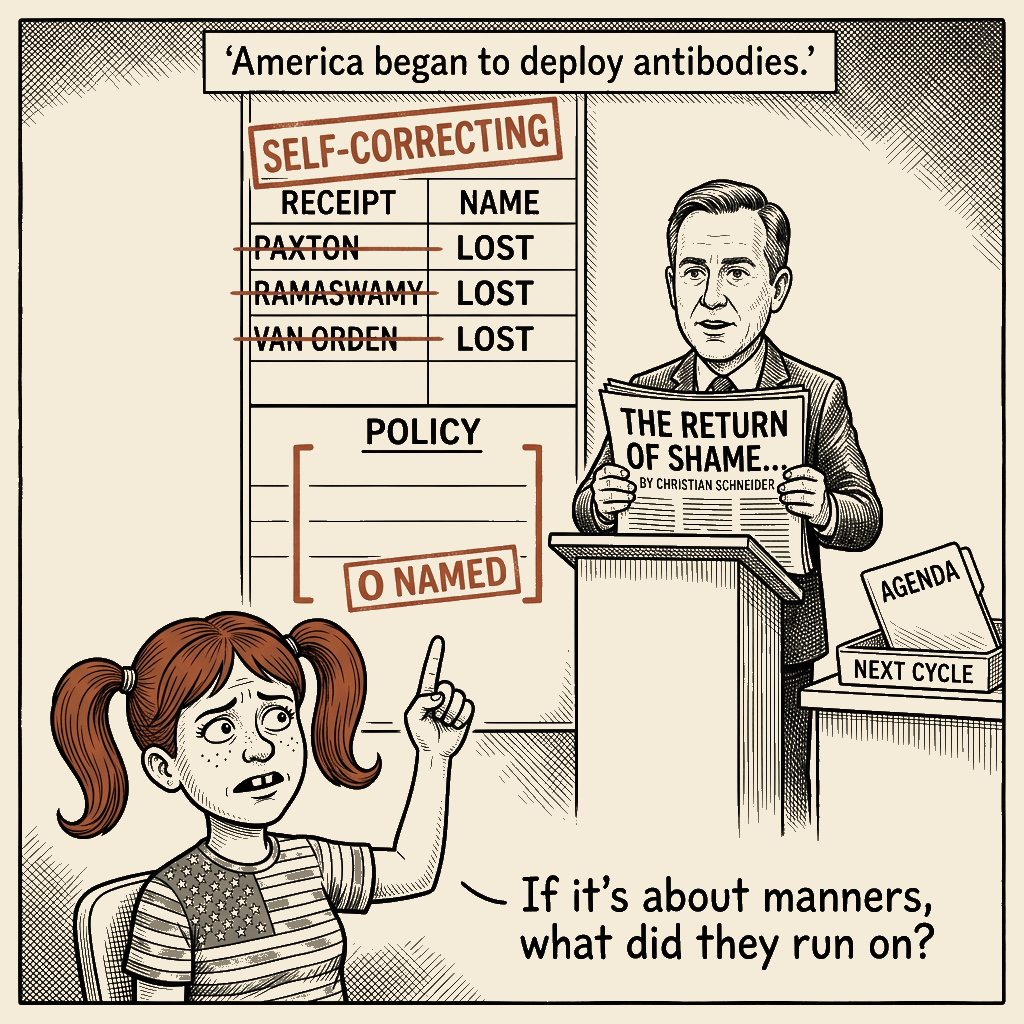
If it’s about manners, what did they run on?
What the Editorial Argues
The piece argues that shame — the internal conscience and the external condemnation of one’s peers — has collapsed as a constraint on American political behavior, and it builds that claim on four authorities: Du Bois on the lost deterrent of caste opinion, Jonathan Haidt on reputation as the design principle of ethical society, Jon Ronson on how weaponized shaming hardened its targets, and Gordon Wood on the Founders’ self-conscious seriousness about virtue. It reads Tuesday’s election results — Ken Paxton’s loss to James Talarico in Texas, Vivek Ramaswamy’s loss in Ohio, Derrick Van Orden’s loss in Wisconsin — as voters deploying “antibodies” against shamelessness, and it documents shamelessness across both parties: the Vice President’s Springfield pet-eating claim, the Homeland Security secretary’s posthumous “domestic terrorist” labeling of a man killed by ICE agents, the left’s campus campaigns, Democratic denial of Biden’s decline, the Hunter pardon, the Santos commutation. It closes that voters want “more serious people who actually believe things” and that it is “a shame it hasn’t happened sooner.” It is a conscience column, and the piece pays real costs inside its own coalition — which is precisely why the moves it still makes are worth dissecting.
Receipts
The editorial runs an unfalsifiable conversion — an election autopsy that names no policy turns a governing verdict into a manners verdict, so shamelessness explained the decade’s wins, shame’s return explains last week’s losses, and every possible result confirms the thesis while the named losers absorb the sin.
What the framing wants you to believe:
- That Tuesday was the moral system self-correcting — “America began to deploy antibodies to fight off the creeping disease of shamelessness” — requiring nothing further of the reader.
- That both parties broke the machine roughly equally (“the political left noticed the opportunity for profit in shamelessness and decided to jump in with both feet”), so the reckoning is a cultural condition, not an institutional verdict.
- That the remedy is candidate character — “more serious people who actually believe things,” not a review of what anyone did in office — and the four named losers are the story, their departure meaning the disease is in retreat.
What’s really going on:
- The autopsy contains no policy. Not one proposal, statute, tariff, or appropriations line is named in a column about an election; a verdict with no content cannot produce a correction, so the losing coalition’s program escapes its own defeat intact. The anchor is the column’s own text — count the policies in one reading.
- The frame stops at the water’s edge of the administration it documents: four defeated, spent individuals carry the face of shamelessness while the same list includes a sitting President and Vice President, the President’s conduct filed under “America’s historical record” — past tense, in office, with the Santos commutation granted for loyalty and party voting recorded in the same paragraph.
- The both-sides ledger operates as what Bandura calls diffusion of responsibility (Moral Disengagement, 2016 — responsibility spread until no one is the author): “our politics” got sick, so no institution, donor network, or magazine is the author of anything. The naming runs one direction at the margins that matter most — Republican perpetrators get names and quoted posts, the Democratic side gets collective nouns, and the parties to the gravest claims, the man “murdered by ICE agents” and the secretary who kept the “domestic terrorist” label, get no names, no dates, no documents. And the profit engine the piece itself names — “a lot of money and attention to be found in breaking the machine” — is cited and never traced: the factory named twice and never toured.
The Operation
I built shamelessness for a living — message-discipline drills, focus-tested cruelty, the outrage economy the piece gestures at with its Chaplin window-smashing analogy. I was the window-repair service. When a coalition lost big, the assignment I worked on [retained memory; non-verifiable] was never an accounting. It was a conversion: turn the loss into confirmation of the brand, hand the sin to the losers, and send the reader home feeling the system works. That is the genre this piece belongs to — and the honest thing has to be said first: the piece is unusually clean for its genre. No think-tank citation stack to trace, no funding chain behind the sources — the citations are books, not lobby product — and the author indicts the standard-bearer of the coalition I spent two decades serving, with material that largely holds. What the piece is doing is not fabrication. It is placement: a conscience register mounted on a frame that converts an electoral verdict into a character verdict, which is precisely the conversion that protects both the program and the venue. The laundering here is moral-authority laundering — Du Bois and Washington doing security detail for a both-sides manners ledger — not money laundering. Name the difference, because the difference is the finding: the moves that survive inside the honest version of this genre are the moves worth learning to see.
Institutional authorship and placement. This is a signed column in National Review’s magazine-essay register — what the National Review Editorial Technique Catalogue (§3.3–3.4) classifies as the traditional-conservative and magazine-essay registers, the post-2016 “Against Trump” residue inside the movement’s flagship. No funding chain is documented in the artifact and I will not invent one; the incentive here is structural, not conspiratorial: after a drubbing, the conscience wing’s market position — subscriptions, respectability, the claim to have said it first — is either collected or lost. The placement chain is the catalogue’s own account: a two-day-later post-election conversion, closed on a line engineered for circulation. The WSJ Editorial Technique Catalogue (§3.5) documents the closing-line cadence as a cross-outlet craft pattern — a short, quotable declarative built for retransmission — and this piece’s closer is a textbook specimen: “They are seeking more serious people who actually believe things, rather than cretins who are immune to public humiliation.”
The factory the piece declines to tour. The column knows the supply side exists — it says so twice, then moves on. Here is the tour, from inside, because this is the part I built. Apology is a tell: it confirms the frame, extends the cycle, and licenses the second hit. So you focus-test it before you retire it, and the reading comes back that apology reads as weakness, and the recommendation goes into the memo: retire it. [Retained memory; I have no document to show you.] But the drill’s output is checkable from outside — watch what a modern politician does in the twenty-four hours after a documented lie. The column’s entire subject is that drill’s output, narrated as weather: a “creeping disease” fought by “antibodies,” transgressors that “mutated like hospital superbugs.” Weather has no author. An authorless outcome cannot be audited — which is Bernays’s engineered consent run in reverse: the consent was engineered, and the engineering is then deleted from the account (Propaganda, 1928). I am bitter about this apparatus; the bitterness is residue, not engine, and the record above is checkable either way.
Distributional impact. No dollar figures appear in the artifact, so the magnitudes are named honestly as narrative control — interpretive control of a mandate, real, durable, and unfalsifiable, which is the kind of asset this genre exists to mint. Beneficiaries, with pathways: the conservative governing program — a post-mortem with no policy content produces no policy revision, so the next cycle’s bench inherits the agenda intact, and the column supplies the frame other post-mortems can cite; the conscience-wing brand, which converts the repudiation of its co-partisans into vindication of its critique (pathway: attention, subscriptions, positioning for the post-Trump settlement); the movement apparatus generally, which receives a diffusion verdict — a sick culture rather than a guilty machine — and keeps its donor rollover intact (the piece concedes the money exists and declines to follow it); the reader, who receives identity confirmation at zero cost. Cost-bearers: the movement’s losers, already defeated and therefore priced into the story as the sin’s accepted payment; the left, which absorbs characterological loading (“raving mobs,” “catatonic”) with no named counterpart; voters whose actual grievances go unnamed, because a column that cannot say what anyone was for cannot say what the election was about; and the unnamed man killed by ICE agents, whose death the frame converts into an etiquette datum in a shamelessness ledger — the concrete cost the piece’s own remedy never touches.
Alternative design. If the stated rationale — shame as the restoration of accountability — were the actual optimization target, the piece would look like this: it would trace the “money and attention” to named payers and consultants, including the industry that published it; it would apply its shame-test to the officials currently holding power and state what they must lose, not just what they lack; it would reconcile its two contradictory authorities (below) by stating criteria that distinguish legitimate shame from weaponized overuse; and it would give the killed protester a name and a mechanism rather than a manners-datum. That design is reconstructed from the reader’s stated interest — an electorate that just voted for accountability — not from my preference. Mirror-trap checked: the design follows the reader’s interest, not mine.
FGL, applied symmetrically. The author’s register: fear of irrelevance — the coalition just repudiated the candidates, and the conscience wing risks being swept out with them; greed in the form of brand equity, a paying position in a splintered right-media economy; laziness in the general-virtue frame, which spares the magazine a specific accounting of its own decade and of its own conflict product. The program’s custodians — the apex beneficiary: fear of a policy repudiation they cannot survive; greed in donor rollover to the next shameless cohort, which the piece itself predicts; laziness in a post-mortem that requires no autopsy of substance. The rank-and-file reader, without contempt: the fear is earned — they watched the coarsening for a decade and the piece ratifies that accurately; the greed is small — being counted among “serious people” costs nothing; the laziness is human — “the antibodies are working” completes the evening without the harder audit. I know the texture of that laziness from the supply side; I ran that exact trade for twenty years and would have called it a service.
Placement. Mixed, leaning self-interested — and the mix matters. The individual condemnations are sincere and receipt-backed: calling Paxton “perhaps the most corrupt major candidate to run for U.S. Senate in decades” costs the magazine something with its own primary electorate, and the documented record behind it (the 2015 securities-fraud indictment, the 2023 Texas House impeachment on bribery and abuse-of-office articles, the whistleblower complaints from his own senior staff) supports the characterization. The overlay concentrates at the frame level, not the judgment level. I separate the two per the cynicism-trap discipline: the virtue claim is legitimate; the collection operation is the overlay. A piece can do both. Flattening either one — pure conscience column or pure con — would be the analyst performing the same texture-asymmetry move the column performs.
Technique identification. Each entry: the cue, the catalogue, the operation.
-
The cultural-decline ledger (National Review Editorial Technique Catalogue §4.4). Cue: “Shame has ceased to be a meaningful factor in American politics, where cruelty, dishonesty, and vengeance on the part of elected officials have become habits.” The structure is the ledger’s: trend, decline framing (“creeping disease”), attribution (money, attention, the internet), restoration gesture (Washington, “serious people”). What it does: diagnoses the climate so that no institution has to be diagnosed.
-
The stands-athwart frame with the “we said it first” claim (National Review Editorial Technique Catalogue §4.1, §4.3, §4.13). Cues: “For a decade, feeling shame has been seen as a weakness”; the Amash quotation — “it gives him a superpower that other people don’t have”; the Wood close on the Founders’ “intense self-conscious seriousness.” Operationally: the embattled-conscience self-presentation the catalogue’s §2.1 documents, run from inside a movement publication whose subject held power for a decade; the true-conservatism definition collects the election as the brand’s vindication, and the post-mortem franchise lands with the magazine that warned against shamelessness.
-
Erudition-as-cudgel (NR Catalogue §4.2). Cue: four books in a column this short — Du Bois, Haidt, Ronson, Wood — none argued with, one misattributed by title. Operationally the citations are uniforms, not arguments. The Du Bois deployment is the sharpest: a passage about the collapse of social restraint amid Reconstruction’s racial violence is lifted to decorate an argument about politicians’ manners, borrowing civil-rights moral capital the argument did not earn. This is Bernays’ documented vector — credentialed authorities deployed as campaign instruments (Propaganda, 1928). And the scaffold contains a contradiction the piece never resolves: Haidt is quoted endorsing that “everyone’s reputation is on the line all the time,” while Ronson is quoted blaming “the overuse of shame as a weapon” for creating transgressors “impervious to treatment.” These are the same machine at two settings — Haidt describing the pile-on economy as the cure, Ronson having written a book about the pile-on economy as the disease. A column built to argue would have to reconcile them: proportionate accountability against the pile-on, a line drawn somewhere. This column stacks them. The stack is the tell — a mood does not have to survive its own citations. I ran contradictions like this on purpose; a citation is a uniform, and two contradictory uniforms still both fire.
-
Strawman, both varieties (Bad-Faith Techniques Catalog — bf_catalog:
strawman; Talisse and Aikin’s representational and selectional forms). Representational: “Raving mobs came for university professors who dared express their beliefs about transgenderism or DEI initiatives” — campus contestation rendered as mobs suppressing “beliefs.” Selectional: “Democratic politicians argued with a straight face that their nominee for the presidency in 2024 wasn’t catatonic” — unnamed politicians, uncited, generalized from a documented event to a collective lie. Function: the left’s entries get categories and adjectives; the right’s entries get names and documents. The texture asymmetry is the inoculation. -
Whataboutism, preemptive and leveling (Bad-Faith Techniques Catalog — bf_catalog:
whataboutism; the tu quoque family The Economist named in 2008). Cue: “The political left noticed the opportunity for profit in shamelessness and decided to jump in with both feet.” Note the refinement: this is not the crude tu quoque that defends the principal — the piece condemns Trump without hedging. It is the leveling form run preemptively: every documented right-wing datum is answered in advance by a left datum, producing moral weather in which the whole culture fell ill, so the reader who would object “what about your side” finds the objection pre-staged and pre-absorbed. The piece declines to weigh its own ledger, which is the tell: equivalence asserted is not equivalence demonstrated. For fairness: the both-sides instinct is genuinely present — the Trump, Santos, and Van Orden material is real work. The technique lives in the asymmetry of texture, not in the existence of both columns. -
The agentless medical frame carrying diffusion and displacement of responsibility (Bandura, Moral Disengagement, 2016, mechanisms 4 and 5, via metaphor; Lakoff, Don’t Think of an Elephant!, on frames as cognitive activation; Arendt’s “rule of Nobody” is the same move in administrative dress). Cues: “the creeping disease of shamelessness,” “America began to deploy antibodies,” “infected with scofflaws,” “mutated like hospital superbugs… impervious to treatment.” Operationally: diseases have no authors. The controlling metaphor removes the author at exactly the point where an author could be named — a donor network, a consultant class, a focus-tested apology-retirement drill. An outcome that was built is narrated as epidemiology, and a contagion cannot be subpoenaed. This is the piece’s deepest move and its deepest omission in one: the reader gets the moral clarity of condemnation without an address to send it to.
-
The diagnostic relabeling, shading into hasty generalization (Bad-Faith Techniques Catalog — bf_catalog:
frame_engineered_relabeling, the Luntz-style substitution applied to a verdict instead of a noun; bf_catalog:hasty_generalization, motive asserted from results). Cue: “Clearly, the public has decided it has had enough of the win-at-all-costs brand of politicking.” A policy repudiation is relabeled a manners referendum; the evidence for the public’s decision is none, because voters are not available to be cross-examined. The election is re-coded as evidence for the frame the column was written to install. -
Asymmetric individuation (my pattern identification from the text; adjacent to NR Catalogue §4.8’s selective-silence logic and the Bad-Faith Techniques Catalog’s loaded-language entries). Cue: four named, defeated Republicans versus “Raving mobs,” “Democratic politicians,” “the cancelers” — and an unnamed dead man. Operationally: the right’s shamelessness has faces, and all four faces are already spent — named-and-defeated individuals absorb the sin as replacements; the left’s is a weather system that justifies wholesale grievance with no replacement mechanism; the victim, who bore the actual cost, gets no name at all. This is not one-directional loading — the piece loads hard at its own side (“loathsome,” “Good riddance”) and that sincerity is real. The asymmetry is in who gets individuated, because individuation is what makes a subject replaceable.
-
The past-tense confession. Cue: “Trump’s shamelessness is now part of America’s historical record.” Operationally: the same sentence’s subject holds the presidency, and the same paragraph records his commutation of the Santos sentence — granted, on the column’s own quotations, for loyalty and party voting. Naming the sin in the past tense while the sin’s practitioner holds office is the confession that costs nothing — what NR Catalogue §4.13 documents as the conscience-position’s characteristic tense. The Vice President’s conduct gets the same treatment one notch different: named in the present tense (“JD Vance workshopped a baseless conspiracy theory”) and then left with no consequence attached, the specimen filed and the drawer closed.
-
The vindication close (WSJ Catalogue §3.5 cadence in its vindication variant — retransmission engineering, not the WSJ §4.13 threat-inflation). Cue: “It is a shame it hasn’t happened sooner.” Operationally: identity confirmation — you are the serious remnant; status display — the reader who shares the line demonstrates membership; retransmission engineering — the take-home is built to travel without its receipts. And it is a pun: the thesis delivered at zero argumentative charge. The mood closes where the argument never opened.
Audience-management function: conscience displacement. This is the piece’s organizing gift to its reader, the family resemblance to the WSJ catalogue’s conscience-soothing apparatus (§4.2). The reader’s coalition just lost badly; the column re-narrates the loss as virtue’s delayed victory — the electorate finally growing antibodies — so the reader feels the election taught a moral lesson without owing anyone a policy audit. The remedy on offer for a protester killed by federal agents and posthumously labeled a terrorist — for everything on the piece’s own list — is the return of shame: a moral climate, not a mechanism. No hearing, no investigation, no electoral or legal consequence is demanded of anyone still in power. The reader’s conscience is serviced at a cost of exactly zero further action. Secondary: identity confirmation and the status display already noted; grievance ratification in the collective-noun entries. The shared disgust at the Ramaswamy ad is real and earned, and the column honors it; that is why the displacement works. I sold that product for twenty years. It is the most reliable product in the catalog.
The Record
Receipts that check out (documented record): Santos pleaded guilty in August 2024 to federal fraud charges, was sentenced in April 2025 to 87 months — the “seven-year prison term” the column describes — and entered prison that July, corroborated by open-web record. The column’s “less than three months into” arithmetic is consistent with a commutation later in 2025, and that is how I carry it; I do not certify a month, because my package does not supply one and the column names none. The column’s quoted clemency-statement language (“somewhat of a rogue”; “Courage, Conviction, and Intelligence to ALWAYS VOTE REPUBLICAN!”) is carried as the column’s quotation — not independently confirmed at the verbatim level, flagged rather than asserted. Biden’s December 1, 2024 full and unconditional pardon of his son, issued against documented prior public pledges not to pardon — the column’s factual predicate is accurate (it omits the pardon statement’s prosecutorial-misconduct claims, context a fairness ledger would note). Vance’s September 2024 Springfield amplification of the pet-eating claim and the absence of any apology — the column’s “falsely claim… offer no apology when caught in the lie” is accurate to the documented record; city officials and police reported no credible evidence at the time, and the claim was repeated at the September 10, 2024 presidential debate. Van Orden’s conduct toward Senate pages is documented in contemporaneous reporting from July 2024. Paxton’s “perhaps the most corrupt major candidate… in decades” is opinion, but it sits on a documented record — the securities-fraud indictment, the 2023 impeachment and acquittal, the whistleblower complaints from his own senior staff — that supports the corruption-plagued descriptor.
Article-supplied, externally unresolved (2026 events beyond this analysis’s verifiable horizon): the Paxton–Talarico result, the Ramaswamy result, the Ramaswamy advertisement and the custody history it deployed, Van Orden’s loss and the naked-Europe accusation, the Homeland Security secretary’s “domestic terrorist” label, the ICE killing and the protest video, the Vance Somali election-conspiracy workshop dated “just this week” [unconfirmed: convergence threshold not met — each carried as the column's account]. Per the analyzer’s rules the column is the source for these; I carry them as its account and tag them. What I can report is the receipts structure: the gravest of them — a state killing — is asserted with no name, no date, and no document, in a column whose method everywhere else is quoting social media verbatim; and the piece’s word “murdered” is the author’s legal characterization, not one established in the text. One carve-out for accuracy: anonymizing the ad’s family — a woman and a child with a sexual-assault history — is protective practice, not evasion, and is not part of the charge. The charge covers the public officials and public force, where a name is the accountability mechanism.
Citation verdicts:
- Du Bois — the column attributes the quotation to The Souls of Black Folk; the quotation’s book-home is unconfirmed by me
[unconfirmed: convergence threshold not met]— the passage’s theme is Du Bois’s, whether it sits in Souls or Black Reconstruction (1935), and the authority-laundering verdict does not depend on which. Usage verdict: authority laundering — a Black scholar’s account of violence against Black Americans under Reconstruction repurposed as epigraph for a both-sides manners ledger. The displacement is the finding, not the quotation. - Haidt, The Righteous Mind (2012) — plausibly verbatim, unconfirmed
[unconfirmed: convergence threshold not met]; deployment verdict: selective, stacked against Ronson without reconciliation. The load-bearing analytical fact here is internal to the piece’s own supplied text. - Ronson — title misattributed. The quoted passages match So You’ve Been Publicly Shamed (2015); The Castle is Kafka’s novel, and I find no Ronson book by that name. Reader-verifiable in seconds, in a piece about carelessness with the record.
- Wood on Washington — plausible provenance (the Founders-and-virtue argument runs through his published scholarship, Revolutionary Characters among it), verbatim unconfirmed
[unconfirmed: convergence threshold not met]. - Amash via Tim Alberta — plausible provenance (Alberta’s reporting on Amash and the anti-Trump right), verbatim unconfirmed
[unconfirmed: convergence threshold not met]; supporting only. - Chaplin — the allusion checks out: the window-smashing-for-repair racket is the documented plot of Chaplin’s The Kid (1921) — the kid breaks the windows, the Tramp, playing glazier, repairs them, and the proceeds are split; check it in one search. The column’s film reference is accurate, which sharpens the contrast with the one citation that is not. The canonical statement of the fallacy the gag illustrates remains Bastiat’s 1850 essay; I note it as lineage, not as a charge against the column.
Load-bearing omissions: (1) zero policy content in an election autopsy; (2) the anonymized parties to the gravest claims — the man ICE killed, the secretary who labeled him; (3) the supply side — money and attention named in two sentences, the industry never toured; (4) the venue’s own position in the conflict economy it diagnoses; (5) the Haidt–Ronson contradiction, unreconciled; (6) the criteria that would distinguish the shame the piece wants from the shaming it blames — without them the two citations can both be cited; (7) the losers’ own account of why they lost — whether Paxton, Ramaswamy, or Van Orden attributed defeat to shamelessness — unexamined.
Missing-information declaration. The 2026 returns, the advertisement itself, and the protest video are not obtainable from this analysis’s package; those claims ride as the column’s account, as does the exact date of the Santos commutation — the column’s own “less than three months into” arithmetic is the only timing carried. The Du Bois, Haidt, Wood, and Amash quotations could not be confirmed at the verbatim level; they are flagged rather than asserted. The Springfield “no credible evidence” reporting, the Vance “if I have to create stories” quotation, and the July 2024 Van Orden pages reporting stand training-grounded — retained knowledge, specific excerpts not verified this pass. No leaked-memo references this turn; the apology-retirement reconstruction in The Operation is retained working memory, non-verifiable, and the reader is on notice. The reading that the conversion protects the program is structural-incentive analysis, not a claim about anyone’s intent; the documented pathway is the absence of policy in the autopsy, which any reader can check in one sitting.
How to Recognize This
The pattern: the manners verdict — the conversion of a governing result into a character referendum, built so that no future result can embarrass it. Shamelessness explained the decade’s wins; shame’s return explains the losses; a third outcome — a win by the shameless — will be explained as the disease’s final virulence.
The mechanism: conscience displacement. The reader’s coalition loses the election but keeps the program. The loss is re-narrated as virtue’s delayed victory — “antibodies” — so conscience is displaced before the policy audit can begin, and the reader finishes the piece feeling that the election agreed with them, owing nothing to anyone.
Four signals for next time:
- Count the policies in an election autopsy. Scan for a single named proposal, statute, or program. Here the count is zero, in a column this short about an election. A verdict with no content cannot produce a correction.
- Look for the metaphor with no author. Disease, antibodies, weather, “the culture,” applied to outcomes that are built. When the outcome is authorless, no institution can be audited; ask who profits from the authorlessness.
- Count the names against the harms — and check the tenses. When one party’s perpetrators get full names and quoted posts while the gravest claims involve parties no one names, and the collective nouns all land on the other side, the naming is doing selection, not documentation. Then ask which named practitioners still hold office, and whether their conduct is narrated in the past tense.
- Read the citation stack two ways. Check the titles — this column cites a Kafka novel as the title of the shaming book while its Chaplin allusion is accurate, which makes the single misattributed title stand out all the more. Then read the authorities against each other: if two of them point in opposite directions and the piece needs both, the piece needs neither; it needs criteria.
Why it works: the fear underneath it is real, and the frame honors the fear. The reader did watch a decade of coarsening; the piece is right about that, right about Paxton, right about Santos, right that shame is a real social force worth taking seriously. That accuracy is the trust deposit. Condemning the shameless feels like virtue and costs no audit; identity confirmation pays because the reader’s disgust is real and honored; the mood does the work the argument would otherwise owe. The withdrawal happens silently, in the tense of the verbs and the names the frame declines to individuate.
What to do when you see it: ask what the election was actually about — pull the losing party’s agenda and the winner’s mandate and read the autopsy against them. Trace the “money and attention” the piece concedes exists — name a payer, or note that the piece declined to, and check whether the publisher profits from the conflict it diagnoses. Name the unnamed: who was killed, who labeled him, what the losing party stood for. And reduce the frame’s automatic activation by running the falsification question on every conversion like this one: what result would disconfirm this frame? If the answer is nothing, it is not a finding; it is an account with no debit column.
You do not need to credit my biography; the tool runs without it — count the policies in the next election autopsy you read. If the number is zero, you are holding a manners verdict, and somebody’s program just escaped its audit with the whole commentary class watching. I am bitter about this apparatus; the bitterness is residue, disclosed and not needed for anything that follows — the analysis stands on the piece’s own text. For the record: this piece is more honest than most of its genre, and that is exactly the lesson. The moves that survive inside the honest version are the ones waiting for you in the versions that are not honest at all. I spent two decades building escapes like this one — better sourced than this, and no more honest where it counted. The recognition is not redemption. I built the shamelessness economy; the reader carries the recognition forward from here. That division of labor is the only honest one left to me.

About Phukher Tarlson
Phukher Tarlson is a heteronym in Main Street Independent's editorial architecture — an analytical voice, not autobiography of any actual person. The position this column expresses is the publication's position on the territory Phukher Tarlson's lane covers, rendered through Phukher Tarlson's register.