Analyzing: It’s All Elon’s Fault — James Lileks · 2026-11-08
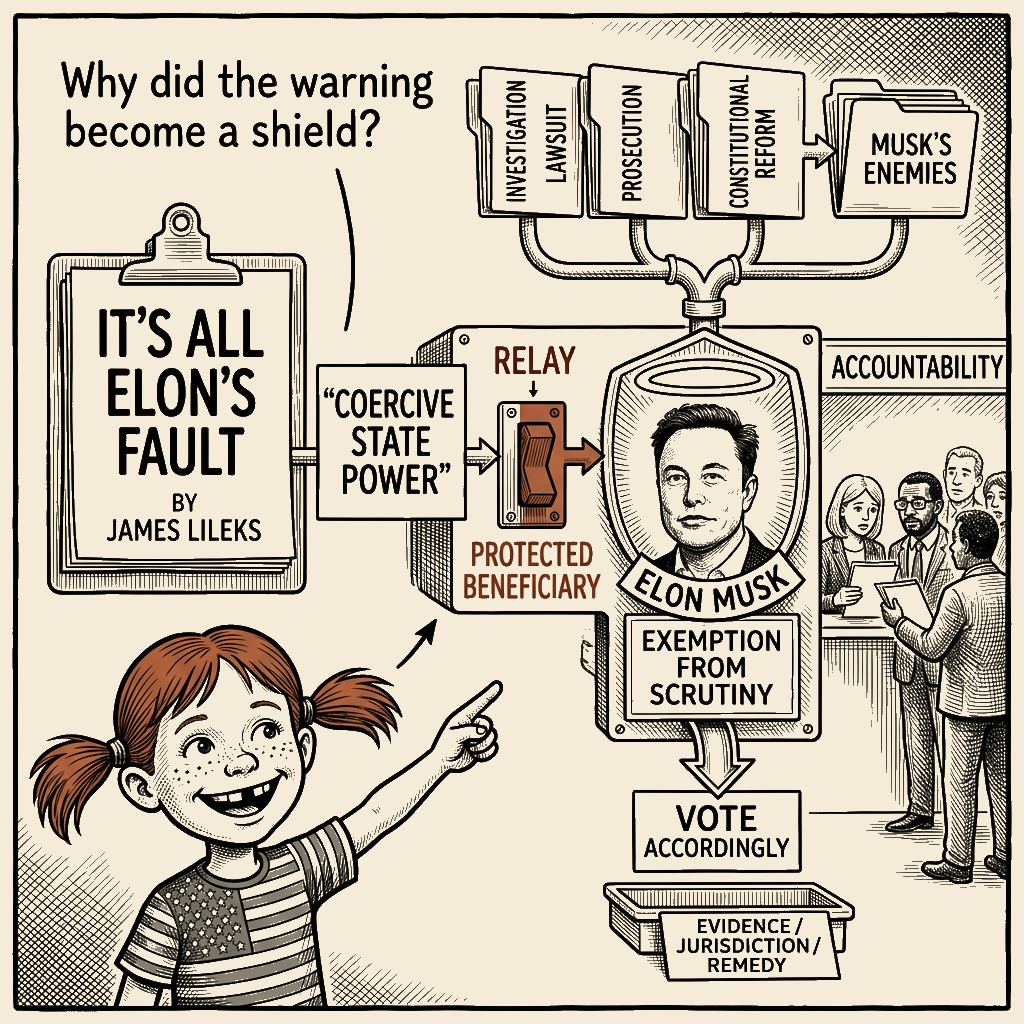
Why did the warning become a shield?
What the Editorial Argues
James Lileks argues in National Review that after the 2026 midterms, anti-Trump and anti-Musk political speech has slid from democratic opposition into a punitive, quasi-fascist project: investigations, lawsuits, jail, possible foreign prosecution of Elon Musk, and state seizure of his businesses. He assembles social-media posts, a call the editorial attributes to Jonathan V. Last, and comic “Musk’s enemies” exchanges into one exhibit of authoritarian overreach, then predicts that the left will use electoral power to remake the Supreme Court, statehood system, and Electoral College while urging Republicans to vote against it. The legitimate concern is real: political hostility should not become indiscriminate punishment or a lawless claim on a citizen or private company; the argument becomes less reliable when that concern is used to settle questions the article never examines.
Receipts
The move is to turn a legitimate warning about coercive state power into a protective halo around Elon Musk and a ballot order for conservatives.
What the framing wants you to believe
- The 2026 midterms handed the electoral left a mandate to investigate, punish, imprison, possibly extradite Musk, and take his companies into state ownership; the opposition is a fascism project, not a collection of proposals with different legal and evidentiary statuses.
- “Most people” admire Musk and his companies, anti-Musk politics will therefore be electorally unpopular, and the right’s history of surviving previous waves gives it reason to believe Democratic overreach will rebound.
- Republicans should vote against the next constitutional program—court expansion, D.C. and Puerto Rico statehood, and Electoral College reform—because the left will keep pressing until every announced objective has been achieved.
What’s really going on
- Protected beneficiary: Musk’s legal, reputational, and operating position, along with the conservative coalition’s electoral interests. Every challenge to Musk is recoded as evidence of authoritarian character, giving conservative voters a reason to rally behind him without examining evidence, jurisdiction, or remedy. “Vote accordingly” supplies the pathway from frame to ballot; the editorial supplies no vote estimate showing that the frame changes behavior.
- Omitted relation — authority: Domestic prosecution, foreign prosecution, investigations, lawsuits, regulation, corporate seizure, and constitutional reform are not interchangeable. Judicial appointments and presidential selection proceed under Article II and the Twelfth Amendment; state admission under Article IV; constitutional amendment under Article V. If “the Hague” means the International Criminal Court, Rome Statute Article 12 supplies jurisdictional preconditions, Articles 17–19 address the exercise of jurisdiction, and Article 53 governs complementarity. The editorial fuses those questions so ridicule can substitute for legal analysis.
- Normalized harm — civic substitution: Critics, disabled advocates, humanitarian constituencies, and democratic process become props in a partisan story. The article thereby treats an untested composite of opponents as the issue, while the cost of insulating a powerful private actor from lawful scrutiny is displaced onto the public and the people who depend on accountable institutions.
The Operation
Triage. This is a signed National Review column by James Lileks, not an unsigned Wall Street Journal editorial-board statement. Its topic domain is electoral mobilization, Elon Musk, corporate power, and constitutional change. Its short, joke-driven post-midterm form is closer to the National Review Editorial Technique Catalogue’s post-2016 A/B political registers than to its long-form Register D magazine essay, while its “stands athwart history” posture supplies the operative frame. Its archetypes are the post-2016 political register, the purity-by-caricature frame, and the threat-inflation closer. The advocated position is mixed, tending selfish: the warning against arbitrary state power is legitimate; the distribution of that warning is not.
Institutional authorship and placement chain. The piece is authored by James Lileks and published by National Review. No public donor, sponsor, agency brief, focus-group instrument, internal memo, or commissioned-placement record is identified in connection with it. National Review’s history as a project of conservative movement coherence does not prove coordination behind this column, and naming a hidden sponsor from ideological proximity alone would violate both the evidence and the fairness floor.
What the column itself shows is its placement chain: unidentified social-media posts supply the alleged incitement; a call the editorial attributes to Jonathan V. Last supplies the foreign-prosecution absurdity; Musk’s own statements supply the celebrity; a historical analogy supplies inevitability; and “Vote accordingly” supplies the action. Each step lowers the evidentiary burden on the next. Unidentified posts are followed by a named commentator, but no original item or link is identified; that commentator is followed by Musk’s prestige, but no evidence about the conduct that might warrant investigation; history is followed by a forecast, but no mechanism connecting overreach to electoral loss.
I drafted memos in this grammar. That is where my recognition comes from; it is not evidence about Lileks, National Review, or this essay’s funding. The resemblance does not establish a memo, sponsor, or coordinated campaign behind the column.
Who benefits, and who pays.
- Musk: The first benefit is protection from scrutiny. If ordinary opposition can be represented as “nationalize private industry” and “stand trial in the Hague,” the merits of any specific investigation become irrelevant to the politics of defending him. The second is continuity: the frame supports the business control and political influence that could be at risk if scrutiny reached questions about his conduct or conflicts of interest. No source-backed valuation, legal exposure, or threatened penalty is supplied, so the pathway can be specified but its magnitude cannot.
- The conservative electoral coalition: The benefit is a ready-made campaign narrative. The editorial offers a fear, an opponent, a history lesson, and a behavioral instruction. If accepted, that narrative can move readers from opposition to Democratic governance into support for Republican candidates and officeholders, with agenda control and campaign advantage as the concrete downstream pathways.
- National Review and the wider conservative media ecosystem: The benefit is attention, recirculation, and coalition cohesion. A Musk-centered frame gives heterogeneous right-wing audiences a common object around which disagreement can be suspended. No traffic, subscription, donation, or syndication figures are available for this column, so this remains a structural benefit rather than a measured financial gain.
- The cost-bearers: The editorial shifts the burden from any demonstrable misconduct to the hypothetical conduct of its opponents. Lawful critics, affected communities, disabled people mocked in the dialogue, and people dependent on humanitarian or constitutional processes bear the cost if scrutiny becomes indistinguishable in public argument from partisan persecution. The broader public bears the institutional cost if a democracy learns to protect private power by branding public accountability as fascism.
There is a legitimate public benefit embedded here: if the warning about overreach causes elected officials to respect legal limits, the political system and the rule-bound reader are better served. The distribution problem is that the warning is converted into immunity for a different concentration of power. The article permits concern about the state to substitute for scrutiny of Musk and, finally, for a partisan ballot order.
Alternative design. An accountability regime optimized for the editorial’s stated rationale—preventing overreach—would keep the distinctions the article collapses. It would identify each proposal separately: domestic investigation, civil lawsuit, regulatory action, possible international proceeding, corporate seizure, judicial appointment, statehood, constitutional amendment, and electoral reform. For each, it would name the actor, legal authority, evidence, and remedy, while preserving notice, hearing, appeal, and the distinction between a proposal and a lawful outcome. Critics of Musk would remain free to prove their claims; conservatives would remain free to oppose any coercive or extraterritorial demand; the public would not have to choose between unlimited state power and unlimited corporate power. That design follows from the interests of people burdened by either abuse: critics who need evidence rather than ridicule, affected communities that need accountable institutions, and readers who need process rather than a celebrity’s immunity.
Fear, greed, and laziness, applied symmetrically. These are incentives visible in the frame, not proof of anyone’s private motive.
- For the author and publication: Fear supplies the stakes—another electoral wave is coming. Greed can supply attention value, though no financial motive is documented. Laziness is supplied by the convenience of one opponent label when legal distinctions would require work.
- For Musk: Fear is rational: scrutiny, liability, and loss of control are concrete risks. The frame shields him by making questioning itself evidence of hostility. His economic and political interest in retaining control is made to look like a public defense of innovation.
- For the rank-and-file reader: Fear of arbitrary state power is real and deserves a serious answer; laziness here is not stupidity but the relief of being handed a finished answer. Identity, status, and the pleasure of a clear victory become substitutes for checking a poll, a jurisdictional clause, or the original post.
The article’s dominant audience-management function is therefore a permission structure: the reader can support the right and powerful private actors while experiencing the decision as principled defense of freedom. Identity confirmation supplies “the right” against “the left”; grievance ratification supplies overreach; status display supplies the knowing voter who remembers previous cycles; the counter-frame makes anti-Musk scrutiny itself suspect; and conscience displacement moves moral concern from private concentration of power to the state.
Technique map.
-
Frame-engineered relabeling. The textual cue is the movement from “investigations, lawsuits, jail” to “nationalize private industry,” from legal accountability to “defeated fascism,” from criticism of Musk to “Final Solution,” and from electoral defeat to “Sweeping Mandate.” These substitutions do not merely add heat; they change what the reader thinks is at issue. This matches the Bad-Faith Techniques Catalog’s
frame_engineered_relabelingand the WSJ Editorial Technique Catalogue §4.1. Operationally, the relabeling makes institutional scrutiny morally disqualifying before evidence or jurisdiction can be considered. Its lineage is Frank Luntz’s term substitution and George Lakoff’s framing work: change the label, change the frame under which the facts are processed. The textual resemblance establishes the technique in this column; it does not establish a Luntz memo, focus group, or coordinated campaign behind it. -
Purity-by-caricature and a partial
strawmanmatch. The cue is the sequence of satirical “Musk’s enemies” exchanges: brain implants answered with “TWO genocides,” satellite connectivity answered with Rowling’s tweets, and Mars answered with the man who smears poop on children’s swings. Another cue is the governing program rendered as “Find a lumpy man in a dress to run the Pentagon” and Gaza as the “53rd” state. The Bad-Faith Techniques Catalog’sstrawmanentry and WSJ Editorial Technique Catalogue §4.6 are the relevant cross-references. The full formal strawman test requires comparing the composite with a specific original statement, and the editorial does not identify those originals; the documented operational pattern is selectional substitution. Lileks selects the most theatrical objections, gives them one identity, and then treats the composite as representative of the opposition. Satire may be intentional exaggeration, but its persuasive work is to replace proposition-by-proposition evaluation with recognition of the enemy. -
Popularity presented as evidence without a poll. The cues are “most people are impressed by Musk and his companies” and “Most view him as a weird flavor of Henry Ford.” The Bad-Faith Techniques Catalog’s
hasty_generalizationis the firmer match; the catalog’s “Appeal to nature, tradition, popularity” is adjacent but not a complete formal claim, because popularity is being used to predict behavior and confer legitimacy rather than to prove a moral proposition outright. No survey, sample, date, sponsor, wording, or denominator is provided. Walter Lippmann’s early work on Public Opinion supplies the relevant lineage: a complex public is represented through a stock image so that the image can govern the response. Here Musk’s celebrity stands in for public opinion, legality, and political viability at once. -
Threat inflation and the Schmittian friend-enemy frame. The cues are “Thank goodness we’ve defeated fascism,” “Sweeping Mandate,” “un-Trump the land,” the conversion of an election result into packing the Supreme Court and admitting new states, and the final instruction to “Vote accordingly.” This matches WSJ Editorial Technique Catalogue §4.13’s threat-inflation closer and sits adjacent to NR Editorial Technique Catalogue §4.5’s civilizational frame, though the article does not literally invoke “Western civilization.” The operation expands the immediate stakes from an electoral result to an existential struggle and then makes voting the only rational response. Bandura’s moral-justification mechanism describes the effect: a higher-cause label—defending freedom against fascism—justifies the partisan conclusion. Carl Schmitt’s friend-enemy distinction supplies the lineage: the opposition is no longer a set of preferences but an existential enemy. That is a formal lineage, not a claim that Schmitt or any documented network shaped this column. The article does not supply the intermediate causal links required for a
slippery_slopefinding; the documented technique is threat inflation, not a completed slippery-slope argument. -
The “stands athwart history” posture and historical inevitability. The cue is the comparison to an immortal vampire watching “everyone lose their minds over Halley’s Comet,” followed by “Dial it back, guys; it’s happened before, and it’ll happen again.” NR Editorial Technique Catalogue §4.1 describes the magazine’s recurring self-presentation as embattled dissent. Here that posture converts prior electoral cycles into permission for present inaction and supplies the conservative reader with status as the veteran who has seen this before. The prior returns are real; the inference from them is not. The editorial never establishes that the same social actors, policies, or economic conditions caused the earlier returns.
-
Multiple-audience targeting. WSJ Editorial Technique Catalogue §4.3 calls this a craft rather than a fallacy. The article addresses at least four layers: the activist right receives a grievance and a ballot instruction; the media-literate conservative receives constitutional vocabulary and a foreign-tribunal objection; the populist online reader receives “Nerd Reich” jokes and mock solemnity; and the Musk-aligned constituency receives a celebrity protected from ordinary scrutiny. The same structure can therefore confirm identity, ratify grievance, display expertise, and deliver a campaign cue. Nothing in the editorial documents coordinated message discipline; the multiple layers are visible in one article, but repetition across a network would need its own evidence.
The Record
The evidentiary base is thin. The editorial is a Tier 1 primary document for its own wording, structure, and attributed statements; it is not Tier 1 evidence for the election, the posts, public opinion, Musk’s projects, or the causes of voter behavior. The external claims below lack independent Tier 2 corroboration. The legal documents below are Tier 1 receipts for the distinctions the editorial omits, not endorsements of its conclusions.
| Load-bearing claim | Receipt and tier | Verdict |
|---|---|---|
| The 2026 midterms produced a Democratic congressional breakthrough that empowers the program described. | The article presupposes the result and cites no certified 2026 returns or official chamber-control record. Tier 3 for the external factual assertion. | [unconfirmed: convergence threshold not met] The analysis treats this as the editorial’s premise, not an independently established fact. |
| Numerous post-midterm posts called for investigations, lawsuits, jail, quartering, seizure of Musk’s businesses, and the editorial attributes to Jonathan V. Last a call for Musk to stand trial in the Hague. | The article’s summary and attribution. No handles, archives, counts, article title, date, link, or verbatim Last quotation is identified. Tier 3. | [unconfirmed: convergence threshold not met] The article’s characterization cannot be checked against the alleged source material. |
| “Most people” are impressed by Musk and view him as a Henry Ford-like innovator. | No poll, survey sponsor, wording, sample, field date, or denominator. Tier 3. | [unconfirmed: convergence threshold not met] |
| The governing left’s program includes packing the Supreme Court, admitting Puerto Rico and D.C. as states, abolishing the Electoral College, and continuing afterward. | No primary proposal text is cited. “Gaza as the 53rd state” is plainly satirical. Tier 3. | Unconfirmed as a unified governing program; documented only as Lileks’s characterization of the opposition. |
| Musk’s brain-implant, satellite-connectivity, Mars, and electric-vehicle projects justify the favorable comparison. | The article quotes Musk but identifies no date, venue, original post, or efficacy evidence. Tier 3 for the editorial. | [unconfirmed: convergence threshold not met] as claims of present accomplishment. Musk’s own words could establish what he said, not the efficacy, feasibility, or public benefit of the projects. |
| Some voters stayed home because of Iran, high prices, or tariffs. | No poll, precinct analysis, survey, or causal study. Tier 3. | [unconfirmed: convergence threshold not met] |
| Previous midterm breakthroughs were followed by familiar electoral rebounds and Republican chamber gains. | Federal Election Commission returns, U.S. House election statistics, and Senate historical party-division records; Tier 1. Republicans took both chambers in 1994, regained the House in the 2010 midterms and the Senate in 2014, won House control after the 2018 midterms and Senate control in 2020, and regained the House in the 2022 midterms while retaining the Senate. | The chronology is anchored as a recurring possibility. The causal claim that Democratic overreach produced those returns is not established, and no invariant cycle follows. |
Primary-document receipts for the omitted relation. Article II supplies the appointment framework for federal officers, including judges; Article IV governs state admission; Article V governs constitutional amendment; and Article XII governs the electoral vote and related procedures. The Rome Statute’s Article 12 supplies jurisdictional preconditions for the International Criminal Court; Articles 17–19 address the exercise of jurisdiction; Article 53 governs complementarity. These documents do not tell us whether Musk should be investigated or prosecuted. They show why “the Hague” cannot answer that question by itself.
Citation verdicts.
- Jonathan V. Last/Bulwark attribution: The editorial attributes a proposal to Last and associates him with Bulwark; no original item, date, link, or verbatim quotation is identified, and that affiliation cannot serve as independent corroboration. The characterization cannot be independently verified.
- Social-media posts: No post is identified, and no counting method is given. Neither quotation accuracy nor representativeness can be assessed.
- Musk statements: The article provides no provenance or date for the quotations and treats aspirational announcements as established projects. They support the joke without establishing efficacy, feasibility, or public benefit.
- Electoral history: The sequence of chamber control is supported. The analogy’s causal step—similar overreach producing similar losses—is not.
- “Most people” and the governing program: Neither claim has a poll or primary proposal behind it in the editorial.
Load-bearing omissions.
- The original posts, Last’s actual words, and any underlying proposal text.
- The legal authority, jurisdictional basis, evidence, and proposed remedy for each demand the editorial merges.
- Survey methodology, public-opinion base rates, and evidence connecting specific voter concerns to abstention.
- The constitutional process required for each advertised change: Article II for judicial appointments, Article IV for state admission, Article V for constitutional amendment, and the Article II–XII machinery for presidential selection and electoral votes.
- The distinction between popularity and legal innocence. Nothing in the article examines the conduct that could support scrutiny, but nothing in it establishes that Musk is immune from it either.
- The cost of the exemption. The state can abuse coercive power; a powerful corporation can abuse private power. The article permits the reader to remember only one side of that symmetry.
- Provenance rather than study funding. There is no study to trace; the equivalent chain is posts → Last → National Review, and no independent corroboration for that chain is identified.
Missing-information declaration. The following could not be verified from the cited material: certified 2026 returns and chamber control; the social-media posts and count; Last’s original item; poll methodology; primary proposal texts; dates, venues, and source links for Musk’s statements; and any financial or vote-effect estimate. No internal document is identified for this essay. Similar work elsewhere does not establish its authorship, sponsorship, or distribution.
The assumptions that filled gaps are narrow and explicit: the 2026 result is treated as the editorial’s premise; historical returns are treated as possibility rather than mechanism; satire is treated as a persuasive exhibit rather than evidence of policy; Musk’s statements are treated as attributed aims rather than accomplishments; and no coordination, donor relationship, or motive is inferred without documentation.
How to Recognize This
The pattern is the protected-celebrity frame: a legitimate fear of concentrated state power is used to inoculate a different concentration of power. Here the celebrity is Musk, the fear is fascism or overreach, and the inoculating instruction is “Vote accordingly.”
The mechanism has a repeatable sequence. Begin with a real danger. Attach a celebrated figure who appears to embody the good side. Replace the opposition with absurd composites. Convert uncertain historical precedent into forecast certainty. End with a simple instruction that saves the reader from having to compare jurisdiction, evidence, and programs. The celebrity does not need to answer every policy or allegation. He only needs to appear so good that questioning him becomes evidence of the enemy’s character.
Four textual signals will help you recognize it next time:
- The plural becomes a bloc. Watch for “the left,” “Musk’s enemies,” or “these people” replacing named actors, documents, differing interests, and distinct legal claims.
- Satire displaces the policy. If “Gaza to be the 53rd state” appears in the same breath as court expansion or Electoral College reform, ask whether any primary text was read. The joke has replaced the proposition.
- Popularity appears without a poll. Ask who was surveyed, when, by whom, with what wording, and against what comparison. “Most people” cannot establish either public approval or electoral durability by itself.
- The diagnosis ends in an order. Watch for the pivot from satire and history to “Vote accordingly,” “wake up,” or “stop this now,” especially when no measure, remedy, or evidentiary link has been supplied.
It works because it gives the reader relief. Fear becomes identity, identity becomes humor, and humor becomes permission. The joke asks the reader to perform expertise rather than exercise it. That does not make the reader foolish or contemptible; fear of arbitrary power is rational, and a ready answer is a genuine relief from a hard question. The operation simply removes the hardest question—whether the admired side has accumulated power of its own—before anyone has to answer it.
When you see the pattern:
- Retrieve the original post, quotation, Last’s original item, poll, policy text, or Musk statement. There is no study here whose funding chain can be followed; the equivalent provenance check is the chain from unnamed posts to named media personalities to the electoral instruction.
- Replace every bloc noun with a named actor, an asserted action, and a source. If no actor can be named, the composite is doing the work.
- Separate each demand into its institutional form. Is it a speech, investigation, lawsuit, prosecution, regulation, legislative proposal, or constitutional amendment? Which institution has authority? What evidence exists? What remedy is proposed?
- Ask who receives the exemption. Here the answer is Musk: the article demands that the left be constrained by evidence while treating one private actor’s popularity as a shield from scrutiny.
- Follow the benefit and the cost separately. Who gains power, attention, immunity, or votes? Who absorbs the legal, institutional, and civic cost? Apply the same question to the favored side.
- Look for the same vocabulary across the outlet’s contributor network and any syndicated versions. Repetition alone is not coordination; documentary direction is required before saying so.
- Reduce the frame’s automatic activation by removing the insulting nouns and writing the literal claims in separate sentences. If the causal claim survives, the evidence is there. If only the grievance survives, that is the finding.
I drafted memos in this grammar. That is complicity, not documentary proof of this essay’s authorship or sponsorship. My complicity does not make the targets right, and their errors do not make the frame honest. The reader’s task is simpler and harder: bring the actor, the authority, the evidence, and the cost back into the sentence. Recognition is not suspicion. It is the refusal to let a conclusion arrive before its reasons.

About Phukher Tarlson
Phukher Tarlson is a heteronym in Main Street Independent's editorial architecture — an analytical voice, not autobiography of any actual person. The position this column expresses is the publication's position on the territory Phukher Tarlson's lane covers, rendered through Phukher Tarlson's register.