Analyzing: Trump Is the Author of the Ruin — Peggy Noonan · 2026-11-05
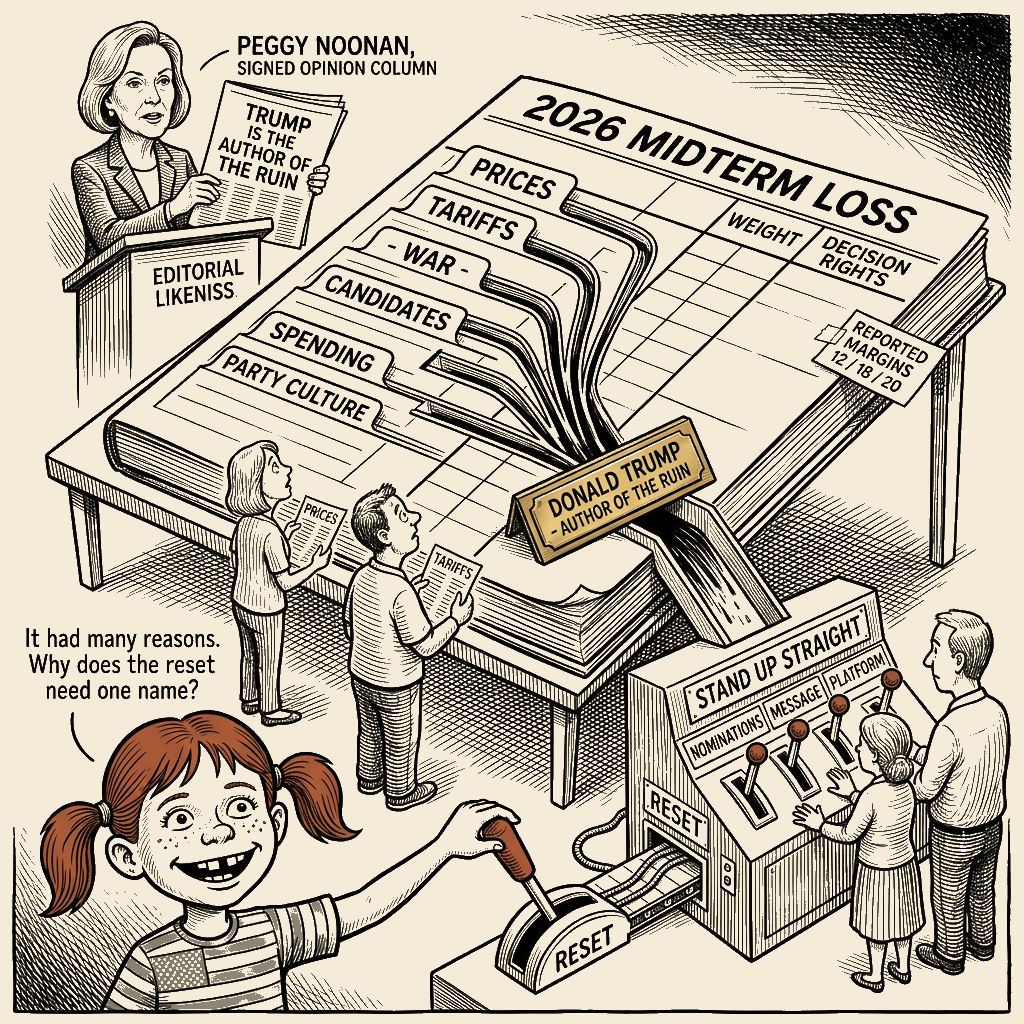
It had many reasons. Why does the reset need one name?
What the Editorial Argues
Peggy Noonan argues that the 2026 midterms were an epochal repudiation of Donald Trump and the political coalition assembled around him. She rejects JD Vance’s claim that the war alone explains the result while naming financial insecurity, high prices, tariffs, war, corruption, candidate selection, strategy, spending, and party culture as parts of the causal story. Her distinctive move is to concentrate the moral and interpretive authorship of that story on Trump, predict his rupture with the Republican Party, and tell Republicans that recovery requires standing apart from him.
Receipts
The editorial converts a multi-cause Republican defeat into a single-agent moral drama and makes the party’s survivors into witnesses rather than co-authors.
What the framing wants you to believe
- Trump “was the author of the ruin”: his political decisions produced the Republican collapse, and the result was a verdict on his character and the decadence surrounding him rather than only on policy and candidates.
- The “Republican rebellion” inside the electorate was driven chiefly by corruption, conspicuous consumption, financial anxiety, and the sense that the White House no longer cared about ordinary Americans.
- The Republican Party can recover by separating itself from Trump, rejecting the coalition’s decadence, and “stand[ing] up straight.”
What’s really going on
- Technique and textual anchor: The piece says “A loss this size has many reasons, a river this raging had many sources,” then makes “Mr. Trump was the author of the ruin” the organizing conclusion. In the Bad-Faith Techniques Catalog, bf_catalog:
frame_engineered_relabelingis the closest but necessarily partial match: the text establishes the substitution from plural causation to singular authorship, but it does not establish a coordinated campaign to engineer that vocabulary. The source proves the structure of the frame, not the election results (Peggy Noonan, “Trump Is the Author of the Ruin,” WSJ Opinion, Nov. 5, 2026). - Omitted relation and normalized harm: Prices, tariffs, war, candidate quality, corruption, and decisions by other party actors are named, but their relative causal weight and shared decision rights are displaced. Material injury to voters is thereby converted into evidence of mood, personality, manners, or corruption rather than an accounting of policy incidence.
- Protected beneficiary: The principal protected beneficiary is the post-Trump Republican leadership class—candidates, officeholders, donors, and strategists positioned to gain control of nominations, message, and the “reset.” That is a structural inference from incentives, not proof of a coordinated plan. Trump’s inner circle receives a possible secondary benefit through a martyrdom-and-betrayal narrative.
The Operation
This is a signed Wall Street Journal opinion column by Peggy Noonan, not the paper’s unsigned editorial board. The byline, the “Declarations” identification in the supplied metadata, the first-person cultural register, and the media-heavy construction make the source identification high-confidence. The domain is the 2026 midterm aftermath. The closest archetype is a leader-authorship blame ledger crossed with a cultural-decline ledger: a plural institutional defeat is compressed into the biography of its nominal leader, while class manners and party culture supply the emotional charge. The advocated position is mixed. Noonan’s demand for accountability and political repair addresses real public interests; the causal architecture also gives post-Trump Republican insiders relief from their share of responsibility. The greater-good-paramount symmetric-application flag is not set: this is a piece arguing from within the Republican coalition, not a greater-good-paramount operation.
Institutional authorship and placement chain. The documented creator of this published version is Noonan; the supplied biography identifies her as a former Reagan speechwriter and longtime WSJ columnist. The supplied artifact sits in WSJ Opinion and is surfaced through an opinion-RSS path. Inside the column, the validation stack runs through Fox News, Morning Joe, a Substack, the New York Times, Yahoo News, a Washington Post pool report, and Josh Dawsey’s reporting for the same newspaper. That stack supplies visible breadth, but it does not establish common sponsorship, coordination, or a donor-to-think-tank-to-outlet pipeline. None appears in the supplied record, and I will not manufacture one.
Distributional impact. No individual beneficiary is named, but the beneficiary class and its pathway are clear. Post-Trump Republican candidates and strategists can gain authority over candidate selection and messaging; donors can gain leverage over the party’s platform and nominee; officeholders can separate themselves from the collapse while retaining institutional position. Trump’s circle can recast defeat as proof of indispensability. The cost-bearers are rank-and-file Republican voters, voters exposed to the editorial’s own named policies—war, tariffs, and high prices—and the Republican Party’s institutional capacity, which may be reset through a personality rupture rather than an audit of shared decisions. The only concrete magnitudes supplied are the reported margins of 12, 18, and 20 for James Talarico, Jon Ossoff, and Roy Cooper. No dollar figures accompany the claims about war, tariffs, inflation, corruption, or campaign spending. Official results and a credible economic series are not supplied to place those figures in context.
Alternative design. If Noonan’s stated rationales are taken seriously—financial security, peace, honest government, and competent candidates—the reset should be designed around the interests of Republicans who want a viable party rather than around the satisfaction of seeing Trump disowned. That would require a shared-decision ledger covering Trump, Vance, congressional leaders, donors, state-party strategists, candidates, and campaign spending; a transparent nomination and candidate-vetting process; a policy review of the relevant war authorities and tariff measures; a public accounting of their distributional effects; and due process for corruption allegations. Ordinary Republicans would get institutional repair rather than a moral spectacle with a preassigned villain.
Fear, greed, and laziness. These are incentive descriptions, not claims about private character. The framing author is rewarded with interpretive authority at a moment of confusion: fear favors decisive diagnosis, status accrues to the person who can name the author, and the convenience of a finished explanation spares the writer a full accounting of every decision. The protected Republican beneficiaries fear a collective purge, gain control of the reset if Trump becomes the whole explanation, and avoid the labor of auditing choices in which they participated. The rank-and-file reader is not contemptible and is not stupid. Fear of another rout or disorder makes a single culprit emotionally legible; the wish for vindication supplies its satisfaction; and the relief of a finished story spares a reader from tracking tariffs, war powers, candidate records, and campaign finance. Under overload, compression is a cognitive economy. The machinery exploits that economy; it does not make the reader defective.
Selflessness placement. The placement is mixed rather than cleanly selfish or selfless. The piece promotes legitimate goods—accountability, anti-corruption, party renewal—and attacks a powerful target rather than a vulnerable out-group. Its self-protective effect lies elsewhere: by making Trump the “author,” the frame gives other Republican decision-makers a clean-looking place to stand. Noonan and the Journal may also gain attention and interpretive authority from a memorable postmortem, but there is no evidence of payment, commissioned placement, or hidden coordination. The beneficiary analysis therefore identifies an institutional advantage produced by the frame, not a secret author of the frame.
Technique identification.
-
Causal focalization—the “ruin-author” substitution. The textual cue is the movement from “A loss this size has many reasons, a river this raging had many sources” to “Mr. Trump was the author of the ruin,” repeated in the headline and the body. The closest catalogue match is the Bad-Faith Techniques Catalog, bf_catalog:
frame_engineered_relabeling: the underlying event is relabeled so that one person’s name carries the explanatory weight. The match is partial because the catalog’s full pattern requires evidence of deliberate term engineering; no such evidence for this column appears in the packet. The Luntz-Lakoff lineage explains how connotation can redirect an argument, but it cannot be used here to invent a memo. Lippmann’s lineage is closer to the public effect: a complicated institutional situation is rendered legible through a simplified type. Bandura’s attribution of blame and displacement of responsibility describe the mechanism—Trump receives concentrated blame while other decision-makers recede from the accounting. This is not a false-dilemma finding: Noonan expressly preserves multicausality. The failure is relative weighting and moral ownership, not a literal denial that other causes existed. -
The cultural-decline ledger and status displacement. The cues are “this White House drove the Republican brand into the ground,” “a low-class, high-tack oligarchy,” “decadent,” and the focus-group complaints about the ballroom and the Reflecting Pool. The NR Editorial Technique Catalogue, §4.4, “The cultural-decline ledger,” is the closest comparative form: a trend is assigned a moral diagnosis and then a restoration narrative. The WSJ Editorial Technique Catalogue, §4.10, “The ‘common sense’ / ‘elite’ rhetorical pivot,” also illuminates the identity operation: ordinary Republicans are positioned outside a decadent White House, allowing the party to retain its anti-elite identity while relabeling its own leadership class as the elite. Operationally, the frame translates questions of prices, policy, and institutional power into questions of taste and class while preserving a moral hierarchy. Lippmann’s stereotype lineage is again relevant. A Schmittian friend/enemy recoding is adjacent, because Republicans are invited to distinguish themselves from Trump, but this remains a partisan boundary rather than a full civilizational deployment; I will not inflate the match.
-
Focus-group-to-consensus laundering. The cue is Josh Dawsey’s report that voters in focus groups who did not normally monitor Washington “often brought up ‘Trump’s pet projects,’” followed by an unnamed strategist’s characters: “He doesn’t really care what I’m going through” and “He wants to put his name on everything.” The Bad-Faith Techniques Catalog, bf_catalog:
hasty_generalization, is a conditional partial match: the supplied text gives no sample size, recruitment method, field dates, locations, or evidence that the groups represent the electorate. The evidence therefore cannot bear the full mass judgment placed upon it. The WSJ Editorial Technique Catalogue, §4.5, “The ‘study shows’ ledger,” supplies the broader mechanism: a research product is deployed as legitimacy while methodology and sponsorship remain outside the argument. This was not a formal study with a disclosed funder, so the piece should not be accused of hidden funding. The omission is simpler and still consequential: a purposive sample is made to stand in for a population without the population ever being shown. -
Threat inflation and historicizing cadence. The cues arrive immediately: “epochal,” “a new era,” “an extinction level event,” “a Watergate-level repudiation,” and “a night of landslides.” The WSJ Editorial Technique Catalogue, §4.13, “The threat-inflation closer,” is a comparative cross-reference: that catalogue locates inflation in the closing line, while Noonan front-loads it and then ends with the prediction of rupture. The NR Editorial Technique Catalogue, §4.5, “The civilizational frame,” is adjacent but not exact—the stakes remain electoral rather than explicitly Western or national in civilizational terms. The operational effect is to make an electoral result feel historically exceptional and therefore unsuitable for disaggregated causal analysis. Quoted validators—DeSantis, Cruz, McDaniel, Martin, Thompson, Vance—perform the Bernays-Lippmann function of showing the reader many authorities rather than requiring scrutiny of one evidentiary chain. That does not prove manufactured consensus; it shows how a chorus is made to do persuasive work.
I know this species of construction because I drafted memos that turned losing coalitions into stories about a leader’s character rather than the choices that produced the loss. That is retained working memory, not evidence of Noonan’s intent, and the public record supplies no leaked account of this column’s construction. It tells us what the machinery resembles, not what she privately believed. The bitterness I carry recognizes the maneuver; it does not supply its proof. The text and receipts do.
Audience-management function. The frame supplies a permission structure for a post-Trump Republican reset without requiring a shared-policy audit. It offers identity confirmation to Republicans who understand themselves as ordinary rather than decadent; grievance ratification by naming the “Republican rebellion” as a legitimate verdict rather than a partisan loss; and status display through a polished cultural register that separates the columnist and her readers from the tasteless objects of the party’s decline. It provides a counter-frame in which recovery means separating true Republicans from their failed leader, and conscience displacement: readers can enjoy moral clarity without asking whether the war, tariffs, candidate choices, or party institutions caused the result. That is the operation’s full effect. The target is powerful, and personal accountability can matter. The problem is not that Trump is named; it is that naming him releases everyone else from the ledger.
The Record
The primary document for the framing claim is Noonan’s own text. Its sequence—from “many reasons” and “many sources” to “the author of the ruin”—is a Tier 1 primary receipt for what the editorial does. It is not a receipt for the truth of the election claims it reports.
The load-bearing factual claims fare less well in the supplied packet:
-
The 2026 election outcome and the reported margins of 12, 18, and 20. The editorial supplies the assertions but no official returns, canvass reports, precinct data, or vote-share denominator. Proper Tier 1 receipts would be the certified state returns and relevant canvass documents; none is included here. [unconfirmed: convergence threshold not met]
-
The quotations from DeSantis, Cruz, McDaniel, Vance, Martin, Thompson, and McCain. The underlying broadcasts, podcast appearances, X posts, or transcripts are not supplied. The quotations are internally coherent in the artifact, but exact wording and context cannot be independently checked. [unconfirmed: convergence threshold not met]
-
The claim that a substantial group of 2024 Trump/Vance voters switched to Democrats in 2026. This is central to Noonan’s rejection of Vance’s account, yet the editorial offers no voter-panel data, aggregate switch estimate, precinct analysis, or contrary explanation. [unconfirmed: convergence threshold not met]
-
Financial insecurity, high prices, tariffs, and war as material causes. The piece names them but provides no price series, income or wage data, tariff schedule, war authorization, spending estimate, or distributional analysis. Their presence in the argument is not evidence of their relative weight. [unconfirmed: convergence threshold not met]
-
The corruption allegations involving crypto, pardons, and federal contracts for the president’s sons. The editorial provides no contracts, charge documents, rulings, agency records, or statements from the parties. It turns allegations and visible associations into a generalized condition of “corruption” without specifying their adjudicative status. [unconfirmed: convergence threshold not met]
-
The Halloween party description. The underlying Washington Post pool report would be a potentially Tier 1 primary contemporaneous description, and Yahoo News is a named secondary account; neither text is included in the packet, so their agreement and details cannot be checked. [unconfirmed: convergence threshold not met]
-
The prediction that Trump will turn on the Republican Party. This is a forecast, not a present-tense fact, and no receipt can confirm or refute it. Its evidentiary role is rhetorical: it supplies Republicans with a script for the rupture Noonan wants them to accept.
The apparent support from many media outlets therefore establishes breadth of repetition, not convergence of independent evidence. The source article itself is Tier 3 commentary for its political and economic claims.
Per-citation accuracy verdicts.
- DeSantis, Cruz, McDaniel, Vance, Martin, and Thompson: The quotations are faithfully represented within the supplied artifact, with no internal contradiction visible. Their underlying contexts are unverified because the primary recordings and transcripts are absent.
- The New York Times ad-price quotation: The reference is too compressed to assess. The editorial supplies a paraphrase, “when the price of ads had been jacked up,” and the fragment “my money,” without the article, date, surrounding sentence, or fuller exchange. The wording cannot be treated as a complete or contextual quotation.
- Yahoo News and the Washington Post pool report: The editorial names two mutually reinforcing accounts, but neither underlying text is supplied. Their corroboration is asserted, not demonstrated in this packet.
- Dawsey’s focus-group reporting: This is original reporting by the same newspaper, not an independent confirmation supplied by the editorial. Even if the quotations are accurate, the missing methodology prevents their use as representative evidence.
- The Manchurian Candidate and A Face in the Crowd allusions: These are illustrative cultural comparisons, not factual receipts for electoral causation. The A Face in the Crowd passage helps stage Noonan’s prediction; it does not make the prediction more likely.
The load-bearing omissions are substantial:
- Official election returns, turnout totals, vote shares, the meaning of the reported margins, and any comparison with prior midterm results.
- Voter-level evidence for switching, abstention, split-ticket voting, candidate effects, and the scale and composition of the alleged 2024-to-2026 migration.
- A relative weighting of prices, tariffs, war, corruption, candidate quality, and party culture. Noonan lists the causes; she does not show how much each contributed.
- A shared-decision ledger identifying who chose candidates, set strategy, controlled spending, made foreign-policy decisions, and benefited from the coalition’s construction.
- Evidence establishing the scope of Trump’s decision authority over those matters. Noonan asserts that authority but does not distinguish his formal powers, informal influence, and the authority exercised by other actors.
- The actual policy text. Within the supplied editorial, “the war” is not identified; no authorization, cost, caseload, or policy consequence is supplied. No tariff measure is named.
- The incidence of economic harm: who paid higher prices, which workers or firms gained protection, who absorbed retaliation, and how those effects compared with other causes.
- The documentary and legal status of each corruption allegation. Perception is evidence of voter response; it is not a substitute for proof of corruption.
- Focus-group sample size, recruitment, geography, dates, discussion guide, and representativeness.
- Alternative explanations the editorial does not engage, including candidate quality, district lines, incumbency, generational turnout, and the possibility that social visibility reflected a preexisting political alignment rather than producing a vote choice.
- The policy basis of the proposed “reset.” The piece says the party must “stand up straight” but does not specify which party rules, candidate-selection practices, economic policies, war positions, or corruption controls would change.
Missing-information declaration. The supplied packet contains the editorial but not the cited New York Times report, Fox appearances, X posts, Yahoo News article, Washington Post pool report, or Dawsey focus-group report. Those receipts were not independently obtained for this analysis, and their contents are not reconstructed here. No leaked memo is claimed or used. The retained-memory passage is used only to identify a familiar construction; it does not fill any evidentiary gap. The assumptions are limited to these: the artifact is the published text supplied under the stated metadata; quotations quoted from it are treated as quotations from the artifact, not as independently verified transcripts; and the election results remain the editorial’s reported claims rather than established facts in this receipt set.
How to Recognize This
The pattern is the one-man ruin frame: multiple causes are named, but interpretive and moral ownership is concentrated in one person while shared decision rights disappear from the accounting.
The mechanism is focalization, not the denial of multicausality. Prices, war, tariffs, corruption, candidates, and party culture remain in view. What changes is the author. One person becomes the organizing explanation, while the people and institutions that made the coalition possible become scenery. The result is television drama: one face supplies the accounting, and the institutional ledger vanishes.
The warning signals are specific:
- The text says there are “many reasons” and then names one “author.” Compare the supposed central cause with the causes being displaced. Are they supported at the same evidentiary level?
- Material forces are named but receive adjectives rather than mechanisms. Ask which causes receive data, dollar figures, records, or timelines—and which receive character judgments.
- Focus-group remarks become a mass verdict without sample, recruitment, field dates, or representativeness. A vivid quote can still be true and still be unable to carry the conclusion.
- The proposed correction identifies who must leave, break with whom, or change sides, but not what policy must change, who exercised which authority, or how the next coalition would avoid the same result.
It works because the frame supplies compression, identity, and emotional closure at once. A complex defeat becomes a story with a culprit, a moral meaning, and a corrective path. Readers receive the satisfaction of explanation; the surviving organization receives authority over the reset; and policy questions can be postponed because the argument has already supplied a personality to blame.
When you see it, make two lists: causes actually supported by evidence, and causes serving the moral narrative. Trace every quotation to the underlying broadcast, transcript, post, report, or primary document. For any study or focus-group report, trace the funding chain and methodology. Build the shared-decision ledger the frame omits: candidates, donors, strategists, officeholders, executive decisions, and institutional rules. Follow the benefits up and the costs down. Ask who gains control of the reset, whose reputation pays for the defeat, and whose material demands have been converted into evidence of bad taste. Search for repeated vocabulary across the network, but do not infer coordination without documentation. Then reduce the frame’s automatic activation by rewriting the conclusion in plainer causal terms: name the policy, the decision-maker, the observed outcome, the beneficiaries, the cost-bearers, and the evidence for each. A less memorable sentence can still be true.
I know this maneuver because I helped build versions of it. That is not a license to presume bad faith in every election postmortem or to treat Noonan’s target as illegitimate. It is a reason to look closely when shared choices are turned into a prewritten moral sentence. The people who made those choices should not disappear from the story before voters are asked to make the next one.

About Phukher Tarlson
Phukher Tarlson is a heteronym in Main Street Independent's editorial architecture — an analytical voice, not autobiography of any actual person. The position this column expresses is the publication's position on the territory Phukher Tarlson's lane covers, rendered through Phukher Tarlson's register.