Analyzing: Something Is Rotten in the State of MAGA — Allysia Finley · 2026-11-08
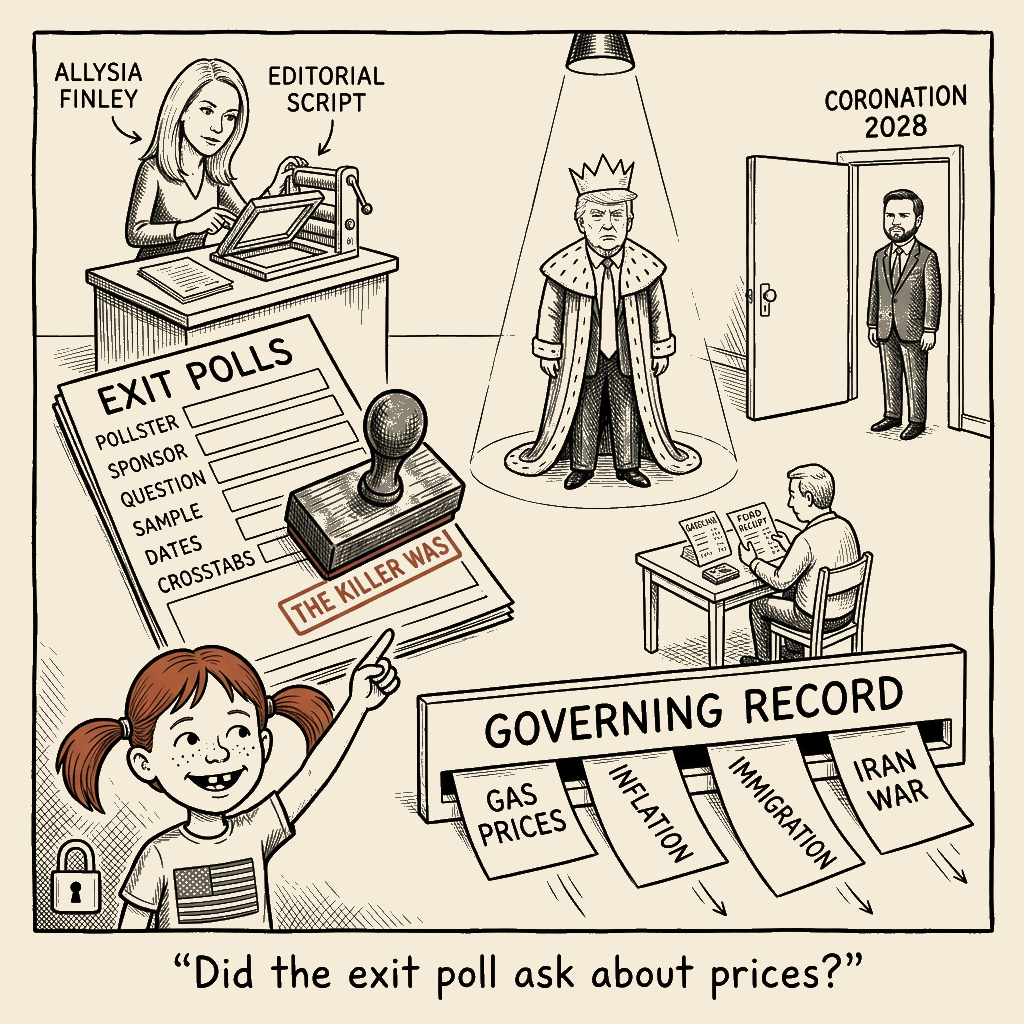
Did the exit poll ask about prices?
What the Editorial Argues
In a named Wall Street Journal opinion editorial, Allysia Finley reads the recent Republican electoral losses as a Shakespearean tragedy of vanity, sycophancy, vendetta, corruption, and bad counsel centered on Donald Trump. She argues that voters punished the president and his allies because they believed he and his advisers put personal and political interests ahead of the country, placing tariffs, mass deportation, the Iran war, and the Trump family’s financial dealings inside that larger indictment. The good-faith case is that sycophancy, official self-enrichment, and refusal of correction are genuine democratic pathologies, not merely partisan insults. She closes by denying that JD Vance can inherit the presidency by coronation and insisting that he must win voters on his own merits.
Receipts
The editorial translates an electoral result whose causes are disputed into a moral drama and lets personal corruption carry causal weight the governing record would have to support.
What the framing wants you to believe
- The decisive problem is Trump’s moral character: his need for flattery, his pursuit of revenge, his alleged self-enrichment, and his inability to tolerate criticism.
- The voters’ judgment was morally coherent: the president put his personal interests ahead of the country, while his advisers manipulated him for their own ends.
- Vance can rebuild the Republican coalition, but only by winning skeptical voters rather than relying on Trump’s blessing or inherited authority.
What’s really going on
- The protected beneficiary is the Vance-centered, anti-MAGA Republican succession lane. By making Vance’s independent mandate the test of succession while assigning the failed governing record to Trump’s court and its courtly circle, the piece gives anti-MAGA Republicans a usable succession narrative without requiring the incoming lane to answer for the governing record. It ends by insisting that “Mr. Vance won’t ascend to the presidency via coronation in 2028. He will have to win over voters who may not be as easily beguiled as Mr. Trump.” Finley, “Something Is Rotten in the State of MAGA,” WSJ Opinion, Nov. 8, 2026. That placement creates a power-position and narrative-control benefit without requiring a donor, money trail, or coordination claim. It is an inference from the editorial’s architecture, not evidence of a concealed campaign.
- The omitted relation is comparative electoral causation. The editorial acknowledges gasoline prices, inflation, tariffs, immigration, and the Iran war, but does not show why corruption, rather than some combination of those pressures and the coalition’s own choices, was “the killer.” Its exit-poll figures cannot be independently verified from the material supplied: no pollster, sponsor, wording, sample, field dates, or crosstabs are supplied.
- The normalized harm is to turn material consequences into court intrigue. Households paying higher gasoline prices and facing persistent inflation, people affected by immigration policy, and workers and businesses exposed to the governing choices disappear behind Lear, Hamlet, Iago, and Falstaff. The article’s literary cast tells us who is corrupt; it does not trace what the policies cost, whom they benefit, or which remedies the voters were demanding.
The Operation
Publication and architecture. The supplied source identifies this as a named WSJ opinion editorial by Allysia Finley and identifies Finley as a member of the Journal’s editorial board; it is not the unsigned collective-board “we.” The topic is post-election Republican coalition politics, Trump’s governing style, and the Vance succession. The form is a Shakespearean moral-cause frame laid over a thin “study shows” ledger: a few unidentified poll fragments and scandal reports support a larger account of electoral defeat, while Shakespeare supplies the causal model. The frame arrives in the first sentence and reaches a named man in the third paragraph: “Last week’s Republican bloodbath has the ingredients of a Shakespearean tragedy,” followed by “Like King Lear, President Trump is a fool for flattery.”
The editorial’s position is mixed. Electoral accountability and scrutiny of officeholder self-enrichment are legitimate public-interest values. Personalist blame and policy displacement are the mechanism by which the editorial turns those values into its causal verdict.
Because the editorial’s stated center is accountability, democratic authorization, and public-office integrity rather than a liberty-frame economic prescription, I have applied the same evidentiary test I would apply to a civic-virtue essay from the opposite side. The same scrutiny would be required of any institutional essay that used public integrity to explain away an inconvenient electoral result.
The hinge: the concession that clears the ground. The piece contains its own suppressed variable, and it runs one sentence: “Yes, Americans are unhappy about high gasoline prices from the war in Iran and persistent inflation. But the killer was that while they struggled to pay bills, Mr. Trump and his hangers-on looked to be enriching themselves.”
That is the displacement mechanism in plain sight. The true half is plausible and is acknowledged: economic pressure, war-related fuel prices, and inflation were plausible electoral grievances. The invalidating relation is the possibility that issue-based reasoning, policy performance, and candidate behavior outweighed the moral explanation. The editorial does not omit those pressures; it names them, subordinates them, and overruns them with “the killer was.” No issue-level voting data, returns, state breakdown, or counterfactual shows how one cause outweighed the others. The structure makes the evidence optional at the moment it is nearly supplied.
Institutional authorship and placement chain. Finley is the named creator and first promoter of this particular Shakespearean arrangement. Shakespeare supplies common cultural capital, not a proprietary message; no earlier provenance for the arrangement is established in the available material. The placement path is direct: editorial-board member, WSJ Opinion, then RSS syndication.
The supplied record identifies no donor network, foundation, ALEC or SPN template, Luntz directive, paid placement, or other coordination chain; this analysis therefore claims no such coordination. What the piece does have is a citation stack: Shakespeare, Trump’s quoted social-media statements, unnamed “polls” and “exit polls,” reports about Trump-family finances, and the administration’s conduct. Sources of radically different evidentiary strength are made to perform one dramatic function. They all become evidence that the central problem is personal corruption. In the WSJ Editorial Technique Catalogue, §4.5, this is the “‘study shows’ ledger” pattern. Its methodology never appears.
The Journal’s named editorial-board authorship and its house doctrine of speaking from “a definite point of view” supply much of the standing required for the piece to serve as interpreter. The Grimes-to-Royster-to-Bartley-to-Gigot lineage explains the institutional home of that posture; it does not establish a coordinated origin for this particular article. Here that interpretive authority arrives without the policy audit the house frame normally demands.
Cui bono.
- Apex beneficiary: the anti-MAGA Republican succession lane, with Vance as its most legible instance. The pathway is power-position and narrative control. A coalition loss rendered as failed kingship allows the successor lane to recast itself as continuity rather than rupture while postponing the harder question of whether it will change the governing record. The editorial itself criticizes Vance’s attempt to shift blame, but it anatomizes Trump while leaving Vance’s own responsibility for the tariffs, immigration policies, and war largely deferred. No money trail is needed for this finding, and no coordination is claimed. What supports it is placement: the final two paragraphs turn the election into a test of who may inherit the throne.
- Secondary beneficiaries. Anti-Trump Republican candidates and strategists receive a usable distinction between the defeated leader’s temperament and the coalition’s political identity. The Journal’s political-class readership receives a portable moral story in which a complex defeat becomes a tragic failure of character. These are structural benefits, not proof that any actor directed the editorial.
- Beneficiaries and cost-bearers removed from the frame. The editorial provides no tariff schedules, labor-market incidence, war-contract data, or fiscal accounting from which to name firms, beneficiaries, or dollar amounts responsibly. The paths it should have traced are specific and checkable: which domestic firms gained tariff protection and which downstream buyers absorbed the resulting price increases; how immigration rules altered employer labor supply and worker bargaining power; and whether, to whom, and on what terms war contracts were awarded. The available material does not identify the firms, dollars, or magnitudes, and I will not manufacture them. Those are the classes requiring that missing analysis—firms positioned to benefit from tariff protection, employers affected by changes in labor supply, and households, workers, and businesses bearing the downstream costs. The article itself names households “struggled to pay bills”; the frame then makes their struggle a subordinate clause. That missing incidence is part of the operation.
- Cost-bearers. Trump, Stephen Miller, and their supporters bear the political and reputational charge. Republican voters bear the cost of having their policy objections translated into a character fable. Vance bears a subtler cost because his record is deferred while Trump’s is dissected. Outside the frame are the households paying the gasoline prices and inflation the editorial names, people affected by immigration policy, and the workers and employers dependent on those policies. The editorial supplies no magnitude, and none should be invented.
- Alternative design. Optimized for its stated rationale—accountability to voters and concern about officeholders enriching themselves—the piece would separate documented conflicts of interest and legal findings from the broader category of “corruption.” It would identify the exit-poll sponsor, wording, universe, sample, field dates, and results; provide official returns and a state breakdown; show whether defecting voters were reacting primarily to corruption, prices, tariffs, immigration, the Iran war, or candidates’ conduct; distinguish conflicts of interest from mere unpopularity; and close on reforms or alternatives responsive to the voters it actually analyzes. That design comes from the interests of accountability and representative government, not from a policy program of mine.
- Mixed, not selfless. Electoral accountability and scrutiny of self-enrichment are legitimate values, and I do not treat them as camouflage. The selfish register enters through causal displacement: legitimate charges are used to relocate attention from the governing record, with the clearest placement benefit running toward the anti-MAGA succession lane. The frame is mixed. The omission is not.
Fear, Greed, and Laziness, applied symmetrically.
- Authorial incentives. As an editorial-board member, Finley has an institutional incentive to make the paper’s postmortem legible and citable, and the story whose characters are legible, whose conclusion can be quoted, and whose apparent lesson fits the electoral result she is addressing is that story. The relevant fear is interpretive incoherence; the greed is narrative control; the shortcut is the familiar allegory. This is an inference from the role and the form, not a claim about her private motive.
- Beneficiary incentives. The anti-MAGA Republican succession lane has a reason to recast the loss as bad kingship rather than policy rejection. Its corresponding fear is inheriting Trump’s blame without changing the substance that produced it; its shortcut is to accept the moral frame and defer the accounting.
- Reader incentives. The rank-and-file reader has a real fear of corruption, chaos, and political incompetence, and a legitimate appetite for an explanation that fits. The literary frame supplies that economy. That is convenience, not stupidity, and not moral failure.
The four benefit-and-burden questions produce a mixed answer. The first is satisfied for the succession lane at the level of power-position and narrative control, not money. The second exposes the missing policy-incidence analysis and the people displaced from the moral drama. The third requires restraint: the editorial provides no basis for assigning dollar costs or claiming a complete causal sequence. The fourth is met because Fear, Greed, and Laziness are applied to the author, the beneficiary, and the reader alike. The beneficiary finding rests on visible placement and political incentives, not an invented secret-funding story. The legitimate value of accountability is not collapsed into the indictment, and the alternative is not a mirror of my own preference.
Techniques deployed.
-
The “study shows” ledger, with a literary causal model in front of it.
Textual cue: “exit polls showed that it was non-MAGA Republicans and independents who turned against Republicans”; “In exit polls 62% of voters said that the president put his personal interests over the interests of the country.”
Catalogue cross-reference: The WSJ Editorial Technique Catalogue, §4.5, “The ‘study shows’ ledger”; the Bad-Faith Techniques Catalog,hasty_generalization, as a partial match.
Operation: The numerical fragments perform the work of authentication without supplying the method needed to reproduce the conclusion. The defect is not proof that the numbers are false; it is that “exit polls” functions as a credential rather than a documented measurement. The reader cannot determine whether the piece describes national voters, likely voters, partisan subgroups, or one pollster’s question. Because polling is invoked, this is not a textbook anecdote-to-population inference. It is a partial match to hasty generalization: aggregate claims are stretched into a causal account without issue-level evidence. -
The concession-and-displacement hinge — the suppressed variable in plain sight.
Textual cue: “Yes, Americans are unhappy about high gasoline prices from the war in Iran and persistent inflation. But the killer was that while they struggled to pay bills, Mr. Trump and his hangers-on looked to be enriching themselves.”
Catalogue cross-reference: The half-truth structure—isolate one true variable, suppress the invalidating relation, extrapolate the half into a categorical claim—adjacent to the Bad-Faith Techniques Catalog,hasty_generalizationas a partial match.
Operation: The true half is conceded so it can be displaced. Prices, inflation, and the war are relevant; the question is whether they explain more of the vote than corruption. “The killer was” is the categorical claim, and it arrives on the far side of the clause disposing of its rivals. This is the hinge of the editorial. -
Frame-engineered relabeling.
Textual cue: “Republican bloodbath”; “the ingredients of a Shakespearean tragedy”; “bad advice”; the editorial’s phrase “lawfare and get-rich schemes.”
Catalogue cross-reference: The WSJ Editorial Technique Catalogue, §4.1, “Frame-engineered relabeling”; the Bad-Faith Techniques Catalog,frame_engineered_relabeling, drawing on George Lakoff’s framing work and Frank Luntz’s documented relabeling line.
Operation: The substitutions replace an account of governing choices with familiar moral vocabulary. “Bad advice” converts responsibility for policy into manipulation by courtiers. “Lawfare and get-rich schemes” collapses distinct questions—lawful political combat, ethics, and financial allegations—into one drama of corruption. This is the Lakoffian operation of making the preferred frame feel like common sense. The piece does not establish coordinated message discipline, so the finding stops at the visible relabeling; repetition across a syndication network would need its own documentary trail. -
Bandura’s cluster: displacement, diffusion, and attribution of blame — partially present.
Textual cue: “Schemers and sycophants who goad him into taking actions against his interests”; “Mr. Miller, another Iago-like figure, has egged on the president’s worst policy instincts”; “The president will get the bad advice he invites.”
Catalogue cross-reference: Albert Bandura’s mechanisms of moral disengagement: displacement of responsibility, diffusion of responsibility, and attribution of blame.
Operation: The Iago role moves some causal weight onto flattering advisers while “the bad advice he invites” preserves Trump’s agency. Responsibility is diffused among the president, advisers, family, party, candidates, and political enemies. Because the editorial ultimately blames Trump for inviting the counsel, the match is partial rather than complete. The literary vocabulary gives the cluster moral drama without documenting an institutional decision process. This identifies a behavior pattern; it does not establish anyone’s undisclosed mental state. -
Motive attribution and circumstantial ad hominem — a partial match.
Textual cue: Vance’s statement was “self-serving because it sought to vindicate the vice president’s private objections”; the advisers are “out to promote their own political interests.”
Catalogue cross-reference: The Bad-Faith Techniques Catalog,ad_hominem, circumstantial variety.
Operation: The motive characterization advances the argument without the statement, evidence, or decision record needed to test it. The editorial can describe what Vance says and the political position his statement advances. It is not independently established that private vindication was his sole or governing purpose. Read the language as interpretation, not receipt. -
Multiple-audience targeting and the quotable close.
Textual cue: “The liberal press at long last admitted last week that ‘democracy works’”; the final statement that Vance “will have to win over voters who may not be as easily beguiled as Mr. Trump.”
Catalogue cross-reference: The WSJ Editorial Technique Catalogue, §4.3, “The multiple-audience-targeting analytic,” and §3.5, the closing-line cadence.
Operation: One editorial performs several jobs. Anti-Trump Republicans receive confirmation that the system worked; Trump loyalists receive a grievance story about sycophants and disloyal candidates; the succession lane receives a public test and a place in the story; the political-class reader receives a portable lesson about political character; and Democrats become a foil rather than a subject receiving a parallel audit. The close is memorable because it returns a policy-laden election to the authority of one leader’s character and the character of his would-be successor.
The Shakespeare roles also perform a Lippmannian function. Lear, Hamlet, Falstaff, and Iago are stereotypes in the original public-opinion sense: ready-made pictures that let a reader interpret complicated actors without reconstructing institutions. Walter Lippmann warned that such pictures in the mind can become substitutes for the world. Here they become substitutes for exit-poll data and policy analysis.
Audience-management function. The piece operates as a counter-frame: electoral defeat becomes moral rot. It confirms identity for anti-Trump Republicans, ratifies grievance for the MAGA base, supplies a permission structure for moral opposition without policy accounting, displays literary and political status, and displaces the reader’s conscience from the consequences of governing choices. It also performs a quiet act of institutional reassurance: democracy is declared to have “worked” because one side prevailed, while the incoming side’s governing record and policy agenda remain outside the audit.
I drafted memos like this: turn a complicated coalition loss into a moral diagnosis, find the character noun, and make the evidence optional. I want to be plain about my own stake in this one. I am stacking extra counts onto a piece whose target is a coalition that just lost an election, and a reader is entitled to wonder whether I am grading rather than auditing. Check the record and do not credit the tone. The tone is residue; the receipts are the finding.
The Record
The editorial is a primary source for what Finley wrote. It is not, by itself, an independent receipt for the political reporting it repeats.
Evidence classes.
- Primary documents: The editorial is the primary record of its own rhetoric and assertions. Shakespeare’s plays are the primary texts for the borrowed language and attribution. The editorial does not reproduce an original Truth Social post, official election return, poll table, personnel order, campaign-finance record, or underlying financial document.
- Specialist reporting and transparent research: A Pew Research Center survey on public attitudes toward the Iran war, “Gas Prices Are Americans’ Top Concern in Iran War”, and contemporaneous reporting on the Trump Jr. wedding-funding question through the BBC, The Guardian, and ProPublica’s podcast provide support for two narrower premises of the editorial. They do not establish its exit-poll figures or its comparative causal thesis, and they do not supply the missing incidence data.
- Commentary and advocacy: The editorial’s unattributed “polls,” “exit polls,” summarized “reports,” and its own commentary provide context at most. They cannot anchor a central claim. An opinion piece’s citation of “exit polls” does not raise the evidentiary quality of the underlying measurement; the instrument must be identified first.
| Load-bearing claim | Receipt supplied in the editorial | Verification verdict |
|---|---|---|
| Republicans suffered the losses called a “bloodbath,” and non-MAGA Republicans and independents turned against Republican candidates | The editorial’s narrative and unnamed “exit polls”; no official returns or poll table | Not independently verified from the available material. Neither the scale of the result nor the claimed voter shift can be reproduced from what is available |
| 62% of voters said Trump put his personal interests ahead of the country | Unnamed exit-poll result; no question wording, sponsor, universe, sample, dates, or margin | Not independently verified from the available material. The figure cannot be attached to an identified survey |
| Corruption ranked at the top of voters’ concerns | “Polls” unidentified; no result or instrument | Not independently verified from the available material. No survey can be dated or attributed |
| The editorial alleges that a Russian oligarch helped bankroll Donald Trump Jr.’s Bahamas wedding and that Kimberly Guilfoyle sought $100,000 from a Republican donor for a credit-card debt | Two reports summarized without outlet, reporter, document, or date | Partially corroborated. Contemporaneous BBC, Guardian, and ProPublica reporting supports the wedding-funding element; the $100,000 Guilfoyle request has no corroborating receipt in the material consulted. The editorial names neither outlet nor reporter, so its own sourcing remains unverifiable |
| Tariffs, immigration policy, mass deportation, the Iran war, “lawfare,” and crypto activity materially caused the Republican defeat | Narrative attribution and selected exit-poll fragments; no issue-voting analysis | Not independently verified from the available material. The relative causal weight of these pressures is not tested |
| Trump elevated Stephen Miller to White House chief of staff on Friday and called him “one of my most trusted advisers” | The editorial reports the personnel action and quotation; no personnel order or other dated public record is supplied | Attributed to the editorial but not independently verified. The appointment, title, date, and quotation are not established by an accompanying primary record, and the relative date “Friday” cannot be anchored while the article’s publication date remains externally unconfirmed |
| High gasoline prices from the war in Iran and persistent inflation were among voters’ complaints | The editorial’s concession and causal attribution | Partially corroborated. The April 2026 Pew survey reports that higher gasoline prices are the outcome Americans are most concerned about in the Iran war. The “persistent inflation” component, and the weight of either issue among voters, are not established by that survey |
These receipts do not independently establish the editorial’s central comparative causal claim. The Pew survey supports a narrow proposition about public concern; the wedding reporting supports a narrow transaction allegation. Neither establishes the 62 percent, the named voter shift, the scale of the losses, the relative weight of corruption, or the Miller personnel claim. The primary documents establish what the editorial says, what it quotes, and how it organizes the story—not the truth of the underlying political claims.
Per-citation accuracy verdicts.
- “Which of you shall we say doth love us most?” — King Lear, Act 1, Scene 1. Accurately attributed. Lear asks his daughters, and the editorial has the speaker right.
- “I am a man more sinned against than sinning.” — Attributed to Lear in the supplied source. The editorial gives Lear the line, describing “the aggrieved Lear” who “rages on the heath after being cast out by his sycophantic daughters.”
- “Something is rotten in the state of Denmark.” — Hamlet, Act 1, Scene 4. Accurately attributed to Marcellus, and the headline riffs on it cleanly.
- The Falstaff passage — Henry IV, Part 1, Act 5, Scene 1. Accurately attributed to Falstaff; the lines the editorial draws on fall in this scene. Any discrepancy would have to be one of punctuation or transcription, not speaker or scene.
- The Iago passage — “In following him, I follow but myself. I am not what I am.” Accurately attributed to Iago in Othello, Act 3, Scene 3.
- Trump’s Truth Social statements. The editorial presents them as quotations—“FoxNews bears responsibility for these losses…” and “Some of the candidates that I endorsed fought me”—but supplies no original posts, dates, or links. Their wording and context cannot be checked from the available material.
- Exit polls. The editorial attributes numbers to “exit polls” without identifying a pollster, sponsor, universe, wording, dates, sample size, or margin. “Exit polls” is a provenance claim, not a receipt.
- Financial and corruption reports. No reporter, outlet, document, or underlying transaction record is named in the editorial. The wedding-funding allegation is independently supported by contemporaneous BBC, Guardian, and ProPublica reporting; the $100,000 Guilfoyle request has no corroborating receipt in the material consulted. Either way, the editorial attributes specific allegations to unnamed reports while withholding the sources a reader would need to verify them.
- “The killer was.” An editorial judgment dressed as a causal finding. Nothing in the available record establishes that perceived corruption outweighed prices, immigration policy, the war, candidate conduct, or the other causes the editorial itself names.
Load-bearing omissions.
- Pollster, sponsor, question wording, sample, field dates, margin of error, state results, and subgroup crosstabs.
- Official vote totals and a denominator from which the scale of the “bloodbath” can be measured.
- Evidence separating disapproval of Trump from disapproval of tariffs, immigration policy, the Iran war, economic conditions, or Republican candidates.
- A definition of “corruption” and a distinction between documented conflicts of interest, questionable conduct, and mere political unpopularity.
- The policy text, chronology, and incidence analysis for the tariffs, immigration measures, and war the editorial says shaped the vote.
- The material beneficiaries and cost-bearers of those policies.
- The Journal’s own positions on the tariffs, immigration policies, Iran war, and other measures it says voters penalized, which readers would need to judge consistency between institutional advocacy and postmortem.
- The counterfactual: if the corruption allegation were discounted, what explains the reported movement away from Republican candidates?
- A parallel audit of the winning side’s governing record and policy agenda.
- Any reform or institutional remedy beyond the proposition that another leader might behave better.
Missing information. The available material contains no primary election returns, poll documentation, personnel records, underlying financial records, campaign-finance filings, energy-price series, or original social-media posts from which the load-bearing claims could be reconstructed. The Pew survey and contemporaneous wedding reporting support the narrower propositions identified above; they do not repair the missing poll methods, personnel record, financial receipt, or comparative causal analysis. The Shakespeare attribution checks rest on the primary plays themselves. The supplied citation identifies the article as Nov. 8, 2026, and its internal chronology points to the 2026 electoral cycle; that publication metadata and chronology are treated as supplied rather than independently established here.
Fairness across coalitions. The editorial’s stated center is accountability, democratic authorization, and public-office integrity. My operator’s-eye reach is stronger on the liberty-frame apparatus than on this operation. Here the autopsy is reconstructed from the public document and the incentives visible in the piece’s placement; no internal editorial process, donor direction, or coordinated campaign is claimed. The same tests would be applied to a civic-virtue essay from the other side that used “defending democracy,” “responsible leadership,” or partisan loyalty to explain away an inconvenient electoral result. Symmetry does not require pretending the evidence is stronger than it is.
How to Recognize This
The pattern is literary moralization of a policy loss and the conservative escape hatch: a complicated electoral result is translated into a drama about corrupt characters, allowing the governing record to be retired without an accounting and a successor to inherit the inheritance without yet paying for a policy reset.
The mechanism works because Shakespeare is both familiar and high-status. Lear, Hamlet, Falstaff, and Iago let a reader recognize the roles instantly. That recognition feels like understanding. A literary analogy is not itself bad faith; the tell is when the analogy begins carrying causal weight that policy records, surveys, and institutional choices were required to carry. Here the roles compress motive, institutions, evidence, and competing causes into stock behavior. The emotional judgment arrives before the missing data can be noticed.
Four textual signals are useful next time:
- The schema arrives before the receipts. Look for a literary or moral frame in the first sentence, before any return, price, or poll has been named, and then again at the third paragraph where it is applied to a person. Here the causal model reaches the reader at “Last week’s Republican bloodbath has the ingredients of a Shakespearean tragedy,” and the evidence never catches up.
- A poll number arrives without a pollster. “Exit polls showed,” “polls found,” “62% of voters,” and “corruption ranked at the top of voters’ concerns” are not receipts when the instrument, sponsor, universe, wording, dates, and margin remain absent. An opinion piece citing “exit polls” has not thereby produced an independent specialist source.
- The true half is conceded and then displaced. Hunt for the hinge: a real rival cause named, subordinated, and overrun by a categorical phrase. “Yes, Americans are unhappy about high gasoline prices… But the killer was…” is the pattern in plain view. Ask what evidence would distinguish the favored cause from prices, immigration policy, candidate conduct, opposition enthusiasm, or the issues the concession swept aside.
- The frame’s own receipts fail inspection, and the close tells you where the piece wants the reader to land. This editorial places the aggrieved Lear’s line inside the Trump frame, then ends on “coronation” and who will have to win voters rather than on the policies voters evaluated. The literary premise is not put under review; the missing poll methods are the separate reason the causal accounting cannot be audited.
It works because familiar stories are cheap to process and expensive to dispute. The reader receives an explanation before needing the evidence, while the literary reference confers status on the explanation. The reader is not being asked to distrust a feeling; the feeling has already been disguised as a conclusion.
When you see it, trace the receipts. For an exit poll, find the sponsor, pollster, field dates, sample, question wording, margin, and crosstabs. Translate each moral noun back into an actor, decision, transaction, and enforceable standard. Ask what “corruption” means here and what documentary or legal finding establishes it. Replace the characters with a causal diagram: policies, institutions, messages, alternatives, voter movements, and results. Ask the counterfactual. If the same tariff, immigration policy, war, inflation record, and campaign remained under a different leader, would the same moral diagnosis explain the vote? Follow the benefit up and the cost down; name the protected beneficiary, the diffuse cost-bearer, and the concrete pathway between them. Search for the same vocabulary across the syndication network, but do not call it coordinated without a documentary trail. Then reduce the frame’s automatic activation: write the causal claim without the metaphor, list three rival explanations, and ask what evidence would cause the writer to abandon the preferred one.
The omitted relation is the voters’ policy calculus and the governing record they judged. The protected beneficiary is the Vance-centered anti-MAGA succession lane, which can become the answer to a moral question without accepting the burden of answering the governing question. The normalized harm is a public learning to treat corruption, policy failure, and electoral defeat as spectacle rather than as decisions requiring correction.
I built pieces that used drama to close that accounting before it opened. I know the trick because I used it. That is not absolution, and it is not a speech about mine. It is a tool. When the curtain rises, translate the characters back into choices, trace the cost to its bearer, and ask who the story has spared. Then read again.

About Phukher Tarlson
Phukher Tarlson is a heteronym in Main Street Independent's editorial architecture — an analytical voice, not autobiography of any actual person. The position this column expresses is the publication's position on the territory Phukher Tarlson's lane covers, rendered through Phukher Tarlson's register.