Analyzing: Something Is Rotten in the State of MAGA — Allysia Finley · 2026-11-08
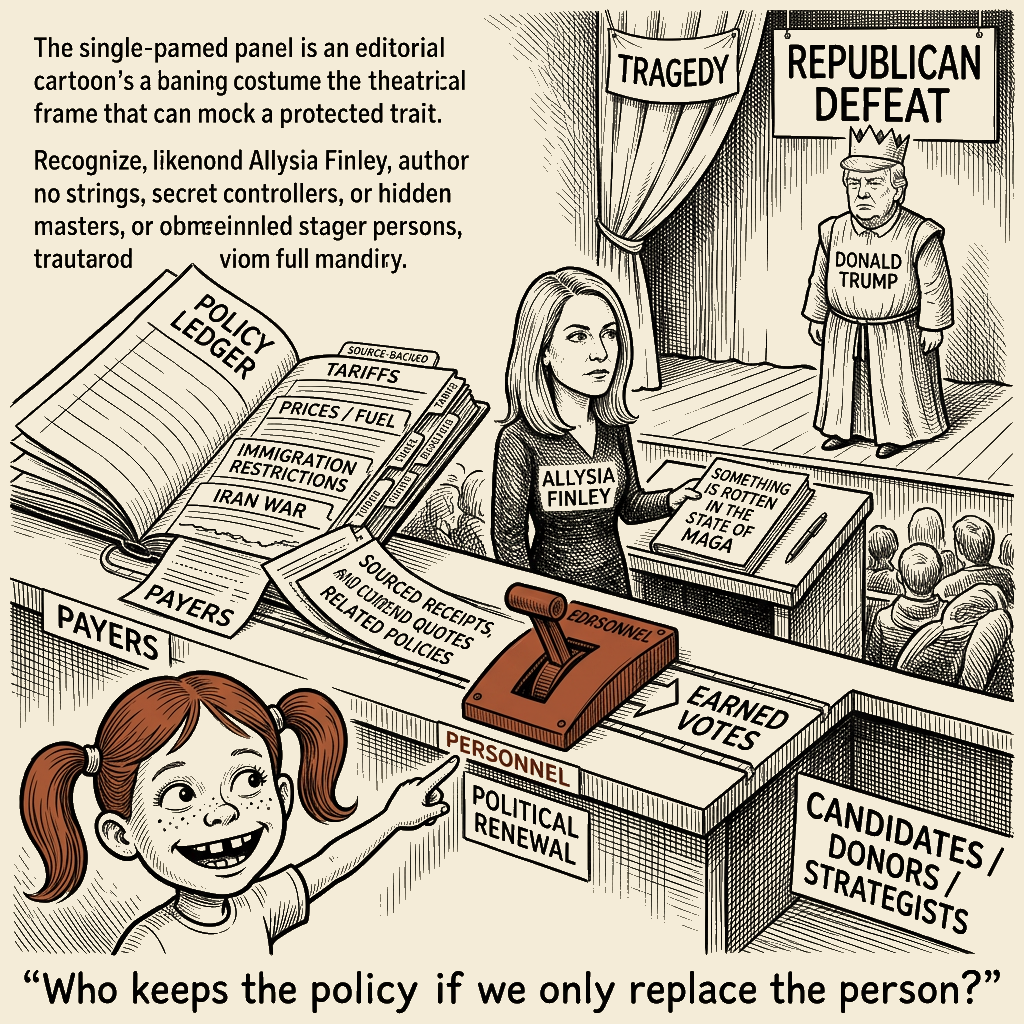
Who keeps the policy if we only replace the person?
What the Editorial Argues
Allysia Finley argues that the Republican electoral defeat was driven substantially by Donald Trump’s character and management of his political circle: his need for flattery, his punitive treatment of dissent, and the self-interest or corruption surrounding him. Shakespearean parallels make Trump a tragic figure whose advisers reinforce his worst instincts and whose desire for revenge consumes his presidency. Finley acknowledges that tariffs, restrictive immigration policies, inflation, gasoline prices, and the war in Iran also generated opposition, but argues that corruption was the decisive voter grievance and that Republicans must replace personnel and earn votes rather than demand personal loyalty. Her closing warning to J.D. Vance is that he cannot inherit the presidency through coronation; he must win voters who will not be “beguiled” by the Trump model.
Receipts
The editorial turns a Republican electoral defeat into a moral drama about Donald Trump’s character, leaving policy and its costs in the background.
What the framing wants you to believe
- That Republican losses chiefly diagnosed Trump’s character—his appetite for flattery, his vendettas, and the apparent corruption of his entourage—rather than the governing choices represented by tariffs, immigration restriction, inflation, gasoline prices, and war.
- That corruption was the decisive voter grievance: “the killer was that while they struggled to pay bills, Mr. Trump and his hangers-on looked to be enriching themselves.” Finley also cites unnamed polls reporting that 62 percent of voters believed the president put his personal interests ahead of the country’s.
- That the remedy is personnel and political renewal: Republicans must select candidates who can win votes, while Vance must earn popular support rather than inherit the office through personal loyalty.
What’s really going on
- Technique and omitted relation: The editorial performs what can be called tragedy substitution. The Shakespearean analogy works in the manner of the Bad-Faith Techniques Catalog’s
frame_engineered_relabelingand the WSJ Editorial Technique Catalogue §4.1: it substitutes a familiar moral type for a complicated causal account. This is a description of the textual effect, not a claim that a message memo engineered the essay. The omitted relation is the vote-policy chain: how tariffs, immigration rules, prices, war, candidate quality, turnout, and party incentives jointly produced the result. - Protected beneficiary: The frame benefits a center-right candidate class that can replace Trump-branded candidates without reopening the broader governing program. J.D. Vance, Republican strategists, donors, and officeholders can gain campaign roles, resources, endorsements, and influence if voters are taught to treat the defeat as a character problem. The WSJ can also position itself as the sober interpreter of the center-right’s next move. No supplied record shows that any of these actors commissioned or coordinated the essay.
- Evidence problem and normalized harm: The editorial itself reports that non-MAGA Republicans and independents turned against Republicans, that candidates who broke with Trump on tariffs suffered, and that Trump’s “mass-deportation agenda” contributed to the rout. Those admissions make policy part of the explanation; the Shakespearean frame simply makes it background. The unnamed “polls” and “exit polls” cannot settle the causal claim without pollster, sponsor, field dates, question wording, sample, margin, and issue cross-tabs. The normalized harm is the material consequence of tariffs, immigration restrictions, inflation, fuel prices, and war, which the frame treats as scenery while character performs the explanatory work. Anchor for the framing: Allysia Finley, “Something Is Rotten in the State of MAGA,” WSJ Opinion.
The Operation
Triage and placement
This is a named editorial by Allysia Finley, identified as a member of the Wall Street Journal editorial board. It is not the publication’s unsigned collective “we,” though the institutional placement is clearly that of the Journal’s editorial operation. The domain is American electoral politics; the archetype is a tragedy-character frame built on a poll-ledger structure and completed with a WSJ-style closing cadence.
The position advanced is mixed: anti-corruption, democratic accountability, and candidate competence are legitimate public interests. The frame’s marginal distributional effect is more selfish, however, because it offers a narrow set of political actors a way to solve an electoral defeat through personnel without conceding the policy coalition that produced the defeat.
Because the essay invokes public goods—clean government, democratic judgment, and electoral legitimacy—from a center-right institutional position, the same analytical apparatus applies. My direct experience is with liberty-frame opinion machinery, while this is a center-right critique of a figure I did not build. I make no claim to its internal process and infer no hidden hand from the pattern alone. I built versions of this operation; that experience helps identify the machinery, not establish who arranged this essay.
Institutional authorship and placement chain
The documented chain is: Allysia Finley → WSJ editorial board → WSJ Opinion → the supplied RSS opinion feed. The record identifies no donor, think tank, campaign, or political operative behind the essay. It would therefore exceed the evidence to call the placement chain coordinated. What can be said is narrower and still material: the piece performs a service for a center-right audience by converting an electoral loss into a personnel-and-character judgment without requiring a full accounting of the governing program.
The first promoter of the broader frame is not established by the supplied record. Finley is the identified creator of this articulation, not necessarily the first person to deploy the pattern.
Cui bono: who benefits
The beneficiaries have concrete pathways:
- J.D. Vance and Republican candidates not tied to the Trump brand gain a favorable definition of the problem: their task is to demonstrate personal and political fitness, not to answer for every policy Trump carried.
- Campaign strategists, donors, and officeholders gain a recruitment rationale for redirecting money, staff, endorsements, and candidate slots toward alternatives to Trump-aligned candidates.
- The WSJ gains the less measurable but still concrete benefit of agenda-setting authority: it can define the meaning of the result and position itself as the sober interpreter of what comes next.
These are not symbolic beneficiaries inferred from ideological alignment. Their pathways are personnel selection, campaign resources, access to candidacies, institutional influence, and control of the terms on which a political recovery is debated. The protected interest is a center-right succession strategy that permits actors to change the people at the top without first reopening the governing coalition that produced the defeat.
The cost-bearers are less visible. If the frame guides Republican renewal without reopening policy, non-MAGA Republicans and independents may continue to bear the electoral consequences of tariffs, immigration policy, price pressure, and war. People directly affected by those policies would continue to absorb the costs the editorial declines to price. The supplied record offers no dollar estimate of that distributional cost, no incidence analysis, and no independent evidence from which one could responsibly be calculated; the numerical figures the editorial offers are its reported 62 percent poll result, whose underlying instrument is not supplied, and the reported $100,000 that former Ambassador Kimberly Guilfoyle sought from a GOP donor to pay off a credit-card debt—a figure the editorial attributes to reports the supplied record does not contain.
This is a beneficiary pathway, not a motive finding. The evidence does not establish that Finley, her editors, donors, or Republican strategists coordinated this essay for those benefits. What the evidence does establish is the distributional effect of the frame: if the personnel diagnosis displaces the policy diagnosis, actors who can replace people while preserving the program are better positioned than actors who would have to bargain over the program itself.
Alternative design
An alternative optimized for Finley’s stated rationale—electoral recovery, clean government, and representative government—would not begin by choosing between character and policy. It would ask two separate questions: which candidate or institutional choices changed the vote, and which governing choices produced the material conditions voters penalized?
The affected constituencies are non-MAGA Republicans, independents, and people directly exposed to tariff and immigration policy. Their interests are not “punish Trump” or “preserve Trump.” They are a legible policy choice, honest government, and leaders who answer to them. A recovery strategy serving those interests would publish the poll instruments and issue cross-tabs; identify policies and candidate failures separately; state what each governing choice costs and whom it charges; and pair personnel reform with specific anti-corruption rules. It would let Vance demonstrate fitness on both competence and substance rather than presenting vote-getting as the only test.
Fear, greed, and laziness
- The framing author and outlet face a real fear: a Republican collapse could pull the center-right toward a more populist and less institutionally credible course. Their greed is for agenda-setting authority and the institutional return that comes from supplying the next movement’s vocabulary. Their convenience is to avoid reopening the policies around which the coalition split.
- The candidate-and-donor class fears primary rejection, donor defection, and the loss of campaign viability. Its greed is concrete: staff positions, fundraising, endorsements, candidacies, and influence. Its convenience is that personnel can be changed without conceding the ideological and economic coalition.
- The rank-and-file reader has reasons not to trust either Trump or the institutions around him. The frame offers identity confirmation, moral clarity, and the pleasure of a finished explanation. Calling that “laziness” would be cheap; the better description is that the tragedy lowers the effort required at the moment effort is warranted. The reader gets catharsis while the distributional ledger remains closed.
The techniques deployed
-
Tragedy substitution — frame-engineered relabeling in effect.
Textual cue: The essay opens with a “Republican bloodbath” that “has the ingredients of a Shakespearean tragedy,” then supplies Lear, Hamlet, Falstaff, and Iago as an explanatory architecture. “Mr. Trump is a fool for flattery” turns the election into evidence of temperament.
Catalogue cross-reference: Bad-Faith Techniques Catalog,frame_engineered_relabeling; WSJ Editorial Technique Catalogue §4.1. The catalog’s evidence requirement for deliberate relabeling is not satisfied by this editorial alone, so the label here describes the frame’s operation rather than alleging a coordinated messaging campaign.
What it does: Replaces a multi-causal political result with a memorable moral type. The reader can recognize Lear without reconstructing turnout, policy effects, candidate quality, or party incentives. The literary analogy is not ornament; it supplies the causal model. Lakoff’s cognitive-frame work and Lippmann’s Public Opinion (1922) describe the general lineage: a compact frame organizes attention before the evidence does. The Luntz relabeling line is historically relevant to the vocabulary of engineering public consent, but no document connects Finley’s essay to that apparatus. -
The citation-shaped poll.
Textual cue: “Corruption ranked at the top of voters’ concerns in polls,” followed by “In exit polls 62% of voters said that the president put his personal interests over the interests of the country.”
Catalogue cross-reference: WSJ Editorial Technique Catalogue §4.5, the “study shows” ledger, here adapted to unnamed polling; the Bad-Faith Techniques Catalog’s evidentiary standard governs whether stronger labels may be used.
What it does: Gives the character diagnosis the appearance of empirical confirmation. A number attached to “exit polls” supplies institutional authority while withholding the instrument that would make it testable. The supplied record does not document manufactured controversy, coordinated polling, or a false consensus, so those stronger labels would fail the truth floor. The proven failure is evidentiary: the poll is asserted rather than cited. -
The concession pivot and the displacement of institutional responsibility.
Textual cue: “Yes, Americans are unhappy about high gasoline prices from the war in Iran and persistent inflation. But the killer was that while they struggled to pay bills, Mr. Trump and his hangers-on looked to be enriching themselves.” Elsewhere: “the president’s refusal to abide criticism insulated him from sage advice,” followed by “The president will get the bad advice he invites.”
Catalogue cross-reference: Bandura’s distortion of consequences and displacement of responsibility, operating through the Bad-Faith Techniques Catalog’sframe_engineered_relabeling.
What it does: Acknowledges price and policy consequences, then pushes them out of the causal center. Responsibility is transferred from the content and operation of policy to the leader’s need for flattery and the character of his advisers. The policy survives as scenery while the emotional payoff remains the story of a bad man led badly. -
Multiple-audience targeting by function.
Textual cue: The corruption narrative gives disaffected voters a legitimate reason to turn; the personnel prescription gives Republican actors a route forward; the Shakespearean apparatus supplies intellectual and movement status; and the Vance conclusion speaks to candidates, donors, and the broader center-right audience at once.
Catalogue cross-reference: WSJ Editorial Technique Catalogue §4.3, multiple-audience-targeting analytic.
What it does: Delivers several compatible messages in one frame: reject the corrupt and chaotic leader, retain a Republican identity, and place the next leadership contest on a plane of earned popular consent. The fit is functionally observable. It does not prove a segmented media plan or conscious coordination, and the catalogue itself treats audience targeting as a craft rather than a bad-faith finding in itself. -
The closing coronation frame.
Textual cue: “Mr. Vance won’t ascend to the presidency via coronation in 2028. He will have to win over voters who may not be as easily beguiled as Mr. Trump.”
Catalogue cross-reference: WSJ Editorial Technique Catalogue §3.5, the quotable closing-line cadence; the relabeling family in §4.1.
What it does: Converts the unresolved question of governing policy into a test of leadership legitimacy. “Earned votes” supplies the moral answer without asking what the votes were earned on. The line gives the reader a clean ending and leaves the institutional ledger outside the frame.
Audience-management function
The editorial performs several audience-management functions at once:
- Permission structure: A reader may reject Trump without rejecting the center-right coalition.
- Identity confirmation: Republican or conservative readers can regard themselves as principled dissenters rather than as beneficiaries of a discredited program.
- Grievance ratification: Corruption, sycophancy, and revenge turn dispersed dissatisfaction into named moral culprits.
- Status display: Shakespeare signals intellectual seriousness and movement membership.
- Counter-frame: The electoral verdict becomes a personnel test rather than an indictment of the governing program.
- Conscience displacement: Moral dissatisfaction substitutes for the accounting of policy effects, allowing the reader to feel politically serious without following the costs to the people who bear them.
The Record
Anchor receipt and load-bearing claims
The primary document supplied is Finley’s editorial. It anchors what Finley argued, what caveats she inserted, and which evidence she cited. It does not independently corroborate the empirical premises she invokes. No election-return table, poll release, wire report, campaign record, or independent study was supplied to verify the underlying claims.
-
Republican candidates suffered a major electoral defeat.
Receipt: The editorial characterizes it as a “Republican bloodbath.” It provides no returns, vote totals, seat changes, turnout figures, or denominator.
Finding: The supplied record supports only that Finley used that description. It does not independently establish the scale and composition of the defeat. -
Non-MAGA Republicans and independents turned against Republican candidates.
Receipt: The editorial attributes this to exit polls without naming the pollster, consortium, field dates, sample, margin, weighting, or questionnaire.
Finding: The voter shift is not independently confirmed from the supplied record. -
Corruption was the leading voter concern, and 62 percent of voters believed Trump placed his personal interests ahead of the country’s.
Receipt: The editorial refers to “polls” and “exit polls” without an instrument or underlying table.
Finding: The figure and ranking are accurately attributed to the editorial’s characterization, but the underlying poll is unavailable. They cannot independently anchor the causal claim. -
The Trump family and administration figures were engaged in financially corrupt activity.
Receipt: The editorial refers to reporting about financial dealings involving Trump family and administration figures, but the supplied source does not identify the original reports or provide primary records capable of testing them.
Finding: These remain attributed reports rather than independently verified anchors. -
Tariffs and immigration policy materially contributed to Republican losses, and Trump’s mass-deportation agenda was a key cause.
Receipt: The editorial makes these claims and observes that candidates who distanced themselves from Trump on tariffs and other positions were punished. It supplies no vote-choice cross-tabs, district estimates, or policy-incidence evidence.
Finding: The supplied record supports that Finley made these claims. It does not independently confirm the causal weight assigned to them. -
Trump blamed Fox News and his endorsed candidates, while Vance blamed the Iran war for Republican losses.
Receipt: The editorial quotes or reports those statements. The original social-media posts, Vance statement, and full context were not supplied.
Finding: Their existence is anchored to the editorial’s reporting; their complete wording and context require the original records.
Per-citation accuracy verdicts
- Polls: No auditable citation exists. Pollster, sponsor, dates, population, question wording, sample, margin, and weighting are all absent. The 62 percent figure cannot be confirmed or contextualized from the supplied record.
- “Exit polls” showing the non-MAGA and independent shift: Same verdict. The phrase identifies a source category, not a source.
- Reports concerning financial corruption: No original publication, document, or filing is supplied. The claims remain attributed reports rather than anchors.
- Trump and Vance statements: The wording is accurately transcribed from Finley’s editorial, but the original posts and surrounding statements were not available for comparison.
- “The liberal press at long last admitted … ‘democracy works’”: No outlet or article is named, so the claim cannot be audited.
- Shakespeare: The quoted lines are textual cues from Finley’s essay. Their role is verifiable as rhetoric; no edition-level claim about wording or variant readings is made. Shakespeare supplies the frame, not evidence for the election’s causes.
No established misquotation or fabricated citation appears in the supplied record. The central problem is different: the essay presents assertions as if they were sourced evidence while withholding the sources needed to test them.
Load-bearing omissions
- The electoral denominator: Vote totals, turnout, competitive-seat results, candidate spending, and the baseline against which the result counts as a “bloodbath.”
- The poll instrument: Sponsor, field dates, wording, sample, margin, weighting, and issue-by-vote cross-tabs for both claims about corruption.
- The actual policy text: Which tariffs, immigration restrictions, pardons, energy measures, and other instruments were at issue, and what their legal and economic effects were.
- The incidence of costs: Who paid through prices, wages, employment, public services, or reduced labor supply; by how much; and over what period.
- Party and candidate mechanics: Primary rules, candidate recruitment, ballot access, donor pressure, and the separate effects of candidate quality and incumbent-party performance.
- The institutional remedy: Specific anti-corruption rules, oversight mechanisms, or candidate standards; “must earn votes” is a norm, not a governing design.
- The reporting behind the corruption claims: Original reporting, documents, or primary records capable of supporting or refuting the allegations.
- The possibility of mixed causation: The editorial’s own evidence permits corruption, policy, candidate quality, and independent voters to operate together rather than in a winner-take-all sequence.
Missing-information declaration
Only the cleaned editorial and its metadata were available. The underlying election returns, poll datasets, questionnaires, original social-media posts, reporting behind the corruption allegations, campaign documents, donor records, and cost estimates were not provided. The supplied record did not establish a publication date, so none is asserted. No leaked memo or internal publication record was available, and none has been invented. Personal recollection is used only as clearly marked witness concerning my own prior work, never as evidence about the authorship or placement of this essay. Where the record is silent, no figure is supplied and no coordination is inferred.
Symmetry and the limits of the expertise
The essay’s stated rationale is democratic accountability, clean government, and electoral legitimacy. My expertise is asymmetric: it reaches farther into liberty-frame opinion machinery than into the internal process of this center-right critique of Trump. The analysis therefore remains inside the public record. I do not claim hidden coordination, donor direction, or a private motive. A structurally identical tragedy-substitution frame in a greater-good outlet would receive the same technique classification if the textual cues and evidentiary conditions were present; a WSJ defense of Trump would receive the same scrutiny if it used the same cues. Coalition does not decide the label.
How to Recognize This
The pattern is tragedy substitution: a complicated political defeat is converted into a moral drama about a leader’s character, and the drama is then used as the explanation.
The mechanism is simple. A leader is cast as a tragic type—Lear, Hamlet, Falstaff, or Iago. Facts that fit the type enter the story; facts that would complicate it are pushed to the margins. The reader receives narrative order without having to reconstruct the election. The frame then grants moral permission: because the problem is a bad man’s vanity, corruption, or bad judgment, one can reject the leadership without confronting the coalition that produced his authority or the policies that made that coalition electorally distinct.
Next time, look for four signals:
- The literary type arrives before the evidence. A candidate is introduced through a famous character, and the comparison begins deciding which facts deserve attention. Here, the Shakespearean apparatus arrives in the first sentence and supplies the causal model before the election has been described.
- Causal verbs attach to personality. Phrases such as “brought down by overweening pride,” “insulated him from sage advice,” and “the bad advice he invites” explain defeat through temperament rather than institutions, policy, or material conditions.
- One cause is crowned after the alternatives are named. “But the killer was” is the giveaway. The concession establishes real grievances; the pivot then announces which one counts without comparative evidence.
- Poll nouns replace poll documents. “Exit polls” and “polls” are not citations. Ask who conducted the poll, what was asked, of whom, when, with what margin, and whether the results were cross-tabbed by issue and vote choice.
This works because it converts uncertainty into recognition. The reader does not need to understand incumbency, turnout, candidate quality, ballot access, or policy effects. He needs only to recognize a familiar face. That is why the Shakespeare is not idle ornament: it furnishes the interpretation while reducing the number of comparisons the reader feels obliged to make.
The true half is also doing necessary work. Trump’s conduct was a legitimate grievance. Corruption was a legitimate concern. Sycophantic personnel decisions are bad government. A candidate who cannot win voters cannot govern. The operation does not need to falsify those propositions. It builds a conclusion on top of them: that a moral diagnosis has supplied a complete causal account and a complete remedy. The reader gets catharsis, identity, and permission to move on. The policy ledger remains offstage because the frame has already supplied its substitute.
When you see it, do four things:
- Trace the poll to its instrument. Find the pollster, sponsor, dates, questionnaire, sample, weighting, and issue cross-tabs. A finding with no visible instrument is a premise wearing a finding’s clothes.
- Make a causal ledger. List every cause the editorial mentions before it names the “killer.” Then demand comparative evidence rather than accepting a narrative transition as a demonstration.
- Ask who benefits. If the answer is a candidate, donor, strategist, institutional franchise, or policy coalition protected by the proposed remedy, you have found the frame’s spine.
- Reduce the automatic activation. Pause at “But the killer was.” Ask what the sentence before it just gave you, and what evidence was required to replace that cause. Then search for repeated vocabulary across nearby opinion items, while resisting the temptation to infer coordination from repetition alone.
From my own recollection of that work, which I cannot substantiate from the public record, I made the man with the program a caricature and moved the cost into a word whenever the operation needed the program defended. I did not then ask who would pay the bill. That omission was mine.
I will not counterfeit a conspiracy to fill the gap between this essay and the apparatus I know. The documentary record does not show that anyone at the Journal, a campaign, or a donor arranged the piece. The textual operation stands on its own: a familiar face is substituted for a hard accounting, a true grievance is made to bear a conclusion it cannot prove, and policy is left unattended while character performs the work.
Recognition is not innocence. It is the pause before a diagnosis arrives in Shakespeare and leaves the invoice unopened. Carry that pause forward.

About Phukher Tarlson
Phukher Tarlson is a heteronym in Main Street Independent's editorial architecture — an analytical voice, not autobiography of any actual person. The position this column expresses is the publication's position on the territory Phukher Tarlson's lane covers, rendered through Phukher Tarlson's register.