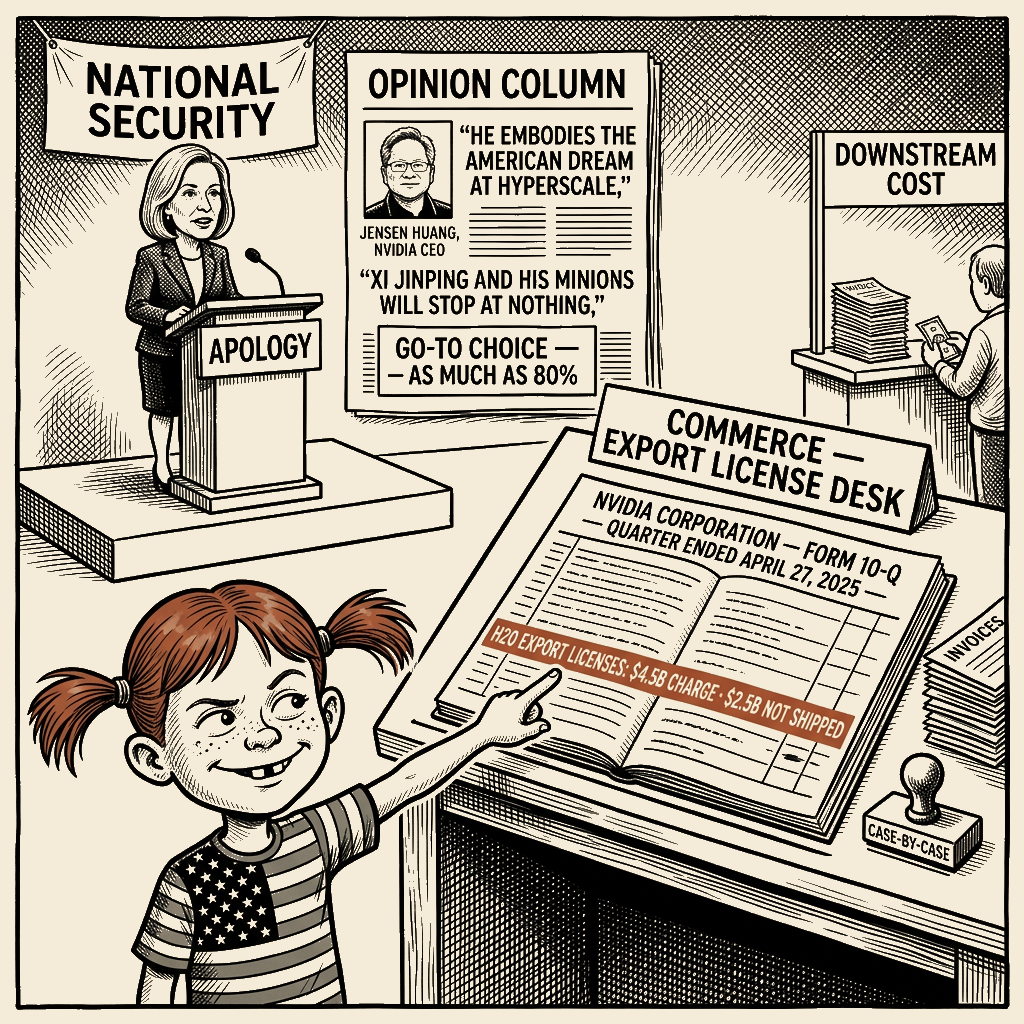
Responding to: REBECCA GRANT: Jensen Huang owes America an apology, and Nvidia owes investors answers — Rebecca Grant · 2026-11-09
Why is nobody reading the filing?
What the Piece Argues
Dr. Rebecca Grant argues that Nvidia CEO Jensen Huang’s admitted affair with Alice Huang, whom U.S. intelligence reportedly suspected of being a Chinese recruit, was a reckless lapse for the head of a company she says controls as much as 80% of advanced data-center AI chips and serves as a national-security asset. She says Huang owes America an apology and Nvidia owes investors answers, while insisting the episode proves Beijing will stop at nothing to erode the U.S. AI lead. She argues the United States should preserve global market share—including the Commerce Department’s prospective case-by-case sales of slower H200 chips to certain Chinese firms—because restricting American technology at home would allow China to undercut U.S. AI services and capture global markets.
Receipts
The framing turns a question about corporate concentration and export policy into a test of one executive’s character, then closes by putting the bill on Beijing.
-
The framing wants you to believe
- A private relationship is a national-security event whose proportionate answer is a public apology: “Frankly, Huang owes America an apology. Here’s why.”
- The lesson is about Chinese predation rather than concentrated American power: “This whole sorry tale proves once again that Xi Jinping and his minions will stop at nothing to slash America’s lead in AI.”
- The company holding the market deserves applause and continued business: Huang “embodies the American dream at hyperscale,” and American technology “can’t lock itself down inside the USA” without surrendering the global data-center market to China.
-
What’s really going on
- Nvidia’s Form 10-Q for the quarter ended April 27, 2025 disclosed a $4.5 billion charge and roughly $2.5 billion in revenue it could not ship after Commerce required licenses for H20 chips bound for China. That is the export-policy receipt. (Anchor receipt: NVIDIA Corporation, Form 10-Q for the quarter ended April 27, 2025.)
- The material beneficiary is Nvidia: licensing decisions determine which customers can buy its chips, while the column’s global-market-share argument protects the revenue model of the dominant American supplier it declines to examine.
- The piece supplies an undefined Yahoo Finance characterization of Nvidia’s share as “as much as 80%,” then moves the argument away from that concentration and toward a private marriage while praising continued global sales.
The Response Ladder
Polite Reframe
When to use: For the security-minded moderate, the voter who accepts the AI race as a priority and has simply never been handed the follow-up question — this version hands over the receipts without making the reader an opponent.
Consider Denise, a representative county records clerk outside Atlanta, not a named individual. She has never chosen an AI-chip policy. She knows that her county buys cloud services, that those services increasingly depend on advanced compute, and that much of the hardware beneath them is sold by one dominant company — the company this column puts at as much as 80% of the world’s advanced data-center AI chips. She did not write the export rule. She does not get to vote on it. She signs the invoices.
The column wants you to be angry about a man’s affair and calls the arithmetic a crisis of character. But export control is a written decision with a price tag. Nvidia’s Form 10-Q for the quarter ended April 27, 2025 disclosed a $4.5 billion charge and roughly $2.5 billion in revenue it could not ship after Commerce required licenses for H20 chips bound for China. A private relationship did not move that money. A rulebook did.
The source’s security concern is real. Espionage is real. An executive at a firm the national-security apparatus depends on owes it candor and disclosure. What is not established here is that a public apology answers the structural question. The piece asks for one man’s remorse and Nvidia shareholder answers, but leaves untouched the rules deciding which Chinese customers may receive which chips — including the prospective case-by-case H200 sales the piece treats as sound policy.
Here is the language for a man who loves competition. Competition is American. Monopoly is the old feudal arrangement with a new logo. The men who threw tea into Boston Harbor were not fighting over the price of tea; they were fighting a company that had been handed the river. When one company controls the critical input in an economy, the country is not living in a free market. It is living inside an arrangement with the legal form of one and the behavior of a cartel. The ordinary American question is simple: what did you build this out of, and what do you owe back?
King understood the scale. In his April 4, 1967 Riverside Church address, “Beyond Vietnam,” he warned against a society organized around machines, profits, and property rather than persons. That warning does not require us to choose scandal over substance. It requires the opposite: put the strategic instrument beside the people who use it, disclose the concentration, expose the license desk, and make the board answer.
Denise does not need a national apology. The country needs the export rules, the concentration number with a date and definition, and the receipts from the board. We are the builders, and we will make the practice measurable: public CHIPS incentives under Public Law 117-167 finance competing advanced packaging capacity; critical production stays domestic; contracts give downstream buyers enforceable prices and delivery dates; and no company gets to turn indispensability into a blank check. We build alternatives to monopoly and audit the rules that sell the output. That is the apology this policy owes — not a press release from the star, but a country reclaiming the power to decide who builds the future.
Mockery and Ridicule
When to use: For the group chat, the reply thread, the colleague who has now heard the talking point for the third time this week — it stops persuading the repeater and performs for the bystander.
There is, of course, no federal form for this. But if the Lexington Institute — where Rebecca Grant serves as vice president — were running the national-security seminar its column imagines, the form would be short. Page one: “List every close personal relationship in the past five years.” Page two: “State employer and nationality.” Page three: “Attach the gift.” There is no page four. There is no page four because, as Huang put it in the press release, “You deserve better from me.” That sentence is supposed to be the national-security remedy.
Now take the market-share receipt the column itself puts on the table: Nvidia is “the go-to choice for all the biggest AI software developers,” and the piece relays an undefined Yahoo Finance figure of “as much as 80%” for advanced data-center AI chips. “Go-to choice” is a phrase for a firm customers like. It is also a phrase for the only shop in town. If your dentist is the only dentist in a thousand-mile radius, people call it a captive market and then complain about the filling.
And what a price. Nvidia’s Form 10-Q for the quarter ended April 27, 2025 disclosed a $4.5 billion charge and roughly $2.5 billion in revenue it could not ship after Commerce required H20 licenses. That is the trade, priced in public filings, and the cost travels down to people who buy compute. But we were all so proud of him — “We were all so proud of him,” the column says. We were, and we were not asked one question about what that pride costs, because the question of who owns the switches on advanced compute is not a question a free-market champion is supposed to ask. Here is the inversion, stated plainly: the free-market champion is the corruption-preserver; the go-to choice is the landlord of the only shop in town, who calls the lease a market and calls the public’s applause competition. A corruption-preserver is exactly what public independence becomes when indispensability is never tested.
See, the column even hands you the fix, and the fix is the tell. “American tech can’t lock itself down inside the USA,” because China might build cheaper data centers. Fine. Good. But notice where the threat is placed. The one thing that must not be locked down is the thing that makes the dominant private actor in advanced compute larger. Commerce may permit case-by-case H200 sales to certain Chinese firms; the AI Diffusion Rule issued in January 2025 was rescinded before its May compliance dates; the firm kept selling. Nobody is worried about Beijing buying a customer list. Everybody is worried about Beijing building a data center.
And then the last page is always the China page, because a named villain at the top of the page is a villain nobody has to file a motion against: “Xi Jinping and his minions will stop at nothing to slash America’s lead in AI.” Meanwhile, the institutions that actually move the chips are left off the page — the Commerce license desk, the public CHIPS incentives authorized by Public Law 117-167, the board that owes investors answers, and the concentration number the article itself invokes.
Nobody overthrew anything here. Nobody had to. That is how it works: the democracy gets given away politely, in a paragraph about somebody’s bad judgment, with everybody applauding because the lapel pin was free and the chips were on sale. George Lucas put it in the Chicago Tribune in 2005: democracies are not overthrown; they are given away. You do not need a coup when you have a free lapel pin. The empire does not storm the Senate; it asks the Senate to be reasonable about the chips.
So here is what actually happened to you, friend. You read a column, felt a clean hot feeling, and went to be angry at a man having an affair while the company he runs holds the share the piece reports and the government writes that company’s export rules. Your anger worked perfectly. It was pointed at the only address that does not accept mail. You are not the villain. You are the applause. We are the builders, which means we fund another packaging line, publish the contract terms, name the prices, and make the next customer compete. We want the docket, the concentration number with a date and definition, and the board’s answer.
Nuclear Satire
When to use: For the room where the column is being passed around as proof that the system is broken — and the system is broken, just not where the column points — this is the version that blows the picture up.
By the authority vested in me — and with the source column’s solemn “No kidding” — I hereby establish the United States Bureau of Apologies, headquartered in the Department of Commerce, whose function shall be to receive, evaluate, and forward to the appropriate corporate registrant any remorse expressed by an executive officer of a critical semiconductor firm regarding his personal life. The Bureau shall rate each apology for sincerity, remorse, and actionable disclosure of the Blackwell architecture. There is no page four, because the imaginary form would stop at “You deserve better from me.”
Now watch what the column actually does. It takes a man’s marriage and sets it on the same page as a submarine fleet, calls the offense embarrassing, prescribes humility, and appoints a villain in Beijing. That is the construction, and it is a construction because of the sentence it gives you free: “Jensen Huang has been a star. He embodies the American dream at hyperscale… he’s become a titan on the level of Henry Ford… We were all so proud of him.” Read that again and hear what it is: a paragraph of free advertising for the private manufacturer of the strategic input, printed inside an espionage scare, where the espionage does the work the advertising could never afford to pay for. You cannot buy the placement. So take the scandal and let it carry the copy at no charge.
Look under the copy. Here is the ledger the column refuses to print: the piece’s undefined “as much as 80%” share; Nvidia’s Form 10-Q for the quarter ended April 27, 2025, with its $4.5 billion charge and roughly $2.5 billion in revenue it could not ship after the H20 license requirement; a January 2025 AI Diffusion Rule rescinded before its May compliance dates; Commerce preparing to permit case-by-case H200 sales; Nvidia’s March 18, 2025 announcement of up to $500 billion for U.S. AI-infrastructure spending; and the semiconductor incentives authorized by the CHIPS and Science Act, Public Law 117-167. That is the race. The column calls it a security emergency and reports it in a magazine for people who already own the winners.
Dante put the traitors in the ninth circle, in a hole of ice, and gave them no warmth to hide in. This column wants the Chinese in that circle and leaves the American one empty. But its pivot has a name: the red herring in Aristotle’s ignoratio elenchi. It leaves the question of who writes the export rules unanswered by replacing it with the question of who is pictured in the threat. “This whole sorry tale proves once again that Xi Jinping and his minions will stop at nothing to slash America’s lead in AI.” What this whole sorry tale actually proves is that a column can name an affair, call it a national-security matter, praise the company holding the reported 80%, and close on Beijing — and every reader nods, because the pattern is older than the chips: name the foreign villain, salute the domestic champion, never touch the wiring. Here is the inversion: the American champion is the corruption-preserver; the corruption-preserver is what happens when indispensability becomes untested and public policy is written around one company’s market position.
I am not interested in the man’s marriage. I am interested in the reported 80%. The woman in California who may have taken a black-market order for GPUs for a Southeast Asian data center deserves a document and a hearing, not a carnival. The villain is the position: one company holding the share the piece reports, the government writing that company’s export rules, a national-security establishment more invested in access than competition, and a commentariat capable of making the whole structure look like a morality story about somebody’s affair. What Jensen Huang did was run the firm, hold the office, sit on the board, and stand at the center of a concentration the state administers on its behalf. The affidavit is not the story. The position is the story.
Malcolm X told Cleveland on April 3, 1964, in “The Ballot or the Bullet,” that we must take our criminal to court. The effect here is to keep the docket filled with small defendants. The docket is filled with the man in the affair and the man in Beijing, while the arrangement sits in a boardroom that announced up to $500 billion for American AI infrastructure on March 18, 2025. The case in front of us is not a carnival for Alice Huang. It is the concentration, the licensing system, and the board’s public duties.
The writers of Star Trek staged the cleanest version of this bargain in “In the Pale Moonlight” (Deep Space Nine, 1998): a good man lies to win a war and then has to decide whether he can live with the lie. The difference is that Sisko owned his compromise in a log he dictated himself. The column asks America to admire a compromise it has not been told about.
We do not need a Bureau of Apologies. We need the export-control rules, the concentration number with a date and definition, and the board’s answer to shareholders — in the order the receipts actually arrive. We are the builders. We put public CHIPS dollars behind competing packaging capacity; we write contracts in which downstream buyers can name prices and delivery dates; we keep critical capacity domestic and contestable; and we do not turn one firm’s national-security importance into permission for unchecked concentration. We build alternatives, not ceremonies of apology.
Profane Scorched-Earth
When to use: For the reader who has read the receipts and needs it said out loud — this is the release valve. Full profanity, gloves off, receipts still doing the work.
Here it is, with the paperwork attached, because somebody ought to say it plainly: this entire column is a confession of who gets to be a patriot and who gets to be the suspect. And what a patriot we are told Jensen Huang is. “Jensen Huang has been a star… We were all so proud of him.” Read those words and hear what they are: a free advertisement, printed inside an espionage scare, for the private manufacturer of the strategic input. And “go-to choice”? That is what they call a firm there is no second choice for. You do not get to be the go-to in a free market. You get to be the go-to because the market ran out of other people. That is not competition. That is a landlord with a logo and a fucking lobby, and this column cuddles it like a champion and then dares you to ask a question.
Because here is what the column will not do. It will not ask what it costs when Commerce requires licenses for H20 chips bound for China and Nvidia’s Form 10-Q for the quarter ended April 27, 2025 discloses a $4.5 billion charge and roughly $2.5 billion in revenue it could not ship. That is the trade. That is the actual national-security decision — billions moving on a rule, written by people who read the same lobbying calendar the columnist reads. And what does the column want from the CEO? An apology. To America. For an affair. Fucking hell. The man leads the firm the piece says holds as much as 80% of advanced data-center AI chips, and the remedy the national-security column has for him is a press release saying, “You deserve better from me.” That is not accountability. That is a receipt for the press release.
Then the last page, the China page, every single time: “Xi Jinping and his minions will stop at nothing to slash America’s lead in AI.” Sure. And while America is busy being angry at the spy thriller, Commerce may permit case-by-case H200 sales; the AI Diffusion Rule issued in January 2025 was rescinded before its May compliance dates; Nvidia announced up to $500 billion for U.S. AI infrastructure in March 2025; and public CHIPS incentives under Public Law 117-167 already sit behind the semiconductor economy. You know what the story is? America is going to lose the AI race to a country that cannot make the chips. Read it again! The column says the Chinese problem is that they cannot get our chips, and then says the solution is to keep selling them the chips. What the fucking hell kind of security doctrine is that? That is a hell of a national-security analysis. That is a sales deck with a flag on it, and the entire bullshit apparatus stays invisible while you are furious at a man having an affair in California.
Here is the inversion, plain as day: the go-to choice is the corruption-preserver. A corruption-preserver is what happens when indispensability becomes policy and the national-security argument becomes advertising. Nobody has to read one line of the export-control rules, because the column handed you a villain and a patriot, and that is the design. Malcolm X said it June 28, 1964, at the Audubon Ballroom founding rally of the Organization of Afro-American Unity: freedom by any means necessary, justice by any means necessary, equality by any means necessary. The means are not mysterious. The means are receipts, names, filings, hearings, and dockets. The means are what the column had in its hands and chose not to use. Take your criminal to court. The case in front of us is not the woman in California; it is the arrangement that turned the piece’s reported, undefined 80% grip into a national-security asset and then hid the arrangement inside a story about somebody’s marriage so America could stay angry at the marriage and proud of the company forever.
Andor says it in one line: “Power doesn’t panic” (Cassian, Andor, season one). This power does not panic, because it is being applauded. No fucking thing changes because one man says he is sorry after the column has done his reputational laundering for him. The man apologizes; the machine keeps selling. The export desk keeps writing. The board keeps governing. The market share the article itself recites keeps doing the work it was doing before the press release.
None of this is on you. You read it, believed the patriotism because the patriotism was free of charge and the advertisement was free of charge and the villain had a face and a name, and you took it. That is not your fault. That is engineering. Your anger is real, and it is aimed at a country that deserves better than a column asking a man to apologize to it. Aim it one desk over — Commerce, the license desk, the board, the rulebook — and it stops being a feeling and starts being a result. Freedom by any means necessary, and the means are a name, a date, and a hearing.
We are the builders, and we are done asking the paper-patriot to bless the vendor. We are the builders: we make CHIPS incentives finance competing packaging capacity; we write contracts with prices and delivery dates downstream buyers can name; we keep critical capacity domestic and contestable; we make public the concentration number the article raises; we put the board and license desk under a receipt light. That is what it means to claim builder instead of patriot — measurable capacity, enforceable terms, public money, and no fucking monopoly sermon from a man with no counterfactual. The arc bends only when specific people in a specific moment push it, and in this story the specific people are the people who write the export rules and the people who called a corporation a patriot instead of asking it for the ledger. So no. No fucking apology — not for his marriage. From the license desk. Fucking receipts. Fucking hearings. Fucking rules that serve the public instead of sanctifying one vendor.

About Malcolm Little King
Malcolm Little King is a heteronym in Main Street Independent's editorial architecture — an analytical voice, not autobiography of any actual person. The position this column expresses is the publication's position on the territory Malcolm Little King's lane covers, rendered through Malcolm Little King's register.