Paramount’s $111 billion Warner Bros. merger expected to close today
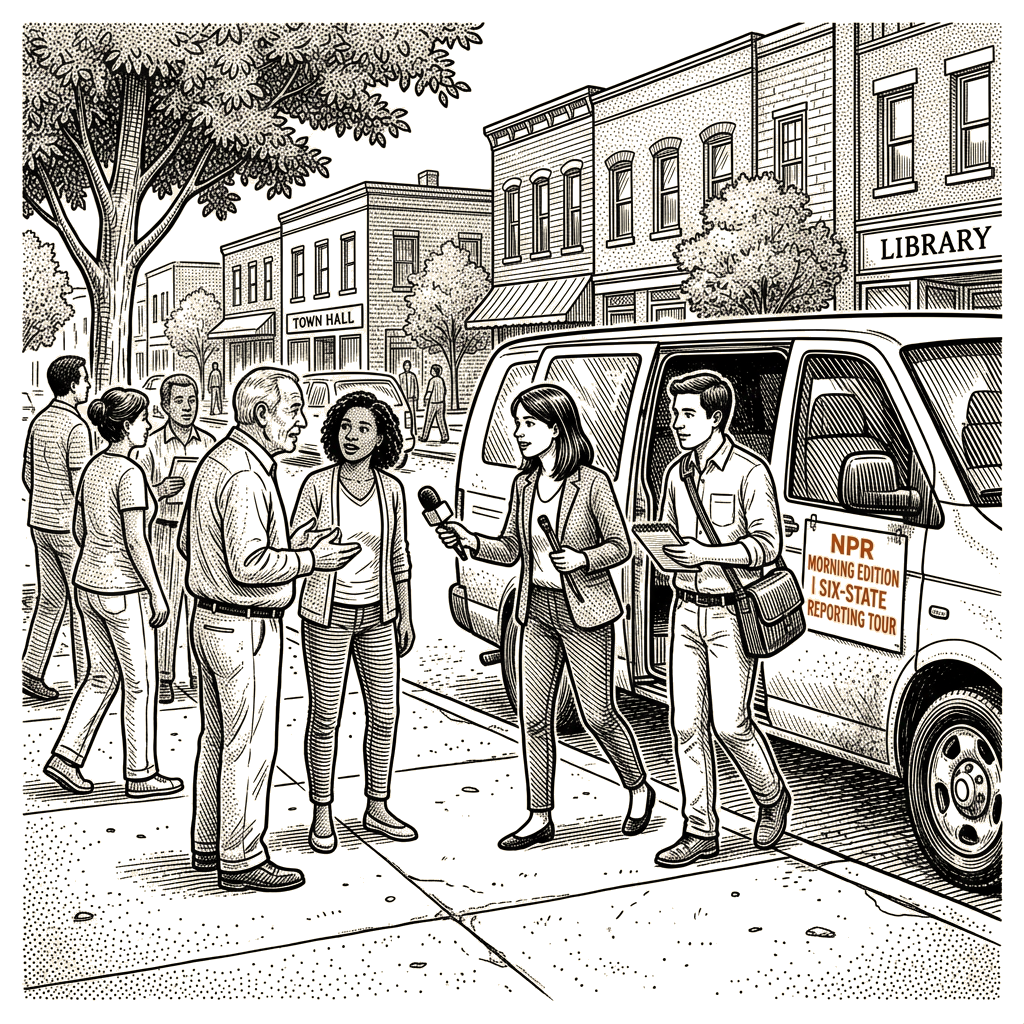
NPR’s Morning Edition launched a six-state reporting tour four weeks before Election Day, sending correspondents to states with some of the most competitive races to hear what voters say is shaping their decisions. Steve Inskeep is reporting from North Carolina and Georgia. Michel Martin is headed to Ohio and Michigan. Leila Fadel is reporting from Maine. And A Martínez is heading to Texas.
Across the political divide, one concern keeps rising to the top: the cost of living and what it means for people’s economic futures, the network said, alongside immigration, the rapid growth of massive data centers, and new restrictions that are raising questions about how ballots will be cast, secured and counted.
Over the next four weeks, Morning Edition will report from different races and electorates across the country, asking many of the same questions: what matters to voters now, what has changed and where the country is headed next.
Inskeep said he is “watching and listening for people who feel this election is personal. By which I mean that, beyond their general opinion of the state of the country, they feel they were directly affected by the events of the past two years — the Trump administration’s dramatic moves to reshape immigration, government, education, science, research, the military, emergency management, taxes, foreign policy and the economy at large.”
Martin said Ohio is “also a key location for the Trump administration’s mass deportation campaign, as well as a leading industrial and logistics hub, a place where we should be able to see how the administration’s economic policies are playing out. Trump isn’t on the ballot, but his policies are. So let’s see how that’s going.” On Michigan, Martin added: “Michigan was once considered a big part of the Democrats’ ‘Blue Wall,’ but in recent years has chosen both Democrats and Republicans in key races. And the Democratic base has had beef with the national party. So what’s driving voters? Are they mad? Sad? Or just exhausted? We hope to find out.”
Fadel said: “The path to controlling the Senate in part runs through Maine, and that’s why we’re reporting in the state before the midterm elections. I want to know what drives voters, and how much party loyalty still plays a role. Are their votes up for grabs? Or are they locked in along party lines?” Fadel described Maine as a state “that’s seen some of the worst of the immigration crackdown; a man was killed by ICE. It has one of the longest borders with Canada, and so the trade war hits differently. The Democratic candidate Troy Jackson is facing incumbent Susan Collins, who has won her state five times before. So, we’ll be asking what people want from their candidate and if it matters which party that resonating message comes from.”
Martínez said: “Texas Republicans gerrymandered five congressional districts to favor the GOP in the upcoming midterms. In three of them, the new maps created more Latino voters.” Martínez asked: “What’s behind the Texas GOP’s big bet on Latino voters, and will it help Republicans keep control of the U.S. Senate?”
Maine coverage airs today. Texas is up next on Oct. 13, followed by reporting from North Carolina and Georgia, and Ohio and Michigan.
The Morning Edition tour launched as new polls showed Democrats favored to win a narrow House majority. The Cook Political Report forecasts a net Democratic gain of five to 15 seats, which would give the party between 220 and 230 seats in January. Democrats need 218 seats for a majority. In the Senate, six seats have moved in the Democrats’ direction since June, according to Cook’s ratings, putting a chamber initially seen as a long shot for the party within reach. The projections come as President Trump’s approval rating is low.
NPR’s Domenico Montanaro told Up First that polls are “just one factor to consider for the midterms.” He noted that history, the national environment, political structure and money are also factors, and that people still have to vote in the elections. Even so, he said, the momentum seems to be shifting toward Democrats, particularly in the Senate. Democratic gains in the House are uncertain, Montanaro added, because of the party’s unpopularity and the fact that 25 of the 31 targeted districts are in areas Trump won in 2024, which could make it hard to tip the scales.
A new era in Hollywood is set to arrive today as David Ellison’s long-anticipated $111 billion merger with Paramount-Skydance and Warner Bros. Discovery is expected to close. The deal has cleared legal and regulatory challenges in the United States and Europe despite months of public protests. The combined media conglomerate unites two film studios, Paramount Pictures and Warner Bros. Pictures, both more than 100 years old.
NPR’s Mandalit del Barco reported that Ellison defended the merger against critics concerned about his media power. As part of a settlement to move the deal forward, Ellison agreed to produce 30 films a year with the combined studios. To address concerns about CNN’s future, given that Ellison is an ally of Trump, he promised to establish an independent oversight board to protect the network from political interference. Critics of the deal predict that viewers may soon see higher streaming costs and fewer choices, according to del Barco.
In Tennessee, Catherine Sweeney of NPR network station WPLN was one of seven media witnesses to observe the state’s failed execution of Christa Pike, the first woman to face the death penalty there in nearly 200 years. Each witness sensed that the lethal injection might not proceed smoothly. Pike’s attorneys had asked the Tennessee Supreme Court to allow hanging instead over concerns that her platelet disorder and small veins would make the injection painful and ineffective. Sweeney described what she saw and heard throughout that day.
In Russia, authorities urged people to remain calm after a worker at an infectious diseases institute in Siberia died from a mysterious illness, raising speculation about a potential plague outbreak. A 28-year-old female lab worker at the anti-plague Research Institute in Irkutsk fell ill last Tuesday and died two days later. Questions remain over the cause of her death.
A new NPR series is taking readers and listeners to breakfast tables around the world. In Munich, Germany, a Bavarian breakfast typically consists of boiled veal sausage, sweet mustard and a giant pretzel, all washed down with beer. Demetrios Kyriakides, who spent a year researching Bavarian breakfast joints in Munich, says the ambiance of Gemütlichkeit, which describes conviviality, is just as important as the food. A meal is often accompanied by brass oom-pah-pah music. This feast is usually finished before the church bells ring at midday.
Under artistic director Robert Garland, Dance Theatre of Harlem is embarking on a new era by reviving its landmark 1982 production of Firebird for an international tour.
Biologists at the University of Massachusetts Amherst have found what may potentially be the world’s loudest birds, and they all live in Brazil, according to WBUR.
Scientist Olivia Sanderfoot wants to establish a new field called “smoke ecology,” which studies the effects of wildfire smoke on wildlife and seeks ways to mitigate its impacts.