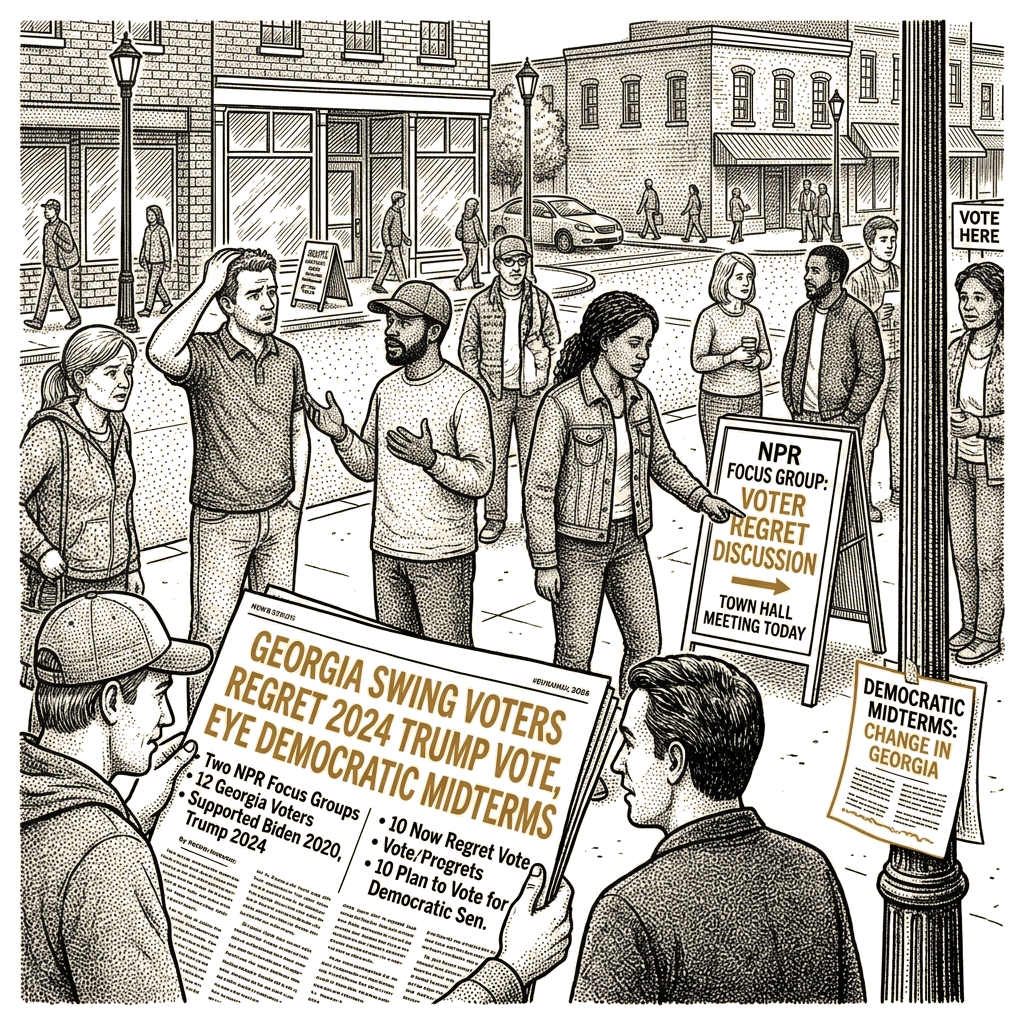
Eleven of 12 Georgia voters tell NPR they are disappointed with Trump
Two online focus groups of 12 Georgia voters who supported President Biden in 2020 and then Donald Trump in 2024, conducted Tuesday night by messaging firm Engagious and recruiting firm Nelson Recruiting as part of the Swing Voter Project, recorded 11 participants saying they were disappointed with Trump’s overall job performance and 10 saying they regret voting for him. (The voters participated under the condition their last names would not be used.)
“I’ve been disappointed,” said Charles P., 43, who identified as a Democrat. “I just don’t feel like there’s any positive to this administration at all,” he continued. “Inflation has only gotten worse, there’ve been more wars. The tariffs haven’t done anything. It seems like we have more enemies now than ever. I just don’t see anything positive with his tenure.”
Richard A., a 56-year-old Republican, said he has been out of work for 10 months and there is a long list of problems he sees with the direction of the country under Trump. “Food crisis, starting the war with Iran, inflation,” he said. “ICE immigration has just torn families apart, has caused deaths. … It just seems like everything has gone downhill.”
The comments align with Trump’s faltering approval rating and a darkening midterm outlook for Republicans, NPR reported. Trump has picked up his campaign travel in recent days, touting his record and arguing for the GOP to retain control in Washington.
Rich Thau, president of Engagious and the focus group moderator, said October marked the first month this year in which a majority of swing voters said Trump would influence their midterm decisions.
“In previous months, when we asked people whether President Trump would influence how they vote, they would say things like, ‘Well, I’m looking mainly at the candidates themselves,’ or ‘I’m looking at the overall sort of environment in the country,’” Thau said. “This month, seven out of 12 said that he would influence them to vote for Democrats. And that was new.”
Karla S., a 49-year-old Democrat, was one of those seven. “I did vote Republican for 2024,” she said. “I made up my mind. I’ve been so disappointed that I’m just going to go straight and just do Democrat, Democrat, Democrat. Because I’m so disappointed with how this administration has been doing.”
Cedric, a 41-year-old independent, said he won’t be voting for any politicians that are closely aligned with Trump. “I think we’re not going in the right direction, so I don’t want to vote for a candidate that’s not going to stand up to him or they’re going to go along with his policies,” he said. “I’m looking for something different.”
Ten of the 12 participants said they plan to vote for Ossoff, Georgia’s incumbent Democratic senator. Some voters said they wanted to keep him in office specifically because he would not be aligned with Trump.
Thau said some voters felt a Democratic-controlled Congress could provide stability to the country, and to the economy in particular. “There was some sense that Democrats could restore some semblance of order, and that they’d be able to control a bit of what the president is trying to do or has been doing, to the point where that might restore some of their confidence in the economy,” he said.
Thomas M., a 65-year-old independent, said he expected a Democratic-run Congress would place more checks on the president. “I think there would be more controls placed on Trump with people who are not afraid to stand up to him,” he said.
By contrast, Thau said, “some respondents told us they thought that the president would have even more control over what goes on because Republicans are afraid to stand up to him.” Jennifer W., a 43-year-old Republican, said she worried “Trump would have free rein.”
The Swing Voter Project runs focus groups every month in battleground states, conducted by messaging firm Engagious and market research recruiting firm Nelson Recruiting, with NPR as a partner. Focus groups are not scientifically significant like polls, but they provide insight into what voters are thinking and how they are deciding whom to support, NPR said.