Tariffs, health costs and AI rules shape the next policy fights
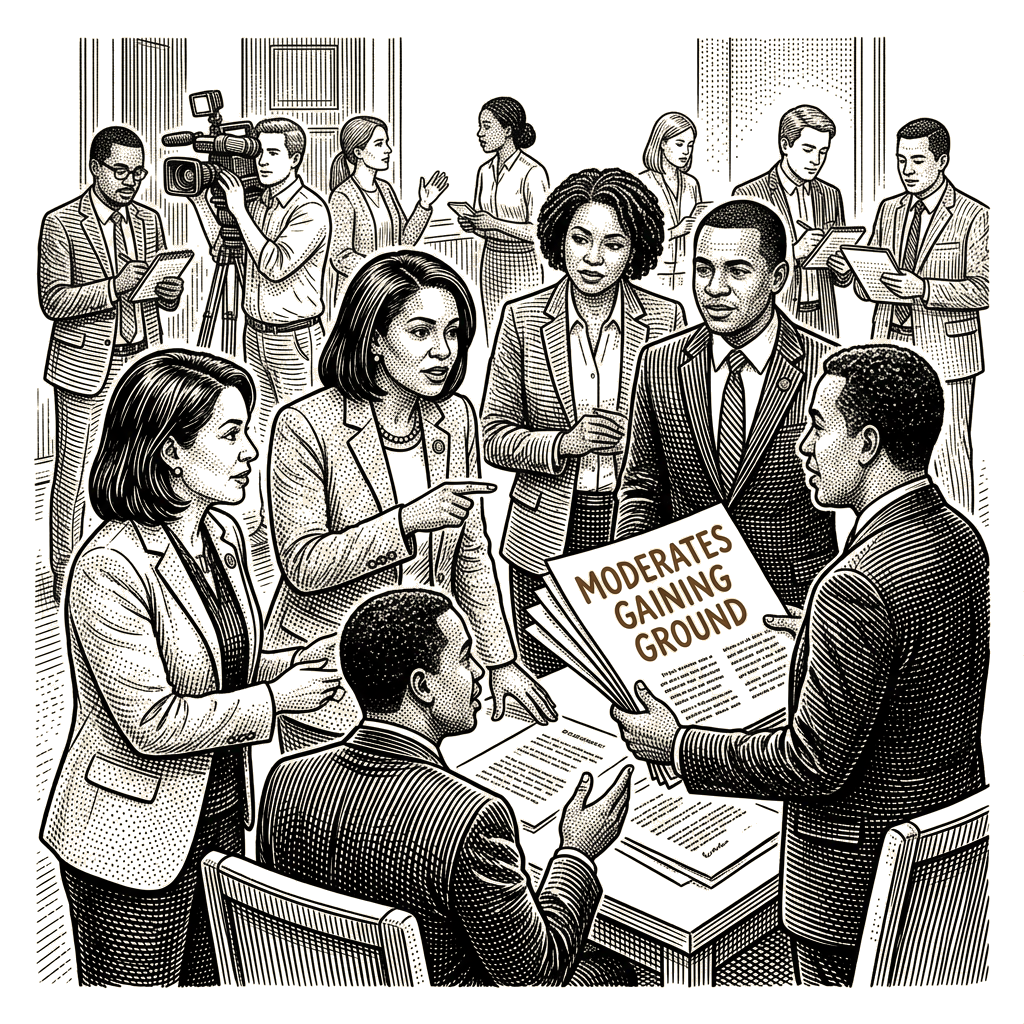
Democratic candidates who delivered their party’s midterm majorities point to a more moderate incoming House and Senate, according to Third Way, even as candidates backed by Sen. Bernie Sanders and New York City Mayor Zohran Mamdani have raised questions about the incoming Congress’s ideological direction. Third Way’s count, as of Wednesday afternoon, found that candidates endorsed exclusively by moderate groups — the New Democrat Coalition, the Blue Dog Coalition or WelcomePAC — had flipped 26 districts, with four more rated highly likely. Candidates endorsed exclusively by Sanders’s political-action committee, Our Revolution, had flipped just three, and another three winners carried endorsements from both camps.
Writing in the WSJ Economics newsletter, Greg Ip said the startling rise of candidates backed by Sanders and Mamdani, both Democratic socialists, may leave the impression that the incoming Congress will pursue a far-left agenda of wealth taxes, Medicare for All and a Green New Deal. Judging by the candidates who delivered their majorities, he wrote, Democrats may be moving toward the center.
Ip wrote that the endorsement figures complicate the idea that the incoming Democratic caucus will be uniformly far left, but that they do not settle which wing will set the party’s priorities. Many new members will hail from Democratic Socialists of America and other groups Ip described as far left, by virtue of having won primaries in deep-blue regions, and the Congressional Progressive Caucus says its ranks have grown by 25 members.
Third Way’s count draws a line between endorsement categories. Candidates endorsed only by a moderate group accounted for the 26 flips and four other highly likely victories, while candidates backed only by Our Revolution accounted for three flips. Robert Dempsey, Our Revolution’s national political director, noted that the committee had flipped a lot of seats in down-ballot and statewide races.
In the Senate, the newsletter’s own count found center-left candidates flipped five states — South Carolina, North Carolina, Kansas, Ohio and Iowa — and left-wing candidates just one, Maine. Minnesota and Michigan, won by Our Revolution-endorsed progressives, were already Democratic. Centrists and leftists both claim Texas’s James Talarico as one of their own; Ip wrote that his platform looks pretty moderate.
Third Way’s estimates of Senate vote margins tell a similar story: centrist Democrats outran 2024 Democratic presidential candidate Kamala Harris by an average of 21 percentage points, while progressives outran her by just five. Moderates ran five points ahead of Democratic House candidates in their states, and progressives ran five points behind, Third Way estimates.
Those margins support the reading that the members delivering the party’s majorities are less uniformly progressive than the most visible primary challenges suggest. Ip framed the open question as who sets the party’s priorities: if Democrats tilt left to satisfy the socialists and progressives, the foothold they just established in red and purple America could melt away at the next election.
Artificial intelligence is one potential fault line. Ip wrote that AI had buoyed the economy and stocks this year and that, judging by Wednesday’s rally, investors expected more of the same under a Democratic Congress; his advice was not to bet on it. His colleagues said investors were betting on growth broadening beyond AI.
Texas, Georgia and Ohio account for more than 40% of all planned data-center capacity in the U.S., according to Evercore ISI, and all three just elected Democratic governors skeptical of the industry. In Congress, Democrats could press for safety guardrails that could slow AI rollouts and increase the industry’s legal liability.
Ip wrote that Democrats do not trust the tech figures behind AI, least of all Elon Musk, who spent almost half a billion dollars trying to defeat them, and that Silicon Valley went all in on Trump, donating to his causes and cultivating his support, his geographical rebrandings and even his preferred moniker for AI, “super intelligence.” That, Ip wrote, cannot help but color how Democrats approach the industry.
At his victory speech this week, Talarico said, “The billionaires who own the social-media algorithms, who own the cable-news networks, who own the politicians fighting on our screens, they want us at each other’s throats. Our unity is a threat to their wealth and their power.”
Tariffs and the war with Iran are two major drags on the economy, and on voters, Ip wrote. Congress cannot force Trump to abandon either, but may be able to strike deals contingent on him ending the war or rolling back tariffs.
Evercore estimates that new tariffs and spending cuts to Medicaid already in the pipeline could trim 0.6 percentage point from growth next year. But a deal with Democrats that delays or undoes some of those cuts and boosts defense could deliver a tailwind of 0.4 to 1 percentage point.
On taxes, Ip wrote that Republicans tried, to no avail, to make the election about taxes, and that this does not mean higher taxes are in the offing, because Democrats did not campaign on them and in fact want to roll back tariffs. The message from the states, he wrote, is that voters do not want them either: the “no” vote on California’s temporary 5% wealth tax was recently ahead of the “yes” vote 55% to 45%, with 61% of the vote counted, and other ballot initiatives sent a similar message — an increased property tax exemption in Florida, a prohibition on statewide property taxes in Tennessee, a cap on income taxes in North Carolina, and a supermajority requirement in both legislative chambers to raise income taxes in Iowa.
Democrats’ vision of affordability does not come cheap, Ip wrote. Undoing cuts to food stamps and Medicaid and restoring Obamacare subsidies would cost $710 billion to $1.55 trillion over a decade, according to Evercore, and Trump wants $300 billion more for defense.
Ip also noted that the deficit has faded as a campaign theme. In 2018, 140 political ads talked about the debt or deficit, according to ad-tracking firm AdImpact. This year, just 30 did, and the deficit ranked No. 52 among topics in this year’s campaigns.
A separate study challenged a common explanation for the election outcome. Christoffer Hentzer Dausgaard, a political scientist at the University of Copenhagen, compared county-level effects of high prices on household income with Republican vote share and found no effect. “I find no sign of ‘pocketbook voting’ in its simplest form, where voters punish the president’s party in proportion to what prices take out of their own budgets…That fits the classic finding that Americans vote more on the national economy than on their own finances,” he said.
Voters interviewed by Ip’s colleagues nevertheless described tariffs as a personal cost. “We’re just fed up,” said Ron Berube, a 64-year-old Lewiston, Maine, resident, who voted for Sen. Susan Collins, R-Maine, in 2020 but this year voted for her victorious Democratic challenger, Troy Jackson. “A lot of people are sick of Donald Trump. They can’t afford it. They can’t afford anything.” More than two-thirds of voters in the state told the AP that Trump’s tariff policies have hurt the state’s economy.
Darin Gadd, a 59-year-old retiree from the military in Columbus, Ohio, backed Trump in 2020 and 2024 and voted Republican again Tuesday, but blamed tariffs for raising the cost of many materials. “A sheet of plywood used to be $4.50, now it’s $30-something,” he said.
Stephanie Hernandez, a 27-year-old retail manager in the Miami area, voted exclusively for Democrats on Tuesday, hoping they would push to reverse what she considers Trump’s most harmful policies, including tariffs and immigration raids. She said the retailer where she works has faced supply issues triggered by tariffs, leaving some products inaccessible. “The tariffs would be something that I would like to obviously do away with,” she said.
In the newsletter’s reader correspondence, Paul Kedrosky, who writes his own AI-centric newsletter, disputed treating rising insurance costs primarily as an inflation and compensation problem, arguing that the U.S. health system is structurally incapable of controlling costs. He wrote that too many discussions substitute things like higher compensation that end up as transfers to an indefensibly tax-advantaged sector now approaching one-fifth of GDP, and that Congress can curb federal spending while presidents rarely veto spending bills.