Production ramp-up and Chinese component restrictions pose hurdles for program
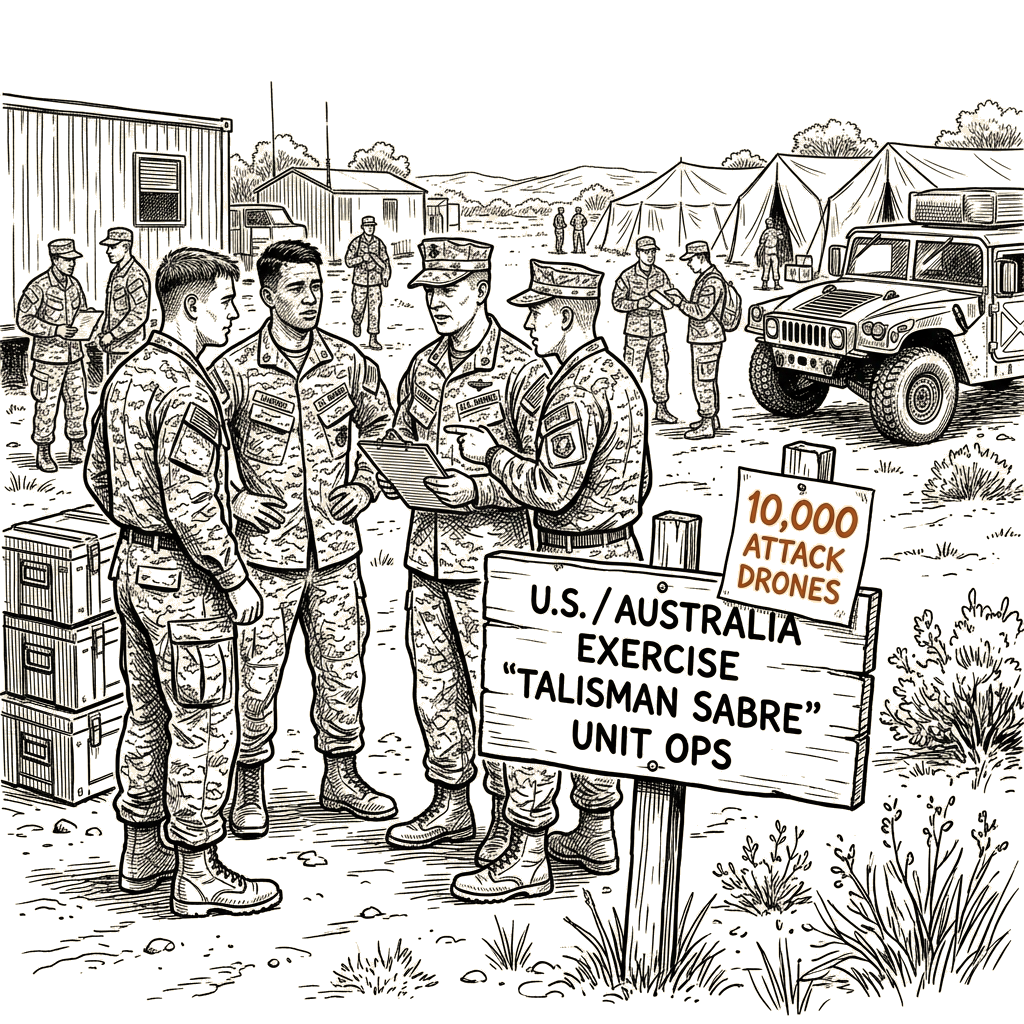
On a hill overlooking an enemy position at the Townsville Field Training Area, Lance Cpl. Brandon Silden donned video goggles and prepared to launch a small, one-way attack drone. Cpl. Cody Holloway watched the video feed on a portable screen and guided Silden toward an enemy armored personnel carrier about a mile away. Moments later, the drone slammed into the target.
“Splash,” a Marine said. “Direct hit.”
The exercise, part of the annual Marine Rotational Force – Darwin deployment, did not involve live munitions, but it illustrated how the Corps plans to give front-line units direct control of precision-strike drones. Air support and artillery require calling up the chain of command and often involve waiting, Kelly Grieco, a senior fellow at the Stimson Center, told the Wall Street Journal. In contrast, first-person-view drones carried by small teams can be employed immediately for strikes or reconnaissance.
“Having the ability to employ that when I need it, I think is massive,” Maj. Joseph Adams, the company commander, said at the exercise. “I can look at a guy or call him over the radio and say, like, ‘Hey, do it now.’”
The Marine Corps and the broader U.S. military are working to field thousands of these FPV drones, a capability that has been used in the war in Ukraine. Yet major obstacles remain.
“They’re at the very start,” Grieco said. “This isn’t a capability they can currently field at scale yet.”
One challenge has been finding drones that aren’t made with Chinese components, though U.S.-made options are emerging. The drone used at the Australian exercise, the Neros Archer, has become a favorite. The Army signed a contract worth up to $500 million with Neros, and the company also won a multimillion-dollar contract with the Marines last year. The Archer sells starting at $2,000 and ranges to about $5,000 depending on equipment. Neros says it currently makes 1,400 Archers a week and aims to produce one million annually from its Torrance, California, facility by 2028.
Around the end of last year, the Marine Corps put out a notice seeking 10,000 FPV-capable small drones in 12 months that can carry mortar bombs or grenades. The drones could play an important role as the service retools for a more nimble footprint in the Indo-Pacific, operating from remote islands to control maritime chokepoints vital in any conflict over Taiwan. Front-line Marines could use FPV drones to harass or target enemy ships in narrow channels, setting up antiship missile strikes. One recent drill involved launching an FPV drone from a helicopter to surveil a nearby ship; the drones could also be launched from surface vessels or sea drone “mother ships.”
Still, Grieco cautioned that resupplying isolated island outposts remains a problem. “The Marines are working the resupply problem, including pursuing autonomous resupply boats and training Marines to build and repair drones, but it’s still a long way from solved,” she said.
The exercise encountered its own hiccup. The Marines had planned to launch two drones simultaneously to strike two targets, but a battery died in one controller. After launching the first drone, they transferred that controller’s battery into the second unit and hit the other target in quick succession, clearing the way to take the enemy position.
Silden, the pilot, said flying through the goggles was smoother and more efficient than using a screen. “It’s definitely more immersive,” he said. Adams, for whom the exercise was a first, called himself a convert. “I learned that the Marines are capable of employing those drones against simulated enemy targets,” he said. “And I learned that they will hit, no questions asked.”