Ottawa pledges $400m for forestry while steel and autos draw billions
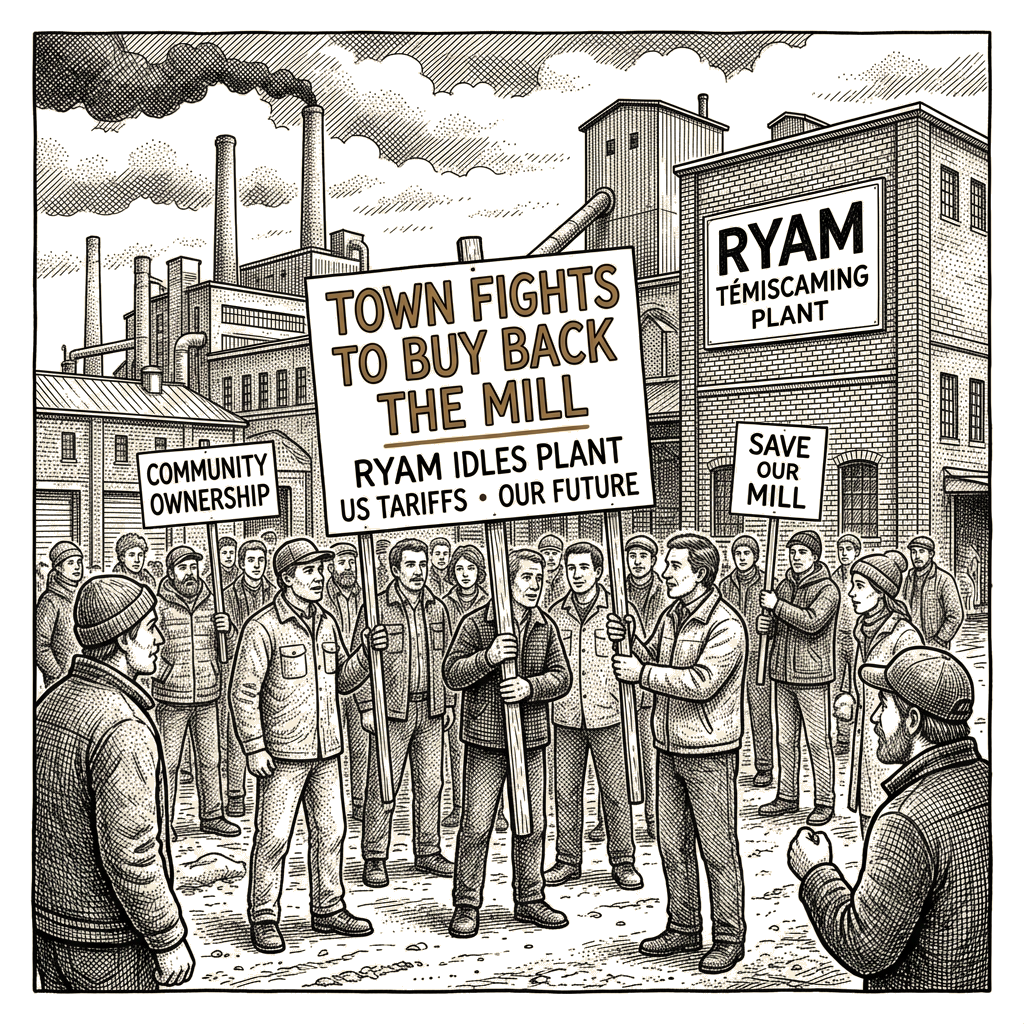
The paper mill that has served as the economic engine of Témiscaming, Quebec, for over a century sits idle along the Ottawa River. In early October, the plant’s American owner, RYAM, went ahead with an “economic shutdown” of the mill for “an indefinite period,” after trade talks between Canada and the United States broke down and President Donald Trump imposed more tariffs on the country. Most of the mill’s 360 employees are out of work, kept afloat for the moment by partial pay from government tariff relief.
The effects landed almost overnight in a town built more than a century ago around the mill and the surrounding forests of pine, birch, spruce and fir. Property values fell almost as quickly, “For Sale” signs dot the yards of the modest middle-class homes that make up most of Témiscaming, and residents fear the town’s essential-service workers — from grocery store clerks to the doctors at the small local hospital — could be the next to leave.
“If the mill goes down, it’ll turn into a ghost town,” said Ronnie Raymond, who like many in the town comes from a family of mill workers. “There’ll be nothing, nothing left. There’s no work for anybody, really. It’s scary.”
For workers like Nadine Suley, the closure threatens a way of life along with a paycheck. Suley, who says she is not “a city girl,” is heading out moose hunting during the short season like much of the town, and quips that residents will all need the free meat this year. “It’s not just a job. It’s our home,” she said, adding that the US tariffs on her town feel like “a personal attack.”
Nationally, Canada’s economy has so far weathered the trade war with the US, its largest customer: the unemployment rate has remained largely steady at around 6.5% since Trump’s tariffs were first implemented, coupled with tepid but consistent growth. But the tariffs of up to 50% are inflicting concentrated pain in the industries they touch — steel, aluminum, automobiles and, in Témiscaming’s case, lumber, pulp and paper — while a trade deal remains elusive. In August, after the breakdown in talks, the US imposed 50% duties on roughly C$28bn of Canadian goods, including wood and paper products such as pulp, stationery and boxes; Canada answered with “dollar-for-dollar” counter-tariffs of its own. Trump argues the import taxes boost US manufacturing and create jobs. The Témiscaming mill, which produces paperboard used in frozen-food packaging across North America and in the scratch-off lottery tickets sold at convenience stores, sends roughly 75% of its production to the United States.
The town has faced an existential threat before. In 1973, when the mill’s then-American owner threatened to shut it down, local workers and managers came together to buy the plant, accepting a 10% pay cut to do it, and built Tembec into a Quebec-owned international company with branches across North America and France. RYAM purchased the mill in 2017.
“We’re hoping that lightning will hit twice,” said Stéphane Lefebvre, a mill employee and union leader whose father and grandfather also worked at the plant, speaking inside the town’s union hall. Workers are mobilizing a coalition of locals who want to buy the mill back from RYAM, but Lefebvre contends they cannot succeed without significant help from Prime Minister Mark Carney and the Quebec government, either in the form of tariff relief or financial support. Suley notes that Carney has emphasized “buy local” and support for Canadian workers since his election, and says backing the town’s bid would be a way for him to fulfill that pledge. In an email to the BBC, RYAM said it would not comment on a potential sale of the plant or any prospective buyers.
Mayor Alain Gauthier does not blame RYAM for its decision. He calls the US tariffs “a bomb to shut down our manufacturing in Canada,” wants Ottawa to retaliate with its own duties on the US board products that currently enter Canada tariff-free, and said that while politicians describe an economic war with the United States, “in reality we see absolutely no evidence of war measures being taken.” “We feel we got into a war with kid’s water guns to fight back,” he said.
Ottawa’s biggest tariff-response moves have so far targeted other industries. This month, Industry Minister Mélanie Joly threatened Stelco, one of Canada’s largest steelmakers, with financial penalties or a forced asset sale should it proceed with planned layoffs of some 500 workers under pressure from steel tariffs. Stelco, in Hamilton, Ontario, is owned by US-based Cleveland-Cliffs, which committed to keeping jobs in Canada when it bought the firm in 2024. Last week, Carney and Ontario Premier Doug Ford announced nearly C$9bn ($6.4bn; £4.8bn) for the province’s steel and auto sector, money meant to help those industries modernize, strengthen domestic demand and open new markets overseas. Lefebvre is among those who feel forestry has taken a back seat. “If there was 10% of job loss in Toronto or Montreal or Quebec City or Vancouver, it’d be all over the news, and it’d be a lot of pressure on the governments to do something,” he said.
A spokesperson for Joly told the BBC that the government has made $400m available to support the forestry sector in rural and remote areas, and has launched a program to help businesses affected by tariffs access cash flow while they work to pivot away from US markets. On the Témiscaming mill, the spokesperson said the government “is actively working with all parties involved to find a viable solution to the issues facing the company, while responsibly managing Canadians’ dollars.” Sébastien Lemire, the Bloc Québécois member of Parliament for Témiscaming, told the BBC he is “very concerned and worried” about what he calls inaction from the Carney government toward the town and Quebec’s forestry industry more broadly. Témiscaming residents have also gathered for a union-led rally to support the mill’s workers and draw attention to the woes of the lumber industry.
The damage may not stop at the plant gates. The economic pain could ripple through the region’s entire forestry industry, including sawmills and trucking, and one local contractor told the BBC he has already had to lay off 13 people. Suley and others hope for a resolution before winter, when sub-zero temperatures could freeze equipment at the idle plant, causing damage that would make reopening even more difficult.
Many workers are also placing hope in the upcoming US midterm elections, expecting the vote to pressure Trump — whose approval ratings have fallen among Americans, according to polls — to ease some tariffs on Canada. Some tariffs on Canadian goods were lifted last week after lobbying from Republican Senator Susan Collins of Maine, who is running for re-election in November, though the changes do not apply to products made at the Témiscaming mill. “We’ll take any help we can get,” Suley said, adding: “There are Americans that care what’s going on, and it’s affecting them too.”
Frank Dottori, now in his 80s and retired in Témiscaming, was the engineer who helped organize the mill’s employees for the 1970s purchase and went on to become the company’s chief executive. He recalled that their ambitions were seen as foolish at the time and that he was “politely ejected” by the Quebec premier when he first came looking for support; the effort prevailed, he has said, with the help of the labor union and an ex-employee with executive experience whose forceful charisma he credits for its success. The new generation of workers needs someone just as bold, Dottori said: “Does the local group have that? Highly unlikely. Can they get it? Yeah, if they organise themselves.” He also said the US tariffs must be lifted to restore the mill’s long-term economic viability, at least in the short term.
Lefebvre said he is committed to making local ownership of the mill a reality regardless of what happens. “We’re in Game Seven right now,” he said. “We’re gonna play till the last whistle.”