Allies face munitions shortages as Pentagon weighs European force cuts
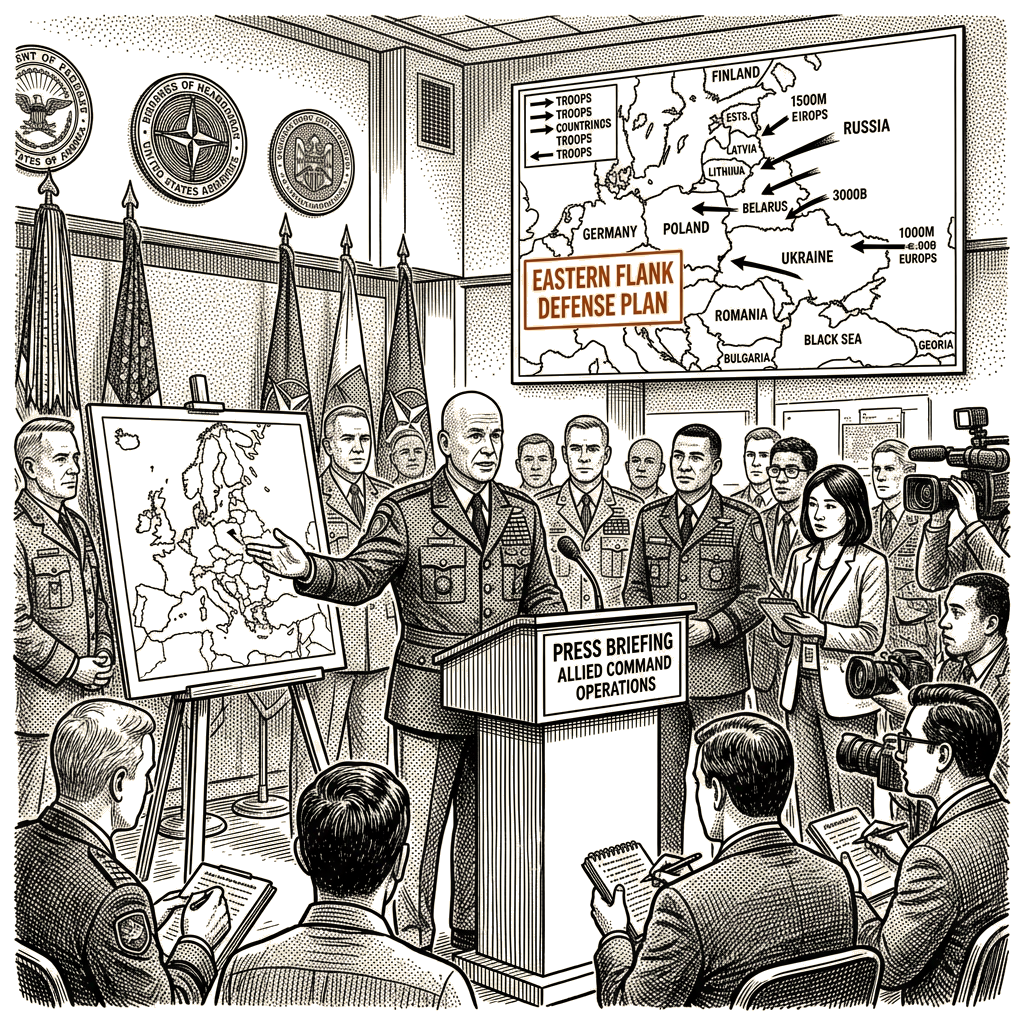
Gen. Alexus Grynkewich, NATO’s top military commander, sought on Monday to steady anxious European allies, outlining the alliance’s new military plan to block a potential Russian assault on its eastern flank with a mix of firepower, autonomous systems and sensors that borrows from the lessons of Ukraine.
In a speech in Poland, the U.S. Air Force general laid out what the alliance calls its “theory of victory” — a series of steps to block an initial attack and, if aggression continues, break an adversary’s ability to control and support its forces. The goal would be to halt an invasion while limiting the risk of conventional or nuclear escalation by stopping short of the complete destruction of the enemy.
The plan rests on three pillars. An extensive “autonomous zone” would be established so that drones and ground robots could blunt a Russian attack without extensive allied casualties. Long-range missiles would strike Russian command posts and air defenses in the Kaliningrad exclave, near St. Petersburg and in Belarus, in an effort to puncture Russia’s control of the skies and enable the U.S. Army’s V Corps and other NATO ground forces to counterattack. NATO air forces would move swiftly to strike Russian reinforcements as they streamed toward the battlefield. All three elements would be enabled by a “data backbone,” a system for instantaneously sharing classified targeting data through the cloud among allied forces. Elements of that network have been tested in the Middle East during the U.S. fight with Iran, U.S. military officials said.
The objective, formally dubbed the Eastern Flank Deterrence Initiative, is to force Russian President Vladimir Putin to look at NATO’s defenses and conclude “not today” if he considers attacking, U.S. military officials said. To reinforce that, alliance forces constantly drill to both test and demonstrate their readiness.
As Grynkewich spoke in Warsaw, more than 20,000 military personnel from across NATO were already deep in a 10-day wargame called “Steadfast Duel,” simulating a scenario in which roughly one million allied troops must defend against an invasion from the east by a similarly sized force. In deference to political sensitivities, the adversary in the simulation is not identified as Russia.
The exercise “ties in 100%” to Grynkewich’s “theory of victory,” German Brig. Gen. Thomas Lowin told the Journal, which observed a portion of the exercise at U.S. Army European headquarters in Wiesbaden, Germany. Key to the scenario, Lowin said, is the use of digital systems for a “data-centric approach, making decisions faster and defending the alliance more effectively.” Another participant said other NATO exercises also simulated disabling strikes against enemy command posts using land-based surface-to-surface missiles.
The strategy addresses a deteriorating threat environment. NATO faces a resurgent Russia that has invaded Ukraine, penetrated Western airspace with drones, and is suspected of carrying out sabotage attacks on infrastructure, military equipment and defense companies in Europe. A senior German intelligence official recently dubbed the activity “shadow warfare.” German officials said an explosive-laden drone was sent to the Leipzig airport in Germany as part of Russian efforts to pressure European nations over their support for Kyiv.
The alliance’s efforts are complicated by munitions shortages in Europe of American PAC-3 Patriot air defense interceptors and Atacms surface-to-surface missiles, because U.S. munitions have been channeled to the Middle East to contend with Iran. The Pentagon is also completing a sweeping review of U.S. military posture in Europe that could see reductions in U.S. forces there.
Grynkewich’s reassurance was needed in part because of President Trump’s weekend pronouncements, which left European allies and U.S. lawmakers reeling. After Trump announced a deal to import Russian diesel fuel, he criticized Ukrainian President Volodymyr Zelensky for continuing to strike Russian energy infrastructure, then announced an energy ceasefire between the two countries. Shortly after that announcement, Russian forces attacked a power plant in the Ukrainian city of Kharkiv.
Some Republican lawmakers have criticized Trump over the diesel deal, warning that it hands Moscow much-needed financial assistance without making a significant dent in U.S. energy prices. “Outlining military plans is important, but it can’t be divorced from addressing what everyone is worried about: Trump’s outbursts, Russia’s war on Ukraine and threats to Europe, and questions on whether we’re pulling significant U.S. forces out of Europe,” said Kurt Volker, a former U.S. envoy to NATO and later to Ukraine under the first Trump administration.
The plan was devised to counter a Russian adversary whose geographic advantages and outsized defense industry could enable it to mass forces against the Baltic states, Poland and other NATO allies before the alliance could marshal a robust response. The approach draws on work by retired Gen. Chris Donahue, the former U.S. Army commander in Europe and head of the alliance’s Land Command, who was forced out of his post in July when Defense Secretary Pete Hegseth downgraded his position.
Western officials had assumed the alliance would have a couple of years after the end of the Ukraine conflict before Russia could mobilize sufficient forces and arms to carry out a substantial invasion of NATO territory. Now, the alliance is in a race to put stronger defenses in place.
Deputy NATO commander, British Air Chief Marshal Johnny Stringer, said in an interview that Russia’s military prowess should not be overestimated, given that Putin’s “three-day special operation is now nudging toward five years.” But even as Russia struggles to win the war, officials acknowledged that the Russian leader’s recent actions were of growing concern. “I think his appetite to take more risk—his appetite to be reckless—is increasing,” Stringer said.
“It is great that NATO is through this adaptation, but they have to hurry. And nations have to come through with the money and the political will to do this,” said Jim Townsend, who served as deputy assistant secretary of defense for Europe and NATO during the Obama administration. “NATO as an institution can do the planning, but it is the members who are going to have to go home, spend the money and train the troops.”