Republican officials more concerned about Ohio, Kansas and Texas than Iowa
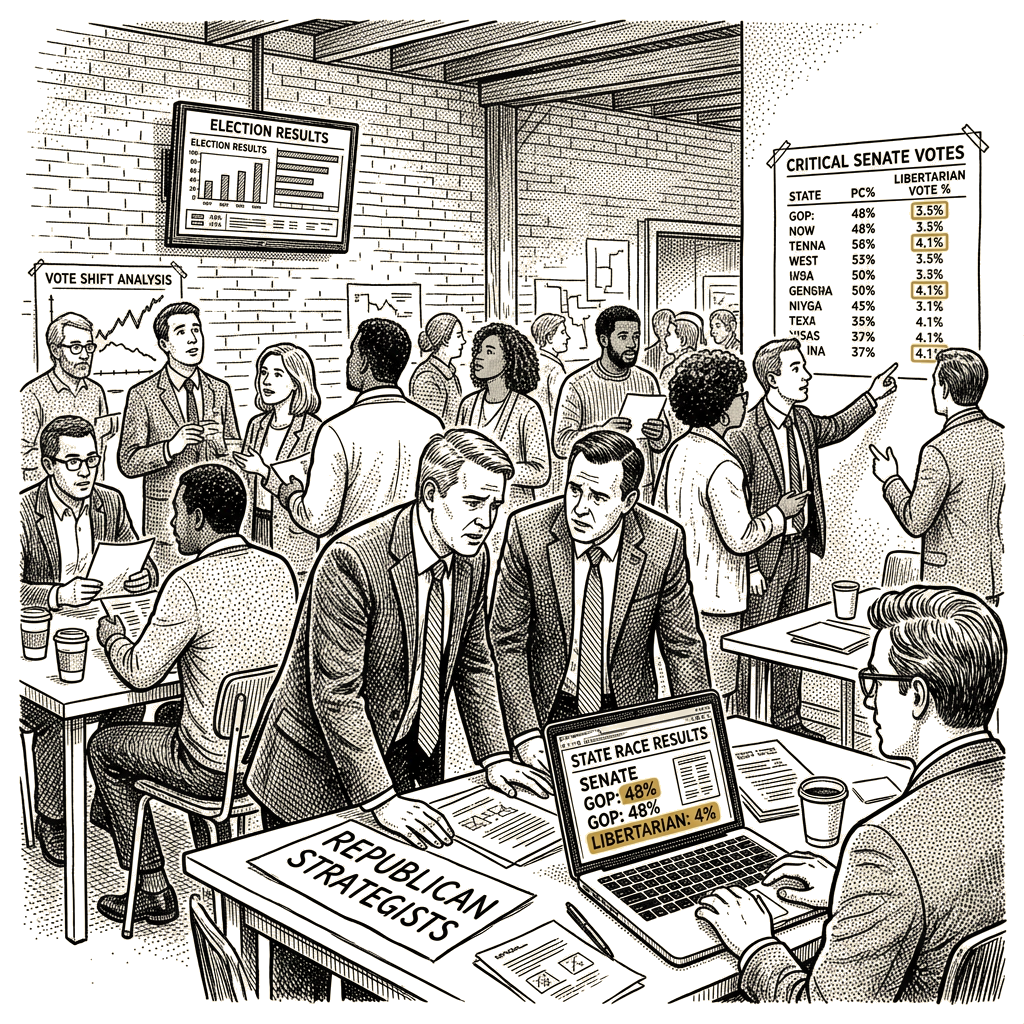
Republican strategists said they were worried that Libertarian candidates could siphon away votes in some of this year’s most consequential U.S. Senate elections, potentially costing Republicans control of the chamber. Texas, Ohio, Kansas and Iowa lean Republican, but the Senate contests are expected to be razor-thin; strategists said a few percentage points for a third party could swing the outcome.
Republican Senate campaign officials said they were less concerned about Iowa, where Libertarians are not a regular presence on the ballot, than they were about Ohio, Kansas and Texas. The officials spoke on the condition of anonymity to discuss internal strategy. President Donald Trump is scheduled to hold rallies in Texas on Tuesday, Ohio on Wednesday and Iowa on Sunday.
Gene Krebs, a Republican former Ohio state lawmaker working on a project to diminish the impact of spoiler candidates, said, “Libertarians, we believe, could draw enough votes to affect the outcome in a number of these races.”
Some party strategists said unhappiness with President Donald Trump could lead some conservatives to cast protest ballots. Separately, the Associated Press said the war with Iran, which it characterized as unpopular, and Trump’s expansion of executive power could fuel the Libertarian Party’s message of nonintervention and limited centralized authority among what it described as an anti-establishment segment of the American right.
Wayne Hamilton, a former executive director of the Texas Republican Party, said Republican Texas Attorney General Ken Paxton’s history of legal and ethical problems could have some conservatives looking for another choice. “Nobody’s voting for the Libertarian. It’s a protest vote,” Hamilton said. “They are going to be voting that way because they don’t want to vote for Paxton, and this is an option.”
Libertarian Senate candidate Ted Brown is a former insurance adjuster from California and a longtime Libertarian Party activist who supported Ron Paul’s presidential campaign in 1988. He said some conservative voters have turned on Trump. “Some libertarians supported him thinking he was an anti-war candidate. And that’s where he’s lost them,” Brown said. “But my view and a lot of libertarians’ view is that separation of powers is very important. This president has seized way too much power in this imperial presidency.”
In Ohio, former Libertarian Party national chairman Bill Redpath is running against Republican Sen. Jon Husted and Democratic former Sen. Sherrod Brown. Krebs said, “The Libertarian can easily pull enough votes away from the Republican so that the Democrat wins.”
Third parties could work against Democrats, too. An organization with Republican ties distributed fliers promoting a socialist candidate, an apparent effort to pull support from Sherrod Brown. Enough Promises Ohio PAC, which sent the fliers, received $2.5 million from Conservative Americans PAC, according to federal disclosure reports.
Libertarian David Graham is running in Kansas, where Republican Sen. Roger Marshall is locked in a close race with Democrat Adam Hamilton. This is Graham’s second campaign. He received 3% of the vote in a race Republican Sen. Jerry Moran won by 23 percentage points.
In Texas, Libertarian Ted Brown received 2.3% of the vote in 2024, when Republican Sen. Ted Cruz easily won another term. The race is tighter this year, with Democratic nominee James Talarico facing Republican Texas Attorney General Ken Paxton.
Brown said he did not expect to compete with Paxton and Talarico for the seat. His campaign has a budget of about $30,000 and has spent $7,000 on advertising, including a streaming spot in four Texas counties where Libertarians have fared better in recent elections.
AdImpact said Talarico, Paxton and aligned groups had spent roughly $390 million on advertising since the May 26 primary. Brown received 267,039 votes in 2024, a record for his party in a Texas Senate race. Brown said that matching 267,039 votes on Nov. 3 would be a good day and would produce a higher percentage in the lower-turnout midterm.
Brown dismissed the criticism he says he regularly receives from Republicans that he is merely spoiling Paxton’s chances. “They could avoid that problem by nominating a better candidate,” he said. Brown said he tells Democrats the same thing. “You can’t spoil a system that’s already rotten,” he said. “There are a lot of people making a protest vote, and there’s good reason to.”