Michigan win balances the Senate’s medical delegation
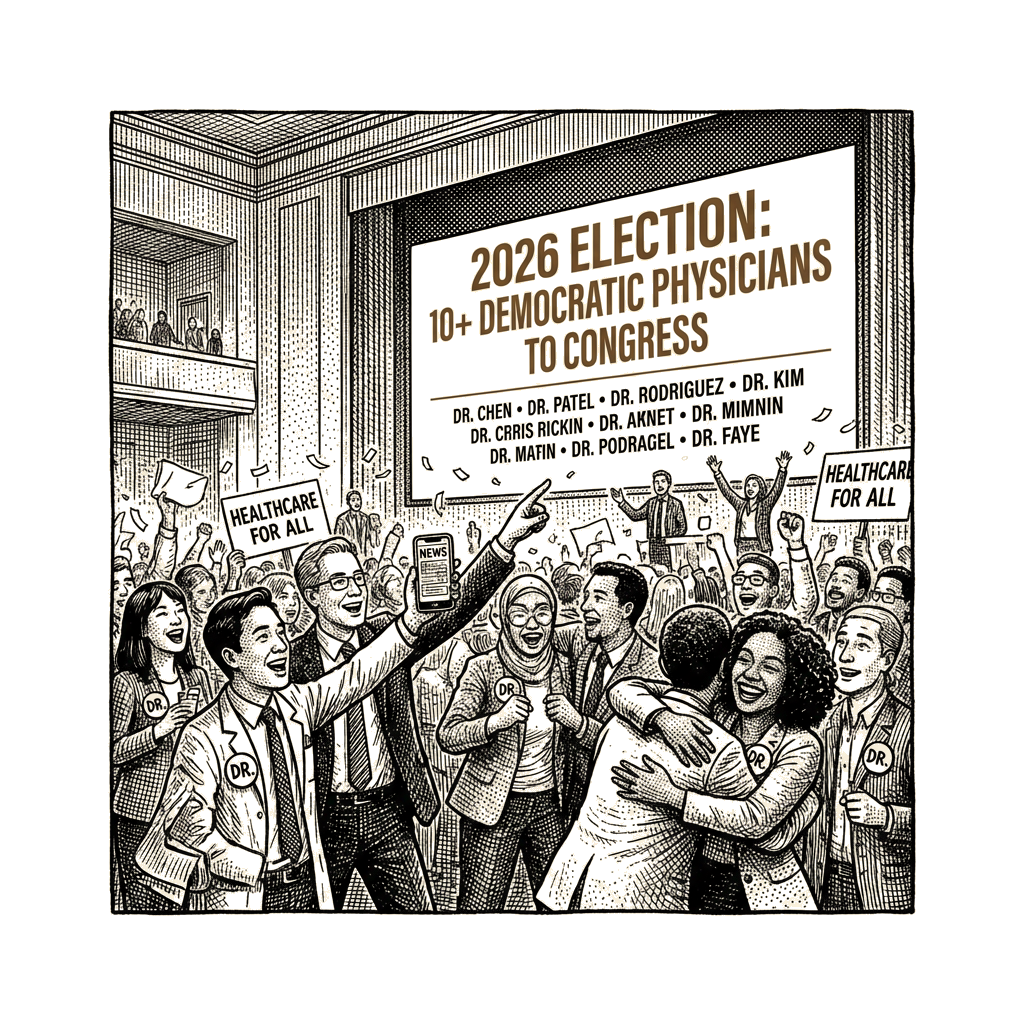
The 2026 election will place at least 10 Democratic physicians in the new Congress, with Dr. Annie Andrews set to become the first practicing physician elected to the Senate as a Democrat since 1938. Andrews, a South Carolina pediatrician, and Dr. Abdul El-Sayed, a Michigan epidemiologist who trained as a physician, are among the medical professionals who won seats while several Republican incumbents lost reelection or retired. With El-Sayed’s Michigan victory, the Senate’s four physician seats will be split evenly between Democrats and Republicans.
NPR described a change in the partisan pattern of congressional physician candidates. Physicians historically were elected to Congress more often as Republicans, but that changed this cycle. In the recent past, the Republican Party attracted doctor-candidates who were essentially small-business people concerned about high taxes and government overreach; the new crop of candidates from health professions often work for large hospital systems and are interested in issues that align with Democratic priorities like public health, equity and affordability.
Andrews said watching parents worry about the cost of inhalers for children with asthma and insulin for children with diabetes pushed her toward politics. “I watch as worried parents leave the hospital in the evening so that they can go work their third shift job just so they can make ends meet,” she said. “And then, like the majority of pediatricians in America, I’ve cared for kids who’ve been shot.” Guns are the leading cause of death for children in the U.S. “It really clicked to me that the path to catalyzing this change that I want to see in America for the children in America is through politics,” she explained.
El-Sayed did not complete a residency or practice medicine after training as a physician; he pursued public health instead. Before the election, all four physicians in the Senate were Republicans. In the House, six members of the Democratic doctor’s caucus will be joined by at least two: former U.S. Army surgeon Dr. Adam Hamawy of New Jersey and pediatrician Dr. Richard Pan of California. Republican neurosurgeon Dr. John Cowan was elected in Georgia. At least two Republican incumbents in the doctor’s caucus lost, and a few races remained too close to call.
Many of the new Democratic physician-lawmakers were recruited and backed by 314 Action, a political organization named for the mathematical constant pi. The group supports progressive candidates with science backgrounds and invested more than $30 million in dozens of Democratic candidates in state and federal races, including 48 physicians. Its president, Shaughnessy Naughton, said the organization recruits scientists, develops their leadership and helps with campaign strategy, communications, media training, exposure and fundraising.
The wins extended beyond the Senate. In addition to Senators-elect Andrews and El-Sayed, 314 Action backed Ohio Governor-elect Dr. Amy Acton and several down-ballot candidates, including incoming state legislators Dr. Nikhil Wagle in Iowa, Dr. Amelia Gallitano-Mendel in Arizona and Dr. Jarod Fox in Florida. Wagle, Gallitano-Mendel and Fox were set to be the only elected physicians in their respective chambers.
Naughton attributed the results to health care and affordability being front of mind. NPR also reported that polls show the public trusts doctors and that the candidates effectively countered messaging from Health Secretary Robert F. Kennedy Jr. NPR described Kennedy as a longtime anti-vaccine activist who had downplayed ongoing measles outbreaks. “People were sick of it,” Naughton said. “We should not have American children dying — or anyone dying — of measles in 2026. And yet, not only did we have that happening, we had a health secretary that only made the situation worse.”
Outgoing Senate Health, Education, Labor and Pensions Committee chair Bill Cassidy, a Louisiana Republican, spoke often from the dais about how his experience as a physician shaped his perspective as a lawmaker. During Robert F. Kennedy Jr.’s confirmation hearing in January 2025, Cassidy said, “In the early 2000’s, I was loading a patient onto an air ambulance, an 18-year-old young woman, to go to get a liver transplant from acute liver failure due to hepatitis B,” noting the expensive surgery and ongoing hospital bills she would face, if she lived. “It was the worst day of my medical career, because I thought: $50 of vaccines could have prevented this all.” Still, Cassidy cast the key vote to confirm Kennedy despite Kennedy’s long history of anti-vaccine activism. Kennedy invoked vaccine-related promises Cassidy said he made to earn that vote, and Kennedy supported the Republican primary challenger who unseated Cassidy earlier this year, according to NPR.
Another senior member of the committee, Republican Sen. Roger Marshall of Kansas, an OBGYN and staunch Kennedy supporter, also lost his reelection bid in a surprise Tuesday night result, falling to Methodist minister Adam Hamilton by four points. The New York Times reported in September that Marshall had sued more than 700 patients over unpaid medical bills, and one patient filed a class-action lawsuit against him last week. Marshall described his legal actions in a last-minute social media video as a way to “keep the lights on.”
Dr. Chadd Kraus, an emergency-room doctor and the vice chair for research for the Department of Emergency and Hospital Medicine at Jefferson Health Lehigh Valley in Pennsylvania, has studied physicians in Congress. Two decades ago, after studying political science as an undergraduate and pursuing a master’s in public health, he worked on an analysis of physicians in Congress. “In 1776, 10.7% of the signers of the Declaration of Independence were physicians,” the paper notes. Kraus said practicing medicine then involved leeches, before germs had been discovered and antibiotics invented, and suggested those physicians were “part of a class that owned land that was educated.”
Kraus said medicine transformed over the next two centuries, and for a time, very few physicians served as federal lawmakers. His study found 25 physicians served in either the House or Senate from 1960 through 2004. The current Congress has nearly as many physicians as that entire period, with 20 total: six Democrats and 10 Republicans in the House, and four Republicans in the Senate. The new Congress will have at least 18 physicians, 10 of them Democrats, and Democratic physician-lawmakers may outnumber their Republican counterparts depending on unresolved House races.
Republican losses in the health-profession caucus extended beyond the Senate. Rep. Neal Dunn of Florida, a urologist, retired, while Rep. Mariannette Miller-Meeks, an ophthalmologist in Iowa, and Rep. Jen Kiggans, a nurse in Virginia, lost their seats. In other health-profession contests, oncology nurse practitioner Kristina Knickerbocker flipped a Republican House seat in Ohio, and Democratic nurse Lauren Underwood held her House seat in Illinois.
Many incoming lawmakers campaigned on health insurance and prescription drug costs, issues tied to widespread dissatisfaction across the political spectrum. Democratic leaders said reversing Republican cuts to premium subsidies for health insurance and work requirements for Medicaid will be at the top of their agenda. More than 15 years after the Affordable Care Act passed, there may be political appetite and public demand for major new health legislation in the coming years. Some candidates ran on Medicare-for-all, a national health insurance plan that has become increasingly popular in public opinion surveys.
“I think we all certainly agree, no matter one’s political views or perspective, that there is the potential for a better system,” Kraus said. “I do think that having physicians and other health care professionals meaningfully incorporated into the policymaking process is really critical to finding what those innovations might be.”
Kraus said physicians bring a valuable perspective but do not have a monopoly on good policy. “And the need for physician voices in government has grown, I think, over the course of time, as healthcare has become more complex and politically consequential,” he said. He said emergency departments show the effects of policy in real time, from early warnings about the opioid crisis to sicker uninsured patients when uninsured rates increase. “We see the challenges of health policy and the consequences of it,” he said.
Naughton said the health-professional candidates 314 Action supported care about the health care system and have ideas about how to change it, but that hasn’t been their only pitch to voters. She said the candidates lead with what they essentially are: “problem solvers.” She added, “We can fix this problem — we can make health care accessible and affordable — and not make it a choice between life or debt.”