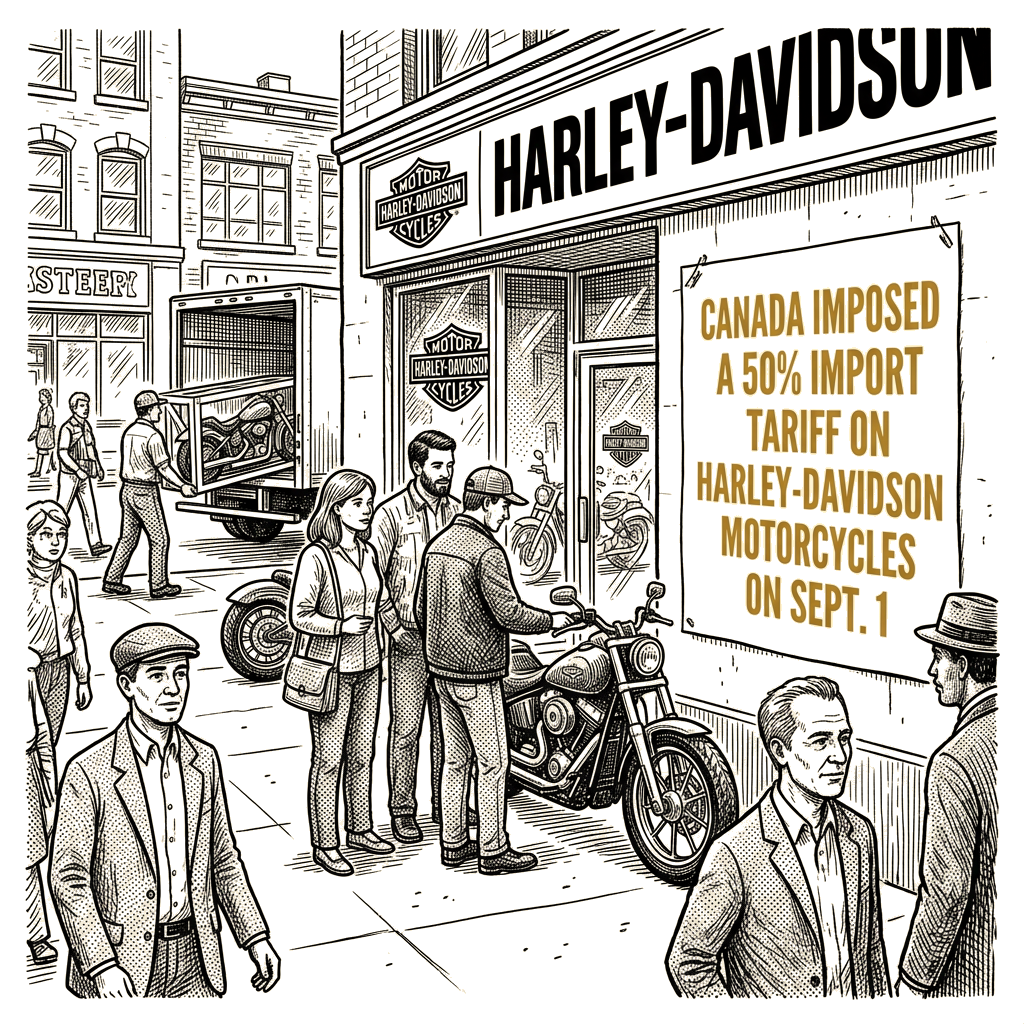
Harley absorbed more than $170 million in retaliatory tariffs over eight years
Canada imposed a 50% import tariff on Harley-Davidson motorcycles on Sept. 8 as part of a wide-ranging response to heightened U.S. tariffs, according to a Wall Street Journal report published Monday. The same day, the United States announced an outright ban on large motorcycles imported from Canada starting Sept. 29.
Harley-Davidson has absorbed retaliatory tariffs to keep retail prices stable, a practice that has cost the company more than $170 million over the last eight years, the Journal reported. Canada accounted for 4% of Harley’s $4.5 billion in revenue last year. The company declined to outline its plans for the Canadian market but said it was committed to supporting the country’s dealers and riders. This year’s inventory has already arrived, but dealers remain concerned about possible future sticker shock.
The pattern stretches back decades. When the company hovered near bankruptcy in the 1980s, it was boosted by levies the Reagan administration placed on imported bikes. In 2018, stiff motorcycle tariffs imposed throughout Southeast Asia prompted Harley to open a factory in Thailand. That same year, the European Union imposed 25% retaliatory tariffs on Harley after President Trump threatened steel and aluminum duties. Then-European Commission President Jean-Claude Juncker announced the measures with pointed references to specific American goods. “We will now impose tariffs on motorcycles, Harley-Davidson, on bluejeans, Levi’s, on bourbon,” Juncker said in 2018, the Journal reported. “We can also do stupid.” Harley responded by shifting some of its Europe-bound production to Thailand, eventually bringing the EU rate down to 6%.
Trump’s return to office with what the Journal described as an even more combative trade agenda continued the pattern. Last year, after Trump imposed duties on steel and aluminum, the EU said it would respond with a 50% tariff on a range of goods — including Harley motorcycles — though the measure never went into effect. Last year also saw the U.S. impose a 25% tariff on Canadian imports; Canada struck back with the same rate on Harleys and other products. That duty remained in place for six months and cost Harley $8 million.
This summer, the Trump administration took exception to Canadian tariffs on American cars and trucks and placed a 50% duty on large motorcycles, along with many other products. On Sept. 8, Canada imposed its 50% tariff on large motorcycles and many other goods. The same day, the U.S. announced an outright ban on the importation of large bikes from Canada starting Sept. 29.
Canada does not have a sizable motorcycle manufacturing industry, the Journal reported, but two models made by Quebec-based BRP were affected: the Can-Am Spyder and Can-Am Canyon, both three-wheelers. BRP declined to say how many of the bikes it exports to the U.S. Raymond James analyst Joe Altobello said Harley might be better equipped than BRP to withstand an extended showdown, given that Canada represents a relatively small portion of Harley’s overall business. “It’s not a good thing, but it’s not existential,” Altobello said.
Scott Lincicome, vice president at the Cato Institute, a free-market think tank, told the Journal that Harley-Davidson’s All American brand identity and swing state location make it a natural target for retaliation. “In terms of getting off the list, I think they’re stuck,” Lincicome said. “The economics are a distant second to the politics.”
On the Canadian side, some dealerships are presenting the trade battle as a buying opportunity, noting that their current inventory is tariff-free. But some Harley loyalists say the national mood is not conducive to big-ticket spending. “It would be very surprising if the Canadian consumer would be willing to pay those prices,” said Mandie Ciotucha, co-owner of Thunder Bay Harley-Davidson in Ontario. Garett Broenner, 60, said he has paused plans to upgrade his 2003 Harley V-Rod. “In Canada, people are struggling from paycheck to paycheck now,” Broenner said. “If you have to pay another $15,000 on a bike, you’re just not going to do it, no matter how much you might like the brand.”
Canada’s motorcycle lobby has appealed for a truce, noting that dealerships employ thousands of people. “We just want everyone to get back to the table and start talking about a deal that will work for the U.S., Canada and Mexico, too,” said Landon French, chief executive of Moto Canada. “What’s been built over the decades has worked very well for all three countries.”
Other U.S. manufacturers, including Indian Motorcycle and Buell, have been caught in the crossfire. Indian Motorcycle, which lists 25 Canadian dealerships on its website, did not respond to requests for comment. Buell Chief Executive Bill Melvin said his Michigan-based company sells only a few bikes in Canada.
Producing Canadian bikes in Thailand could be an option for Harley if the conflict drags into next year. Canada’s Department of Finance said goods that don’t originate in the U.S. aren’t subject to the tariff.