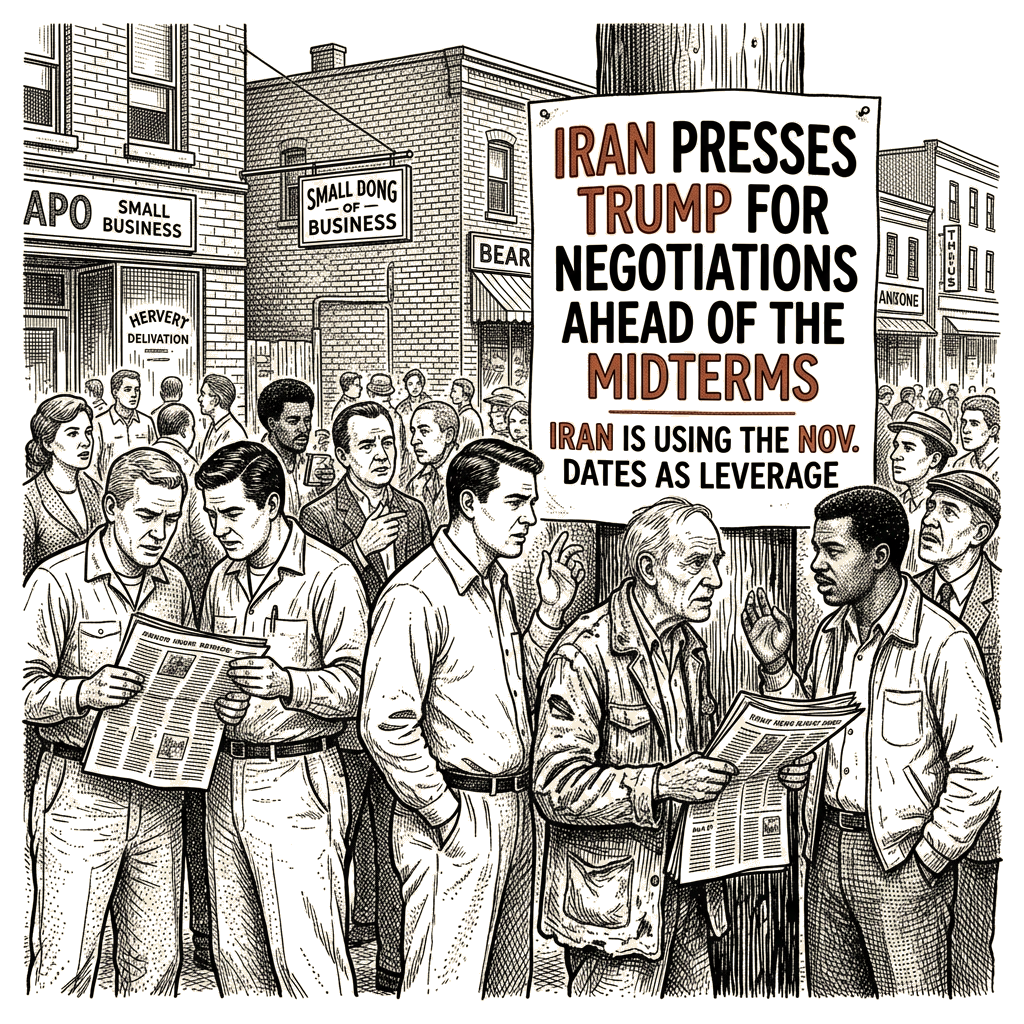
Iran offers to reopen the Strait if talks resume
Iran is using the Nov. 3, 2026 U.S. midterms to pressure President Trump to return to negotiations, according to NPR. The newsletter said the election could signal a possible return to conflict with the United States and Israel. Iranian officials said they preferred negotiations, and NPR’s Hadeel Al-Shalchi reported that Tehran was hoping it could wait out the election and possibly see Trump’s party lose control of Congress.
Iran offered to reopen the Strait of Hormuz in two days, ahead of the seven days it proposed in September, if the United States re-engaged in talks, Al-Shalchi said. The Associated Press reported that the U.S. conducted defensive strikes on Iranian targets in the strait the previous night, including Qeshm Island, a key launch point for Iran’s strikes. NPR said it could not independently confirm those details, and Iran reported explosions on the island. NPR said the pattern had occurred several times in recent months, coinciding with heightened Iranian attacks on shipping vessels in the strait.
Al-Shalchi also reported that Iran’s inflation rate was around 90%, with residents facing dire economic conditions and fears of possible bombings. As winter approached, officials urged millions of Iranians to conserve energy to avoid soaring natural-gas prices, and they said the country’s natural-gas networks were unstable because of damage from the war.
Just before Election Day, the U.S. Supreme Court rejected the Department of Justice’s last-minute request to intervene in a dispute with California over voter rolls. The department sought to halt California from processing ballots for thousands of individuals identified as “likely” noncitizens.
NPR education correspondent Jonaki Mehta, who focuses on disabilities and learning differences, reported that America has not had enough special-education teachers for half a century. The shortage has worsened as the number of students with disabilities has grown rapidly; the most recent federal count put that number at 8.2 million, or about 1 in 6 students. Research offered some explanations for why the positions are difficult to fill: Special-education teachers enjoy working with students but spend more time on legally required paperwork and tasks other than teaching. They often do not receive more pay despite having more responsibilities than many other teachers, and those who remain in the profession are often handed a bigger load because of the shortage.
To go beyond the research, NPR senior producer Lauren Migaki and Mehta exchanged voice memos with more than a dozen teachers from large and small districts around the country. So far, the educators have described joy when a student found success, tearful moments when they felt like they had failed, and waking before dawn to make sure they were prepared.
Jeffrey Carroll, who teaches in Newport News, Virginia, said last year that he taught students across three grade levels and multiple subjects — second, fourth and fifth — and was constantly running from one classroom to the next. “I just didn’t feel like I was teaching, I was never in a class long enough to be a meaningful part of it,” he said. This year, he was relieved to teach across two grade levels. “It’s been good to support my students in the classroom. I get to do some co-teaching. The lesson plans come to life.” Mehta and Migaki said they would remain in touch with the teachers throughout the rest of the school year and visit some in their classrooms to better understand what the job requires.
The Siena Drone Photo Awards showcase aerial views of the planet each year, highlighting landscapes and human stories often hidden from view. Photographer George Steinmetz won the 2026 top prize for his photograph, “Shipbreaking on the mudflats, Bay of Bengal,” which shows a stranded vessel off the coast of Bangladesh and workers around a partially dismantled tanker designed to transport liquefied natural gas. The image depicts the country’s shipbreaking industry, in which enormous vessels from around the globe are dismantled and their materials are repurposed.
A separate legal development concerned Lindsay Clancy, who faces first-degree murder charges for the 2023 deaths of her three young children in the Duxbury home. Her trial ended in a mistrial in September after jurors failed to reach a unanimous verdict. Plymouth Superior Court Judge William Sullivan was considering a motion to dismiss the case and was scheduled to announce his decision later that month. At the court hearing the previous day, Clancy’s attorney asked Sullivan to dismiss the case or initiate a new trial. The Plymouth County district attorney’s office had not disclosed its next steps, including whether it would seek a new trial or pursue lesser charges. In a recent motion, prosecutors stated they aimed to “pursue justice” for Clancy’s children.
Midterms background. Election Day arrived on Nov. 3, 2026, with NPR describing the campaign as having the biggest price tag in U.S. history, a record number of lawmakers stepping down, Democrats positioned to potentially regain control of Congress and Trump’s popularity at an all-time low. NPR identified four types of House races to watch and provided an hour-by-hour guide to poll closings and results. NPR’s Stephen Fowler said Trump’s unpopular policies had rocked the economy and made states such as Arkansas, Kansas, Mississippi and Iowa crucial to deciding congressional control. Voters in those states cited the war in Iran, rising gas prices and corruption, and said they felt neglected by Trump’s focus on grand events instead of their priorities. Both parties were investing heavily across numerous House races. Republicans’ closing message asked for two more years to fix issues, while Democrats argued they had already had too much time.
Trump said the previous day that if a portion of his supporters voted, they could win in a “landslide.” NPR’s Franco Ordoñez said Trump appeared to recognize the challenges ahead and spoke in the past tense, unlike what Ordoñez described as his usual bombast. Results could take days, and Trump’s team planned to monitor Republican turnout closely in Senate races in Ohio, Kansas and South Carolina, where polls would close sooner. Ordoñez said strong turnout might ease Trump’s concerns, while close races in South Carolina or Florida could signal a tough night for Republicans.
Race calls were also central on election night, with NPR saying it collaborates with the Associated Press to make them. Just before Election Day, NPR conducted one final check-in with swing voters for its Swing Shift project. All of them had cast a vote for Trump in the past decade. They were now rating his presidency while considering their choice in races where he did not appear on the ballot.
National Symphony Orchestra. The orchestra is without a home while its Kennedy Center venue is involved in a federal court dispute. It has had to find six alternative concert venues in the Washington, D.C., area while trying to maintain its budget amid ongoing controversies.
Raja’s move. Raja, a 10,000-pound Asian elephant who spent decades entertaining visitors at the St. Louis Zoo, has moved to the Cincinnati Zoo and Botanical Garden, according to STLPR.
Virginia and D.C. arch lawsuit. The Commonwealth of Virginia and the District of Columbia filed a lawsuit seeking to stop construction of Trump’s proposed 250-foot-tall triumphal arch.